Personalizing Digital Gifts for Diverse Recipients at Scale
Automation and data turn generic B2B gift sends into personalized moments that actually move deals.

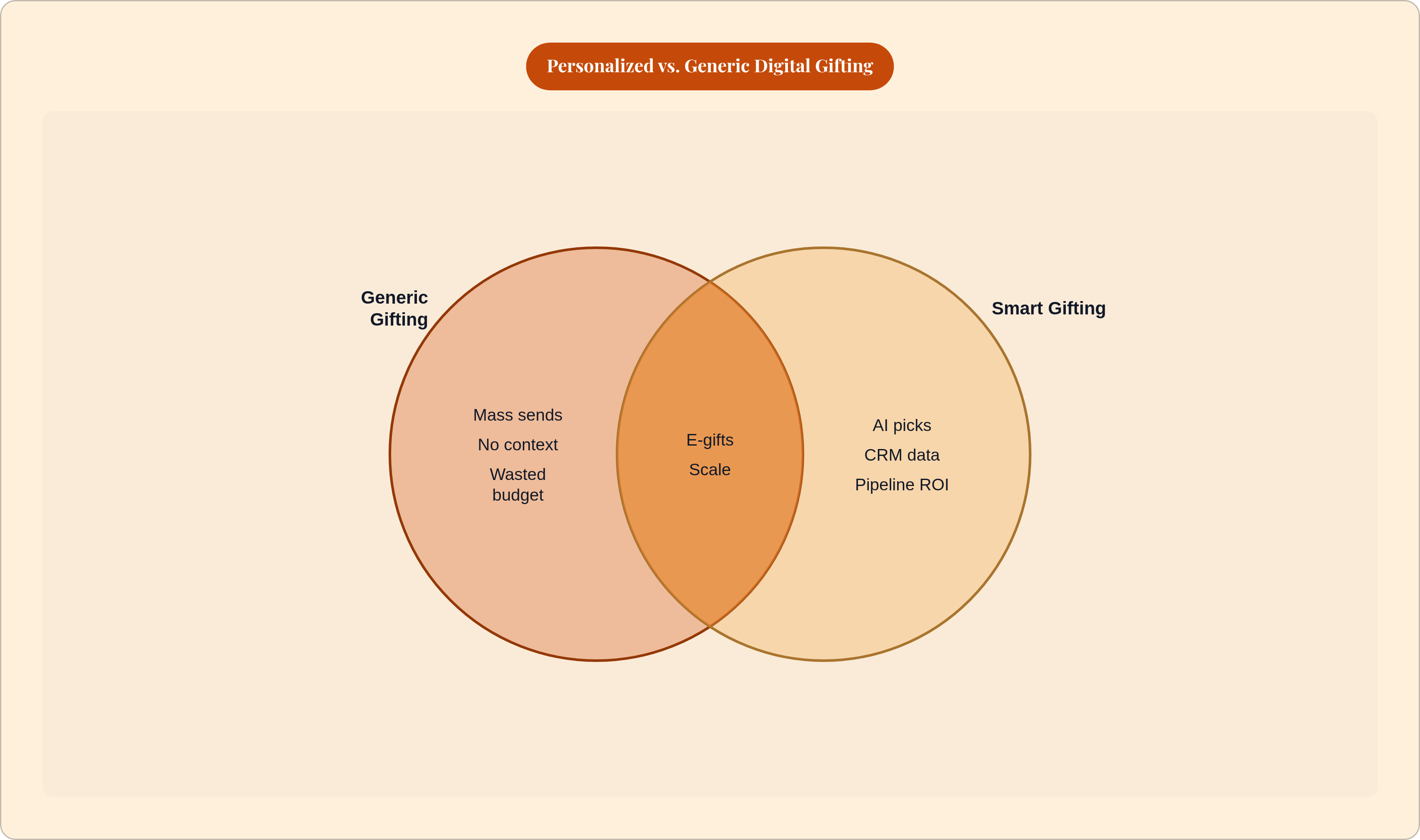
Personalizing digital gifts at scale means building a system where recipient data, cultural context, and AI tooling work together so every send feels chosen for that one person. Most B2B teams miss this in the same way: they blast the same e-gift card to 400 contacts, merge a first name into the subject line, call it a day. That gap between "personalized" and "actually relevant" is where most gifting budgets quietly go to waste.
I've sat through enough campaign reviews to stop being surprised by it, and honestly, that's the part that bothers me. Corporate gifting turned into a multibillion-dollar category faster than most teams figured out how to run it well, and a coordinator picks something that seems nice, sends it to a list, hopes.
That gap costs more now than it used to, because buyers tune out digital touchpoints across the board: emails, ads, personalized landing pages, all of it, since too much noise is competing for the same five minutes of attention. Forrester found 81% of B2B marketing leaders say they're very likely to open a physical package in a work context. Even a digital gift needs to feel different from the fortieth cold email that landed in someone's inbox this week, or it dies the same quiet death.
Here's the catch nobody likes talking about: the moment a gifting program gets big enough to move a real pipeline number, it also gets too big for any human to keep each send feeling individually picked. Nobody has the headcount to hand-customize four thousand sends a quarter, so personalization at scale has to mean something narrower than "made by hand." It means a system that produces recipient-relevant outcomes automatically, send after send, without someone re-deciding from zero every time. A gift that misses tells the recipient nobody did the homework, while a gift that lands tells them the opposite, and that difference shows up in response rates, in meeting acceptance, in whether a stalled deal starts moving again.
What actually makes a digital gift land with a recipient who doesn't look like the last one
Gift type and gift fit get confused constantly. Whether you send an e-gift card, an experience, or a subscription matters far less than whether that category fits who the recipient actually is. A mid-range coffee gift card can feel thoughtful to one person and beside the point to another; same dollar amount, same category, completely different read.
Three layers of context decide whether a gift lands or falls flat.
Individual preferences come first, along with role, seniority, known interests, whatever history exists with the person. A VP who's been a customer for three years reads a gift differently than a prospect you've never spoken to, and treating them the same is the first mistake most programs make.
Cultural context is the layer most programs skip, which is exactly why it does the most damage when it's missing. Gift norms and taboos shift by region and background, and none of that is optional to learn. Gift card denominations and merchant relevance swing hard by country: a $100 card to a US retailer means nothing to someone in a market where that retailer doesn't exist. Certain food and beverage gifts run straight into religious or dietary restrictions a US-centric catalog never thought to check. Luxury framing lands differently depending on seniority and national culture too. What reads as a generous executive gift in one context reads as excessive, even inappropriate, against another company's procurement norms.
Then there's situational context. Where does this person sit in the relationship right now, as a prospect, mid-deal, loyal customer, or brand-new hire, and what moment is the send actually marking?
Diversity here isn't only geographic either. It spans industry vertical, job function, relationship stage, all shaping what "thoughtful" looks like for that one person. So how do you make any of this workable across a thousand sends a month? You break "the recipient" down into a known set of attributes first, and only after that decomposition can automation do anything useful.
Why the data you already have probably isn't the data you need
Most teams sit on a pile of data, just not the right pile. Firmographic data tends to be solid: company size, industry, revenue band, all sitting there in the CRM already. Behavioral and preference data on the actual human inside that account is usually thin, and sometimes it doesn't exist at all.
The data that drives gift relevance breaks into a few buckets. CRM fields like job title, seniority, geography, deal stage, customer tenure. Behavioral signals like content consumed, events attended, product usage. Declared preferences a recipient chose themselves through a landing page or a pick-your-gift mechanic. Relationship signals like last meaningful touchpoint or open opportunities tied to that person.
That third bucket, declared preference, earns its own callout because it solves two problems at once. Recipient-choice gifting, letting someone pick from two or three curated options instead of getting one predetermined gift, generates first-party preference data while making sure the gift actually lands. The act of asking becomes useful information for whatever gets sent next time.
None of it works if the underlying data is dirty. Bad addresses, duplicate records, stale contact info; these cause fulfillment failures that sink the whole experience before a gift ever ships. A bounced or misdelivered package undoes whatever goodwill the personalization was supposed to build in the first place, and it does it fast.
There's a stakeholder problem too, and it's easy to underestimate. B2B deals tend to involve multiple buyers per account, spread across departments and seniority levels. Build a personalization system around a single "the buyer" profile, and it breaks the moment a deal has four or five stakeholders who each need something different.
So where do you actually start? Audit the CRM fields you already have against what matters for gifting, and find the gaps before you shop for a tool. Buying software before you know your own data gaps is how programs end up with an expensive platform and thin, generic sends anyway.
Segmentation done right groups people without erasing what makes them different
Segmentation sounds like a step away from personalization. In practice, it's the mechanism that makes personalization possible once volume outgrows what anyone can track by memory alone.
A handful of dimensions carry most of the weight in gifting programs. Geography and cultural region shape gift category and how the note gets worded. Relationship stage, prospect versus active deal versus existing customer versus new hire, shapes tone. Account tier shapes how much budget a send is worth. Job function and seniority shape formality. Industry vertical shapes what feels relevant versus what feels off entirely.
The practical move is building segment-level gift catalogs instead of one master list everyone draws from. Curate a shortlist for each segment, and that bounds the decision space, so a recommendation engine, or a coordinator for that matter, isn't choosing from an unconstrained universe, while recipients still get real choice inside that shortlist.
A good segment definition also has to name the moment, not just the person. Who someone is matters, but so does when and why the send is triggered. Is this reactivating a stalled deal, welcoming a new hire, or marking a renewal? Without that triggering condition, a segment is just a list sitting there, waiting on a rule to give it purpose.
Over-segmentation kills programs from the inside, and I'd flag this as the more common failure mode than under-segmenting. Build too many micro-segments and the operational weight collapses on itself: coordinators can't keep up, catalogs go stale, nobody remembers which rule applies where anymore. The goal is enough segments to feel human, not so many the system breaks the first time someone tries to update it.
Account-based marketing is a decent reference point here. ITSMA's 2024 benchmark study found mature ABM programs engaged a median of 4.2 stakeholders per target account, versus 1.6 in accounts without ABM treatment. That gap tells you something concrete: a gifting program that segments by stakeholder role, not just by account, reaches that wider buying group in a way one mass send to "the account" never could.
AI's real job is picking up the volume no coordinator could ever keep pace with
AI earns its keep by handling what doesn't scale with human attention. Gift recommendation, based on recipient attributes and past behavior, is one piece. Message personalization at send time, tuning tone and content to role, deal stage, and cultural context, is another. Address confirmation and delivery routing matter too, since a failed delivery is one of the fastest ways to torch an otherwise well-chosen gift. Anomaly detection catches the sends likely to land badly before they go out: wrong category for a region, a duplicate send to someone already gifted last month.
Deciding which segments matter, what the program is trying to accomplish, and what the brand's voice sounds like in that note, that stays a human call. I don't see that changing anytime soon, and honestly, I hope it doesn't.
The real value AI adds is speed. It compresses the gap between "we have the recipient data" and "a relevant gift is on its way" from hours of coordinator work down to minutes. Some sending platforms now bundle AI-powered gift selection, address confirmation, and message personalization together, so a team sends something relevant at scale without manually rebuilding the decision for every single recipient.
It's worth understanding how the recommendation engine actually behaves, because this is where the catalog point from earlier comes back around. AI surfaces options from within a curated catalog, bounded by choices humans already made, rather than from an open-ended universe of every gift that exists. That curation, done by humans setting up segment-level catalogs, is what keeps the AI's suggestions culturally sound. The AI works inside boundaries a person already drew, which is a decent way to think about the whole relationship between the two.
Automation triggers tied to the CRM close the loop. A deal stage change, an inactivity threshold, an event registration, a renewal date coming up: any of these can kick off a send without a human having to notice and act manually. That's the difference between a program running on a coordinator's memory and one running on its own rails.
If a send can't show up in the pipeline report, it didn't happen
None of the personalization work matters commercially if nobody can point to what it did. A program that can't say which sends drove pipeline can't defend its budget in a planning meeting, and it can't improve either, because there's no feedback telling the team what worked and what didn't.
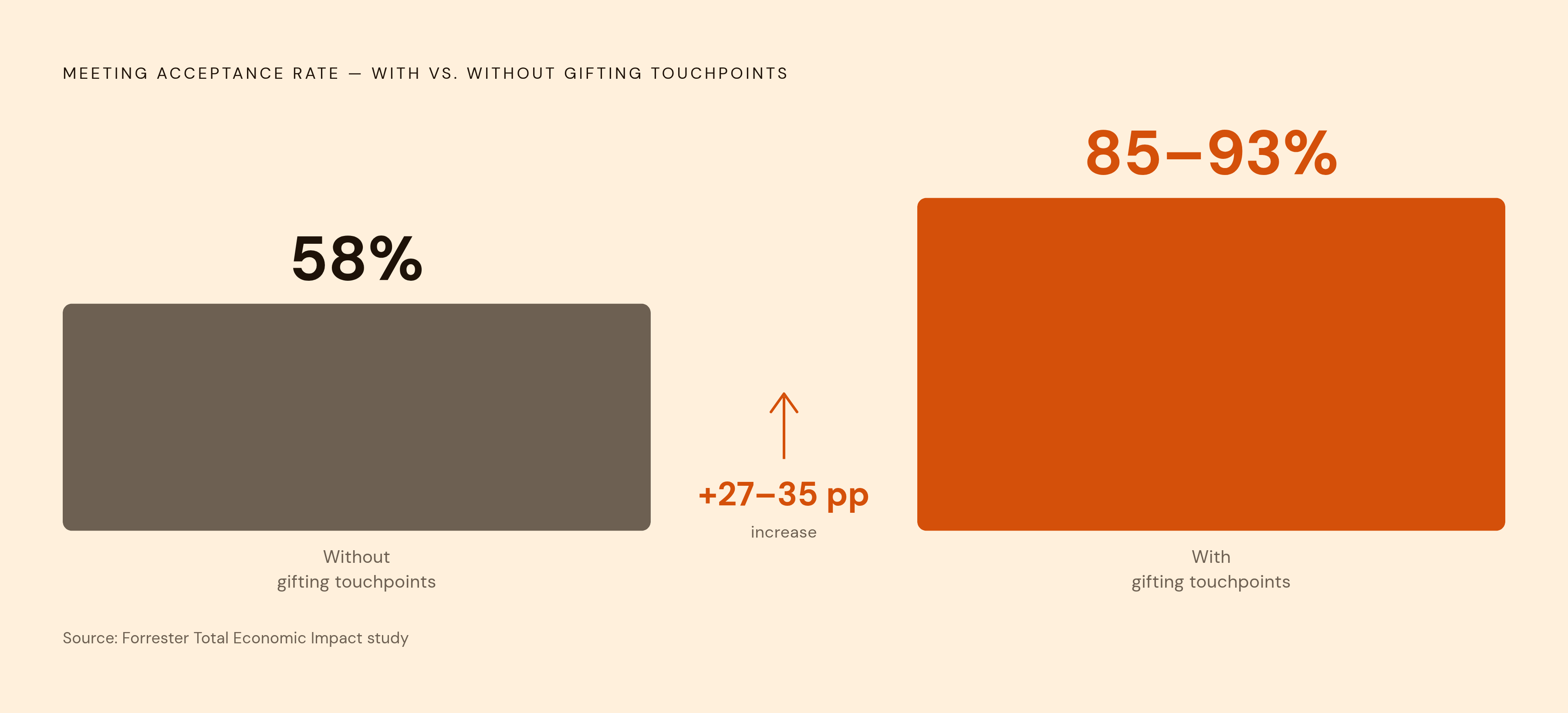
Forrester's Total Economic Impact study is a useful reference point here. It documented meeting acceptance rates climbing from 58% to somewhere between 85% and 93% once teams built gifting touchpoints into their sales motion. That's a specific, commercial number moving because of a specific tactic, not a vague sense that things got better.
Tracking revenue impact well means splitting it into three separate buckets instead of lumping everything into one vague "gifting worked" claim. Pipeline sourced, where the gift itself was the first meaningful touchpoint. Pipeline influenced, deals already in motion that sped up because of a send. Revenue retained, renewals and expansions tied to gifting sent during the relationship.
For sales cycles stretching across months, multi-touch attribution is the more honest model. It spreads credit across every touchpoint in the buying journey instead of handing it all to whichever touch happened first or last. That's a harder story to tell than "this gift closed this deal," but it survives a CFO's scrutiny better, since it doesn't pretend gifting was the single cause of a win.
CRM integration is what makes any of this measurable in the first place. Tie every send to a contact record, and redemption, meeting conversion, deal movement can all get read back against that original send event. Gifting stops living as some offline activity floating outside the rest of the data stack.
Picture a campaign targeting 500 stalled opportunities. It generates 75 responses, 40 booked meetings, 8 closed deals worth $120,000 in new revenue. That works out to roughly a 400% return on the send investment. The math holds up because the campaign was built around one specific, well-defined segment (stalled deals) with one specific goal: reactivation. Specificity is what makes the ROI number mean anything at all.
Redemption rates by segment, by gift category, by send moment: that's the feedback loop. It tells a team which personalization choices worked and which fell flat, and that's how the whole thing improves over time instead of staying frozen at whatever assumptions it launched with.
What it actually takes to run this at scale without the wheels coming off
Scale isn't just a software problem. It's a fulfillment problem, an address-management problem, a global-reach problem, and all of that has to get handled systematically, or the personalization work upstream goes to waste the moment a package doesn't show up.
A few things matter when sizing up whether a platform can support a diverse, global recipient base. Can it fulfill in the markets where recipients actually live, not just near wherever the vendor happens to be headquartered? Is the catalog locally relevant by region, not just technically available there? Does redemption data flow back into the CRM and marketing automation systems the revenue team already lives in day to day? Does the AI personalization cut coordinator workload without cutting send quality? Can recipients pick from a curated set, keeping relevance intact while still giving them some say in what shows up?
Sendoso is a working example of this kind of setup assembled in one place: fulfillment across more than 165 countries, a dedicated fulfillment center handling everything from procurement through returns, SmartSuite AI for gift selection and address confirmation, CRM integrations tying every send back to pipeline data. Built for teams that need scale and measurability at the same time.
For a team earlier in this journey, it helps to think in stages rather than trying to build the mature version on day one. Start with one or two trigger-based sends wired into existing CRM workflows, basic segment logic underneath, then add segment-level catalogs next, recipient-choice mechanics, redemption tracked against deal stage. The mature version runs AI-driven recommendations across a fully segmented global base, uses multi-touch attribution, refines its catalog continuously based on the acceptance data coming back in.
The idea underneath all of it stays the same no matter the stage. The right gift reaches the right person at the right moment, reliably, again and again, with proof that shows up in the pipeline instead of in a coordinator's gut feeling about whether the send "felt right."