Using CRM Data to Drive Gift Personalization
Rich CRM data after the sale unlocks personalization most teams leave on the table.

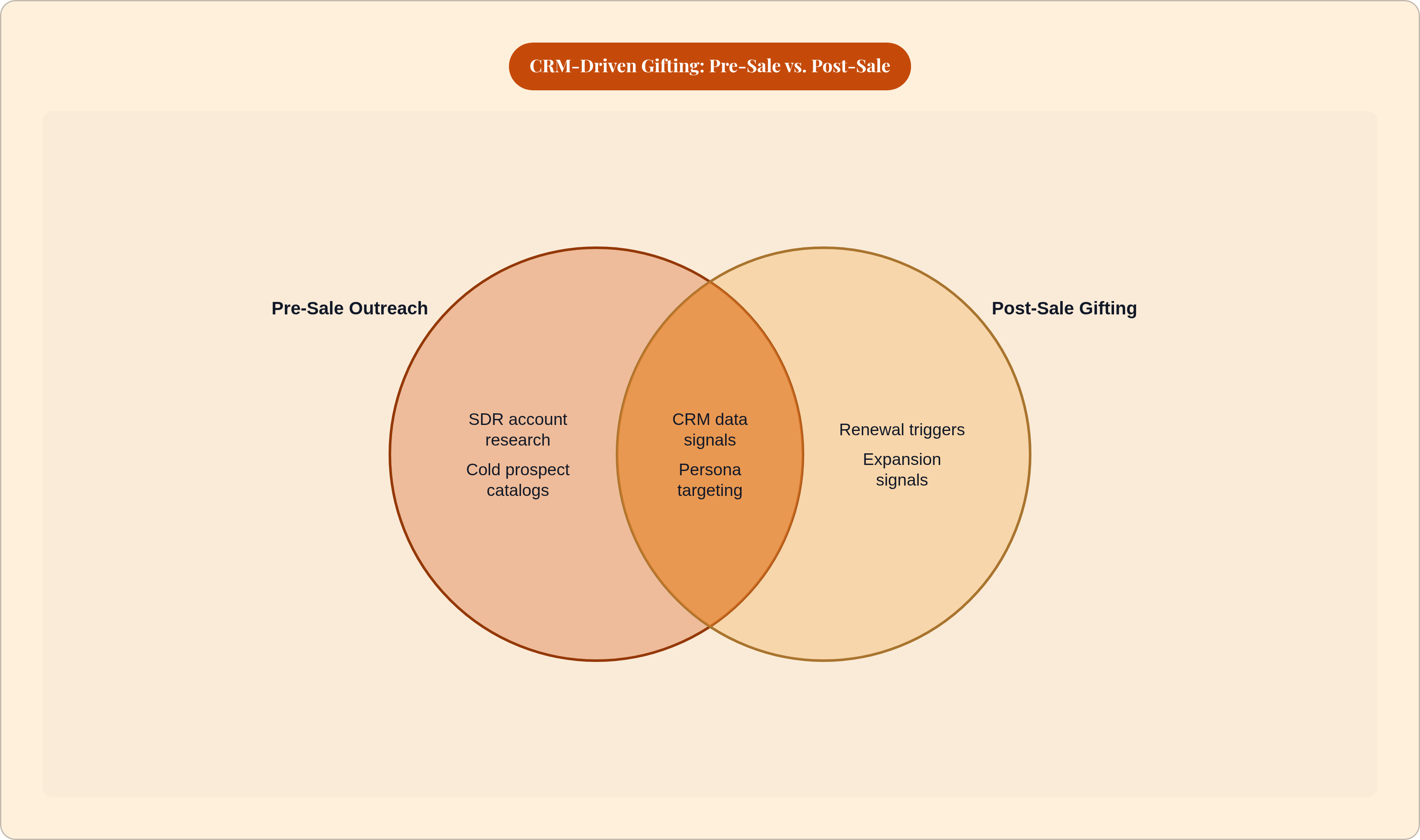
Most B2B revenue organizations front-load personalization precisely where relationships are thinnest. SDRs research accounts before a single email goes out. Paid programs are segmented to the job title. Outbound sequences are hyper-targeted. Then the deal closes, the customer onboards, and the personalization largely evaporates.
Which is strange, because that's when CRM data gets richest. Engagement history accumulates. Product usage patterns emerge. Renewal windows become visible. Expansion signals start firing. You know more about this person than you did on day one of prospecting, and you're doing less with it.
Buyer expectations don't soften after purchase. The expectation of personalized treatment persists across the entire customer lifecycle, not just acquisition. Post-sale gifting sits at the precise intersection of the highest data richness and the lowest personalization effort. Onboarding completion, renewal triggers, expansion signals, contract anniversaries: these are unambiguous moments, and most teams meet them with the same generic catalog approach they'd use for a cold prospect.
The gap isn't mysterious. It's habitual. And habits, once you can see them clearly, are breakable.
Which CRM fields actually drive gift relevance, and what each one tells you
Not every CRM field carries the same signal weight. Some tell you what to send. Others tell you how much to spend, or when, or to whom. The hierarchy matters before you build any logic on top of it.
Deal stage is the most immediate filter. I'll come back to it in the next section because it deserves more space; it's the field that should govern format and investment level before any other consideration.
Industry and vertical shape what feels appropriate versus what feels oblivious. Financial services buyers operate inside compliance constraints that make certain gift categories genuinely problematic, not just awkward. Technology buyers often carry sustainability expectations that make packaging and sourcing choices visible in ways they wouldn't be elsewhere. Matching industry context isn't playing it safe; it signals that you understand the environment someone actually works in, which is a different thing.
Firmographics, company size and revenue tier especially, calibrate proportionality. A startup founder and an enterprise CPO can receive the same gift and have completely different reactions to it. One feels seen. The other feels like you misjudged the relationship. Company size is a reasonable proxy for that calibration when you don't have more granular context.
Job role and persona matter because economic buyers, technical evaluators, and end users have different stakes in a decision. What resonates with a CFO is not what resonates with a lead engineer. Salesforce's State of Marketing 2025 Report found that B2B deals now involve an average of 11 stakeholders, each consuming multiple assets before engaging sales. A gift strategy that reaches only the primary contact misses most of the decision-making surface.
Engagement history is the most underused signal in the stack. Email open patterns, content downloaded, events attended: each one maps to a topic the recipient has already indicated interest in. A gift that mirrors a content theme someone has engaged with repeatedly feels like continuation. It doesn't feel like a campaign.
Milestone dates are the clearest signal of all because the timing is unambiguous. Contract anniversaries, onboarding completion, renewal windows: when these dates live in the CRM, the send logic nearly writes itself. The only question is whether anyone actually looks.
Intent data, when surfaced inside the CRM, creates a time-sensitive category of its own. ZoomInfo's 2025 ABM Intelligence Study found that teams acting on intent spikes within 24 hours see a 29% lift in opportunity creation. A well-timed physical send into that window doesn't feel like marketing. It feels like the right thing arrived at the right moment, which is a meaningfully different experience for the recipient.
How deal stage maps to gifting format, not just gifting content
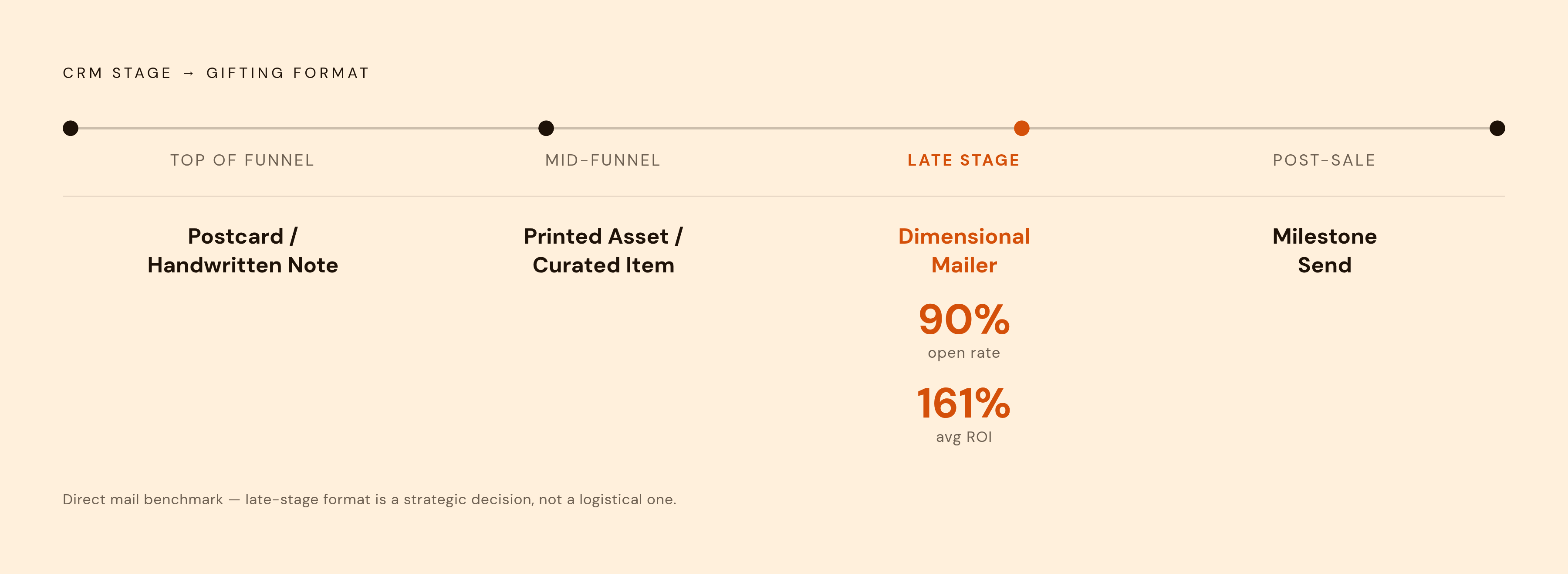
This is the distinction most gifting programs miss entirely. The conversation about CRM-driven personalization almost always gravitates toward what to send. The format question, the physical shape and delivery mechanism of the send, gets treated as logistical afterthought. It isn't.
Format communicates intent before the package is opened. A postcard and a dimensional mailer aren't just different sizes. They signal different levels of investment, different relationship assumptions, different expectations of the recipient's time.
At the top of the funnel, where the relationship is thin and the risk of presumption is real, a postcard or handwritten note carries exactly the right weight. Low friction, low implication. It opens a door without walking through it uninvited.
Mid-funnel, when the conversation is already underway and a content theme has emerged, a printed asset or curated item tied to something the prospect has already engaged with signals continuity. It says: I remember what we talked about. That's a different register than: I found something I thought you'd like.
At late stage, the format shifts again. Dimensional mail, a physical package with actual depth, achieves something no digital channel can replicate: it gets opened. The reflexive response to a physical package is to open it, and that behavior bypasses the gatekeeper screening that filters most executive-targeted email before it's ever read. B2B direct mail carries a 90% open rate and an average ROI of 161%, outperforming most digital channels when integrated into a multi-touch sequence. Coordinating a physical send with a digital sequence in the same motion produces measurably higher response rates and website visits than either channel alone.
CRM stage is not just an audience filter. It is a format brief. The stage field should determine the physical shape of the send as deliberately as it determines the content inside it. Content makes a gift feel personal. Format determines whether it gets noticed in the first place.
The ABM use case: using account-level CRM data to gift across the buying group
ABM is the natural home for CRM-driven gifting because the account record already aggregates firmographic, engagement, and stakeholder data in one place. You're not working from a single contact. You're working from a full picture of an account's behavior, momentum, and composition.
With anywhere from six to ten stakeholders involved in a typical B2B buying decision, a single-contact gifting strategy leaves most of the buying committee untouched. Account-level CRM data reveals who else should receive a send and what each role's engagement pattern suggests they actually care about. Which personas have gone quiet after an initial burst of activity? Which have accelerated? Which have consumed content on a specific topic that a gift can reinforce?
The aggregate engagement score across an account's contacts is useful for timing and urgency. The disaggregated view, which roles are hot and which have cooled, is what allows you to allocate send resources intelligently across the buying group rather than concentrating everything on the primary contact.
Coverflex generated $1.3M in supported pipeline with a two-person marketing team using personalized ABM. That result isn't a benchmark to copy; it's evidence that account-level personalization at scale is fundamentally a tooling and infrastructure question, not a headcount question. The constraint isn't people. It's whether the data and the workflow are connected.
CRM integrations that surface account-level data directly in the send workflow mean a marketer or SDR can see the full account picture and act on it without toggling between platforms. The account record and the send decision exist in the same operational context, which sounds minor until you've watched a program collapse because no one wanted to do the lookup.
The data infrastructure problem that breaks CRM-to-gift logic before it starts
Everything described above assumes clean, populated, synchronized CRM data. That assumption breaks constantly, and when it breaks, it breaks quietly. Nobody gets an error message. The program just produces generic sends while everyone believes the data is informing them.
Salesforce's Connected Customer Report found that 48% of businesses say data silos prevent a consistent customer experience across teams. The CRM fields that should drive gifting logic are only actionable when they're maintained, current, and accessible to the people executing sends. When they're not, the personalization logic collapses before it starts.
The failure modes are predictable enough to prevent. Deal stage fields don't get updated consistently because sales reps are focused on the deal, not the record. Engagement data lives in the marketing automation platform but never syncs to contact records, so the person deciding what to send has no visibility into what the recipient has actually consumed. Milestone dates are captured in one system and never surfaced to the team executing sends. Address fields, the most basic logistical requirement for physical gifting, are frequently incomplete or stale. A perfect personalization decision fails at the doorstep when the address is wrong.
There's also an attribution problem that compounds all of this. Gift sends that should register as pipeline influence disappear from the record entirely when data isn't unified. The program looks like it isn't working when the actual problem is that no one can see what it's doing. Those are two very different diagnoses, and confusing them is expensive.
The prerequisite for building a CRM-triggered gifting program is not a new platform or a bigger budget. It's a data hygiene audit focused specifically on the fields that drive the send logic. Which fields are populated at what percentage? Which are being kept current? Which are siloed in a system that doesn't talk to the CRM?
Address confirmation tooling can address one of the most common execution blockers directly: even when CRM address data is stale, the physical delivery step doesn't have to fail. The broader data infrastructure problem still requires attention upstream, before any automation is built on top of it, but at least the last mile has a contingency.
How to wire CRM triggers to automated send workflows without losing the personal feel
A CRM trigger is a defined field condition or event that automatically initiates a send. Deal stage moves to "proposal sent." A contract anniversary date arrives. An engagement score crosses a threshold. The trigger fires, the personalization logic runs, and a send is initiated without someone manually reviewing the contact record and making a gut-feel decision.
The trigger categories worth building first are relatively clear. Stage-advance triggers fire when a deal moves between defined milestones: discovery to evaluation, evaluation to proposal, proposal to negotiation. Each transition is a natural moment to reinforce the relationship. Milestone triggers, onboarding completion, first renewal window, multi-year anniversary, are time-certain and high-signal. Re-engagement triggers are useful when an account goes dark after a period of active engagement; digital channels have stopped working, and a physical send can reopen a conversation that email cannot. Intent spike triggers create a time-sensitive window where speed compounds the value of the send.
The critical design principle: the personalization logic runs at trigger time, not at campaign-build time. The CRM field values present when the trigger fires, industry, persona, engagement history, company size, are what determine what gets sent to that specific contact. The same trigger can produce meaningfully different sends for two contacts in the same sequence, because the data behind them is different.
The concern about automation killing the personal feel is worth taking seriously, but it conflates mechanism with outcome. The personal feel is preserved not by having a human choose every gift, but by ensuring the selection logic reflects data the recipient would recognize as specific to them. AI-powered gift selection tools can read CRM signals at trigger time and recommend a gift appropriate to the recipient's context. The manual lookup that makes personalization feel like overhead disappears. The relevance stays.
SG360° found that trigger-based programs consistently outperform batch campaigns on response quality and return on ad spend, with precise audience targeting and enhanced personalization as the two attributes most correlated with better direct mail results. The automation isn't the compromise. It's the mechanism that makes personalization consistent at scale rather than heroic and occasional.
Measuring whether the CRM-to-gift logic is actually working
The measurement architecture needs to be built into the CRM before campaigns run, not retrofitted afterward. Programs that don't log sends as CRM activities cannot produce attribution. Programs that cannot produce attribution become discretionary budget items at the next planning cycle, which is a predictable outcome that still surprises people every year.
The core metrics map directly to CRM records. Meeting rates for contacts who received a triggered send, compared to a matched group that did not. Days-to-close for gifted opportunities versus comparable non-gifted opportunities at the same stage. Total pipeline value associated with accounts that received a send during a measurement period. Renewal and upsell rates for customers who received post-sale milestone sends versus those who did not.
Attribution requires physical sends to carry trackable signals back into the digital record: unique URLs, QR codes, offer codes embedded in the send that tie an offline touchpoint to a CRM record and a pipeline outcome. Without these, the send is invisible in the data. The conversation it sparked, the meeting it influenced, the renewal it reinforced: all of it disappears, and the program gets evaluated on anecdote rather than evidence.
GiftAFeeling's TSSL Lab found that a majority of companies report increased sales after launching corporate gifting programs, with meaningful ROI in client retention and employee engagement. Those figures are only realizable when the program is measured rather than assumed.
CRM integrations that log every send as an activity on the contact and account record make pipeline influence and deal velocity visible in the same dashboards revenue teams already use. The gifting program stops being an offline gesture and becomes a data point in the revenue stack.
Once the data shows which trigger types and gift categories are producing the strongest pipeline influence, the personalization logic can be refined. The system gets smarter. The next cycle is more precise than the last. That's the actual goal: building something that learns from itself rather than running the same catalog exercise every quarter and wondering why the results feel flat.