Cultural Considerations in International Corporate Gifting
What you gift and how you give it signals respect or disrespect across cultures.

Hold two countries in your mind at once.
In Sweden, 78% of organizations actively discourage business gifts. The logic is almost puritanical: professional relationships should stand on the quality of the work. A gift implies the work isn't enough. It raises an eyebrow more than it warms a room.
In South Korea, 92% of companies maintain structured gift-giving protocols mapped carefully to hierarchy. A gift isn't a nice gesture there. It's an expected signal of respect, and its absence is noticed the way skipping a handshake would be noticed anywhere else.
Then there's Singapore, which adds a third dimension entirely. Gifting is permitted, even encouraged, but 89% of corporations require detailed documentation for any business gift regardless of value. The practice is governed before it's cultural. Compliance is the first conversation, not an afterthought.
These aren't outliers. They're archetypes, and every market lands somewhere on this spectrum. But what if the norms themselves tell you something deeper? They aren't arbitrary; they reflect deeply held values about hierarchy, professional distance, and what trust between business partners actually looks like.
The $919.9 billion global corporate gifting industry, projected to climb past $1.65 trillion by 2033, is largely built by companies that haven't reckoned seriously with this divide. Most global gifting programs are designed by U.S.-based teams, calibrated to U.S. sensibilities, and exported without much examination. A 2024 Harvard Business Review study found that roughly 25% of recipients discard gifts that conflict with their dietary restrictions or cultural preferences. One in four sends, gone. Not just wasted budget but actively counterproductive: someone opened a package, felt unseen, and now associates that feeling with your company.
The fastest-growing market for this spending is Asia-Pacific, expanding at over 10% annually toward a projected $433 billion by 2033. The region where cultural precision matters most is also where the money is moving fastest.
So before any of the regional specifics: the first question an international gifting program needs to answer isn't "what should we send?" It's "should we send anything at all, and if so, what rules govern the act?" Everything else follows from there.
East Asia: where presentation, hierarchy, and symbolism govern every exchange
If you've spent real time doing business in Japan, you already know the gift is almost secondary to the giving. Omiyage, the practice of bringing back regional specialties when you travel, and ochugen, the midsummer gift-giving season, aren't informal gestures. They're relationship maintenance rituals with specific timing, specific product categories, and specific expectations around presentation. The wrapping matters. Offering with two hands rather than one matters. Timing matters.
And here's the thing that tends to catch Western senders off guard: the gift will not be opened in front of you. Don't prompt it. Don't hover expectantly. Restraint, on both sides, is the correct posture.
Two things to remove from Japanese sends immediately: sets of four, which carry death associations through phonetic overlap with the word for death, and white packaging, associated with mourning. These aren't obscure details. Every Japanese recipient will register them.
China has its own version of these dynamics, and the scale of corporate gifting there tells you something about how seriously it's taken: gifts represent up to 3% of annual company expenses for Chinese firms. Red packaging conveys good fortune; white is again inappropriate. The four-avoidance rule applies here too. Clocks are a well-documented taboo: in Mandarin, the phrase for giving a clock is a homophone for attending to the dying. There are plenty of gift categories without that liability. As in Japan, gifts in China are frequently set aside to be opened later. No immediate reaction isn't a bad sign. It's the expected one.
South Korea's protocols layer hierarchy on top of everything. Gift value and selection should map to the recipient's seniority. Brand recognition functions as a signal: a well-known brand communicates that you took the relationship seriously enough to choose accordingly.
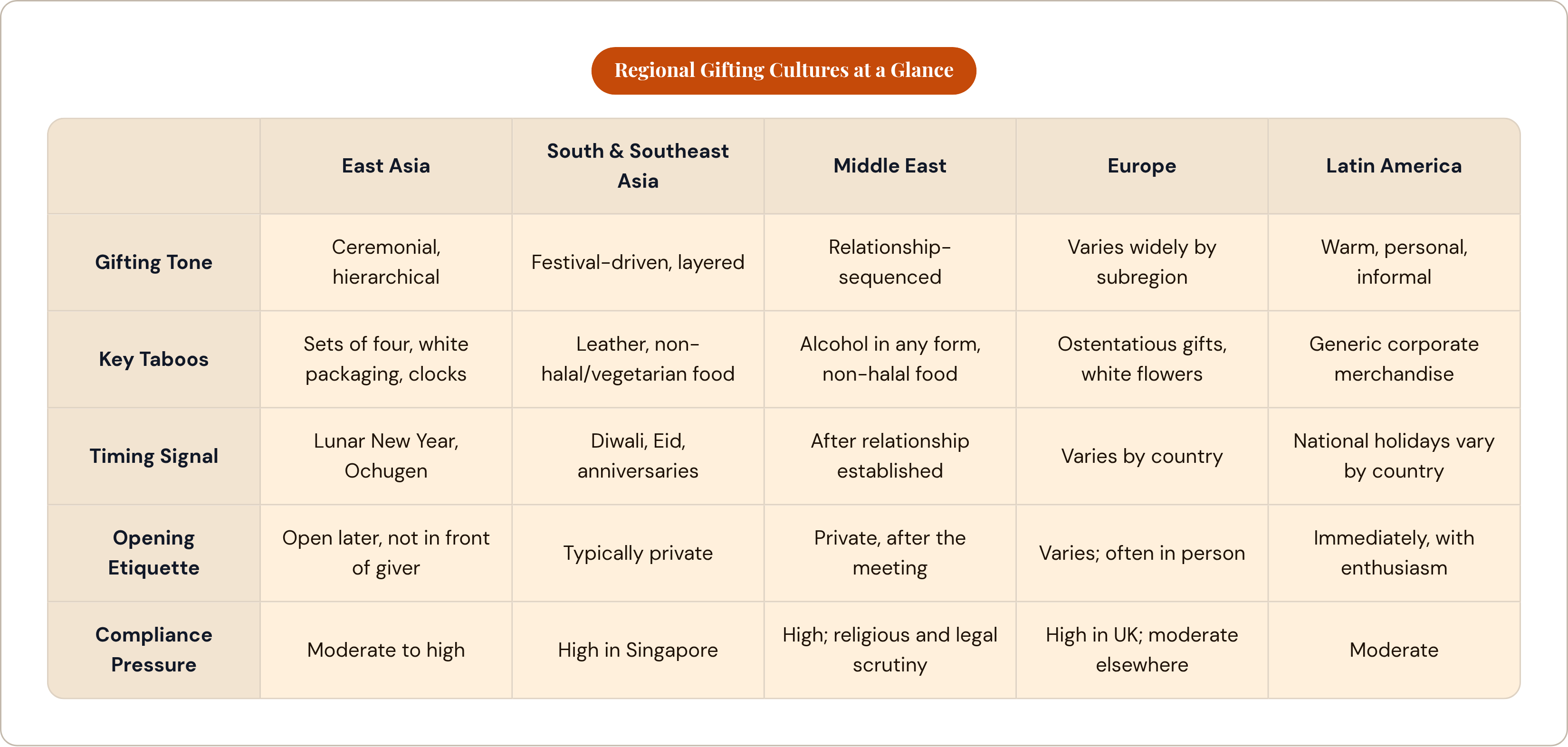
Across all three markets, the act of giving is a performance of respect. Wrapping, quantity, color, timing: every element communicates something, which means every element requires intentional attention. Get one wrong and the message changes. The gift is the message, not just the container for it.
South and Southeast Asia: festival calendars, documentation requirements, and dietary complexity
India's corporate gifting market reached approximately $75.16 billion in 2024, projected to grow to $92.32 billion by 2030. That scale reflects how institutionalized the practice is. Unlike North American gifting, which clusters hard around a single holiday window, Indian corporate gifting maps to relationship milestones: onboarding, work anniversaries, project completions. And then the festival seasons.
Diwali and New Year together account for 40 to 45% of annual corporate gifting expenditure. If you're entering the Indian market and you make only one calendar decision, get your sends out before Diwali. That is your highest-impact moment.
The dietary and religious considerations require real care. Avoid leather products for Hindu recipients. For food gifts, verify: does this recipient observe vegetarian, halal, or other dietary requirements? A single recipient list in India can span multiple religious communities, which means multiple food-gift configurations for the same send window. That's not a hypothetical edge case; it's routine.
Singapore is compliance-first. The 89% documentation requirement isn't cultural nuance; it's a regulatory expectation. Build documentation into the workflow architecture before the first gift ships. The country's multi-ethnic population creates the same dietary layering as India: halal, kosher, and vegetarian constraints can all exist within a single recipient list.
Across Malaysia, Indonesia, and Brunei, majority-Muslim populations create a clear rule: no alcohol. That includes alcohol-containing confectionery, not just bottle gifts. Food items should be halal-certified. Ramadan and Eid are significant gifting occasions, but send before Ramadan rather than during the fasting period. The timing distinction matters more than people expect.
The Middle East: relationship sequence, religious observance, and what never to send
The most consequential thing to understand about gifting in the Middle East is sequencing. A gift isn't a relationship-opener here. It becomes appropriate after a relationship is established. Send too early, and it doesn't signal enthusiasm; it reads as presumptuous, as transactional in a way that undermines the very thing you're trying to build.
Religious observance structures both the calendar and the gift categories. For Muslim recipients across the region, alcohol is categorically off the table: not just wine and spirits, but liqueur chocolates, alcohol-infused confections, anything where alcohol appears as an ingredient. Food gifts broadly should be halal-confirmed before they ship.
Israel operates on a different cultural register. The significant gifting moments are Rosh Hashanah and Passover. Food gifts for Jewish recipients should be kosher; verify this before selecting anything edible. Worth noting: the personal and professional spheres overlap more in Israel than in Northern European contexts, and relationship warmth in gift selection isn't just acceptable, it's expected.
The practical implication for sender programs is that the Middle East requires more pre-send research per recipient than almost any other region. Religious affiliation, holiday timing, relationship stage, dietary requirements: all of these need to be confirmed before anything ships. That raises an important question for program design: how do you build the infrastructure to gather that information reliably, at scale, before a single package leaves the warehouse? There's no shortcut that doesn't carry real risk.
Europe: a single market with at least four distinct gifting cultures
Treating Europe as one gifting territory produces consistent misfires. The regulatory framework is relatively unified. The cultural norms are not.
Northern Europe, Sweden, Germany, the Nordics, operates on professional restraint. Germany specifically: high-quality gifts are appropriate, but ostentatious ones are uncomfortable. A flashy gift reads as an attempt to curry favor, which lands badly in a culture that prizes directness and earned credibility. The Nordics lean toward minimalism, sustainability, and practicality. Eco-friendly, locally crafted, or experience-based gifts perform well; elaborate corporate packages tend to produce the opposite of the intended effect.
The UK is professional and refined in register but lighter than Germany. A subtle, intelligent touch of humor can work in ways it wouldn't in Frankfurt. Compliance matters here too: the UK Bribery Act creates real value thresholds that recipients in regulated industries bump against, and a send without a value check can create an awkward situation for your recipient specifically, not just for your program.
Southern Europe is a different culture entirely. Italy and Spain build business relationships on personal connection, and gifting is an extension of that warmth. In Italy, artisanal and locally made items signal craftsmanship in ways generic corporate merchandise cannot replicate. Across Southern Europe, gifts are typically exchanged during face-to-face meetings rather than shipped in advance; the in-person presentation is part of the gift.
One nearly universal note for European flower or plant sends: white flowers carry mourning associations across much of the continent. An easy detail to overlook, and exactly the kind that sticks with a recipient.
Latin America: relationship warmth, personal touch, and looser formality
There's a finding from Brazil worth pausing on: 65% of professionals consider personal gifts essential for relationship building. Not helpful. Not a nice touch. Essential. Why exactly does this happen? The personal dimension in Latin American business culture isn't a soft preference layered on top of professional norms. It is one of the professional norms, which changes how you should think about gift selection entirely.
Compared to East Asia and the Middle East, the formality around gift exchange in Latin America is considerably lower. Recipients open gifts immediately, respond with enthusiasm in the moment, and make the exchange feel social rather than ceremonial. That warmth is a feature, not a breach of protocol.
What this means practically is that generic corporate merchandise lands particularly flat. Localized, thoughtfully personalized choices signal that you understand the relationship and invested in it. Mass-produced swag signals the opposite.
Gifting calendars vary significantly by country. Brazil, Mexico, Colombia, and Argentina each have distinct national holidays and cultural moments that shape when gifting feels resonant. A regional send that ignores these distinctions will feel imprecise to recipients who notice them, and they will notice.
North America: the baseline most global programs are built around, and its blind spots
American and Canadian corporate gifting is pragmatic. Useful, tasteful, brand-aligned. The calendar peaks hard between Thanksgiving and New Year's, creating a concentration of send volume unlike most other markets, where gifting is distributed across the year.
Sustainability has moved from preference to expectation for a meaningful segment of recipients. In 2024, roughly 26% of corporate gifts were eco-friendly, and that category is expanding at approximately 9.5% annually. Sending something that conflicts with widely held environmental values is an increasingly visible misstep for certain recipient profiles.
Compliance matters here too, especially for recipients in financial services, healthcare, and government-adjacent roles. Many of these professionals operate under strict internal gift value limits. A send without a value check doesn't just create a compliance problem for your program; it creates one for the recipient, which is a faster way to damage a relationship than sending nothing at all.
The deeper issue is structural. Most global programs are built by U.S.-based teams, and the assumptions embedded in the North American playbook get exported without examination. That's how you end up with a gifting program that technically ships globally but actually operates as if Chicago and Osaka share the same professional vocabulary. They don't. Recognizing that gap isn't a minor calibration; it's the prerequisite for any program that works across borders rather than just ships across them.
The universal rules that hold across almost every market
Across all the regional variation, a few things stay consistent.
Dietary and substance awareness is non-negotiable everywhere. Alcohol is unwelcome in Islamic cultures broadly and in many individual workplaces regardless of market. Leather products create problems for Hindu recipients. Halal, kosher, vegetarian, and allergen considerations apply to large recipient segments globally. When uncertain about a recipient's preferences, non-perishable or non-food gifts remove the variable entirely.
Number and color symbolism appear across multiple markets. Sets of four carry death associations in both Japanese and Chinese culture; avoid them in product sets and quantities. White packaging has mourning associations across several Asian cultures, and white flowers carry similar connotations in parts of Europe. Red packaging, conversely, actively signals good fortune in Chinese culture and does real relational work when used correctly.
Timing is signal. Aligning a send with Lunar New Year, Diwali, Eid, or Rosh Hashanah demonstrates that you did the work to understand your recipient's context. That demonstration is itself part of the gift.
Opening etiquette varies sharply, and it affects how you configure your messaging. Latin American and North American recipients often open gifts immediately; in Japan and China, opening in front of the giver is considered impolite. If your message is inside the wrapping, it won't be read in the moment in East Asian contexts. Design your sends with that in mind.
And consistently, across every market studied: quality over volume. High-quality, thoughtfully chosen gifts outperform high-volume generic sends in virtually every market. This is the rare norm that crosses cultural lines with remarkable consistency.
How compliance and anti-bribery laws shape what's permissible before cultural norms even enter the picture
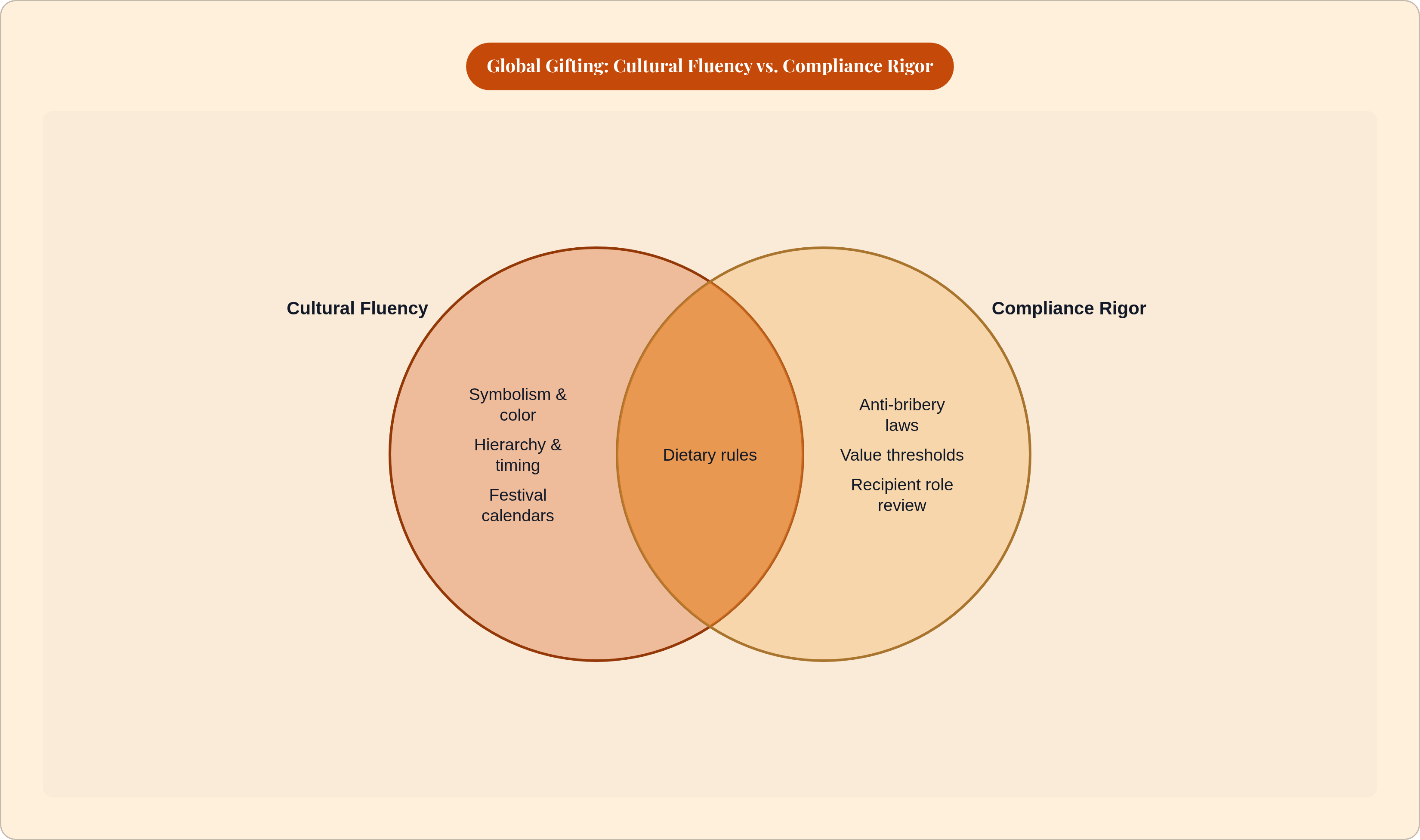
Every cultural consideration in this piece exists downstream of a more fundamental question: is this send legally permissible?
Singapore's documentation requirement isn't just cultural expectation; it's a compliance mandate. And Singapore isn't unusual. Regulatory frameworks governing business gifts exist across most major markets. The UK Bribery Act, the U.S. Foreign Corrupt Practices Act, and equivalent legislation across the EU and Asia-Pacific prohibit gifts intended to improperly influence recipients in regulated and government-adjacent sectors. Critically, these laws don't set fixed monetary thresholds. Intent and recipient role are the operative variables.
Recipient role matters as much as recipient culture. A government procurement officer in any country is a categorically different sending situation than a private-sector counterpart in the same market. The cultural norms covered throughout this piece apply to the latter. For the former, legal review comes first, before any cultural calibration begins.
Documentation isn't a Singapore-specific obligation. In many markets, senders need the infrastructure to produce a record of what was sent, to whom, at what value, and for what stated purpose. Treating this as something to sort out later is how well-intentioned programs quietly accumulate compliance exposure. Build the documentation workflow before you build the gift catalog.
It is also worth considering what happens when these two disciplines are treated as separate workstreams rather than integrated ones. The programs that work at scale hold both things simultaneously: cultural fluency and compliance rigor. Cultural fluency without compliance awareness creates one kind of risk. Compliance awareness without cultural fluency squanders what a well-timed, well-chosen send can accomplish. They aren't competing priorities. They're the same discipline, applied at different layers of the same decision.