Corporate Gift Policy Development
A formal governing instrument that controls when and how employees give or receive gifts.

Most people mischaracterize this document from the start. A corporate gift policy is a formal governing instrument: it dictates when and how employees give or receive gifts, hospitality, swag, and incentives across business relationships. Not a memo. Not a paragraph buried in a code of conduct. A governing document with real consequences.
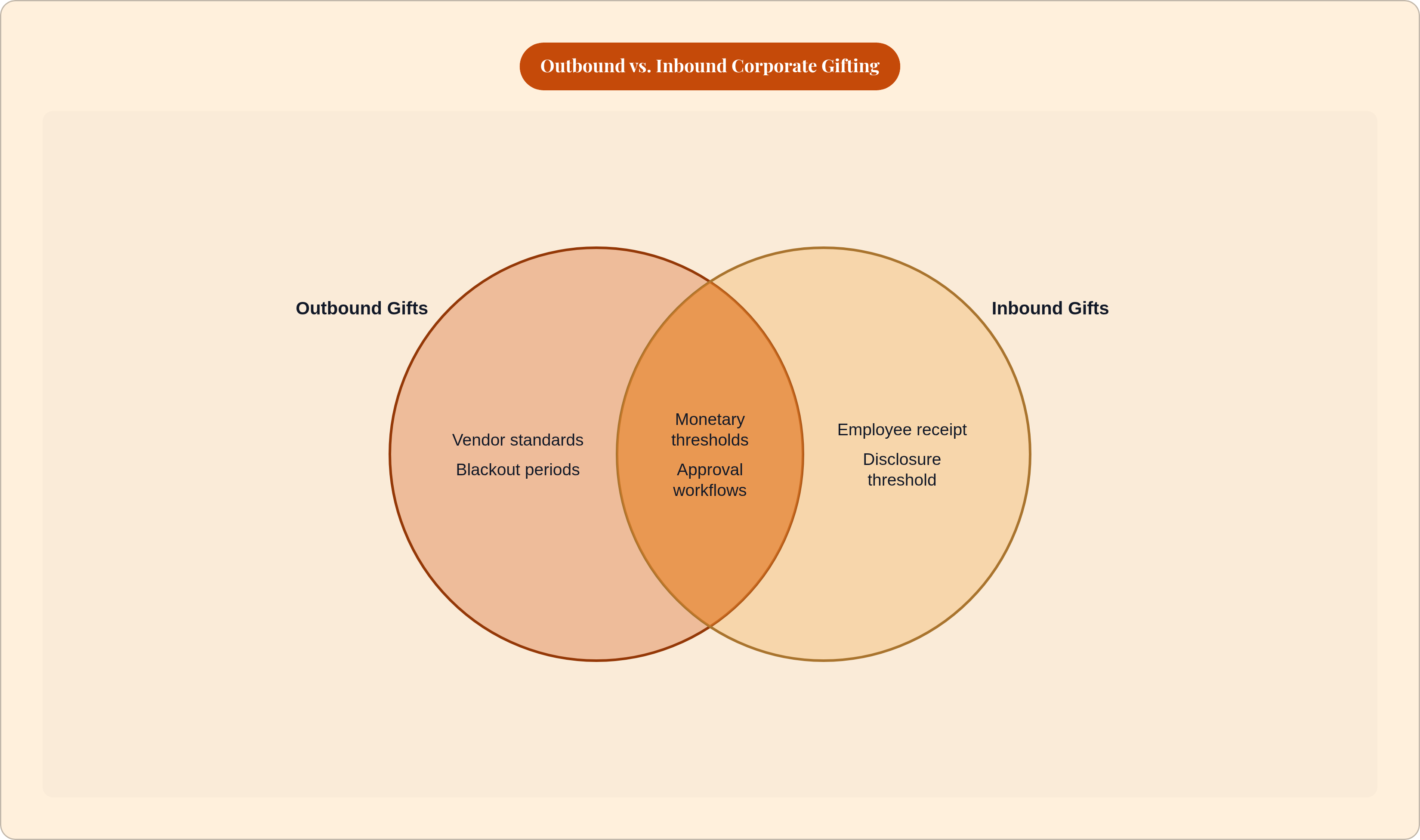
It operates in two directions, and that bidirectionality is where most companies stumble. Outbound covers what the company sends to prospects, clients, and partners. Inbound covers what employees receive. Both carry compliance risk, but the failures I've watched unfold almost always involve the inbound side. Gifts received, not disclosed, not logged, just pocketed or left on a desk until someone starts asking questions.
The policy must address: monetary thresholds per gift and per year; covered categories including physical gifts, gift cards, meals, entertainment, event tickets, and charitable donations made in someone's name; prohibited recipients; approval workflows; documentation requirements; vendor standards; and a review cadence. That list isn't exhaustive by accident. Each element exists because someone left it out and paid for it.
One definitional question the policy has to answer without hedging: what is a "gift" versus a "promotional item" versus an "entertainment expense"? Courts and regulators draw those lines differently, and an ambiguous policy leaves employees guessing and lawyers arguing. A branded pen left on a conference table is not the same as a personalized gift delivered to someone's home address. The policy should say that explicitly, with examples.
Ownership typically sits with Legal or Compliance, but this cannot be a unilateral document. HR and Finance need to co-author it, and Sales and Marketing must be consulted. A policy written without input from the people who actually run gifting programs will be quietly circumvented before the ink dries. I've watched that happen: a beautiful document, technically airtight, completely ignored because it made routine client entertainment functionally impossible. The people it governed had no hand in writing it, and they returned the favor.
Setting Monetary Thresholds That Are Defensible and Workable
The IRS caps the tax-deductible portion of a business gift at $25 per recipient per year. That figure has not changed since 1962. It is laughably out of step with current market norms, and yet it remains the controlling federal standard for deductibility, which creates persistent confusion inside organizations.
Here is the distinction that trips people up constantly: the $25 IRS limit is a tax rule, not a compliance ceiling. Companies can and do send gifts above that threshold; amounts above the limit simply aren't deductible. But employees and managers conflate "not deductible" with "not allowed," and that conflation generates friction that kills programs. Your policy language needs to address this directly, not bury it in a footnote.
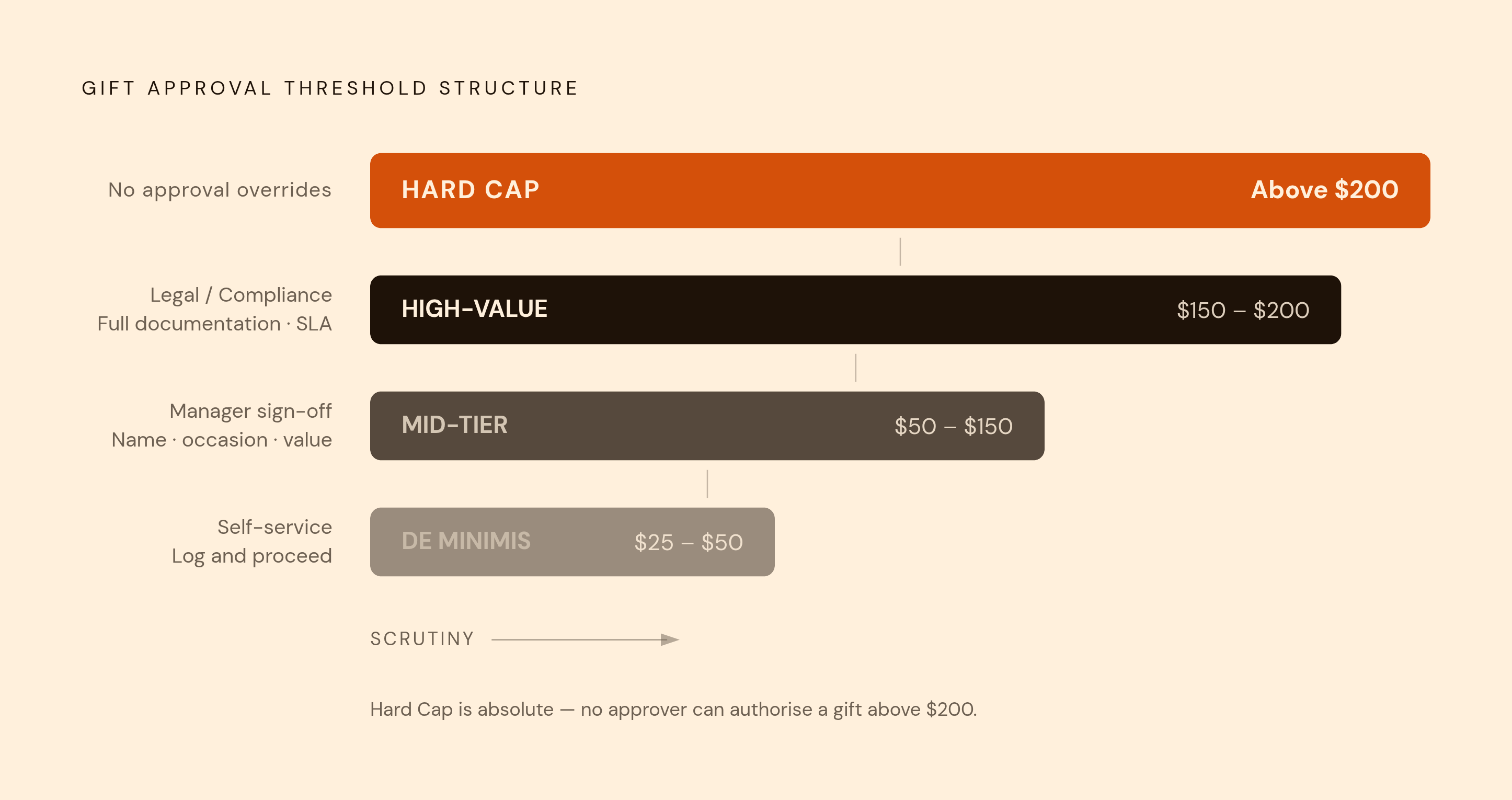
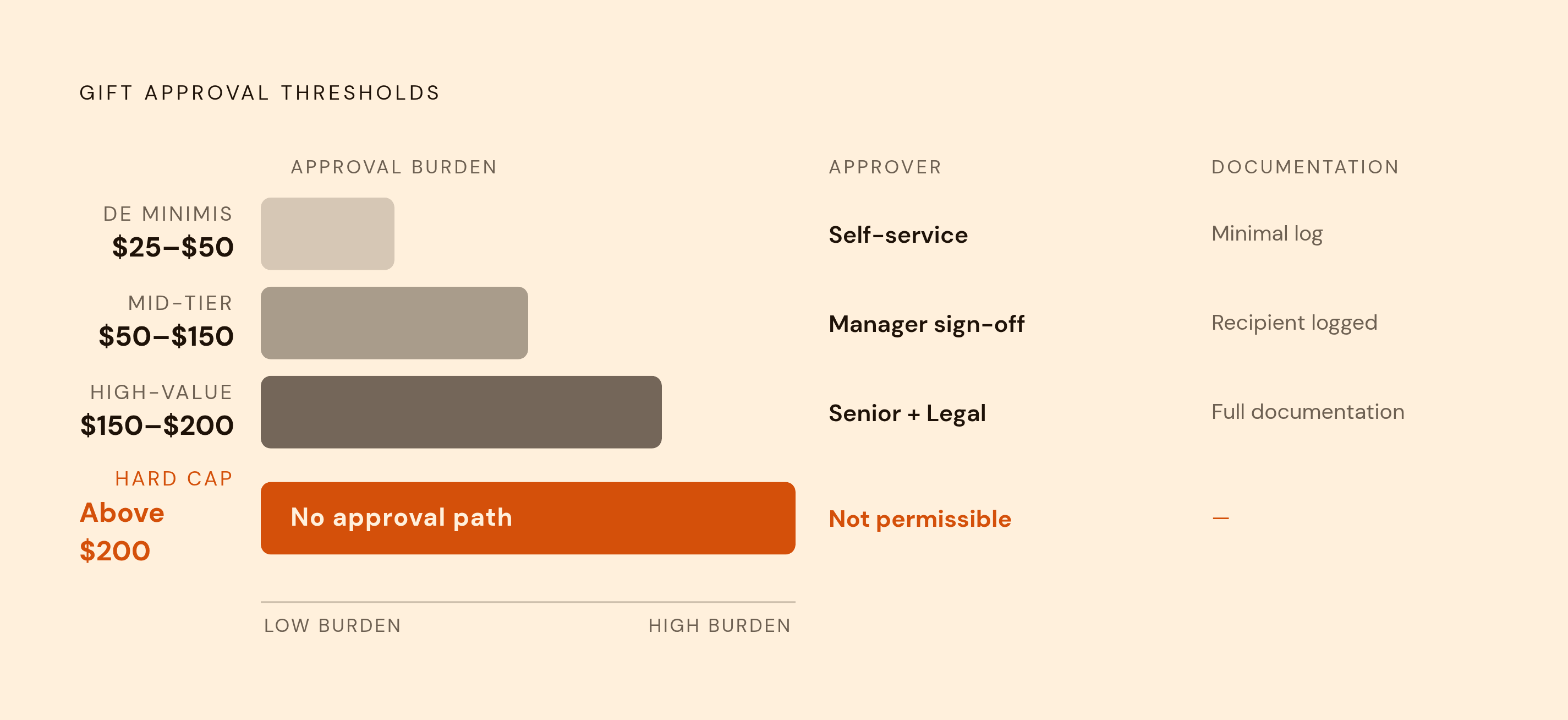
Well-structured policies use a tiered threshold architecture. A de minimis tier, typically $25 to $50, requires no approval and minimal documentation; the goal is to keep low-friction sends frictionless. A mid-tier, commonly $50 to $150, requires manager sign-off and basic recipient logging. A high-value tier above $150 or $200 requires senior or Legal approval plus full documentation. And then a hard cap, above which no gift is permissible regardless of who approves it, a provision that becomes non-negotiable for any company doing business with government entities.
Thresholds also need to account for the world your clients operate in. Many enterprise procurement policies cap inbound gifts at $50 or $100. If your major customers operate under those limits, your outbound threshold needs to be calibrated accordingly, because a gift that puts your contact in violation of their own company's policy is not a gift. It is a problem you created for someone you were trying to impress.
Aggregate annual limits per recipient deserve as much attention as per-gift limits. A series of $40 gifts to the same contact accumulates into a compliance problem if no annual ceiling exists. That pattern shows up in enforcement cases with regularity; it is not a theoretical risk.
Gift cards and cash equivalents warrant separate treatment entirely. The IRS generally treats them as taxable income to the recipient regardless of amount, and any policy that fails to address that explicitly is leaving a gap with real tax reporting implications on both sides.
The Legal Landscape Every Policy Must Account For
The Foreign Corrupt Practices Act is the primary U.S. law governing gifts with international exposure. It prohibits offering anything of value to foreign government officials to obtain or retain business. "Anything of value" is interpreted broadly. So is "government official," and this is where companies consistently get caught: in many countries, employees of state-owned enterprises, including hospitals, utilities, and telecoms, qualify as government officials under FCPA analysis. Enforcement is extraterritorial, meaning a U.S. company can be liable for gifts given by a foreign subsidiary or a third-party distributor acting on its behalf. That last point surprises people who assumed liability stopped at the subsidiary's door.
The UK Bribery Act 2010 goes further. Unlike the FCPA, it covers private-sector bribery, not just gifts to government officials. Canada, France, and Germany each have their own analogous statutes. A policy written purely around U.S. law is a domestic policy with an international exposure problem, not a global one.
Industry-specific regimes require explicit, granular treatment rather than a generic "consult Legal" placeholder, which is advice so vague it functions as no advice at all. In healthcare, the Physician Payments Sunshine Act requires manufacturers of drugs, devices, biologicals, and medical supplies to publicly report transfers of value to physicians and teaching hospitals. Gifts that would appear unremarkable in another context become public record in that one. Anti-kickback statutes go further still: the intent behind a gift becomes legally relevant, meaning a gift tied even implicitly to a referral arrangement can constitute a violation regardless of dollar value.
In financial services, FINRA rules restrict non-cash compensation given by broker-dealers to employees of other firms. SEC rules separately address gifts that influence investment decisions. In government contracting, zero-gift policies are the norm.
The practical implication is this: the legal section should map each regulatory regime to the specific business units and geographies it governs, and tell employees in those contexts precisely what they need to do differently. A policy that treats a healthcare sales representative and a software account executive as interchangeable for compliance purposes is not fit for purpose.
Review cadence matters here in particular. Anti-bribery enforcement guidance evolves. Industry-specific rules change. A policy left unreviewed for more than a year is likely non-compliant by the time someone consults it, and "we hadn't updated it yet" is not a defense that lands well.
Approval Workflows and Documentation Requirements
A policy without a workflow is aspirational, and aspiration does not hold up in an audit.
Employees need to know who approves what, what information they need to provide, how quickly they can expect a decision, and what to do when a time-sensitive send is pending and approval hasn't come through. If those answers aren't in the document, people will make their own decisions. The documentation will be whatever they felt like creating in the moment.
The approval ladder should mirror the threshold structure. The de minimis tier is self-service: log the send, proceed. The mid-tier requires direct manager approval with a brief rationale covering the recipient, occasion, business purpose, and estimated value. High-value or sensitive sends require Legal or Compliance sign-off, and the turnaround SLA should be defined explicitly. An undefined turnaround time is effectively an indefinite hold, and indefinite holds kill programs faster than any compliance rule. Prohibited categories have no approval path; the policy should say that plainly, not bury it in a subordinate clause.
At every tier, documentation should capture the recipient's name, title, and company; the nature of the business relationship; the occasion or trigger; the estimated fair market value; whether the recipient's employer has a known gift policy and whether it was checked; and the name and date of whoever approved it. That last element matters because accountability without attribution is just a log.
For inbound gifts, the documentation burden should be lighter but present. A disclosure threshold, typically set just below the company's outbound per-gift limit, triggers the obligation to report. Employees should know exactly where to report a received gift, who reviews those disclosures, and what happens to gifts that exceed the threshold. Common resolutions include returning the gift, donating it, or raffling it internally. Pick one and write it in. Ambiguity about what happens to the gift is a quiet incentive to skip disclosure entirely.
Gifting platforms can carry most of this administrative load when integrated properly into the approval process. When every send flows through a centralized platform, the audit trail is built in real time rather than reconstructed under pressure. Retention matters, too: documentation should be kept for three to five years in a retrievable format. A spreadsheet on one employee's laptop is not an audit-ready record, regardless of how thorough it is.
Handling High-Risk Recipient Categories and Edge Cases
Government officials, domestic or foreign, require a higher standard of scrutiny independent of a gift's dollar value. The defensible default is a blanket prohibition with a narrow exception process requiring Legal sign-off and documented business justification. The policy should also distinguish clearly between a branded item left at a trade-show booth and a personalized gift sent directly to a procurement officer's office. Those two scenarios occupy very different legal and relational territory.
Procurement and purchasing decision-makers at private companies don't carry the same anti-bribery exposure as government officials, but they often operate under their own employer's gift policies. Sending a gift that violates their internal rules can embarrass them and damage the very relationship the gift was intended to cultivate. Policy should require senders to check whether a recipient's employer has a publicly available gift policy before sending anything above the de minimis threshold. That check takes five minutes.
Timing creates risk independent of value. A gift arriving during an active contract negotiation or RFP process can be construed as an attempt to influence even when the dollar amount is nominal. Many companies address this with a blackout period: no gifts to any contact at a company during an active procurement or competitive bid process. That is prudent insulation, not overcaution, and the distinction is worth making clearly in the policy so employees don't interpret it as distrust.
Cash equivalents, gift cards, and prepaid cards are taxable income to the recipient under IRS rules regardless of amount, and that creates employer-side reporting implications that are easy to miss until they aren't. The policy should either prohibit cash equivalents for external recipients outright or establish a clear, functional process for handling the tax reporting. Leaving it ambiguous is a deferred problem, not a neutral choice.
International sends require their own layer of governance. A business gesture that is entirely ordinary in one market is illegal or culturally inappropriate in another. The policy should require Legal review for gifts above a defined threshold sent to any foreign government-affiliated contact, and it should provide practical cultural guidance rather than leaving employees to navigate that terrain on instinct.
Employees in procurement, finance, or any role that influences vendor selection are higher-risk inbound recipients. A stricter disclosure threshold for those roles reflects the actual risk profile. It is a defensible design choice that will make sense to anyone who thinks about it for thirty seconds.
Vendor and Supplier Standards the Policy Should Establish
Outsourcing the execution of a gifting program does not outsource the liability. A company is responsible for gifts sent in its name regardless of who fulfills them.
Approved gifting vendors should be able to demonstrate transparent, auditable pricing, so that every gift's fair market value is determinable for documentation and tax purposes. Opaque bundled pricing makes that determination impossible and creates documentation gaps that are difficult to close retroactively. I've sat in rooms where this became a significant audit issue over what started as a relatively modest gifting program. Nobody thought the pricing structure would matter until it was the only thing that mattered.
Vendors should also meet the company's standards for data handling. Any vendor collecting recipient names and addresses is in scope for GDPR if European recipients are involved, and for CCPA if California contacts are in the mix. Privacy compliance cannot be a post-hoc consideration in vendor selection.
Product sourcing standards belong in the policy as well. Whether the company requires sustainable sourcing, fair labor practices, or sourcing from DEI-aligned suppliers, those requirements should be explicit so that procurement decisions are consistent rather than driven by whoever happened to have a vendor relationship. A gifting platform that logs send details in a format compatible with the company's audit trail requirements is a compliance asset; one that falls short on this creates an evidentiary gap.
Vendor vetting should be recurring, not one-time. Product catalogs, pricing structures, and compliance capabilities change. An annual review is reasonable and signals to vendors that standards are actually enforced.
Preferred vendor lists are worth the upfront investment. When employees choose from a pre-approved catalog, the policy's value limits and product standards are enforced at the point of selection rather than after the fact. That architectural choice eliminates an entire category of compliance failures before they can occur.
Branded merchandise and swag sent at scale, event kits, onboarding packages, seasonal sends, generate significant aggregate spend and warrant their own vendor standards rather than being folded into general gifting provisions. A program that looks different every quarter because different vendors were used for each campaign is not a program. It is a series of one-off decisions that happen to share a budget line.