GiftLogic Alternatives for B2B Revenue Teams
B2B gifting platforms differ vastly in scale, pricing, and who they're built for.

Someone typing "GiftLogic alternatives" into a search bar and landing on a list of retail point-of-sale tools has a mismatch problem, not a shopping problem. GiftLogic is a non-cloud POS and retail management platform built for brick-and-mortar stores, starting at $69/month per Capterra's listing, and it handles payment processing, inventory, and customer records at a register. A B2B revenue, marketing, or HR team searching that phrase isn't trying to ring up sales. They're trying to send physical or digital gifts to prospects, customers, and employees, at scale, tied to a CRM. That's a different category entirely: corporate gifting and sending platforms, and it's worth mapping out what that category actually contains before anyone signs a contract in it.
What the B2B corporate gifting market actually looks like in 2026
Corporate gifting spend overall, covering physical goods, food, experiences, all of it, was projected to grow from $258 billion in 2022 to $312 billion by 2025, per Coresight Research. That covers the whole market. It is not the software market, and mixing the two up leads buyers to badly wrong assumptions about how big or stable any given vendor actually is.
The platform layer, the actual sending and automation software, is much smaller: somewhere around $300 to $500 million a year in revenue. Small in dollar terms, but growing fast, and that growth is what reshaped the vendor map. Alyce got acquired in February 2024. Postal.io followed in 2025, also acquired by Sendoso. Merch.co joined the same parent company around the same period. Three formerly separate platforms, one owner, inside about two years.
That kind of consolidation changes what a buyer is actually choosing between in 2026. It's no longer a wide field of interchangeable tools. It's a small number of platforms with genuinely different architectures, different buyer profiles, and different bets on where the category goes next. Shopping this space by feature checklist alone misses the part that actually matters: which of these companies is building for a five-person startup team, and which is building for a 500-rep enterprise floor. Confuse the two and the checklist won't save the purchase.
How B2B sending platforms differ from retail gifting tools, and from each other
Retail gifting tools ring up a transaction and hand over a receipt. B2B sending platforms do something structurally different, and the gap shows up in a handful of places worth naming directly.
Sends trigger off CRM and marketing automation events (deal stage changes, behavioral signals, meeting-booked milestones) instead of someone manually entering an order. Fulfillment runs through infrastructure built for shipping to 180-plus countries with regional warehousing, not a single store's back room. Attribution ties a send back to pipeline movement, open rates, redemption, and closed-won outcomes, so a marketer can answer "did this gift do anything" with a number instead of a shrug. Address intelligence solves a problem retail never has to think about: B2B senders often don't have a verified physical address for a prospect, only an email and a profile on a professional networking site. And recipient choice lets the person on the other end pick from a curated set of options instead of getting stuck with something they didn't want.
Once inside that category, though, platforms split along lines worth understanding before evaluating any single vendor.
Enterprise depth versus ease of entry. Some platforms ask for a real IT lift and an annual contract before a single gift ships. Others let a team start sending with no platform fee at all. Neither approach is wrong, but they solve different-sized problems, and picking the enterprise-grade tool for a five-person team just means paying for infrastructure nobody touches.
Employee recognition versus revenue generation. Some tools are built primarily for HR: onboarding kits, work anniversaries, milestone recognition. Others are built for GTM teams running account-based marketing and deal acceleration. A platform tuned for one rarely does the other well, and that's worth knowing before anyone signs anything, not three months in when the recognition workflow turns out to have no pipeline reporting attached.
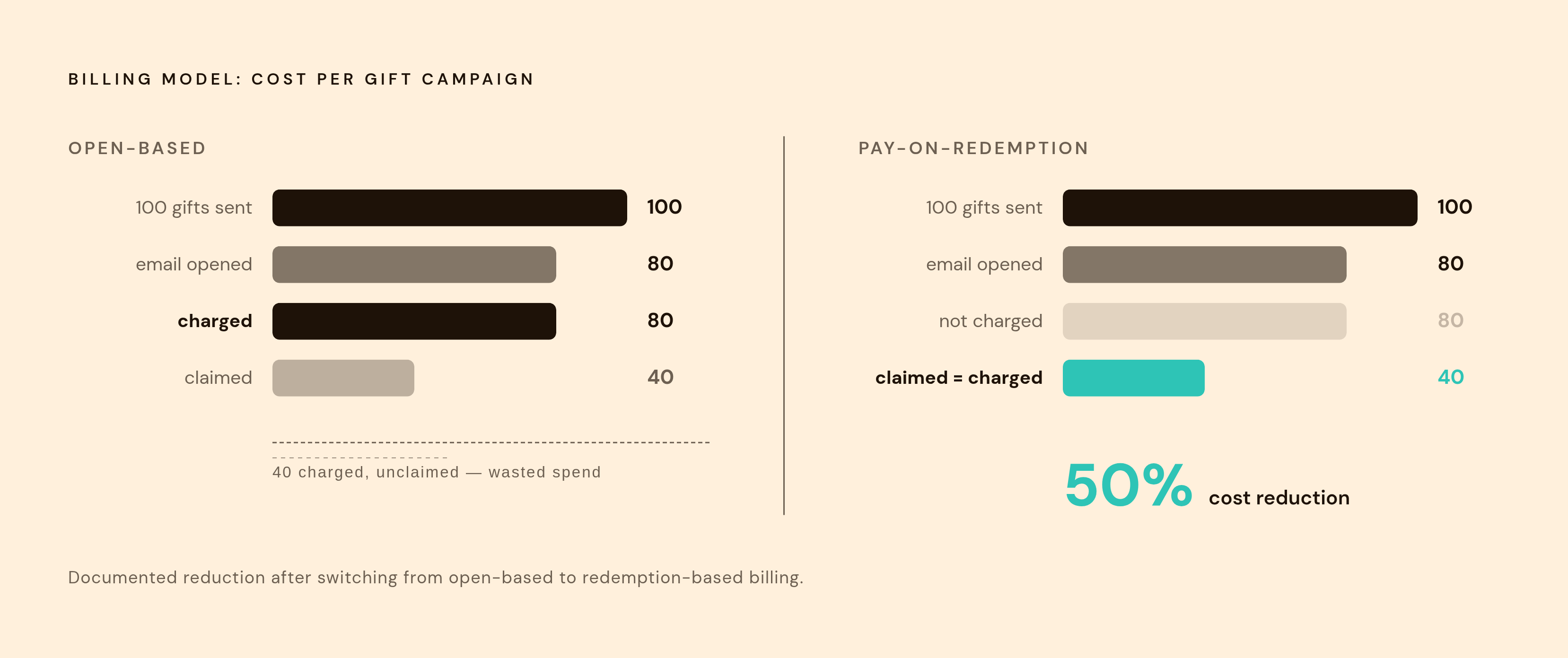
The eGift billing model. Some platforms charge the moment a gift email gets opened. Others charge only once the recipient actively claims the gift. At low volume this barely registers. At a few thousand sends a quarter, it changes the invoice by a real amount that gets skipped in a demo and discovered on an invoice.
Marketers already juggle many tools daily, so integration is a core requirement. It's a decision made every single morning at 9am when a rep opens the CRM. A platform that doesn't sync cleanly with the CRM a rep already lives in doesn't get ignored gently. It gets abandoned within a quarter.
The platforms B2B revenue teams are actually evaluating in 2026
Sendoso has spent the past two years buying its way into end-to-end coverage. It owns Alyce (acquired February 2024), Postal.io (acquired 2025), and Merch.co (acquired 2026), which brings merchandise production in-house instead of through a third party. The platform has processed more than 15 million sends across 800-plus global customers, including Gong, Samsara, Thomson Reuters, Zendesk, VMware, and Nutanix. Fulfillment runs through owned centers in the US, UK, the EU, and Australia, shipping to more than 180 countries.
The newer piece is a set of AI tools called SmartSuite, launched September 2025. SmartSend recommends gifts using first-party data, public signals, and past engagement history. SmartMessage writes personalized note copy automatically. SmartDelivery handles address verification. SmartSignal and SmartCampaign are listed as forthcoming, not yet live, so those two belong on the roadmap column, not the working-features column, until they ship.
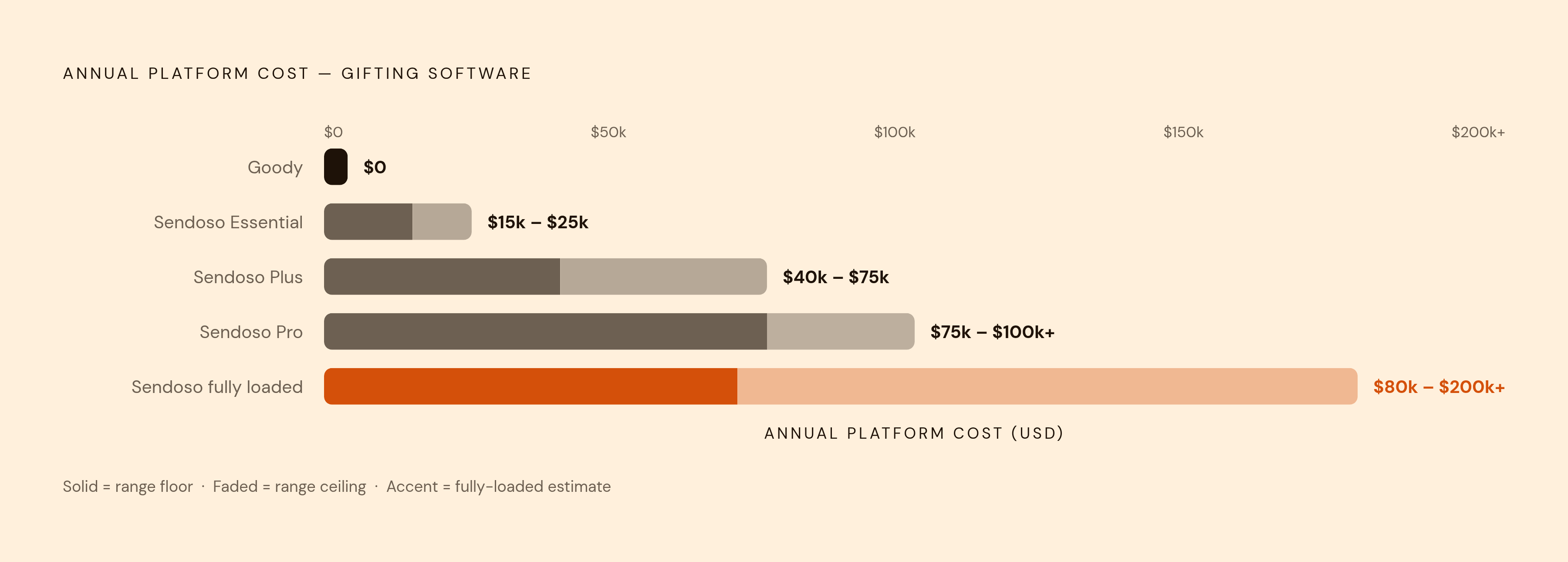
Pricing, per figures compiled by Docket.io, runs in tiers: Essential at $15,000 to $25,000 a year, Plus at $40,000 to $75,000, Pro at $75,000 to $100,000-plus. Fully loaded, the annual cost lands between $80,000 and $200,000-plus. That's a platform built for mid-market and enterprise GTM teams running account-based marketing, demand generation, event fulfillment, and retention at real scale. It is not built for a five-person sales team sending occasional thank-you notes, and pricing it out for that team is a wasted exercise.
Goody takes the opposite approach on friction. No platform fee to start, and no address required to send a gift; the recipient supplies it during redemption. That makes it the fit for smaller teams or individual senders who want to test gifting before committing to a contract.
Snappy leans toward employee recognition over revenue generation, a better match for HR and people teams marking internal milestones than for a sales team chasing pipeline.
PerkUp builds around global swag, aimed specifically at HR teams running branded merchandise programs across multiple countries.
Loop & Tie centers on recipient choice with a sustainability angle built into the catalog, which matters for teams where environmental values shape how the gifting program gets built, not bolted on after the fact.
&Open focuses on brand impression over pipeline mechanics, working with brands including Airbnb and Spotify. It fits brand and customer experience teams where how a gift looks and feels outweighs closed-loop attribution. It fits scaled ABM programs needing deep two-way CRM sync and revenue reporting much less well, and a revenue team buying it for that reason will end up frustrated by month two.
Six platforms, six different centers of gravity. None of them wins on feature count alone. The right one comes down to which problem is actually sitting on the table, HR's or sales's, domestic or international, light-touch or enterprise-grade.
Why gifting platforms stall after purchase, and what separates programs that deliver pipeline
A pattern shows up again and again in G2 reviews of gifting software. A platform gets purchased, a kickoff call happens, and adoption quietly stalls. The tool becomes what people in software circles call shelfware: paid for, rarely opened.
Why does this happen so consistently? Sequencing, or the lack of it, is the core issue. Gifting works best as one step in a coordinated chain: an email before the send to set context, the gift itself, then a follow-up after delivery lands. Skip that sequence and treat the gift as a standalone surprise, and most of the return evaporates before anyone notices it's gone.
Research consistently shows that sequenced outreach combining direct mail with follow-up substantially outperforms email-only sequences. That gap is the whole argument for sequencing right there: the gift by itself isn't the mechanism, the gift plus the follow-up is.
Event no-show rates run between 50% and 75%, per Banzai benchmarks, which turns pre-event gifting from a nice touch into one of the highest-leverage moments on the calendar. A gift landing a few days before a webinar or a conference booth meeting is a no-show countermeasure with real math behind it. Skipping it on a high-value event means leaving a known lever unpulled, and that's a strange thing to do with a lever this cheap to pull.
A tool with weak sequencing support, shallow CRM integration, or no attribution visibility makes that sequence nearly impossible to build, and even harder to measure afterward. The gap rarely shows up during the demo or the onboarding call. It shows up three months later, when someone asks what the gifting budget actually produced and nobody has a clean answer.
How to measure whether a sending program is actually working
Most platforms, at a basic level, will tell a buyer sends, opens, redemptions, and engagement rates. That's table stakes. Nearly every vendor in the category covers it, and none of it should be mistaken for proof the program works. A stack of open rates is not an ROI case. It's a pulse check.
What most platforms miss is multi-touch attribution: connecting a gifting touch to the pipeline and revenue that followed, alongside every other channel that touched the same deal. A team serious about proving ROI needs that connection, not a redemption count sitting alone on a dashboard with nothing tying it back to a closed deal.
The billing model itself deserves to be treated as an ROI variable, not a line item, before a single campaign goes live. Open-based billing charges the moment a gift email is opened, whether or not the recipient ever claims anything, which at scale means paying for gifts nobody redeemed. Pay-on-redemption billing ties every dollar spent to an action the recipient actually took. One documented comparison showed up to a 50% reduction in gift card costs on a single campaign after switching from open-based to redemption-based billing. That figure is far too large to dismiss as a rounding error. On a six-figure annual gifting budget, that's the difference between the program funding itself and the program needing to be defended every quarter in a budget review nobody wants to sit through.
There's a slower-moving benefit worth accounting for too. Roughly 66% of people can recall a brand name a full year after receiving a promotional gift. Pipeline attribution won't capture that kind of slow-burn brand impression, but it's real, and a well-designed program accounts for both the immediate pipeline signal and the longer memory effect sitting underneath it.
Before signing with any vendor, check for opportunity-level reporting, closed-won tagging, and campaign spend measured against influenced revenue. A dashboard showing how many boxes got opened is not any of those three things.
The evaluation criteria that should actually drive the platform decision
Four variables do most of the work in this decision, more than any single feature comparison, and the one buyers get wrong most often is the first.
Who owns the use case. HR and people teams need tools built for recognition, onboarding, milestones. GTM and revenue teams need tools built for pipeline, ABM, retention. These are not the same buyer, and a platform optimized for one rarely serves the other well. Buying the wrong one because it had a slicker demo is the single most common mistake in this category, and it's an easy one to avoid just by asking which team actually owns the budget line.
Geography. A domestic-only sender has very different fulfillment needs than a team running real volume through EMEA or APAC. Regional warehousing and catalog depth vary a lot across platforms, and the gap only becomes visible once international shipping actually starts, usually a quarter or two after the contract's signed, which is exactly the wrong time to find out a vendor has no warehouse east of Dublin.
Integration depth. A team running sequenced ABM across Salesforce, Outreach, Marketo, and Gong needs a real integration layer, not a token API connection. A vendor offering 90-plus integrations is solving a fundamentally different problem than one offering 19, even if both check the same box on a comparison chart.
Budget and billing structure. Entry points range from low or no upfront platform costs up to $80,000 to $200,000-plus fully loaded annually at the enterprise end. The billing model, whether charges trigger on delivery or only upon recipient redemption, compounds that total cost meaningfully once volume climbs into the thousands of sends per quarter.
AI capability belongs on this list now as a real, present-tense criterion, not a future promise to check back on in six months. Platforms building in gift recommendations, automated address verification, and intent-based send triggers are cutting out manual judgment calls that otherwise slow adoption to a crawl. That's a working difference in the product today, and it deserves the same scrutiny during evaluation as pricing or integration count. A vendor still promising a feature on a roadmap should get a lot less benefit of the doubt than one already shipping it to customers.