Corporate Gifting for New Client Onboarding
Strategic gift timing and relevance drive client retention more than budget alone.

Roughly 60% of recipients say they're more likely to do business again with a company after getting a thoughtful gift. In B2B specifically, 45% of buyers say a gift influenced a renewal or expansion decision, nearly half of pipeline shaped by something most account teams still bolt onto the welcome email as an afterthought.
Here's where most people get it backwards: they chase the retention number instead of asking what actually produces it. Feeling valued and renewing a contract are two different things. One's a mood, the other's a decision, and onboarding programs exist to produce decisions. Run this test on any gifting stat before you build a program around it: does it describe a feeling, or a behavior change? If it's the former, it belongs in a slide deck, not a budget line.
This is the part worth saying plainly: spend and frequency matter less than timing and fit. A branded tumbler blasted to a distribution list and a gift picked for one person at one specific moment in their onboarding often get budgeted identically, as if they're interchangeable. Treating them as equivalent is where most of the wasted spend in this category comes from. If outcomes hinge on quality and timing, the job is building that into a repeatable process, not leaving it to whichever account manager happens to remember.
The difference between a welcome gift and a gifting strategy
Most companies do one thing and call it a program: a branded box ships when the contract's signed, and that's the whole motion. Call that what it is: a gesture, and it's exactly why so many gifting budgets get cut the first time someone asks what they produced.
A real strategy maps sends to onboarding milestones: contract signed, kickoff completed, first value delivered, then the 30, 60, and 90 day marks. Each moment needs something different from the last one. A send at kickoff should feel like momentum building, while a send at 90 days should feel like proof the relationship is working, a signal that the vendor is still paying attention somewhere down the account list.
Worth separating out clearly: the closing gift, the one that lands within 48 hours of signature to say thanks for choosing us, does a different job than an onboarding gift. Collapsing the two wastes the emotional window onboarding actually opens. The closing gift closes a sales moment, while onboarding gifts have to build something that survives the next 89 days, which is a longer and harder assignment entirely.
Relationships in B2B are rarely singular, either. Gartner puts the typical B2B buying group at 9 to 11 stakeholders, climbing to 25 on enterprise technology deals. The champion who signed the contract is one person among many who need attention during onboarding, so a sequenced, multi-stakeholder plan has to account for that. A single congratulatory box sent to one inbox does not, no matter how nice the box is.
Here's a rough test for any program: if there's no calendar attached, one tied to onboarding events rather than the wall calendar, what you're looking at is a gesture dressed up as a strategy.
How to choose the right gift for a new client
Relevance beats generosity, full stop, and this is where gifting budget quietly evaporates. A $50 gift picked for one specific client outperforms a $150 item pulled from a generic catalog, because the recipient can tell the difference between something chosen and something ordered in bulk and shipped out on autopilot. Spend more, aim worse, and the outcome is still worse, the trade most catalog-based programs make without ever noticing they're making it.
A Promotional Products Association International survey found 83% of recipients said a thoughtfully chosen business gift made them feel more positive about the sender's company. "Thoughtfully" is the word carrying that entire sentence, and the other 17% probably got the tumbler.
So what does thoughtful mean in practice? A few questions worth running for every send, not just the first one:
- What does this client actually value, based on discovery calls or what's known about their role and industry?
- Will it get used, or sit in a drawer? Usable items get remembered; decorative ones fade fast.
- Does it match the client's own brand values? Sustainability, local sourcing, or a premium feel can all signal attention.
- Is it appropriate for the recipient's seniority? A gift for a VP and a gift for a project coordinator shouldn't look identical.
Most companies land in the $75 to $125 range per client gift, enough to signal real investment without tripping a compliance review or reading as excessive.
Branded merchandise still has a place, but only when the quality holds up. Cheap swag with a logo slapped on it reads as self-promotion, not appreciation, and clients notice it the same way they'd notice a gift bought in bulk. For larger accounts, vary the gift by role instead of assuming the economic buyer and the technical lead want the same object. Whatever ships, attach a handwritten note. The note signals effort, the gift signals taste, and together they land harder than either one manages alone.
Timing the sends across the onboarding arc
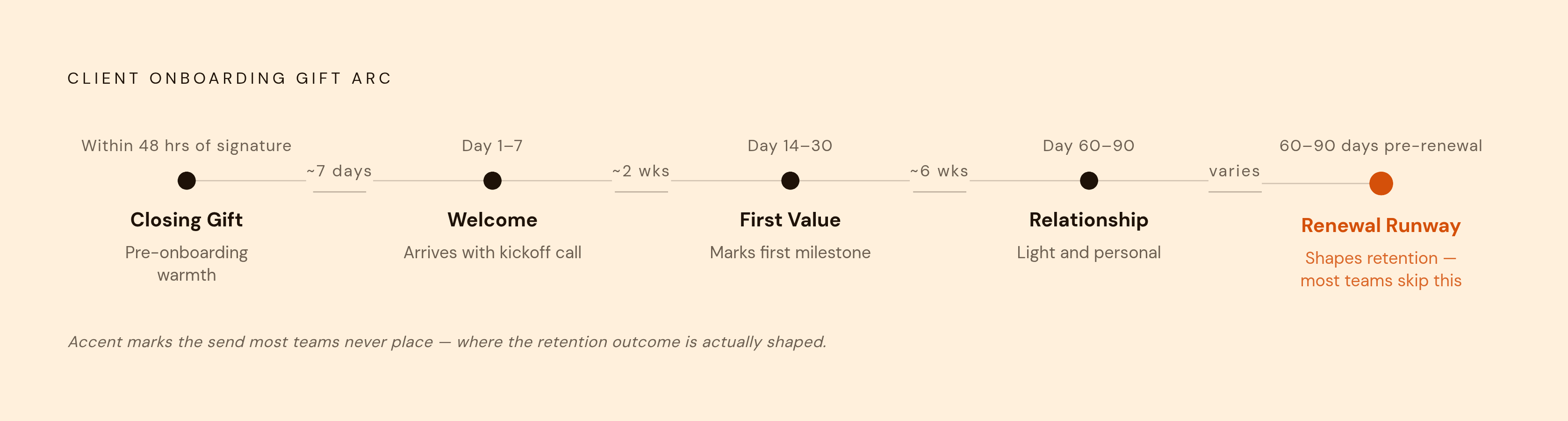
Momentum from the sales cycle shouldn't die the moment the contract gets signed. In most programs, though, that's exactly where it dies: right at the handoff between sales and CS, where ownership goes fuzzy and nobody sends anything for weeks.
The welcome gift needs to land in the first week of the client relationship, not the first week of product rollout. If deployment doesn't start for a month, the welcome gift still goes out now, marking the start of the relationship rather than the start of the project. Sequencing after that looks roughly like this:
- Day 1 to 7, welcome: arrives before or alongside the kickoff call, so the relationship feels underway before anyone's actually met.
- Day 14 to 30, first value moment: acknowledges the client's first real milestone.
- Day 60 to 90, relationship deepening: something lighter and more personal, proof the attention didn't stop once the ink dried.
- Renewal runway: a send 60 to 90 days before renewal, opening that conversation from goodwill instead of urgency.
A complex enterprise rollout hits different emotional beats than a SaaS setup that's live in two weeks. Treat that calendar as a starting point, not a script to follow blindly.
One underrated benefit worth naming directly: "did the package arrive okay?" is a genuinely warm way to open a check-in call. It carries the tone of one person checking on another, a tone most onboarding calls lose under the weight of status updates.
Here's a caution that cuts against instinct: avoid stacking sends around holidays unless the relationship specifically calls for it. Holiday gifting tends to register as noise, since everyone's doing it at the same time and little of it stands out. Milestone gifting carries signal, because it's tied to something that actually happened between the client and the vendor.
Personalizing at scale without losing the human touch
Here's the tension built into everything above. Personalization is what makes gifting work, but no revenue team managing hundreds of accounts can hand-pick a gift for every contact at every milestone. Something has to give, so automation absorbs the volume while a person keeps the judgment calls.
That's the actual problem AI-powered gifting platforms solve: automating selection, messaging, and logistics while keeping the feeling that someone thought about this specific person. Done well, automation handles a few distinct jobs. Gift recommendations pull from CRM data, stated preferences, role, and prior interactions, while address confirmation and shipping routing remove the logistics friction that otherwise eats an afternoon out of someone's week. Trigger-based sends fire automatically when a CRM milestone hits, so nobody has to remember to click send at hour 47 of a busy Tuesday.
That orchestration matters more once multi-stakeholder accounts enter the picture. Coordinating sends to 9 or 11 contacts on one account by hand is a scheduling nightmare, and a system built for it handles that so the account team isn't babysitting a spreadsheet.
Be honest about the failure mode here, too: automation doesn't guarantee good gifting. It's entirely possible to use these tools to send more of the wrong thing, faster, to more people, which can do more damage than sending nothing at all. The tool is the delivery mechanism for a strategy someone still has to design. The goal stays fixed either way: a gift that feels handpicked even though the process behind it runs on rails.
Integrating gifting with CRM so onboarding sends tie to pipeline data
A gifting program that lives outside the CRM is invisible to anyone running revenue numbers. Nobody can measure it or defend it in a budget review, because there's no record connecting a send to what happened next. This is where most programs actually die: in the absence of a paper trail.
CRM integration fixes that directly. A send fires the moment a client record moves into the "Onboarding" stage in Salesforce or HubSpot, and gets logged with a timestamp, gift type, and recipient. Downstream, someone can actually check the record: did accounts that got an onboarding send renew at a higher rate than accounts that didn't? Did they expand into new products sooner?
Only 40% of North American companies formally measure ROI on their recognition programs. That's a low bar, and it means the other 60% are leaving a structural advantage on the table for no good reason. Teams that can show a clean line from gifting to retention have a far easier time defending budget than teams asking for money on a feeling.
Metrics worth tracking on a regular cadence: retention rate for gifted accounts versus non-gifted accounts, time-to-expansion, and meeting acceptance rates heading into renewal conversations.
Compliance, budget, and approval workflows that prevent gifting programs from stalling
Plenty of gifting programs die not because the strategy was wrong, but because nobody cleared it with legal or procurement before trying to scale it. Know the client's own gifting policies before anything ships. Regulated industries like financial services, healthcare, and government-adjacent work often cap per-recipient gift value tightly, or ban physical gifts outright. Sending something that violates a client's internal policy undoes the goodwill the gift was supposed to build in the first place.
On budget: most companies set annual gifting budgets somewhere between $5,000 and $200,000, which is too wide a range to mean much on its own. The real work is building a per-account allocation model that scales with account tier instead of treating every client the same. The $75 to $125 per-client figure is a solid default, but it should flex up for enterprise accounts and down for smaller ones.
Worth flagging tax exposure early, not discovering it late. Gifts above certain per-recipient thresholds can trigger reporting requirements under U.S. tax rules, which is a conversation for legal review well before enterprise accounts start receiving anything with real value attached.
Approval workflows solve two problems at once. Multi-level sign-off on high-value sends reduces compliance risk, while letting recipients choose from a curated set of options raises satisfaction at the same time, since a curated choice still feels thoughtful while respecting dietary restrictions or personal taste. That's a different shape of personalization, one built around choice instead of a single fixed selection made on someone else's behalf.
What a mature onboarding gifting program looks like in practice
Strip away the pitch decks, and a mature program has a specific shape, one that's fairly easy to check for from the outside.
There's a documented send calendar tied to onboarding milestones, not to dates on a wall calendar. Gift selection criteria are tiered by account size and stakeholder role, so a small SMB account and a large enterprise account aren't treated the same way by default. CRM-triggered automation initiates sends, with a human reviewing anything above a set value threshold. Coverage extends across the buying committee: the economic buyer, the day-to-day champion, and the technical lead each get something suited to their role, spreading attention instead of concentrating it on one person while everyone else gets ignored.
Measurement happens quarterly, gifted cohorts tracked against non-gifted cohorts for retention and expansion signals. There's also a feedback loop: the CS team logs how recipients actually reacted, and that feeds back into what gets chosen next time. This is what separates a program from a habit, the fact that the CS team's read on how a gift landed actually changes the next one.
The real test is simple to apply. Can the CS or marketing team explain, without hesitating, exactly what gets sent, when, to whom, why, and what result they expect from it? Guessing, or checking with three different people first, means the program is still a gesture wearing the costume of a strategy.