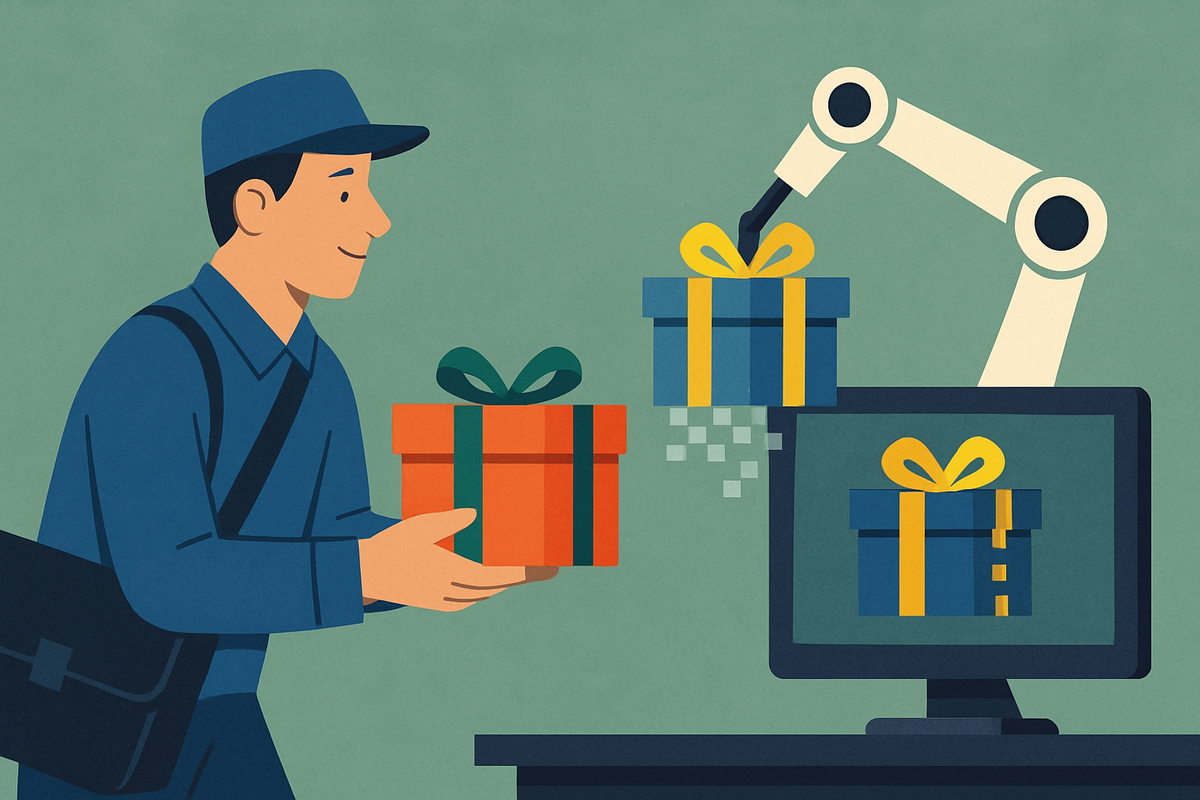
AI Gift Recommendation Engines in B2B Gifting Platforms
AI models match gifts to individual buyers by learning what actually gets claimed.

Corporate gifting turned into a real revenue motion somewhere in the last few years, and AI recommendation engines are the machinery running underneath it: pulling CRM data, behavior signals, and recipient context together so personal gifting can happen at a scale no human sender could pull off alone. The part that still surprises people is how much of it comes down to plumbing, not magic.
The global corporate gifting market is set to hit $919.9 billion in 2025, up from $839.6 billion in 2024. That's a 9.6% jump in one year. About 79% of businesses now run gifting through HR, marketing, or sales as a standard function, not something you dust off in December.
When everyone's gifting, the gift itself stops being the differentiator. Relevance takes its place. A generic box sent to a thousand accounts is just noise, and no sales rep can hold hundreds of recipient profiles in their head and pick something that actually fits each one. This isn't a creativity problem. It's a data problem, and it's the gap AI recommendation engines were built to close.
What an AI gift recommendation engine actually does, and what it is not
People picture a recommendation engine as a fancy search filter, basically a catalog with better sorting. That's not quite it. A more accurate picture: a system that takes a pile of scattered signals and spits out a ranked list based on what it's learned actually matters.
Two mechanisms run inside most of these platforms, and vendors tend to blur the line between them on purpose.
Rule-based automation is the first. A trigger fires, a renewal date hits or a deal moves stage, and a pre-set gift goes out. Nothing gets learned here. A rule just executes, the same way every time.
Machine learning recommendation is the second. The model weighs signals against each other and generates a relevance-ranked shortlist, adjusting as it watches what gets claimed and what doesn't.
Most platforms run both layers at once. Automation decides when a gift goes out; the model decides what it should be. What comes out the other end is a ranked set of options, not a single verdict. And "personalization at scale" means something specific here: the model computes a fresh answer for each recipient instead of sorting people into buckets and calling it done. Send to a thousand people in one campaign, and each one is still its own calculation, run separately.
The inputs that power gift recommendations, and the signals the model actually reads
A recommendation is only as good as what feeds it. Three categories of data carry most of the weight, and they're not equally reliable.
CRM and firmographic data comes first: job title, seniority, industry, company size, deal stage, opportunity value, account tier, plus whatever gifting history already exists (what was sent before, when, and whether it got claimed).
Behavioral and engagement signals sit on top. Email opens, clicks, meeting attendance, event participation. Increasingly, conversation intelligence pulled straight from sales calls, the kind of integration tools like Gong make possible, surfacing topics a prospect raised or interests they mentioned out loud without ever filling out a form. Some platforms also track what happens once a recipient lands on a preference page.
Then there's data recipients hand over directly: dietary needs, hobbies, causes they care about. This is the best signal available, since it comes straight from the source instead of being inferred. It only shows up when the recipient actually does something, though, so most programs can't lean on it across the board.
Signal quality beats volume, every time. Feed a model stale CRM records and it'll still spit out a confident-looking recommendation. It just won't be a good one, and confidence isn't the same thing as accuracy.
One structural step forward worth flagging: a protocol called MCP (Model Context Protocol), launched by Sendoso in mid-2026 alongside Demandbase, UserGems, Gong, Outreach, and Warmly. It lets AI agents read live signals across the entire revenue stack and trigger physical sends without anyone queuing a task manually. Signal to send to follow-up, running on its own. If you're evaluating a platform, this is the practical test: the recommendation engine is only as sharp as what's actually wired into it. A platform disconnected from your CRM and your call data is working off a fraction of what's knowable about a recipient.
How the model learns over time: feedback loops and what gets refined
The signal that matters most for learning is redemption. Did the recipient actually claim or use the gift, not just receive it and let it sit in a closet?
That data loops back and reshapes future picks. Say a certain gift category keeps getting claimed by VP-level contacts at SaaS companies. The model starts weighting that option higher for similar profiles going forward. A gift that sits unclaimed sends the opposite signal, and gets quietly down-weighted for that persona.
Redemption isn't the whole story, though. Did the recipient respond to a follow-up? Book a meeting? Move the deal forward? Platforms that tie gifting outcomes back into CRM opportunity records can trace that chain end to end. Platforms that don't are flying blind on everything downstream of the send itself, which is most of what actually matters.
Catalog size plays into this too. Giftpack runs a catalog of more than 3 million gifts across over 220 countries, and a wider option set gives the model more room to land on something that fits, instead of defaulting to whatever's popular or safe.
New programs run into the cold-start problem: no redemption history yet, so nothing for the model to learn from. Platforms work around this by leaning on aggregate, category-level patterns, or declared preferences and firmographic proxies, until enough account-level data piles up.
A program that's run a year on a learning platform ends up structurally sharper than one that's run the same year on a static catalog. That's a real switching cost. It's reason enough to dig into how a platform's model actually learns before you sign anything, not after.
How recommendation engines handle the buying committee problem
LinkedIn's 2025 B2Believe research puts the average B2B buying group at around 22 stakeholders. That's well past the smaller numbers that shaped older account-based marketing playbooks.
Run the math for a second. Personalizing individually for 22 people across a 50-account ABM program means the model makes over a thousand distinct per-recipient decisions in a single campaign cycle. No spreadsheet solves that, and no human team keeps up with it either.
So what actually has to change at the committee level?
Each stakeholder needs their own recipient profile, not a shared account-level guess dressed up to look personal. The model also has to avoid sending the same gift to two people at the same company. If the VP of Finance and the Head of IT both get identical boxes, that reads as automation, not care, and people notice. Spend thresholds need to flex by role too, since what's appropriate for a C-suite contact isn't what's appropriate for an individual contributor. A sender shouldn't have to manually override every send just to fix that.
There's a localization piece that gets overlooked constantly. For global buying committees, relevant means more than a good product match. It means notes written in the recipient's own language, and gifts chosen with an eye toward customs clearance and how well something survives transit. Once a buying committee spans multiple countries, that's part of what "recommendation" has to mean, whether a vendor advertises it or not.
Done well, this lets an ABM program touch an entire buying committee with sends that feel individually considered, at a scale no human team hand-curating gifts could realistically hit.
Where recommendation engines currently fall short
No platform in this space has fully solved attribution. Vendors don't lead with that on their homepage, but it's true, and anyone who's run a program for more than a quarter has run into it.
Gifting platforms are strong on the operational side: triggering sends, managing fulfillment, tracking who redeemed what. Where they struggle is connecting those actions to actual business outcomes without pulling in outside tools. Without a two-way CRM sync that updates an opportunity record the moment a gift goes out, there's no clean line from gift to pipeline. The send just sits there, an offline event disconnected from everything else happening in the deal.
Privacy rules add another wall. Behavioral signals like social activity or browsing history raise real compliance questions in some regions, and GDPR-style regulations cap how much profiling a platform can do even when the data's technically sitting right there. Nobody's fully resolved the tension between sharper recommendations and data minimization, and I'm not sure anyone will, given how the regulatory ground keeps shifting.
Catalog depth limits things too. A model can only recommend what's actually in front of it. A shallow or region-limited catalog produces the best available answer, which isn't necessarily a good one.
A few capabilities are still more promise than product. AR previews that let a recipient see a physical gift before it's chosen. Emotion-based inference pulled from message tone. Interesting directions, both of them, but neither is running at real scale in enterprise deployments yet.
There's also a trust problem underneath all of this: when a system hands over a recommendation with no explanation for why it picked that option, senders hesitate to use it, especially for anything high-value. A black box doesn't earn confidence just because it sounds certain when it talks.
How leading B2B gifting platforms implement AI recommendations differently
Platforms in this space tend to split along four lines that actually affect recommendation quality, once you get past the marketing copy.
Learning architecture is the first question: does the model update per account, per persona cluster, or only at some broad, global level? Integration depth is the second: how many parts of the revenue stack actually feed the model? Just CRM, or also call intelligence, intent data, HR systems? Catalog breadth sets a ceiling on what the model can ever recommend, no matter how good the model itself is. Attribution infrastructure closes it out: can the platform trace a send back to pipeline impact inside your CRM, in something close to real time?
Giftpack leans hardest into catalog scale, over 3 million gifts spanning more than 220 countries, and treats AI personalization as its central pitch. It reports a 98.62% recipient satisfaction rate and serves HR, marketing, and sales use cases.
Other players carve out narrower territory on purpose. Snappy focuses on recipient-choice recognition gifting. &Open works in premium brand gifting. Both run more curated, intentionally smaller catalogs, which makes the recommendation problem simpler by design, not by accident.
One platform, formed through the acquisition of Alyce in early 2024, combined Alyce's machine learning and recipient-choice model with enterprise-grade workflow automation, warehouse management, and deep CRM integration, including the MCP agent layer that launched in 2026. That combination currently sits as the most complete signal-to-send setup on the market, as far as I've seen.
Here's the thing worth keeping in mind when you compare any of these: high accuracy on a narrow catalog in one region tells you almost nothing about how a platform performs at real enterprise scale, against real, messy CRM data. Test it against your own recipient list. Not a demo account built to look clean.
What the ROI evidence actually shows about personalized vs. generic sending
Start with the headline number: a large majority of companies report higher ROI from personalized gifts compared to generic ones. That's not a small gap, and it's close to the whole story of what makes a gifting program work or fail.
Other numbers back this up from different angles. 52% of companies report higher sales after launching a corporate gifting program. Gifting has been linked to a 43% increase in customer retention. Companies sending luxury or higher-quality gifts report retention rates five times higher than those sending standard promotional items.
There's a timing piece too, and it's easy to miss. Research has consistently shown that physical touchpoints sitting alongside a digital sequence change how people respond, and that change shows up in the numbers, not just the anecdotes.
So what does all this actually add up to? The ROI case rests on relevance, not on how many gifts go out the door. AI recommendation engines make relevance possible at scale. Strip away the vendor language and the business case for the AI layer is basically the personalization premium, just repackaged.
One caveat, and it's a real one. Most of these figures come from vendor-sponsored research or platform-reported numbers, not independent studies isolating gift quality from every other variable in a campaign. I'd treat them as directional and build your own tracking rather than taking any single stat at face value. At minimum, the broad adoption figures already cited tell you organizations believe this works, even in places where the independent research hasn't caught up.
How to evaluate an AI recommendation engine before committing to a platform
The question worth asking a vendor goes deeper than "do you use AI?" Everyone says yes to that one. The real question is what feeds the model, how it learns, and whether it ever closes the loop back to your CRM.
A few things worth pressing on. What data sources actually feed the recommendation engine, and which of those are live integrations versus something someone has to manually upload every week? How does the model respond when a recipient doesn't redeem a gift, and how fast does that feedback actually change future recommendations? Does the platform keep a separate preference profile for each contact on a multi-stakeholder account, or does it flatten everyone into one account-level guess?
Ask about attribution too. What's actually native to the platform, meaning can it update deal stage or value in your CRM when a send plays a role in an outcome? And what does the catalog look like for your specific recipient base, not the marketing page's global headline number?
Watch for a few warning signs in a demo. If a vendor only shows recommendations running on pristine, complete data, ask to see it work against sparse or partial CRM records, since that's what most real accounts actually look like. If nobody can explain why a recommendation was made, that's a black box, and black boxes don't build trust with the people sending the gifts. If attribution gets waved off as "coming soon," or requires bolting on a separate analytics tool the platform doesn't own, take that seriously before you sign anything.
One more thing, and it's on you, not the vendor: look hard at your own CRM data quality first. A recommendation engine running on outdated contact records or missing job titles underperforms no matter how sophisticated the model is underneath. I've seen teams blame the platform for what was really a data hygiene problem sitting one layer down.
Taken together, the platforms wired deepest into the rest of the revenue stack, CRM, call intelligence, intent data, and fulfillment all talking to each other in one workflow, are simply better positioned to produce sharper recommendations and cleaner attribution than tools built to do just one piece of this well.