Physical vs Digital Gift Delivery Automation
Digital gifts scale effortlessly but fade fast; physical gifts resonate longer and cost more.

The core mechanism is an API trigger. Something happens in your CRM, a deal closes, a contract anniversary hits, a survey response comes in, and the system fires a send without a human touching it. No one clicks a button. The event itself is the instruction.
But the trigger is just the entry point. What makes digital gifting automation sophisticated is the rules engine underneath it: the logic that determines which recipient gets which gift, in which currency, under which conditions. Personalization at scale doesn't live in the gift itself. It lives in the decision architecture routing the right thing to the right person at the right moment. Most teams, frankly, underestimate how much configuration that actually requires before it works the way they imagined.
Layer in recipient management, and the system handles address collection, preference capture, opt-outs, and re-sends without human intervention. A properly configured digital gifting workflow is largely self-sustaining once the logic is set. The catch: the system is only as intelligent as the data feeding it. Dirty CRM records, missing recipient fields, misconfigured triggers. These don't produce neutral outcomes. They produce failed sends, misdirected gifts, and attribution noise at exactly the volume where errors compound fastest.
There is also a fraud and security dimension that physical gifting cannot replicate. Digital gift cards are traceable. Delivery codes are tokenized. If something goes wrong, a card can be disabled and reissued in minutes. When the majority of a platform's customers are using native integrations to automate sends behind the scenes, that capability stops being a feature and starts being the product itself.
What this architecture enables is distribution to virtually any geography in minutes, with no proportional increase in headcount. That is the actual value proposition. It sounds obvious until you've watched a manual gifting workflow crack under volume, and then it becomes very obvious very fast.
What Physical Delivery Automation Actually Involves Under the Hood
Physical gifting automation is a supply chain problem. Warehousing, pick-and-pack, carrier handoff, customs documentation, last-mile tracking. Not a data pipeline: a logistics orchestration. The distinction matters because the tooling is different, the failure modes are different, and the team that owns it is often entirely separate from whoever manages your CRM integrations.
Modern platforms have layered real technology into this: AI-driven inventory management, autonomous mobile robots for picking accuracy, dynamic demand forecasting using machine learning to anticipate volume spikes before they arrive. That automation is legitimate. But it's automation applied to a physical process, which means the surface area for failure is larger and, critically, harder to reverse.
Where platforms absorb this complexity well, they're essentially operating as third-party logistics providers with a gifting interface. Real-time inventory tracking, low-stock alerts, procurement, packing, shipping, and returns all sit behind a dashboard. Some run regional warehouses across multiple continents specifically to compress delivery windows and reduce customs exposure.
The persistent friction points are real, though. A meaningful share of businesses report supply chain delays and product customization challenges in bulk procurement. Labor shortages, freight cost volatility, and customs regulations compound this. International physical sends can carry costs that rival the gift's value itself. Each new country or SKU adds configuration, compliance requirements, and lead time. Physical automation reduces that burden substantially; it does not eliminate it. The supply chain surface area grows with geographic scope, and no software layer changes that underlying physics.
Where Each Format Breaks Down as Programs Scale
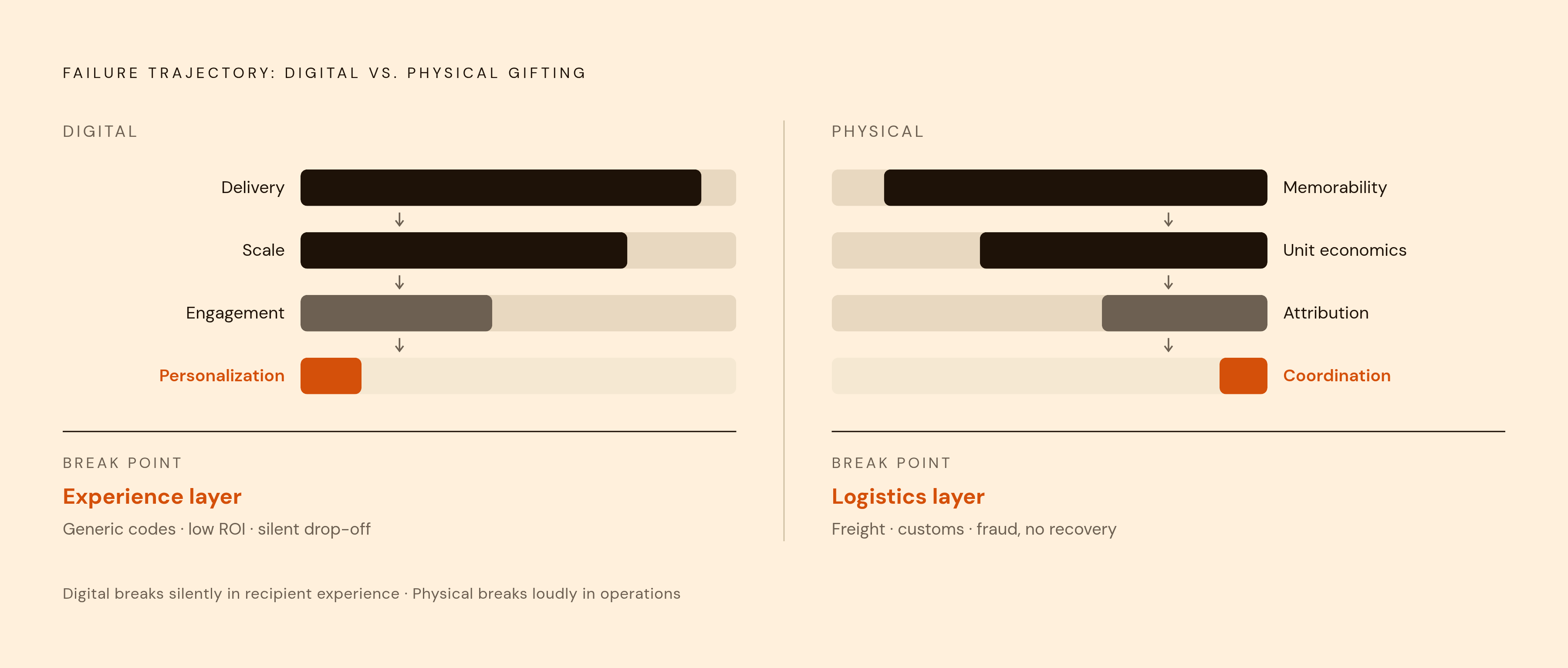
Digital breaks at the personalization layer first. Automated sends at volume trend toward generic gift card codes because generic codes are the path of least resistance inside a rules engine. Recipients recognize that. A bulk eGift send with no choice, no branding, and no contextual framing reads as a transaction. It lands in the same psychological register as a mass email: technically delivered, functionally ignored.
Programs built on personalized gifts report substantially higher ROI than those built on generic ones, and the gap is not marginal. When automation optimizes for volume at the expense of felt relevance, you get scale without the outcomes scale was supposed to generate. The infrastructure looks excellent on a dashboard. The experience is forgettable to the person who receives it.
Physical breaks at the coordination layer. International sends requiring customs forms and multi-week delivery windows don't hold up in high-velocity use cases. Per-unit economics erode at volume. Visibility gets murky the moment a package leaves the warehouse. Did the gift arrive before the meeting? Was it received at all? Attribution on physical sends depends on manual confirmation or the recipient self-reporting, neither of which is reliable at scale.
The fraud exposure asymmetry is worth naming directly. Physical gift cards face theft during shipping and card skimming, with no real recovery path once compromised. Digital cards can be disabled and reissued. At enterprise send volumes, fraud exposure becomes a material budget and compliance consideration, not a hypothetical.
The break points are different, not just the costs. Digital scales cheaply but shallowly. Physical scales richly but expensively. Both break eventually. Knowing which break point you're approaching determines whether you need a systems fix or a logistics fix, and those require very different conversations with very different people.
Why Recipient Preference Data Complicates the Format Decision
The aggregate data points toward digital. A majority of consumers prefer digital gift cards for convenience and instant delivery, and that preference skews even stronger among millennials. Real signal. Also incomplete.
There's a countervailing pattern that gets consistently underweighted. The same generational cohorts who prefer digital gift cards also report strong appetite for physical, tangible brand touchpoints, specifically as a counterbalance to digital overload. The "Return of Touch" framing emerging in recent consumer research isn't nostalgia. It reflects something measurable about how people experience digital saturation, and it has direct implications for gifting programs that have automated entirely toward digital delivery without questioning that choice.
The tension isn't simply generational; it's contextual. Physical gifts outperform digital on brand recall and referral metrics in ways that matter specifically for retention-focused programs. Recall a year after receiving a promotional physical gift, likelihood to refer the brand: these numbers favor tangible objects by wide margins. Digital gifting rarely produces equivalent retention outcomes, even when the experience is thoughtfully designed.
Cultural context compounds this further. In markets where the physical presentation ritual carries relational weight, a smartphone notification is not a culturally equivalent substitute regardless of the gift's dollar value. The automation layer cannot account for this automatically. It requires intentional configuration, and someone on the team has to know enough about those markets to configure it correctly.
Recipient preference, in other words, isn't a stable input you can set once and trust. It varies by relationship type, geography, the emotional register the program is trying to hit, and the broader context in which the recipient lives. Any platform decision that treats preference data as a fixed parameter is working from a simplified model, and that simplification has real costs downstream.
How the Choice Between Formats Maps to Program Goals
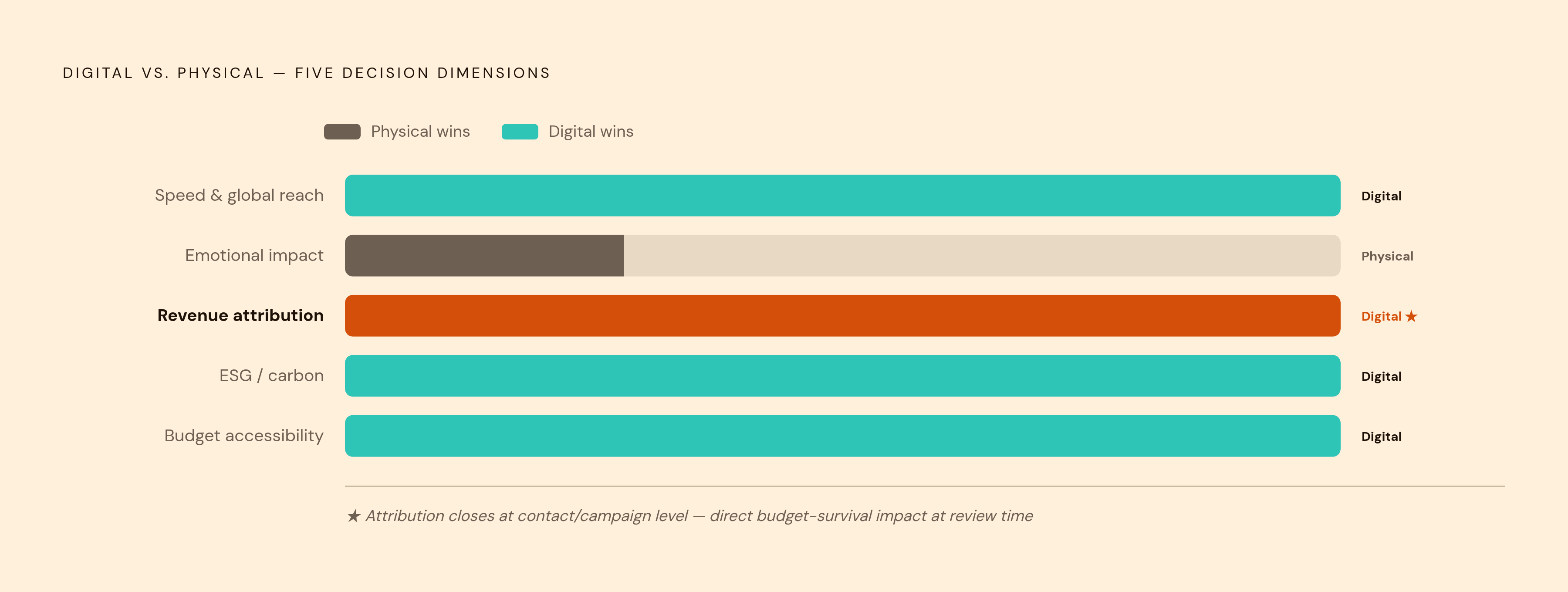
Speed and global reach favor digital, and the advantage is not close. eGifts distribute worldwide in minutes with no customs exposure. Physical international sends carry freight costs and delivery windows that make them structurally unsuitable for time-sensitive use cases.
Emotional impact and brand memorability favor physical, and that advantage concentrates in high-value contexts. Tangible objects engage multiple senses, occupy physical space, and produce the kind of brand recall that matters most for enterprise prospect and retention programs. This is a performance difference with downstream revenue implications, not an aesthetic preference.
Revenue attribution favors digital, significantly. When sends are fully tracked through CRM integration, closed-won impact can be measured at the contact, opportunity, and campaign level. That attribution clarity is structurally unavailable for physical sends, where the data closes out at delivery confirmation rather than CRM outcome. Without it, you're running on narrative rather than evidence, which is a precarious position when budget reviews come around.
Employee recognition presents a split case. The evidence that gifting boosts engagement and retention is strong; the Snappy 2026 Workforce Study, sampling 1,500 employees, found that a large majority say gifting improves engagement, and nearly three-quarters say an anniversary gift would make them more likely to stay. But whether digital or physical delivers that lift depends entirely on whether the gesture reads as personal. A tokenized eGift sent automatically on a work anniversary can feel like a calendar notification. A physical gift can feel like someone noticed. The format is not the differentiator; the perceived intentionality is. And automation, by definition, makes intentionality harder to signal convincingly. So here's the uncomfortable question: if the automation is invisible to the recipient, does it matter? It does, because the experience of receiving something that feels considered is precisely what drives the outcomes the ROI case assumes.
ESG commitments push toward digital, and the environmental difference is not trivial. Digital gift cards have been shown to reduce carbon output dramatically compared to plastic alternatives. For programs operating under sustainability mandates, that's a structurally relevant constraint, not a secondary consideration.
Budget model shapes accessibility depending on program maturity. Pay-per-send pricing with no minimums makes digital pilots feasible before committing to warehousing infrastructure, which matters for teams that haven't yet built organizational trust in gifting as a program worth funding.
How Teams Are Combining Both Formats in Practice
The hybrid model has become the operational norm for mature gifting programs. The logic is straightforward once you understand the break points: digital handles high-volume, time-sensitive, geographically distributed sends; physical handles high-value, relationship-critical, or culturally specific moments. They're not competing with each other. They're handling different jobs within the same program.
Trigger logic makes this manageable at scale. CRM signals determine format automatically. An enterprise deal close routes to a curated physical send. A renewal reminder routes to a digital gift card. The rules engine is doing what rules engines do, except now format selection is a variable in the decision tree, not just gift selection.
At the platform level, the acquisition of Alyce by Sendoso in early 2024 reflects a direct bet on this hybrid architecture. Combining eGifts, customized swag, virtual experiences, direct mail, and handwritten notes within a single sending layer isn't a feature expansion. It's a product thesis: the format decision should live inside the platform, not outside it, and forcing users to context-switch between tools to run both formats is where programs lose coherence and measurement integrity.
The recipient-choice model, which Alyce helped pioneer, partially dissolves the format decision by delegating it to the recipient. Letting someone swap a physical gift for a digital alternative or a charitable donation offloads the preference judgment to the person who actually has the preference. It sounds obvious in retrospect. Most good solutions do.
The operational reality of running both formats simultaneously is that you're managing two different failure modes at once. The logistics pipeline has its own failure surface. The integration layer has its own failure surface. Most mature gifting platforms now surface both in a unified dashboard, which is the right architecture. But visibility doesn't eliminate the underlying complexity; it just makes that complexity legible enough to respond to it before it becomes a problem your recipient feels.
What to Evaluate When Choosing a Platform to Run Either or Both
For digital-first programs, the depth of CRM integration is the primary criterion. The number of native connectors matters. The configurability of trigger logic matters. Most critically, whether attribution closes back to revenue matters, because that's the evidentiary basis for the program's budget justification. Without it, you're running on narrative.
For physical programs, warehousing geography determines realistic delivery SLAs regardless of what the platform's marketing materials say. A platform with fulfillment infrastructure concentrated in North America cannot promise sub-week delivery in APAC. Geographic coverage is a logistics constraint, not a software feature. Contract review is the moment to surface this; after signing is not.
For hybrid programs, the decisive question is whether both format types live in a single sending workflow or require context-switching between tools. Fragmented tooling produces fragmented visibility, which makes program optimization significantly harder and program reporting nearly impossible to trust.
Pricing model shapes accessibility and unit economics differently depending on program maturity. Subscription models with minimums suit programs running at consistent volume. Pay-per-send models suit pilots or teams with variable cadence. The distinction matters most at the beginning of a program, when committing to volume is premature and potentially costly.
The charging model on eGifts specifically deserves scrutiny. The average North American B2B gift card reached $193 in 2025. At that unit value, the difference between being charged on send versus charged on redemption creates meaningful budget variance at scale. Most teams miss this in contract review, and it surfaces as a budget surprise at precisely the worst moment.
Fraud and compliance controls are baseline expectations at enterprise scale. AI-based anomaly flagging, tokenized delivery, and instant card disablement are not premium features. Regulations mandating stronger fraud prevention controls are set to take effect in 2026, which means platform compliance architecture will become a vendor selection criterion for programs that aren't already treating it as one.
The evaluation criterion most teams skip is the one that determines whether any of the above actually matters: what does the recipient experience? Choice, delivery speed, branding, contextual framing. Because if the automation investment is excellent and the recipient experience is still generic, the retention and recall numbers the ROI case assumes will not materialize. The platform is the vehicle. The experience is the point.