Security and Privacy Considerations in Gifting Platforms
Fraudsters exploit weak security across platforms and gifting channels at massive scale.
The most unsettling version of gift card fraud requires no computer. It happens in the store aisle, while other shoppers walk past. Someone opens the packaging, photographs the card number and PIN, reseals it well enough to pass a quick look, and puts it back on the rack. Then they wait. When you load value onto that card, the balance is gone within minutes. You hand someone you care about a piece of plastic worth nothing. The operation is patient, low-tech, and it works constantly.
I think about this whenever I pick up a physical card. There is no reliable way to tell from the outside. But what if the physical card is the least of your worries?
The digital version runs at a different scale entirely. Automated bot attacks test millions of card number combinations against platform interfaces, probing for valid balances systematically, the way water finds cracks in concrete. These are not targeted operations. They are volume plays, and gifting platforms are attractive targets precisely because the cards are liquid and the redemption window is narrow.
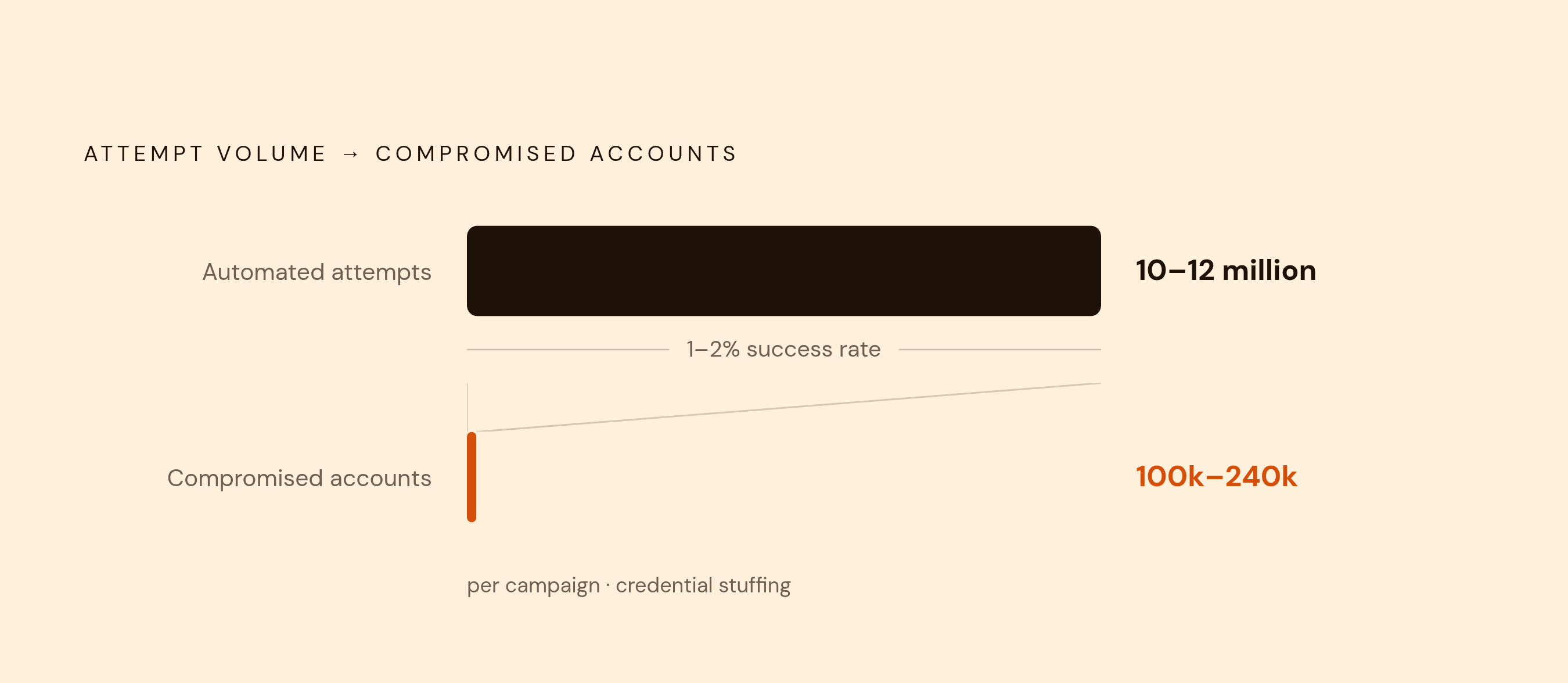
Credential stuffing powers most of this. A fraudster buys a leaked database of usernames and passwords from some earlier breach, then runs automated scripts against gift card and loyalty platforms. The success rate sounds negligible, one or two percent, until you apply it to a campaign running ten or twelve million attempts. That math produces a lot of compromised accounts fast. Why exactly does this work so reliably? It is not technical ingenuity. It is that most people reuse passwords, and fraudsters have learned to count on that.
The gift card purchase is sometimes not even the target; it is the laundering step. Stolen payment credentials get converted into digital gift cards, which are then resold or transferred into clean value that is nearly impossible to trace back. Riskified found that gift card transactions carry a fraud rate up to seven times higher than other purchase categories relative to their share of legitimate volume. That gap is not a coincidence.
What this means practically is that the fraud has often already occurred before you arrived. The anti-bot controls and velocity monitoring on a platform are not background infrastructure. They are the mechanisms that determine whether the card you just bought still has value when it lands.
Social Engineering Scams That Use Gifting as the Payment Rail
From a fraudster's perspective, gift cards are close to an ideal payment instrument for coercive scenarios. Fast, anonymous, irreversible. The specific narrative of any scam matters less than its underlying structure: manufacture urgency, establish credibility, and point the target toward the fastest anonymous payment mechanism they can access within the hour.
The archetypes are well-documented. IRS impersonators. Utility companies threatening shutoffs. Sweepstakes administrators requiring a small processing fee before your prize releases. In 2024, fake sweepstakes and bogus gift offers were the single largest fraud complaint category, more than 38 percent of all reports, and 87 percent of those scams began with a phone call.
AI voice cloning has made the phone call significantly harder to dismiss. Fraudsters can now replicate a family member's voice with enough fidelity to deceive someone who knows that voice well. The grandparent scam, which once depended on a stranger sounding vaguely distressed, now sounds like your actual grandson calling from a bad connection. The gifting platform in that scenario is just the payment endpoint. The manipulation is complete before the platform ever opens.
Roughly 34 percent of American adults have been targeted by a gift card payment scam at some point. That is not a fringe group. It is about one in three people you would recognize. That raises an important question: if the targeting is this widespread, why does the scam keep working?
The most reliable heuristic is blunt: no legitimate government agency, utility company, employer, or prize administrator requests gift cards as payment, ever, for any reason. The scenario surrounding the request is engineered to sound credible, even urgent. The payment method is where the construction comes apart. Fraud attempts spike sharply around major gifting occasions too, with documented increases of around 30 percent near Mother's Day, which means the seasonal context itself functions as cover.
What Platforms Know About You and What Happens When That Data Is Exposed
Gifting platforms accumulate more personal data than most users consciously register. Names, email addresses, delivery addresses, purchase histories, payment credentials, wish-list contents. Platforms that implement Know Your Customer verification for regulatory compliance collect government-issued identification documents and photographs on top of all that. This accumulation is not incidental to the product; it is how personalized gifting works. It builds quietly over years of account use.
The MyGiftCardSupply incident, disclosed in January 2025, is worth looking at closely. An unsecured cloud server exposed sensitive customer data for approximately 200,000 people, including government-issued IDs and photographs. The company did not publicly acknowledge the breach or commit to notifying affected individuals.
The number 200,000 sounds large, but the category of data matters more than the headcount. This was not a payment card breach. It was a dossier breach. The harm extends well beyond unauthorized purchases into identity fraud, account takeover on other platforms where the exposed identity passes verification checks, and synthetic identity creation, where real and fabricated information are combined to construct a new fraudulent identity. These harms do not land immediately. The person affected in January 2025 will not encounter the downstream consequence until 2027, or later.
KYC data represents a categorically worse risk tier than standard retail data. A driver's license or passport in a gifting platform's database enables far more damaging fraud than an email address and a shipping destination. That distinction matters when deciding how much verification to complete on a platform you have not used before. It is also worth considering what you are actually consenting to when a platform asks you to upload identification — not just the verification itself, but where that document lives afterward and for how long.
What makes the MyGiftCardSupply case instructive beyond the breach itself is the cause. Not a sophisticated nation-state attack. Not an exotic exploit. A misconfiguration left data accessible to anyone who found it, and eventually a researcher did. The user had no way to know it was happening. Unlike a phishing email, which requires the target to act, a misconfigured server exposes data silently and indefinitely. IBM's 2024 Cost of a Data Breach report documented credential stuffing attacks causing an average of $4.81 million in damage per incident. Those costs do not stay with the platform.
How Third-Party Vendors Inside Gifting Platforms Extend the Risk Beyond the Platform Itself
When you use a gifting platform, you are not interacting with a single system. You are interacting with a network: payment processors, shipping APIs, loyalty program integrators, KYC verification providers, email delivery services, cloud infrastructure. Each connection is a potential entry point, and your data is protected not by the platform's own posture but by the weakest link in a chain you cannot see.
Verizon's 2025 Data Breach Investigations Report found that breaches involving a third party rose to 30 percent of all incidents, up from roughly 15 percent the prior year. Third-party exposure doubled in a single reporting cycle. RiskRecon's 2024 State of Third-Party Risk Management report found that nearly a quarter of organizations suffered security incidents caused by third parties, compared to 9 percent in 2020. The direction of that trend is consistent.
When a breach originates from a third-party system, remediation is harder and more expensive, averaging approximately $4.8 million, because the affected organization does not directly control the source. Investigation is more complex, forensic access is more restricted, and the response requires coordination across organizational boundaries that were not designed for joint crisis management.
Here is the part that gives me pause about how this actually functions in practice. According to RiskRecon's 2024 data, only 4 percent of organizations report high confidence that their third-party risk questionnaires reflect actual vendor security reality. The questionnaire process exists. The assurance it provides is largely ceremonial. One might argue that a questionnaire answered in good faith is better than nothing — but does a self-reported document really tell you anything about how a vendor behaves when no one is checking?
For a user, the implication is uncomfortable and specific: when a gifting platform shares your data with a shipping partner or loyalty integrator, you have no visibility into that partner's security posture. Your data is only as safe as the least rigorous vendor in an ecosystem you did not choose and cannot audit. Platforms that publish vendor management practices, contractual data-handling requirements, and incident response obligations across the vendor chain are providing a signal worth weighing. Silence on these questions is also a signal.
The Regulatory Floor Platforms Are Supposed to Meet, and Why Compliance Gaps Hurt Users
PCI DSS version 4.0 became fully mandatory in March 2025. Among its requirements: multi-factor authentication for all access to cardholder data environments, not just administrator accounts. It also explicitly addresses phishing resistance, web-skimming prevention, and supply-chain security in ways the prior version did not. This is the standard against which any platform handling payment card data is supposed to be measured.
Here is the context that deflates that somewhat. Fewer than half of businesses maintain full PCI compliance year-on-year, according to Verizon's research. Penalties are real, fines starting at $100,000 and reaching $500,000 plus per-card penalties applied individually. Non-compliance is still the norm.
Privacy regulation has expanded in ways that create genuine pressure on platforms, unevenly applied. Eight U.S. state privacy laws took effect in 2025, nearly doubling the enforceable count from two years prior. California's Delete Act introduces a mechanism, launching in August 2026, through which residents can submit a single deletion request to all data brokers simultaneously. The penalty for non-compliance runs $200 per consumer per day per failure to delete. At scale, that is existential financial exposure for platforms that built business models around data resale.
The 23andMe case is worth understanding as precedent. A credential stuffing attack in 2023 accessed approximately 6.9 million records. The UK's Information Commissioner's Office fined the company £2.31 million specifically because multi-factor authentication was not mandatory on the platform. Regulators are now treating weak authentication as a material governance failure, not a technical oversight. That framing shifts accountability from the technical team to the executive and board level, where security investment decisions actually get made. That shift in framing is, in my view, one of the more meaningful regulatory developments of the past few years.
What a user can reasonably expect from a platform operating in good faith is fairly modest: disclosed PCI DSS compliance status, stated data retention periods, and clear terms around third-party data sharing. Willingness to address those questions is a minimum signal. Evasion is informative too.
How AI Is Making Both the Attacks and the Defenses More Consequential
The same underlying technology is being deployed simultaneously by fraudsters and by the platforms trying to stop them. The implications for users depend entirely on which deployment you are examining.
On the offensive side: voice cloning enables real-time impersonation of people a target trusts. Automated systems generate personalized phishing messages at volumes no human operation can sustain. Bot attacks grow more adaptive, learning from failed attempts to evade detection more effectively with each iteration. The cost of launching a sophisticated social engineering campaign has dropped sharply as the tooling has become widely accessible. This is not a future concern. It describes current operating conditions.
On the defensive side, the advantage is real but qualified. IBM's 2024 Cost of a Data Breach report found that organizations using security AI and automation identified and contained breaches nearly 100 days faster on average than those that did not. Platforms investing in AI-driven fraud detection can recognize anomalous behavior and respond to emerging attack patterns at a speed and scale that manual review cannot match. That is a genuine operational advantage.
The tension worth sitting with is this: the behavioral and preference data that enables a platform to recommend a well-suited gift, learning what you give, what occasions you mark, what price ranges you use, is the same data that becomes a high-value target if controls fail. More data collected to serve you better is also more data at risk. But how does this affect our original promise of personalization as a feature? AI personalization systems process personal data in ways that are rarely transparent to users and almost never consented to in any granular sense. The EU AI Act, in effect since August 2024, introduces risk-category requirements for AI systems based on potential societal impact, and gifting platforms using AI for recommendations or fraud scoring fall within its scope depending on implementation.
The asymmetry that benefits fraudsters is structural. Attackers adopt AI with no compliance overhead. Platforms deploying defensive AI face regulatory scrutiny and must balance detection capability against data minimization obligations. Users benefit from the defensive investment while bearing the privacy implications of the data it requires. That is the current arrangement.
Concrete Steps Users Can Take to Reduce Their Exposure on Gifting Platforms
Enable multi-factor authentication on any gifting or loyalty account that offers it. CISA estimates that MFA makes an account approximately 99 percent less likely to be compromised in an account-takeover attack. It is the highest-return protective measure available and costs nothing but a few minutes.
Use unique passwords for every gifting and loyalty account. Sift's 2024 research found that 78 percent of people reuse passwords across accounts, which is the direct behavioral enabler of credential stuffing at scale. A password manager eliminates most of the friction of not doing this.
For physical gift cards: inspect the packaging before you buy, look for tampered seals, and try to purchase from a locked display case when one is available. Register the card immediately after purchase. Check the balance before you give it away.
Treat any request to pay a debt, fine, prize fee, or emergency expense via gift card as an automatic disqualifier, regardless of how credible the surrounding scenario sounds. Government agencies do not accept gift cards. Neither do utilities, legitimate employers, or prize administrators. The scenario is constructed to sound plausible. The payment method is where it falls apart, every time.
Before using an unfamiliar gifting platform, look for signals of baseline security credentialing: PCI DSS compliance status, ISO/IEC 27001 certification, or a SOC 2 Type II report. These are not guarantees, but their absence, or a platform's refusal to discuss them, tells you something.
Read the privacy policy, specifically the sections on third-party data sharing, data retention periods, and whether the platform sells or licenses data to advertisers or brokers. This is where the most consequential disclosures usually live, and it is the section most users skip.
Monitor gift card balances immediately after purchase and set up alerts where the platform supports them. Early detection is, in most cases, the only realistic recovery path.
California residents: the DELETE platform launching in August 2026 will let you submit deletion requests to all registered data brokers through a single mechanism. Worth knowing now.
The $212 million in reported 2024 losses is not primarily a story about sophisticated adversaries or exotic vulnerabilities. Fraudsters operate at industrial volume because the hit rate does not need to be high when the denominator is large enough. Individual protective measures matter because they make individual accounts not worth the marginal automated effort, pushing campaigns toward softer targets. That is not a satisfying conclusion, exactly. It is how this ecosystem actually functions.