Personalizing Corporate Gifts at Scale
True personalization requires choosing which layer to invest in, not pretending you can do it all.

Most corporate gifting programs are performing personalization rather than practicing it. There's a difference, and the people receiving the gifts can feel it, even if they can't always articulate why.
Slapping a name on a Yeti tumbler is not personalization. It is the appearance of personalization, which is more cynical than just sending something generic. At least a generic gift makes no claims about knowing you.
Personalization in a corporate context exists on a real spectrum, and where you land on it depends on three things that are worth treating as separate decisions: what you send, how it's presented and what the message says, and when it arrives. These dimensions operate independently. A program can be sophisticated on one axis and completely underdeveloped on the others. I've seen companies send beautifully curated products with messages that read like they were generated by a mail merge, and I've seen the reverse, a thoughtful handwritten note attached to something wrong for the person receiving it.
Timing, specifically, is the most underrated of the three. A gift that arrives the week a client closes a painful deal, or the day after an employee hits a difficult anniversary, with a message that actually acknowledges the moment, will outperform an engraved product mailed to everyone in January with a form letter. Not because the product is better, but because it lands inside a specific human context.
Recipient-choice models deserve separate consideration here. Instead of predicting the right item, you offer a curated selection and let the person choose. This sidesteps the prediction problem entirely. It trades the "they really knew me" feeling for a much higher floor of relevance, and for most programs operating with thin preference data, that trade is worth making more often than it is made.
Before you choose a platform, a vendor, or a workflow, you need to decide which layer of personalization you're actually investing in. Organizations that skip that decision buy tools designed to solve problems they weren't trying to solve. It happens constantly.
The data gap that makes most gifting programs operate on guesswork
Gallup found in 2024 that only 20% of employees strongly agree someone at their organization has ever asked how they prefer to be recognized. Eight in ten people have never been asked a basic preference question. And yet organizations are spending real money every year trying to make those same people feel seen.
I don't think the people designing these programs are careless. I think they're working with what they have, and what they have is almost never actual preference data. So they default to demographic proxies: role, tenure, geography, department. These aren't useless, but they're crude. The senior sales director and the senior product director share the same tenure bracket and similar compensation levels. They almost certainly want different things.
The client side has a parallel problem. CRM records often capture firmographic detail with high precision: company size, industry, deal stage, renewal date. What they rarely capture are the signals that would inform a meaningful gift. Hobbies, dietary restrictions, recent personal milestones, how the person actually prefers to communicate. The data that would make gifting feel personal is not being routed to the people making gifting decisions. It's sitting in email threads, in Slack, in the notes field that nobody updates.
The practical starting point for any personalized gifting program is auditing what you already hold and identifying the gaps clearly. Most organizations have more usable data than they realize. Onboarding surveys contain preference signals that nobody looked at again after the new hire's first week. LinkedIn profiles are public and rich with context. CRM interaction history captures relationship temperature over time in ways that are underutilized. Manager input, for employee gifting, is frequently the highest-quality data source available and the most consistently ignored one.
The best time to collect preference information is during onboarding or account setup, when the questions feel natural and there's a logical reason for asking them. Building that collection moment into existing processes, before any gifting decision needs to be made, is the structural fix. Collecting it after a gifting failure is both too late and awkward for everyone involved.
Why scaling personalization breaks without a tiered structure
Here is the core tension: true one-to-one curation does not scale, and true automation strips out what makes gifting feel personal. These two things are in conflict. The way through is not a single approach applied uniformly. It's accepting that different recipients warrant different levels of effort, and building a structure that reflects that honestly rather than pretending the tension doesn't exist.
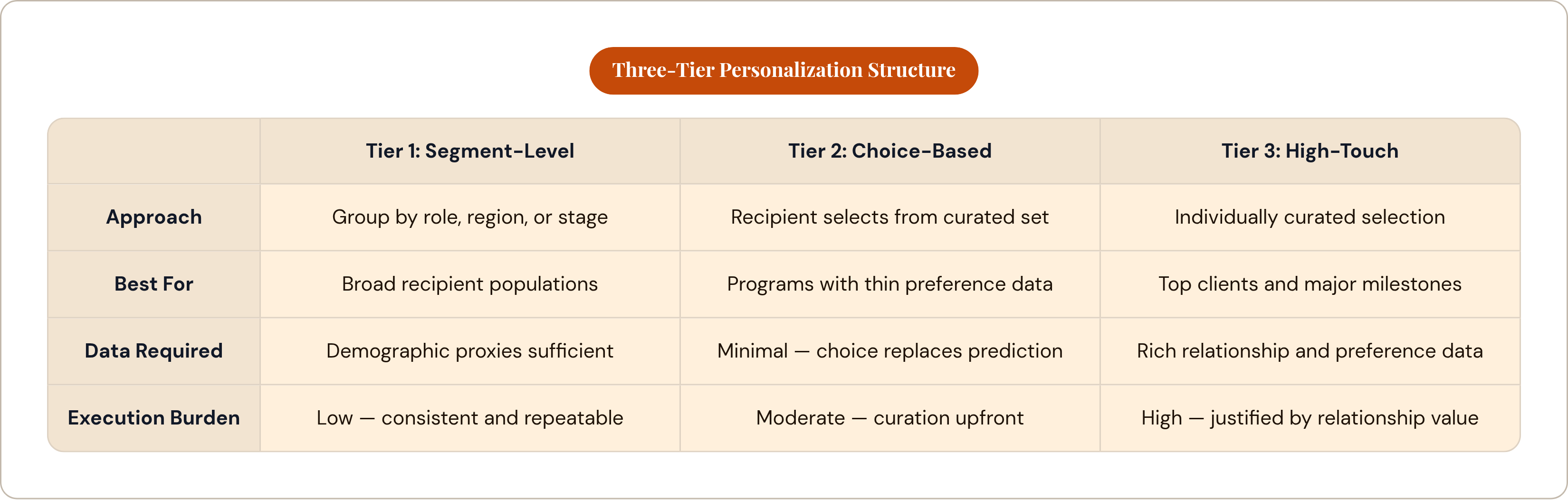
A tiered approach assigns personalization depth based on relationship value, available data, budget, and what your team can actually sustain. The first tier is segment-level: grouping recipients by role, region, or relationship stage and selecting product categories appropriate to each group. Everyone in this tier gets something thoughtful. Nobody gets something individually tailored. The second tier is choice-based, where recipients select from a curated set of options, which improves relevance without requiring accurate individual prediction. The third tier is high-touch, individualized selection reserved for top-tier clients and significant employee milestones where the curation investment is clearly justified by the relationship.
One platform's internal research found that 70% of people find personalizing gifts a real challenge, with budgeting, logistics, and thin recipient knowledge cited as the top obstacles. A tiered structure addresses all three, not by eliminating them, but by concentrating the harder work where it actually generates return. A well-executed tier-one experience is better than a fumbled attempt at tier three. That sounds obvious, but programs routinely try to operate at tier three across an entire recipient population and then wonder why execution falls apart.
The tiering only works if the assignment criteria are written down and enforced. The moment you start making case-by-case decisions about who gets which level of treatment, you've reintroduced the chaos the structure was designed to eliminate. Tier assignment should be a rule, not a recurring conversation that happens differently every quarter.
The real operational costs of customization that teams underestimate
Custom engraving, monogramming, bespoke packaging: these feel like marginal additions when you're looking at a single gift. At scale, they become a categorically different kind of problem, and most program managers discover this only after they're already behind.
Production lead times for engraved or monogrammed items routinely run more than twice as long as for standard items. Customization requirements compound that timeline pressure in ways that are hard to anticipate until you're living inside a specific crunch. Cost per unit for custom products runs substantially higher than mass-produced equivalents, and supply chain disruptions over the past few years have added further pressure on specialty materials that budgets weren't designed to absorb.
The labor cost is the number most organizations fail to capture entirely. Large companies spend enormous amounts of staff time on the gift quoting cycle alone, before anything ships. That's not fulfillment time. That's negotiating, sourcing, and approving. It represents the equivalent of multiple people who are not producing gifts; they're managing the process of procuring them. That cost rarely appears in a gifting budget, and it should.
Nearly 40% of businesses report supply chain delays and customization challenges in bulk gifting procurement. These aren't edge cases. They're structural features of running a personalized program without infrastructure built to absorb them. The teams that manage personalized gifting well are not better at improvising under pressure. They have built systems that treat lead time buffers, minimum order quantities, regional fulfillment routing, and peak-season capacity constraints as known variables, not annual surprises.
How to build the vendor and platform infrastructure the system depends on
Choosing a gifting platform is not primarily a catalog decision. The catalog matters, but it's the structural capabilities that determine whether personalization becomes part of your actual workflow or stays an additional manual task layered on top of everything else.
CRM integration is the foundational requirement for client gifting. If your platform doesn't connect to Salesforce, HubSpot, or whatever system your revenue team actually lives in, personalization remains a manual process dependent on someone remembering to act at the right moment. The same logic applies to employee gifting: integration with Workday, SAP SuccessFactors, or a comparable HRIS is what transforms milestone recognition from an occasional scramble into a reliable program.
A 2025 analysis of 1.5 million gift sends found that gifted campaigns achieved 56% conversion rates compared to 3% for standard email campaigns. That gap exists because a gift, when integrated into an outreach workflow, lands differently than another message in an inbox. The platform that makes that integration seamless is not a nice-to-have. It's the mechanism that produces the outcome.
A major platform merger in early 2024 is worth reading as a market signal. That consolidation brought together a recipient-first choice model with broad fulfillment infrastructure, reflecting a conclusion the industry had been moving toward: these capabilities need to be bundled, not sourced separately and stitched together by someone on your team with limited time and patience.
For organizations not ready for enterprise-scale platforms, the right move is phased deployment rather than a rushed full rollout. Start with one integration: CRM to gifting workflow, or HRIS to milestone trigger. Make that one thing work reliably. Then expand. The programs that fail are usually the ones that tried to automate everything simultaneously and ended up with a fragile system that nobody trusted enough to actually use.
Vendor evaluation should also cover minimum order flexibility, multi-country shipping and customs support, data handling compliance with GDPR and CCPA, and analytics that connect gift sends to actual business outcomes. That last criterion is consistently underweighted in vendor selection conversations and consistently becomes the loudest complaint twelve months into a program.
How AI fits into a gifting system and where human judgment still belongs
By 2024, nearly half of companies had adopted some form of AI-based gifting solution. These platforms pull from CRM data, LinkedIn profiles, and interaction history to recommend gifts, replacing catalog browsing with algorithmic suggestion.
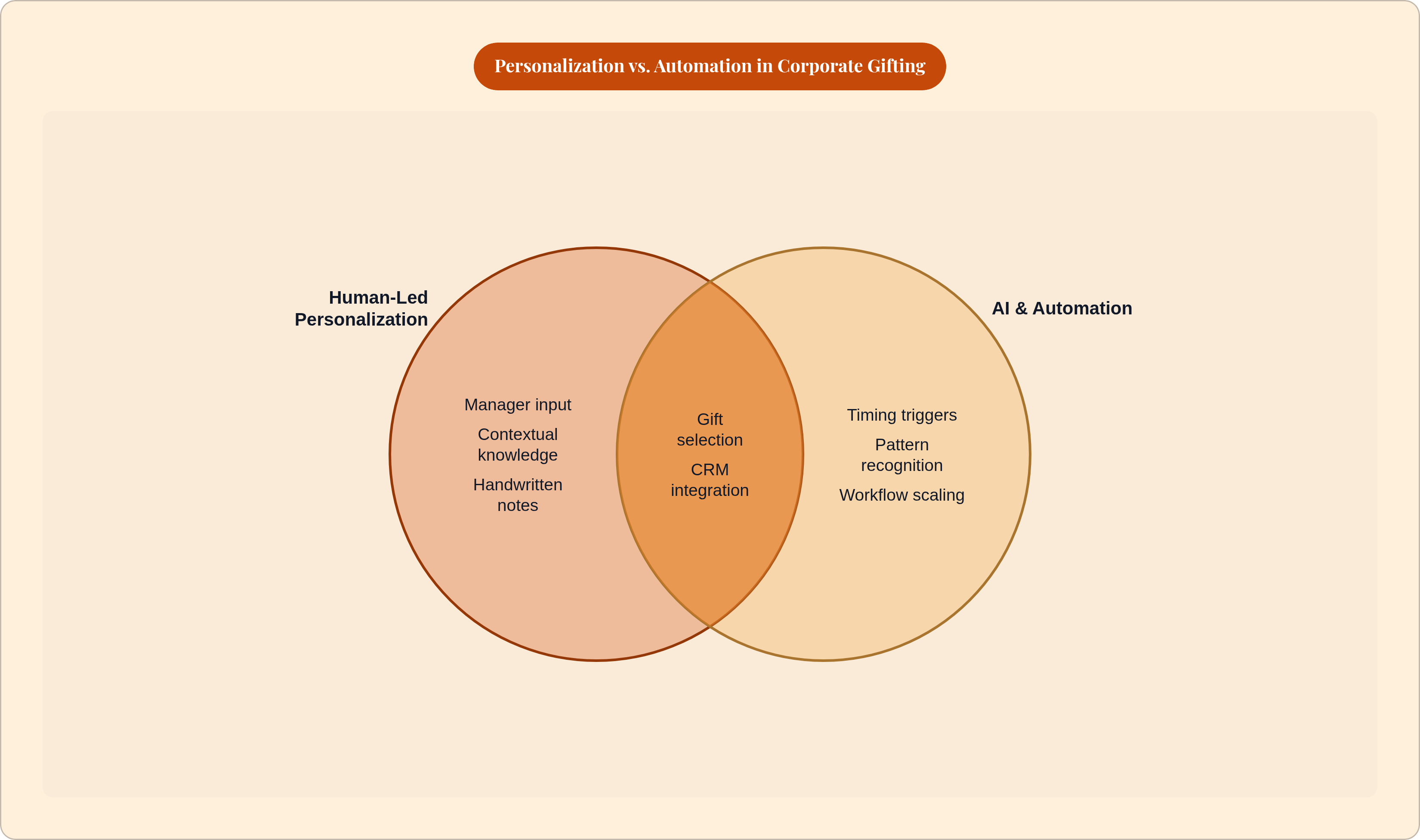
Where AI earns its place is specific: reducing selection time from hours to minutes, identifying optimal send timing based on engagement signals, flagging recipients who haven't been recognized in a meaningful period, and scaling message personalization across hundreds of relationships in ways that would be implausible for a human team. Pattern recognition across large datasets is what these systems are built for, and they're good at it.
The limitation is real and worth taking seriously. Algorithms operate on structured data. They surface preferences that were captured somewhere, in some form, at some point. What they cannot reliably detect is cultural nuance, personal circumstances that emerged after the last data update, or the contextual knowledge that exists only in a manager's memory. A personalized gift that misses can actually feel worse than a neutral one, because it signals that someone tried, processed information about you, and still got it wrong. That failure mode is more uncomfortable than receiving something generic, and it's worth accounting for before you automate your way into it.
Data privacy belongs in this conversation. AI-driven personalization requires access to recipient data, and GDPR, CCPA, and a growing body of state-level regulation govern what can be collected and processed. Compliance needs to be a platform selection criterion from the beginning, not something retrofitted after the contracts are signed.
The division of labor that works, in programs I've seen function well: use AI for selection suggestions, timing triggers, and workflow automation. Keep human review in the loop for high-tier recipients and, especially, for message personalization. The note attached to a gift is often where personalization is most acutely felt by the recipient, and it is the thing least reliably handled by a system working from a CRM record. That remains a human job.
Matching gift format to recipient and relationship type
Format is a decision most gifting programs treat as aesthetic when it's actually strategic. The format you choose signals something before the gift is even opened.
Physical gifts with custom embroidery, laser engraving, or bespoke packaging accounted for over a third of corporate gift orders in 2025. They carry the highest perceived value and the strongest tactile impact, and also the longest lead times and the highest per-unit cost. That makes them the right choice for milestone moments and high-touch relationships, and a logistical problem for distributed workforces or time-sensitive recognition.
eGifts and digital gift cards are the fastest-growing segment. Corporate eGift card transactions roughly doubled between 2021 and 2024. Lower friction, faster delivery, and a natural fit for global or remote workforces make this format increasingly important, particularly for programs managing large employee populations across multiple countries. There's also something worth acknowledging here: a lot of people simply prefer choosing their own thing, and a well-scoped digital gift respects that preference without requiring you to have predicted it.
Experience-based gifts, wellness offerings, virtual events, curated local experiences, show strong relationship-building effects with high-value clients. They work best where the relationship is data-rich enough to make the experience feel intentional. An experience gift that misses the recipient's actual interests reads as a different kind of failure than a gift card that misses. The gift card failure is neutral. The experience failure is memorable in the wrong way.
Sustainability is now a real factor. A quarter of corporate gift orders in 2024 involved sustainable options, and a significant share of corporate gifts still end up discarded. Personalization and sustainability are aligned goals, rather than competing ones. A gift that's relevant to the person receiving it is far less likely to get thrown away.
A workable heuristic: physical for milestone and high-touch moments where the tactile experience carries weight; digital for speed, geographic distribution, and recipient autonomy; experience-based for relationship deepening with key accounts where you have enough data to make it feel earned; choice-based for large employee populations where preference data is thin.
Budget allocation that makes personalization financially sustainable across a program
The Incentive Research Foundation's data shows average annual per-person spend on non-cash rewards dropped from roughly $1,090 in 2023 to about $921 in 2024. Programs are being asked to produce more with less. That makes allocation strategy more consequential, not less.
Industry benchmarks put U.S. client gift spend somewhere between $75 and $125 per person and employee gifting around $50 annually. These numbers are useful as floor figures, but they obscure the more important point: within a tiered program, spend should vary substantially by tier. A top-tier client relationship that generates significant recurring revenue warrants a materially different investment than a general-list contact. This is obvious when stated directly. It is consistently ignored in how programs actually budget, where the pull toward uniform per-person spend is strong and hard to resist organizationally.
There is an IRS consideration that programs frequently discover too late. The business gift deduction is capped at $25 per recipient per year. Any program spending above that threshold is spending non-deductible dollars, which affects the true program cost in ways that compound at scale. This doesn't mean limiting spend to $25. It means modeling the non-deductible portion accurately from the start. Verify current IRS guidance as part of budget planning; this is the detail that surprises finance teams mid-year.
The budget line most programs systematically undercount is program management time. The hours spent on the quoting cycle alone, before a single gift ships, represent a real cost that rarely appears in a gifting budget. Platform investment that reduces that overhead has a measurable return entirely separate from the impact of the gifts themselves. If you can meaningfully cut the management burden while improving execution quality, the platform begins paying for itself before the first gift goes out.
Concentrate higher spend where relationship value and data richness are both present, and accept proportionally lower spend where they are not. A program spending meaningfully more on a smaller group of high-value clients and less on a broader general population will generate more measurable return than one spending a uniform amount across everyone. When you actually run the numbers, this allocation logic holds. The challenge is having the organizational will to enforce it.
Measuring whether the system is producing the outcomes it was built for
Companies with structured corporate gifting programs report meaningfully higher employee satisfaction scores and improved retention rates compared to those without. Those are the outcomes a program should be designed to produce. Redemption rate is a useful leading indicator, but it is not the signal that matters. Confusing the two is how programs end up optimizing for engagement metrics while the business outcomes they were built for quietly flatline.
The measurement problem that trips up most programs is the absence of baseline data. Roughly 90% of companies report higher ROI on personalized gifts compared to generic ones, but ROI is only calculable if you know what you were starting from. Running a program for two years and then asking whether it worked is a question you cannot answer without a baseline. Establishing those metrics before a program launches is the precondition for knowing whether anything is working at all, and it should happen before any gifts go out.
The metrics worth tracking vary by tier and objective. For client gifting, downstream CRM activity after a gift send is the most direct signal of pipeline influence. For employee milestone gifting, retention correlation over time is the relevant measure. Redemption rate and time-to-redeem function as engagement proxies across all tiers. Recipient feedback scores close the loop on whether the selection actually landed.
Modern analytics dashboards, which became standard in enterprise platforms around early 2025, aggregate engagement metrics, sentiment analysis, and cost breakdowns across gift types in ways that make this tractable at scale. That measurement infrastructure should be a platform selection criterion from the beginning, not something you go looking for after two years of running a program with no legible data to show for it.
What actually happens in a measurement-driven program, over time, is that the system gets better without requiring proportionally more effort. Preference data collected through post-redemption feedback improves future selections. Tracking which product categories consistently underperform lets you remove them from the rotation before they waste more budget. Manager input on high-tier recipient responses surfaces contextual knowledge that structured data will never capture on its own. The personalization improves not because you hired more people, but because the infrastructure accumulates signal. That process takes a few honest cycles of measurement before it becomes visible, and it doesn't happen at all in programs that treat gifting as a campaign rather than a system.