Unique Gift Ideas for Female Clients and Prospects
Personalized gifts outperform cold outreach by three to five times the response rate.

Corporate gifting used to mean a box of chocolates from the office manager in December. Now it's a line item with a budget owner and, increasingly, data behind it. That shift happened fast, and I think most sales teams still haven't caught up to what the numbers are actually telling them.
Decision-makers report that a personalized gift creates a real human connection, and plenty say they remember a vendor's gift a full year later, which outlasts most sales cycles. Send something personalized before a first meeting and you can beat cold outreach by three to five times the response rate, sometimes more.
Category matters more than most people assume going in. Electronics pull the highest acceptance rate of any gift type in direct mail, with gift cards close behind. Both win because of their relevance and quality, with no lifestyle guesswork attached, so nobody has to figure out whether she drinks wine or hits the gym at 6 a.m.
For calibration, the average sales-driven gift budget sits between $75 and $100. Keep that number loose in your head, since it'll tell you when you're in range and when you've badly overshot.
Gifts that work for early-stage prospects you don't know well yet
At this stage you know her title and her company, but you don't know her habits, her taste, or what she'd actually want sitting on her desk. So the gift has to carry itself, leaning on broad appeal instead of any guess about her life outside work.
A few rules I keep coming back to:
- Go for near-universal utility with a value that feels higher than what you actually spent
- Skip anything that assumes a lifestyle: fitness trackers assume she works out, wine assumes she drinks, and neither has to be true
- Keep personalization simple, her name and a short, specific note, and save the deeper customization for later
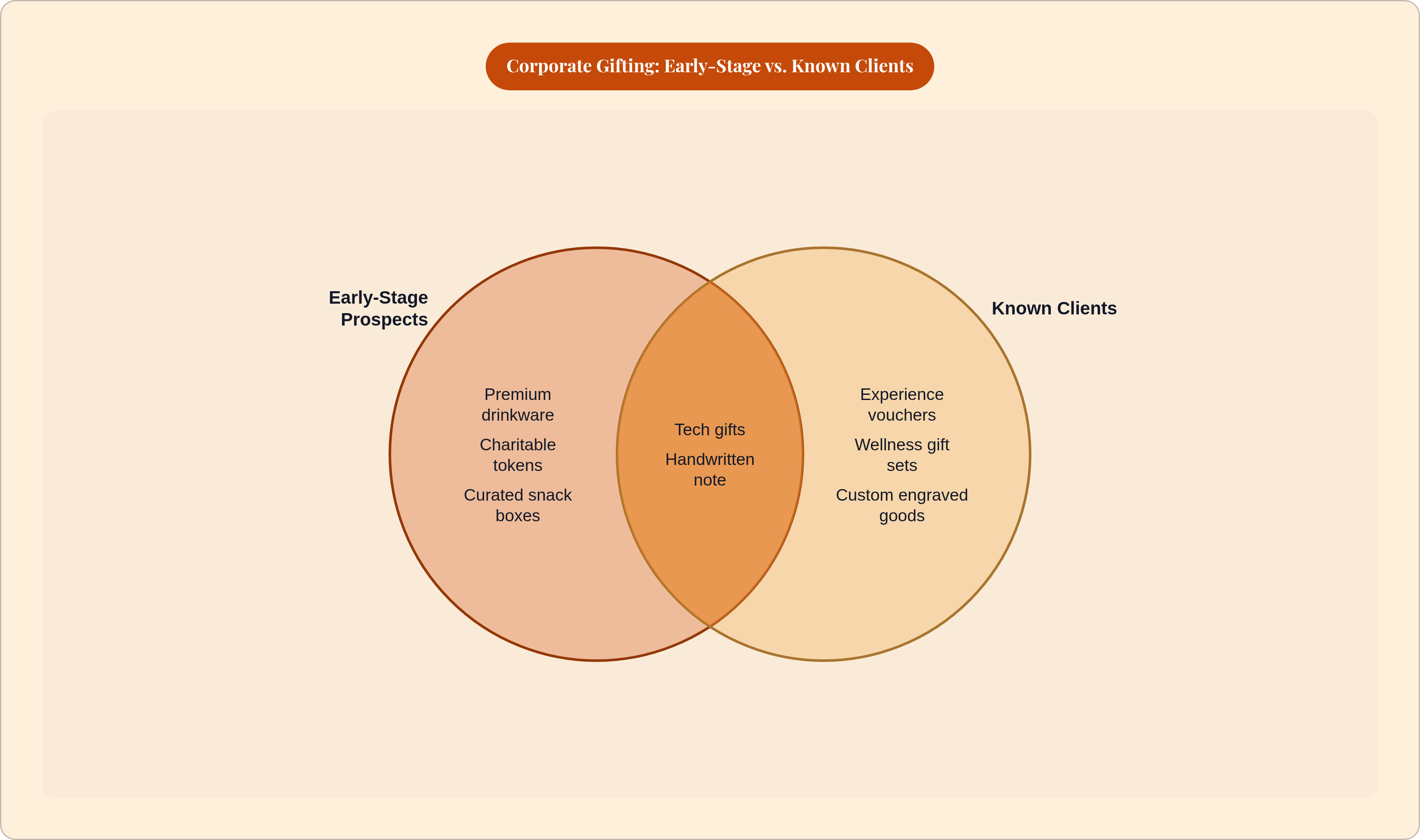
Premium drinkware checks every box here. An insulated tumbler or a well-made travel mug reads practical and gender-neutral without trying too hard, and curated snack boxes work for the same reason, since they're consumable and low-commitment. Gift cards to platforms people already use land well too; a ClassPass credit hands the decision of what "reward" means back to her instead of making it for her. Charitable tokens work at this stage as well, since they're symbolic rather than personal, and they open a conversation rather than betting on a guess.
That $75 to $100 range fits almost exactly, and overspending on someone you've never met starts to feel less like a gift and more like pressure.
One category worth skipping entirely here is anything beauty or wellness-coded, since lotions, bath sets, and spa kits all need context you don't have yet.
Gifts calibrated to a known client relationship
Once you know how she travels, what she reads, how she likes to communicate, the gift can do more work. At that point it's proof you were paying attention.
I sort this into two rough types, nothing formal about it. The strategic, high-energy exec tends to respond to experience: travel vouchers, event tickets, credit toward something she wouldn't splurge on herself. The detail-oriented, process-driven leader responds better to tools she'll actually use, a solid pair of noise-canceling headphones, a good notebook, a smart charger, nothing flashy, just well made.
Personalized goods do well here too, especially ones that signal craft over mass production. A custom-engraved leather notebook or a monogrammed portfolio lands better with executive women than anything logo-branded ever will. Even something small, like a brass bookmark stamped with initials, sticks with people precisely because it's unexpected at this price point. A quality tote works, or a nice belt bag, so long as you skip the version plastered with your company logo, since her monogram beats your logo every time.
This is also where wellness gifts start to make sense. A sunrise alarm clock, a guided journal, a skincare ritual kit: these read as thoughtful once there's relationship context behind them, though the same gift six months earlier would've felt presumptuous, maybe a little odd.
Don't sleep on pairing either. A good notebook plus a good pen plus a handwritten note from the account exec says more than any single item could carry alone, and the combination becomes the message.
Gifts tied to specific occasions and moments in the relationship
Timing changes how a gift lands almost as much as the gift itself. Send outside the late-November-to-January crunch and you cut way down on the competition for attention, since a gift in March gets remembered precisely because nobody's inbox is fighting for space that month.
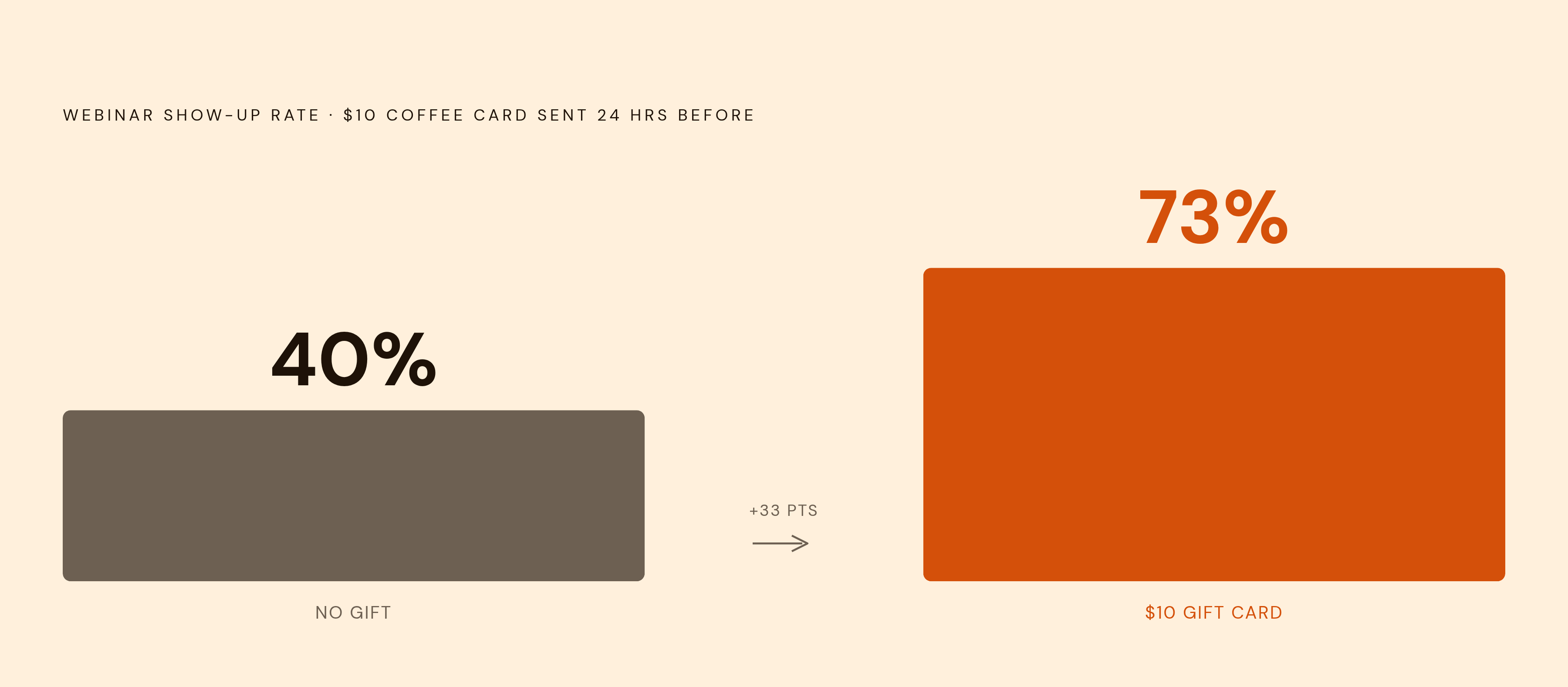
Build around actual moments, not the calendar. Before a big meeting or conference, a compact recovery kit, eye masks, a mini moisturizer, a couple of good snacks, reads as useful for someone who's constantly on a plane. I keep thinking about one number from a webinar campaign: a $10 coffee gift card sent to attendees pushed show-up rates from 40% to 73%. It was small and well-timed, and it moved something real.
At a deal close or major milestone, you can go bigger. A genuine spa set with a good robe, or an experience voucher that lets her pick how she wants to celebrate. After an event, reference the actual conversation you had; a book on something she brought up, or a piece from an artisan in her home city, both prove you were listening rather than skimming your notes. At renewal or expansion, step the quality tier up a notch: a premium skincare set or a candle from a real craft brand signals you're in this for the long haul.
New executive onboarding deserves its own approach. The strongest sends I've seen pair something practical, a tote, a notebook, a tech accessory, with something more personal, apparel in a color she picks, a good pair of socks.
Across every one of these moments, a handwritten note does more work than most teams give it credit for. It's underused in B2B, which is exactly why it's disproportionately memorable sitting next to a physical gift.
Tech and productivity gifts that consistently perform across profiles
That high acceptance rate for electronics in direct mail holds up because tech avoids the traps other categories fall into, and nobody's second-guessing whether a good pair of headphones fits their life.
Noise-canceling headphones remain a benchmark for a reason. Bluetooth earbuds work for commuters and frequent flyers, and smart wireless chargers hit a nice ratio of low cost to daily use, since people forget what these things even cost once they're using them every morning. Fitness trackers are the one exception worth flagging: they only work once you actually know she tracks her own data, and otherwise you're right back to assuming a lifestyle you haven't confirmed.
The strongest approach I've seen pairs two or three genuinely useful items, a notebook, a water bottle, a set of earbuds, with her name and a specific message. The tech carries the value, and the note carries the relationship.
Tech performs across such different profiles for a simple reason. It doesn't assume anything about her weekend plans, it has obvious and immediate use, and it signals you thought about her time rather than her title.
Sustainable and purpose-driven gifts for values-aligned prospects
Sustainable gifting is growing faster than almost any other category in corporate gifting right now, and that tracks with a real shift in what recipients, and the companies they work for, actually care about.
Sustainability only works as a gift when the quality holds up next to it. A few ways I've seen this land well:
- Upcycled or plant-based products, soaps, packaging, sourced through certified B-corps or verified sustainable suppliers
- Desk plants or other living gifts, low-maintenance, low-waste, and they actually last
- Charitable donations made in her name, tied to a cause connected to her industry or something she's publicly supported
- Give-back tokens that are symbolic and shareable by design, the kind people photograph and post
Personalization matters just as much here as anywhere else. The best version of a sustainable gift ties back to something specific: her company's own sustainability pledges, a cause she's spoken about publicly, a local maker in her region.
I've seen this go wrong enough times to say it plainly: eco-friendly framing only counts alongside genuine quality, and a flimsy recycled tote impresses nobody, no matter how green the packaging looks. The bar is high quality and sustainable, both at once.
How to build a scalable gifting process that doesn't sacrifice personalization
Every gifting program eventually runs into the same tension. Personalization that actually lands takes research, judgment, and time, while scale demands systems. The fix is building a workflow that respects both.
I think about it in three rough tiers. Cold prospects with no data get a pre-approved catalog of solid, universal options, drinkware, snack boxes, gift cards. Warm prospects or known clients get personalized picks guided by CRM notes, LinkedIn research, whatever came up in past calls. Strategic accounts and executive relationships get something bespoke and occasion-specific, sometimes an experience instead of an object.
This matters even more inside account-based marketing, where gifting is already one of the proven levers, and most B2B marketers now rank ABM as their best-performing investment by ROI.
What lets this scale without losing the personal touch comes down to the system underneath it. Recommendation tools that factor in recipient profile, industry, and relationship stage cut down on the guesswork, though someone still has to build the logic behind the suggestion in the first place. Address confirmation solves the real headache of shipping to remote or hybrid teams. CRM integration means every send gets logged and tied to actual pipeline data, which turns gifting from a nice gesture into something measurable. Global fulfillment starts to matter the moment your prospects live outside North America.
Sendoso built its SmartSuite around this kind of workflow, catalog curation and CRM integration working together so a team isn't rebuilding the process from scratch with every send. It's one example of the category, and it's the one I've watched teams actually adopt.
Measurement is what makes a program grow instead of stalling. Enterprise teams that track engagement from their gifting spend directly are the ones who can actually defend the budget line next year, and skipping that step means leaving real pipeline visibility on the table.
The principles that make any gift to a female client or prospect land well
One well-chosen item at the right moment beats a volume-based, spray-and-pray approach, and I haven't seen it go the other way yet.
Context matters more than category. Relationship stage, the specific occasion, and what you actually know about this one person, that's what should drive the decision, not a template.
Personalization lives in the small stuff: her name written by hand, a reference to something she said on a call three weeks ago, a product sourced from a maker in her own city, and all of it carries more weight than whatever number sits on the price tag.
Timing is its own kind of respect. A gift that shows up right after a rough quarter, or right at renewal, says something a holiday batch-send never will.
Measure it too, by tying every send to a CRM event, watching how people respond, and seeing what it does to pipeline. That's how a program earns its budget instead of running on faith.
The people on the other end of these gifts are executives and decision-makers doing serious work under real pressure, and treating them that way is most of it. The quality of what you send, and the thought sitting behind it, is pretty much the whole game.