Industry-Specific Gift Restrictions for Financial Services and Healthcare Clients
FINRA's tripled gift cap and entertainment exemptions demand precision from firms to stay compliant.

Most B2B gifting advice treats the constraint as budget or taste: how much to spend, what feels thoughtful without feeling excessive. That logic falls apart in financial services and healthcare, where the gift itself can break the law regardless of what the sender meant by it. What they share is a single worry: gifts that might tilt a decision someone is making on behalf of somebody else, whether that's an investor's money or a patient's care.
A lot of senders get caught off guard by this. The marketer, the sales rep, the account manager sending the gift is often not even the regulated party themselves. But the send can still trigger the recipient's own compliance obligations, and it can still create legal exposure for the sender's company. A gifting program built for tech or manufacturing clients, copied over to a healthcare or financial services account list without modification, is a liability generator waiting to activate.
None of this means gifting is off the table. It means the senders who take the time to learn the actual rules, the exclusions, the paperwork, end up with programs that work precisely because most competitors either get the rules wrong or give up on gifting altogether. Understanding the terrain is the differentiator now.
FINRA Rule 3220 After Its March 2026 Overhaul
FINRA Rule 3220, known as the Gifts Rule, got its first real update since 1992 when the SEC approved amendments on February 12, 2026, with an effective date of March 30, 2026 FINRA'S Revised Gifts Rule | StarCompliance The new FINRA Gifts Rule | Norton Rose Fulbright. The headline change: the annual per-recipient gift cap tripled, from $100 to $300 FINRA'S Revised Gifts Rule | StarCompliance Regulatory Notice 26-05 | FINRA.org. FINRA had floated $250 first, moved to $300 after industry pushback, and industry groups had actually been asking for $500 FINRA'S Revised Gifts Rule | StarCompliance Regulatory Notice 26-05 | FINRA.org. FINRA's own reasoning ties the number to inflation since 1992 plus roughly a decade of projected inflation forward, an attempt to avoid revisiting the cap again anytime soon FINRA'S Revised Gifts Rule | StarCompliance Regulatory Notice 26-05 | FINRA.org.
The core prohibition stays simple in structure even as the number moved: no FINRA member firm or associated person may give anything of value worth more than $300 a year to a person, where that gift relates to the business of that person's employer FINRA'S Revised Gifts Rule | StarCompliance Regulatory Notice 26-05 | FINRA.org. The update sits inside FINRA's broader Forward initiative, an effort to modernize rules and guidance across the board. Conforming changes also lifted the cap to $300 in Rules 2310, 2320, 2341, and 5110, the non-cash compensation rules touching direct participation programs, variable contracts, investment company securities, and corporate financing FINRA'S Revised Gifts Rule | StarCompliance Regulatory Notice 26-05 | FINRA.org.
Proposed Rule 3220(d) gives FINRA staff a new mechanism to grant exemptions, conditional or unconditional, for "good cause shown". That's meant to give some flexibility across firms of different sizes and business models, rather than forcing every firm into an identical box.
The distinctions within Rule 3220 that most senders misread
A lot of well-meaning compliance programs go sideways right here. Rule 3220's scope is narrower than most people assume: it covers gifts to employees of institutional clients, vendors, and counterparties. It does not cover individual retail customers, and it does not cover a firm's own associated persons. That means a gift sent to a prospect at a company that isn't an institutional account might fall entirely outside the rule, and senders ought to confirm how a recipient is classified before defaulting to the $300 cap on every send FINRA'S Revised Gifts Rule | StarCompliance Regulatory Notice 26-05 | FINRA.org.
Entertainment is its own category and carries no dollar cap at all. Business entertainment, meals, a ballgame, theater tickets, comparable outings, stays permissible as long as a firm representative is actually present and the frequency or scale doesn't start to look excessive FINRA'S Revised Gifts Rule | StarCompliance Regulatory Notice 26-05 | FINRA.org. The line that trips people up during exams is the accompanied versus unaccompanied distinction: if the host attends alongside the client, it's entertainment. Hand over the same tickets without showing up, and it becomes a gift that counts against the $300 annual limit FINRA'S Revised Gifts Rule | StarCompliance Regulatory Notice 26-05 | FINRA.org. Anything incidental to an entertainment event, a small item tossed in alongside the tickets, counts toward the cap too, unless it separately qualifies for an exemption FINRA'S Revised Gifts Rule | StarCompliance Regulatory Notice 26-05 | FINRA.org.
FINRA also codified a set of exclusions that sit outside both the cap and the recordkeeping requirement. Personal gifts tied to infrequent life events, weddings, births, qualify as long as they're customary, reasonable, genuinely personal, and unconnected to the employer's business. A firm-reimbursed gift doesn't count as personal under this test, even if it looks identical to one that would. De minimis items and promotional items carrying a logo also fall outside the cap, provided their value sits substantially below the $300 threshold, not just technically under it FINRA'S Revised Gifts Rule | StarCompliance Regulatory Notice 26-05 | FINRA.org.
How aggregation and supervision requirements shape the gifting workflow in financial services firms
The $300 cap is firm-wide, not a per-gift limit or even a per-sender limit. It's firm-wide. Firms must aggregate all gifts from the firm and every associated person to a single recipient across the entire year (the $300 cap is firm-wide, not per-sender) FINRA'S Revised Gifts Rule | StarCompliance Regulatory Notice 26-05 | FINRA.org.
This seems counterintuitive at first. A higher cap should reduce risk, right? In practice it does the opposite for tracking purposes. Under the old $100 limit, small gifts hit the ceiling quickly and got flagged early FINRA'S Revised Gifts Rule | StarCompliance Regulatory Notice 26-05 | FINRA.org. At $300, gifts can quietly accumulate over a much longer stretch of the year before crossing the line, which means ongoing tracking matters more now, not less FINRA'S Revised Gifts Rule | StarCompliance Regulatory Notice 26-05 | FINRA.org.
That tracking can't be self-policed by the person sending the gift, either. Classification and compliance review need to run through a process independent of whoever's doing the giving, and every gift needs to be recorded in the firm's books and records for someone else to check FINRA'S Revised Gifts Rule | StarCompliance Regulatory Notice 26-05 | FINRA.org. Put those two requirements together (aggregation across the whole firm, plus independent review) and the practical conclusion is hard to avoid: a centralized sending system with CRM integration and per-recipient spend tracking is close to a necessity now. It's close to what the rule requires as a matter of operations. Firms also need to update written supervisory procedures, compliance manuals, and expense reimbursement systems to reflect the new threshold and the newly codified valuation rules, and refresh training for anyone sending gifts on the firm's behalf FINRA'S Revised Gifts Rule | StarCompliance Regulatory Notice 26-05 | FINRA.org.
MSRB Rule G-20 and the additional layer for municipal securities firms
Firms working in municipal securities don't get to stop at FINRA Rule 3220 FINRA'S Revised Gifts Rule | StarCompliance The new FINRA Gifts Rule | Norton Rose Fulbright. Municipal securities dealers and municipal advisors also answer to MSRB Rule G-20. On May 1, 2026, the MSRB filed proposed amendments to G-20 with the SEC, designed to keep it aligned with the FINRA changes.
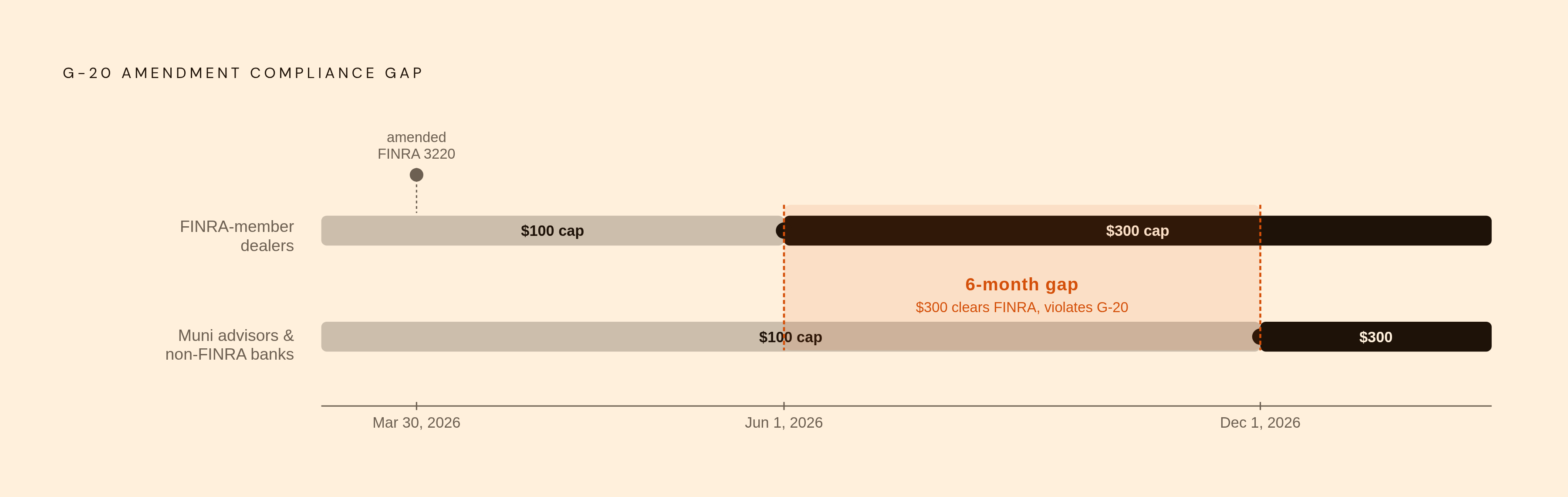
The rollout, though, is staggered in a way that creates a genuinely awkward transition period. FINRA-member dealers hit their operative date on June 1, 2026, and are already living under the amended G-20. Municipal advisors and bank dealers that aren't FINRA members don't reach their compliance date until December 1, 2026, and until then they're still bound by the old $100 annual limit FINRA'S Revised Gifts Rule | StarCompliance Regulatory Notice 26-05 | FINRA.org.
That gap matters more than it sounds. A gift that comfortably fits inside the new $300 FINRA threshold can still violate the older $100 G-20 limit if it goes to a municipal advisor or bank dealer before December 1, 2026 FINRA'S Revised Gifts Rule | StarCompliance Regulatory Notice 26-05 | FINRA.org. Senders working across both types of counterparties need to check which limit applies before assuming the higher number is universal.
G-20 also doesn't hand out blanket exemptions the way some might expect. Even a gift that technically matches an exempt category description can still violate the rule if it creates an apparent or actual material conflict of interest. And state or local law can impose tougher limits than either federal framework, something the MSRB specifically calls out, particularly around gifts to government officials tied to municipal bond issuance. Check state by state before sending anything into that world.
One more wrinkle for firms that are dual-registered. Investment advisers under the Investment Advisers Act answer to SEC Reg BI and fiduciary duty standards rather than FINRA Rule 3220 directly, though a dual-registrant firm can end up facing both frameworks at once. Reg BI requires written policies that identify conflicts tied to recommendations and either disclose or eliminate them.
Healthcare's anti-kickback framework sets a much harder baseline with "anything of value"
Financial services regulation, for all its complexity, still gives senders a number to work with. Healthcare doesn't offer that comfort. The federal Anti-Kickback Statute bars paying "remuneration" to induce or reward patient referrals, or to generate business involving anything payable by Medicare, Medicaid, or another federal health program. And "remuneration" is defined about as broadly as language allows: anything of value, direct or indirect, overt or hidden, cash or in kind. There's no floor below which a gift is automatically safe. None.
Both sides of the exchange carry exposure, too. The company or person offering the gift can be prosecuted, and so can the recipient who accepts it. The penalties reflect how seriously the statute treats this: civil penalties running up to roughly $50,000 per violation plus treble damages, three times the value of the kickback itself. Criminal penalties reach up to roughly $100,000 in fines and as much as 10 years in prison, classified as a felony, reflecting board-level risk FINRA'S Revised Gifts Rule | StarCompliance Regulatory Notice 26-05 | FINRA.org. That's not a fine line item a company writes off. It's board-level risk.
The mental model shifts entirely from what financial services trains people to think. Under FINRA, the operating question is "am I under $300?" Under AKS, the question is different in kind: could this gift be read as inducing a referral or a purchase decision tied to a federal health program FINRA'S Revised Gifts Rule | StarCompliance Regulatory Notice 26-05 | FINRA.org? A diagnostic lab handing physicians free trips to encourage referrals violates AKS regardless of what the trip cost. The link between the gift and the referral is the violation FINRA'S Revised Gifts Rule | StarCompliance Regulatory Notice 26-05 | FINRA.org.
Disclosure Under the Physician Payments Sunshine Act
Layered on top of AKS sits a second mechanism, this one built around disclosure rather than prohibition. CMS collects those reports and publishes them in the Open Payments database. Covered recipients include physicians, teaching hospitals, physician assistants, nurse practitioners, and clinical nurse specialists, a list that's expanded since 2021.
Even something as ordinary as a lunch or an educational handout given to a healthcare professional gets logged and reported, and CMS audit activity around this has kept expanding. Reports are due to CMS by March 31 each year, after which covered recipients have 45 days to review and dispute entries before the data is posted publicly around June 30 FINRA'S Revised Gifts Rule | StarCompliance. Skip the reporting requirement and the civil penalties can reach up to roughly $1 million, adjusted annually.
What makes Open Payments sting in a way plain fines don't is that the database names names publicly, both the company that gave the item and the physician or institution that received it. That's reputational exposure sitting on top of regulatory exposure. And the data doesn't just sit there for public curiosity. It's shown up repeatedly as the evidentiary starting point for federal and state kickback enforcement actions. Legislative appetite to widen this net hasn't slowed either: senators reintroduced the Open Payments Expansion Act to broaden reporting requirements further, still pending as of publication.
What does that mean for a gift that's technically legal? It still leaves a permanent public record. Recipient physicians and their employers have gotten increasingly sensitive to how that record looks, independent of any rule getting broken. Optics now carry weight alongside legality.
The PhRMA Code and Stark Law: the practical "no-gift" standard most pharma and device senders operate under
Given AKS and the Sunshine Act sitting side by side, it's not surprising that most pharmaceutical companies have settled on something close to a blanket no-gift policy toward HCPs. That posture traces back to the PhRMA Code, a voluntary ethics standard first enacted in 2002 governing how pharma companies interact with healthcare professionals.
The prohibited list under the Code is specific and leaves little room for interpretation. Entertainment and recreation items for HCPs who aren't salaried company employees are out entirely: theater tickets, sporting event tickets, golf outings, sports equipment, leisure trips of any kind, vacations, boating, fishing, hunting excursions. That holds regardless of dollar value and regardless of the HCP being engaged as a paid speaker or consultant. Dollar value simply isn't the test here, the category of the item is.
Speaker programs remain the main context where anything resembling event gifting still happens, but the constraints are tight. The program needs a genuine educational purpose tied to a real need among attendees. Meals have to stay modest by local standards and stay incidental to the content. Alcohol isn't permitted in connection with these programs, and high-end restaurant venues don't pass muster. Invitations are limited to people who actually have an educational need for what's being presented.
Stark Law adds its own paperwork requirement on the provider side: healthcare organizations need to maintain a physician gift log, monitored across the calendar year, and non-monetary compensation can't be requested by the physician, by members of the affiliated practice, or by immediate family. The strategy shifts toward educational value, compliant speaker programs, and peer-reviewed evidence instead.
Worth a scope note here, because it's easy to over-apply this. The Code and Stark Law are aimed at HCP-facing interactions specifically. Senders targeting healthcare administrators, procurement staff, IT, or operations roles inside a health system operate in a different compliance environment, closer to standard B2B norms, though AKS and whatever institutional policy the health system runs internally still deserve a look before anything gets sent.
Where gifting still works in healthcare and financial services
Gifting hasn't disappeared from either industry. It's narrowed, and it's gotten procedural. In financial services, the room to operate sits inside clearly defined boundaries: know whether the recipient counts as institutional or retail, track spend at the firm level rather than the individual level, and lean on entertainment (with a host present) where gifts alone would trip the cap. The compliance work isn't glamorous. Aggregation tracking, independent review, updated procedures, none of that is exciting. But it's what makes the $300 threshold usable rather than theoretical.
Healthcare asks something different. With HCPs specifically, gifting in the traditional sense mostly isn't the play anymore, and the honest programs have already accepted that and moved toward education and disclosure-ready engagement instead. Move one step over, toward administrators, procurement, and operations staff at health systems, and the constraints loosen enough that thoughtful, well-documented gifting can still build a relationship without becoming a liability.
The throughline across both industries isn't really about gifts at all. It's about knowing exactly who the recipient is, exactly what role they hold, and exactly which rule book applies before anything ships. Get that sequence right, and gifting still works. Skip it, and the nicest gift in the world becomes the easiest way to end up in a regulatory filing nobody wanted to write.
Sources
- FINRA’S Revised Gifts Rule | StarCompliance
- Gifts, Gratuities and Non-Cash Compensation
- Rule G-20 Gifts, Gratuities, Non-Cash Compensation and Expenses of Issuance (Legacy Rule for Certain Regulated Entities Effective until December 1, 2026) (LEGACY RULE APPEARS AFTER CURRENT VERSION. SCROLL DOWN TO VIEW.) | MSRB
- msrb.org
- asahq.org