Measuring Recipient Satisfaction with Corporate Gifts
Three measurement dimensions separate real satisfaction from delivery logistics.

Let's be precise, because "satisfaction" is one of those words that gets stretched until it loses all diagnostic value.
A delivered package is not a strengthened relationship. Delivery confirmation tells you the logistics worked. It tells you nothing about what happened in the recipient's mind when they opened the box, or whether they thought about your company at all afterward. I've seen programs celebrate near-perfect delivery rates while their pipeline sat completely unmoved, and the two facts were not in tension; they were describing entirely different things.
Recipient satisfaction in a corporate gifting context has three dimensions worth actually testing. Did the recipient feel the gift was worth receiving, relative to their expectations? Did it signal that the sender understood something true about them, their role, their context? And did it shift how the recipient feels about the sending company? These aren't soft, feel-good variables. Research across more than a million gift sends found that a large majority of recipients feel more valued after receiving a corporate gift, and most remember the company that sent it. Memory is a satisfaction outcome. It is not a delivery outcome.
What satisfaction is not: a redemption rate standing alone. Claimed doesn't necessarily mean valued. And the absence of complaints isn't satisfaction either; most dissatisfied recipients say nothing. They just quietly forget you, which is its own kind of signal, and one most programs are architecturally blind to.
There's also a contextual problem that trips up a lot of programs. A modest gift to a cold prospect and a substantially larger gift to a renewing enterprise account are evaluated against completely different baselines. A measurement framework that doesn't account for that distinction will actively mislead you.
The signals that actually indicate whether a gift landed
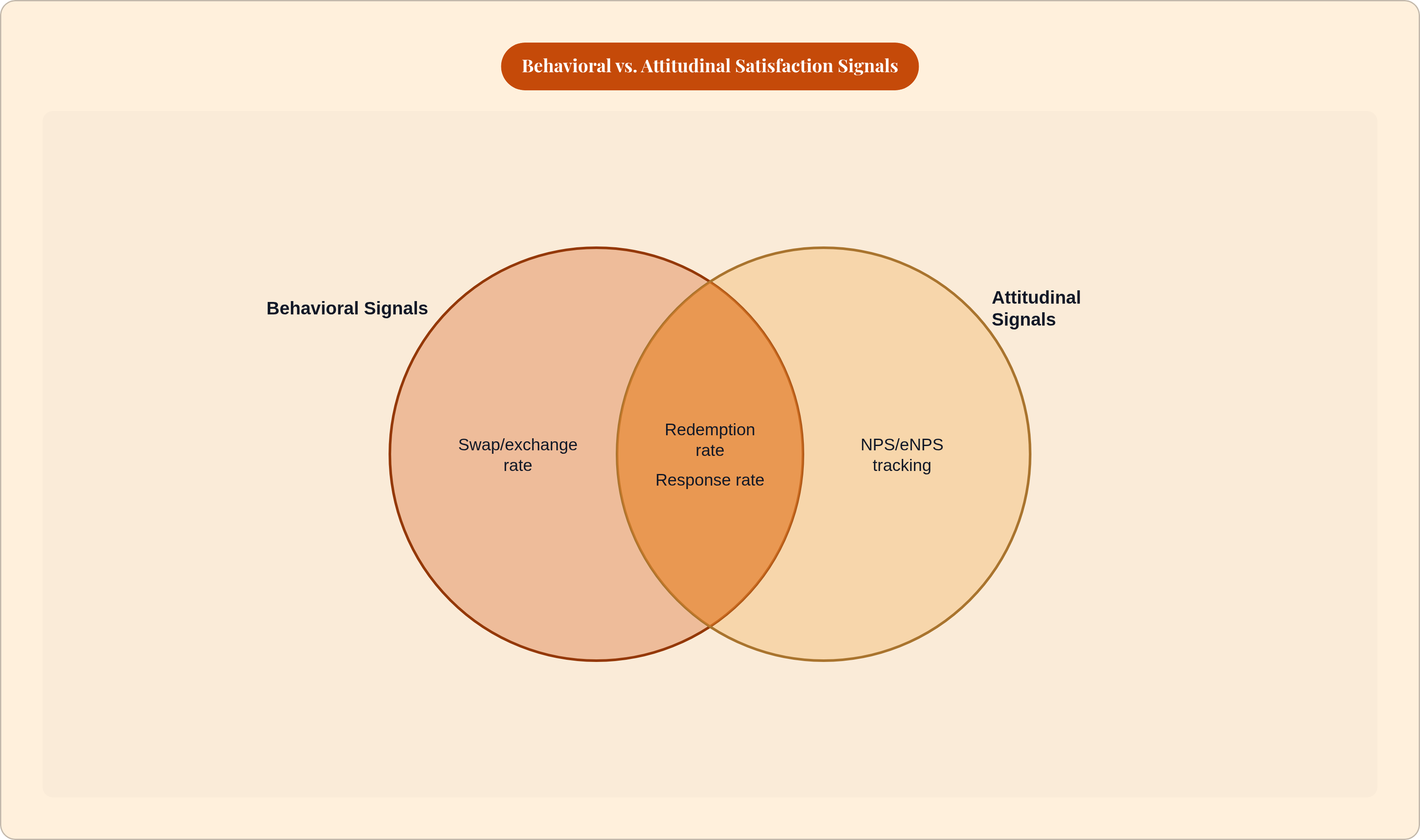
Once you know what you're measuring, the practical problem is capturing it without building a parallel data operation your team will abandon in six weeks. Signals fall into two broad categories: behavioral and attitudinal.
Behavioral signals are observable actions that don't require recipients to volunteer anything. Redemption rate is the baseline. Response rate, whether someone replied, booked a meeting, or took a next step after receiving a gift, is frequently more useful. In choice-based gifting models, exchange or swap rate is revealing in a way that most teams underuse: a high swap rate means the initial offer didn't resonate; a low one suggests the curated option actually landed. Time-to-response is perhaps the most underrated signal in the whole stack. How quickly someone acts after receiving a gift is often a more honest proxy for enthusiasm than anything they'd write in a survey. And the signal teams most consistently ignore: the non-redemption. A gift that goes unclaimed is data. Wrong audience, wrong offer, wrong timing. It shouldn't be filed as a failed send and forgotten.
Attitudinal signals are what recipients say when you ask them directly, which requires that the ask be short, timely, and embedded in something they're already opening. One satisfaction question. One open-ended question, something like "What would have made this more meaningful?" Optionally, an NPS-adjacent item for employee programs. For internal gifting specifically, eNPS tracked before and after recognition campaigns tells you whether the program is moving sentiment or generating noise.
Choice-based platforms generate behavioral signal data automatically: accept, exchange, donate. The platform captures something real about satisfaction whether or not anyone fills out a survey. That matters because more than half of employees, in one survey, said they'd prefer to choose their own gift. That's not a logistics preference; it's a structural argument for choice-based models, and the data those models generate is a byproduct of giving people what they already want.
Connecting satisfaction signals to business outcomes teams actually report on
Satisfaction is the leading indicator. The real question is what satisfied recipients do next, and whether you can connect that behavior to something a CFO finds credible.
In a sales context, two pipeline metrics are worth the effort of tracking carefully: pipeline sourced, whether the gift served as the first meaningful touchpoint that triggered a response from a cold or stalled account; and pipeline influenced, whether a deal already in motion moved faster or closed after a gifting touchpoint. Meeting conversion is a useful bridge between the two. If satisfaction-indicating behavior (a quick reply, a warm tone, a same-day booking) correlates with meetings set, you have a behavioral chain you can actually defend in a QBR.
On the retention side, the connection is one of the more compelling arguments for systematic measurement, and one of the least often made rigorously. Recipients who feel valued do more business again; this shows up consistently in research. But the more useful version of that finding isn't the industry benchmark. It's whether you can trace the chain in your own CRM, tagging gifting touchpoints and comparing renewal rates between gifted and non-gifted cohorts over the same period. The comparison tells you whether the effect is real in your program specifically.
Employee engagement dropped from 23% to 21% globally in 2024, a number that sounds like rounding error until you price out what even marginal disengagement costs in turnover and lost productivity. The metrics worth tracking on the HR side: eNPS movement before and after recognition campaigns, 90-day retention rates for gifted versus non-gifted onboarding cohorts, and absenteeism compared across periods when gifting campaigns ran and when they didn't.
One structural note on attribution: multi-touch attribution with a conservative estimate of gifting's share survives executive review far better than first- or last-touch claims. Tie each initiative to one primary outcome and keep supporting KPIs to three or five, maximum. Programs that track everything and surface nothing give budget-cutters exactly the ammunition they need.
The ROI formula itself is simple enough: revenue impact minus total program cost, divided by total program cost, multiplied by 100. What teams consistently undercount are staff hours spent sourcing and coordinating, packages returned due to bad addresses, and undelivered sends that still consumed budget. Miss those, and the calculation looks better than it is until someone audits it.
Building the feedback loop: how to actually collect satisfaction data without friction
Most teams don't measure because they don't have a lightweight, repeatable system. That's almost always a process problem, not a motivation problem.
Timing matters more than the survey itself. The best window for feedback is within 24 to 48 hours of confirmed delivery or redemption, before the gift has faded from working memory and before the recipient has mentally filed the interaction away. Automated, triggered follow-up via your CRM or gifting platform makes this feasible at scale without anyone manually chasing responses. Leave it to manual follow-up and it simply won't happen consistently enough to matter.
Survey design should be ruthlessly short. One to three questions, embedded in a thank-you or gift notification email rather than sent as a separate request. The separate request reads as work. Embedded in a message the recipient is already opening, it reads as a natural continuation of a warm interaction. That framing distinction actually affects response rates.
For teams that can't get survey responses above the noise floor, choice-based platforms offer a more pragmatic path. When recipients can accept, exchange, or donate their gift, the choice itself is the signal. Alyce's Power-of-Choice model feeds those actions into AI personalization recommendations without a separate feedback step.
Satisfaction data that lives outside your CRM is, operationally speaking, satisfaction data that doesn't exist. It needs to live where deals and accounts live so scores can be cross-referenced with pipeline movement and account health. Without that integration, you have a report card. With it, you have a diagnostic.
A sensible review cadence: weekly operational review covering delivery and redemption, monthly program review covering funnel and satisfaction trends, quarterly executive roll-up covering satisfaction-to-outcome correlation. That structure keeps the data actionable without turning it into a second job.
What satisfaction data reveals about personalization gaps in a gifting program
The pattern that shows up most often in satisfaction data isn't uniformly low scores. It's average scores with high variance. Some recipients loved the gift; others were indifferent. That variance almost always maps to personalization quality, not gift cost. The $75 gift that felt chosen for someone outperforms the $150 gift that went to anyone.
Generic sends to segments rather than individuals are a leading cause. Roughly half of vendors send identical items to every client, according to available research, which means the variance in satisfaction isn't mysterious; it's predictable. Timing mismatch is another common failure: a gift that arrives after the deal closes, or after an employee's first week has passed, lands with a fraction of the intended effect. Format mismatch is subtler but equally damaging. Swag sent to a remote worker with no office. Food gifts to someone with dietary restrictions. These aren't edge cases. Snappy's 2025 Holiday Gifting Report found that 70% of employees have received an unwanted holiday gift. A majority experience, not a minority one, and most of those employees never said anything to their employer about it.
When satisfaction is high, personalization is typically the explanation. Research shows 84% of decision-makers say a personalized gift helps them feel a human connection. Satisfaction data segmented by gift type, recipient persona, deal stage, or send trigger can isolate which combinations drive the strongest signal. That's where the data stops being a report card and starts being a prioritization tool.
Alyce's 5to9 interest research surfaces personal interests from public data for individualized recommendations at scale. Because the satisfaction feedback loop feeds back into the AI model, recommendations improve over time. The system learns from what didn't land as much as from what did, which is the part of the loop most programs never close.
Applying satisfaction data across the full sending program: sales, marketing, customer success, and HR
Each team is accountable for a different primary outcome, so satisfaction data looks different depending on where you sit.
For sales, the signals that matter most are response rate and time-to-meeting after a send. Gifted email campaigns, in one large-scale study, achieve an 85% open rate compared to roughly a third for standard outreach, with conversion rates many times higher compared to 3%. What the data tells sales leadership, concretely, is which gift types break through at which deal stages, and which accounts justify a deeply personalized, more expensive send versus a lighter touch. That's a resource allocation question, and satisfaction data gives you the evidence to answer it with something other than gut feeling.
For marketing, particularly account-based marketing and event programs, the primary signals are account engagement rate post-send and event attendance lift for pre-event sends. A Forrester Consulting study of B2B marketing leaders found that 76% say buyers are less likely to engage with digital touchpoints than a year ago. Satisfaction data segmented by persona tells ABM teams which verticals or buyer profiles respond best to gifting versus other channels, which is the argument that converts skeptical stakeholders.
For customer success, the signals are NPS or CSAT movement and renewal rates in gifted versus non-gifted cohorts. Research shows more than half of recipients are more likely to continue a business relationship with companies that send thoughtful gifts. Whether that benchmark holds in your specific program is something your own data either confirms or challenges. Both outcomes are worth knowing.
For HR and people teams, the feedback loop is the most direct of the four. An employee who receives a gift that feels impersonal isn't just unimpressed; they're reflecting back something about how well the organization understands them. That signal, tracked through eNPS movement and 90-day retention rates, can inform the next onboarding cohort's experience before it becomes a retention problem rather than after.
Across all four functions, the constraint is the same: satisfaction data is only as useful as the decision it enables. Track it against one primary outcome per initiative. Close the feedback loop. Let the data shape the next send.