CRM Integration for Corporate Gifting
Bidirectional sync with your CRM turns gifting into a measurable revenue driver.

When people say "CRM integration," they usually mean something narrower than they should. A CSV export is not integration. A manual sync that runs twice a week is not integration. Real integration, the kind that makes gifting a revenue motion rather than a line-item gesture, is bidirectional, and that distinction gets glossed over when teams are shopping for a platform under deadline pressure.
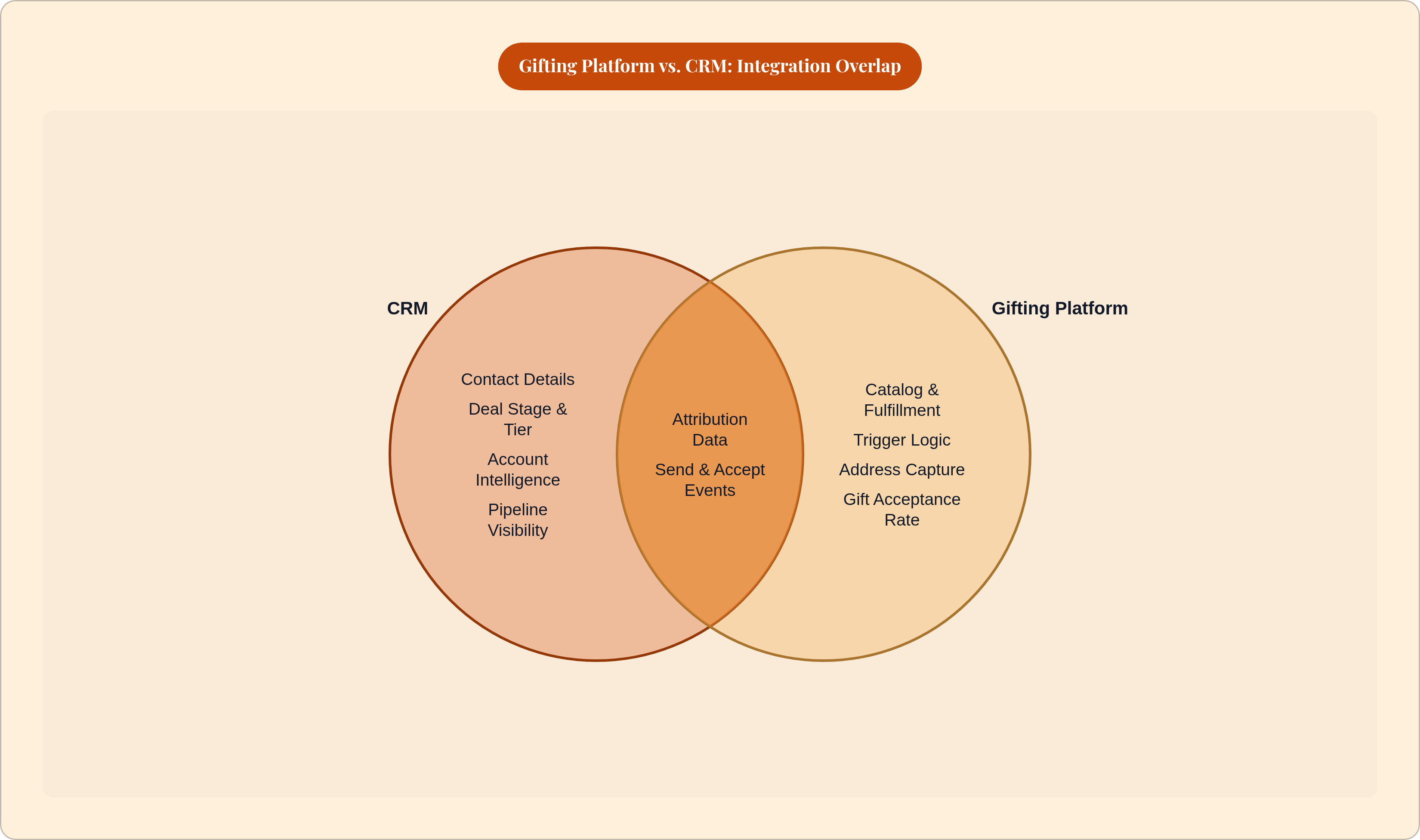
Here's the mechanical reality: the CRM pushes contact details, deal stage, account tier, and trigger conditions into the gifting platform. The gifting platform pushes send confirmations, acceptance events, and click data back. That acceptance event lives in the contact's activity timeline alongside calls, emails, and meetings. The deal record updates. Gifting activity becomes visible in the same place your pipeline is visible. Without that feedback loop, you have sends without attribution, activity without evidence, and a budget line that's indefensible when procurement starts asking questions.
What bidirectional integration actually replaces is a kind of operational archaeology. Manual exports. Separate tracking spreadsheets. Offline gifting that leaves no footprint in the CRM record. If a gift went out the week before a deal closed and the deal closed, was the gift a factor? Without integration, you cannot answer that question. And "we think it helped" is not a position you want to defend in a budget review.
There's also a mundane benefit that gets systematically undersold: address capture. One of the more tedious realities of corporate gifting is chasing down shipping addresses, especially across distributed buying committees. Integrated platforms solve this by sending the recipient a confirmation link that captures the address directly, then writing it back to the CRM record. The sender never has to ask. Small friction, but small frictions accumulate in ways that kill adoption before a program ever gets traction.
The infrastructure question every team should settle early is whether to use native integration or middleware. Native connectors, direct integrations with Salesforce, HubSpot, or an HRIS, are preferable: less setup complexity, better data fidelity, and no additional habit formation for reps who are already inside those workflows. Middleware tools like Zapier can bridge gaps when a native connector doesn't exist, but each connector is another point of failure. The baseline any serious program needs is a CRM connector, trigger logic, and a reporting layer that maps send events to pipeline records. Everything else builds on top of that.
How Trigger-Based Sending Turns CRM Events into Timely Gifting Moments
A trigger, in this context, is any CRM event that automatically initiates a send: deal stage change, form submission, renewal date, NPS score crossing a threshold, employee start date, contract anniversary. The CRM already captures these moments constantly. So the question worth sitting with is: why aren't more teams acting on them automatically?
Consider what this looks like across a funnel. A prospect submits a demo request; within minutes, a modest gift card goes out alongside the confirmation. Show-up rate for that cohort becomes a measurable data point rather than an assumption someone argues about in a retrospective. Mid-funnel, a deal moves to "Proposal Sent" in Salesforce; a personalized note and a relevant gift reach the economic buyer. Time-in-stage for gifted deals gets tracked against baseline. For deals that have gone cold, thirty days of no logged activity triggers a re-engagement send, and the response, or the silence, goes back into the record.
Post-close is where the timing argument has felt most urgent to me, more than any other stage. When a deal flips to Closed Won, an onboarding gift arrives within hours. Not days later, when your new customer is already deep in implementation stress and the momentum of signing has dissipated. Hours. The first impression of the customer relationship gets set programmatically, not by whoever happened to remember that week.
B2B teams using gifting programs report 40 to 60% higher demo show-up rates and two to three times improvements in outbound response rates. Trigger-based sending is the mechanism that makes those numbers achievable at scale, because without triggers, gifting depends on human memory and available bandwidth. Both are unreliable in ways that don't surface until you're trying to explain why Q3 performance was inconsistent. With triggers, the right send happens at the right moment whether the rep is on vacation or managing five other deals simultaneously.
The principle worth internalizing: timing matters more than spend. A well-timed, contextually appropriate gift tied to a specific CRM event routinely outperforms a larger, generic gift sent without context. The signal matters as much as the substance.
How Gifting Fits into ABM — and Why the CRM Connection Is What Makes It Work There
Account-based marketing and corporate gifting look, on the surface, like adjacent activities running in parallel. They should actually be the same motion. According to the 2024 State of ABM Report from the ABM Leadership Alliance, 82% of B2B companies have an active ABM program, and gifting is increasingly a channel within those programs rather than a separate initiative orbiting beside them.
The reason CRM connectivity is essential here is that ABM runs on account intelligence: industry, persona, engagement history, deal size, strategic tier. All of that lives in the CRM. None of it reaches the gifting platform without integration. And without it, a gift sent to a target account is generic by definition, because the platform has no way to know what makes that account distinct from any other account in your ICP.
Integration enables account-tier logic. Accounts above a certain ACV or engagement score receive a higher-touch send; tier-two accounts receive something lighter. These rules fire programmatically through CRM data, not through a marketing coordinator making judgment calls on a spreadsheet at the end of the quarter. As engagement scores shift, the rules update accordingly.
The alignment problem this solves is chronically underappreciated. The same ABM report found that only 36% of companies executing ABM programs consider their sales and marketing teams tightly aligned. Better communication can fix that in some cases, but consider what actually happens when it doesn't: marketing sends a gift to a target account, sales sends one the same week, and the prospect receives two packages with no coherent narrative connecting them. Integration surfaces these conflicts before they happen, because both teams see the same CRM record, gifting activity included, and can coordinate around it.
Personalized gifts drive nine times higher engagement and faster responses from prospects. The physical send amplifies the digital sequence rather than competing with it. But personalization at that level requires account intelligence, and account intelligence lives in the CRM.
The Metrics That Prove Gifting's Contribution to Pipeline
This is where gifting programs fail even when the integration is solid. The data gets generated, and then nobody builds a framework to interpret it. Measurement is not automatic; it requires deliberate construction, and the teams that skip this step end up defending gifting spend in a difficult Q4 with nothing but anecdote.
The core methodology is cohort comparison: gifted contacts versus non-gifted contacts on the same pipeline metrics, at the same deal stages, over comparable time periods. Integration makes this comparison possible because the send event and the deal outcome live in the same system.
The metrics worth tracking cluster into a recognizable set. Gift acceptance rate is your leading indicator, segmented by account tier, gift type, and deal stage. Pipeline velocity measures whether gifting accelerates deal progression: average time-in-stage for gifted contacts versus baseline. Close rate uplift compares win rates for opportunities where a gift was sent against matched opportunities where one wasn't. Meeting show rate tracks attendance for prospects who received a gift before a scheduled demo. On the retention side, renewal rate and upsell lift for accounts in a gifting program versus a control group tells you whether the post-sale investment is compounding or simply burning budget.
For calibration: the ANA Response Rate Report found that direct mail delivered 161% ROI when sent to house lists, compared to 44% for email and 21% for social media. Personalized, triggered gifting is reaching toward that ceiling. Without the cohort comparison methodology that integration enables, though, those numbers belong to someone else's story. The teams with integration can finally tell their own.
It is also worth considering what happens to programs that never build this measurement layer. Research from ITSMA suggests only about half of companies are tracking the ROI of their ABM programs at all. Gifting programs without attribution data face the same accountability gap, and a feel-good line item with no evidence is usually the first thing cut when budgets compress. There's no mystery to why that keeps happening.
What High-Performing Teams Look For When Choosing an Integrated Gifting Platform
Vendors use the word "integration" loosely enough that specificity becomes your own responsibility. "Integration" describes everything from a bidirectional native connector to a webhook that fires one direction and calls itself a day.
Bidirectional data flow is the first question to ask: can the platform read CRM records and write send and acceptance events back to both the contact and the opportunity record? A platform that initiates sends based on CRM data but cannot write outcomes back is half an integration. It produces sends without attribution, which is activity without evidence.
Native connectors matter for reasons already discussed: reliability, data fidelity, adoption. If reps have to leave the CRM to initiate a send, usage will be inconsistent in ways that compound quietly over months. The programs with real staying power are initiated from within existing workflows, requiring no additional habit formation.
Trigger flexibility determines how sophisticated the program can become. Platforms with rigid trigger sets, only deal stage changes, for instance, constrain the program's ceiling. The more granular the logic available, deal stage plus account tier plus custom field value, the more precisely the program can target moments that actually matter rather than approximating them with blunt rules.
Fulfillment infrastructure is the variable most easily overlooked during evaluation. But what if the integration is excellent and the logistics aren't? A platform with excellent CRM connectivity but unreliable delivery creates a different kind of problem for a global team trying to reach accounts across multiple regions. Fulfillment coverage deserves evaluation alongside integration depth, not as an afterthought once the contract is signed.
Reporting location matters more than it initially sounds. Does gifting data surface inside CRM dashboards and revenue reports, or only inside the platform's own analytics UI? Attribution requires the data to live where revenue teams already work. If the proof that gifting contributed to pipeline is locked inside a separate tool that leadership never opens, the attribution argument is very difficult to make to a room full of skeptics.
Finally, catalog quality matters for acceptance rates. Data from Postal shows electronics at a 90.8% acceptance rate and gift cards at 90.3%. A narrow or outdated catalog undermines the whole program regardless of how well the integration is architected.
Building a Gifting Program That Compounds Over Time Through Better Data
Here is the argument that registers last and matters most: a connected gifting program generates a dataset, and that dataset improves every decision that follows. Which gift types drive the highest acceptance by persona. Which trigger timing produces the best pipeline velocity. Which deal stages benefit from a physical touchpoint versus a digital one. None of this is visible without the data, and the data doesn't accumulate without integration.
Without it, each send is a discrete event with no institutional memory attached. When the person who ran the program leaves, the program effectively starts over, because the knowledge was in their head rather than in the system. That's not a hypothetical; it's a recognizable pattern in teams that treat gifting as a campaign rather than a program.
The compounding dynamic has a natural cadence. In the first year, the goal is baselines: acceptance rates, pipeline velocity by stage, show rates for gifted versus non-gifted cohorts. In the second year, that CRM data becomes the basis for refinement. Cut the triggers that show no correlation to pipeline outcomes; increase investment in the moments that show the clearest lift. Over time, AI-assisted recommendation layers can sit on top of accumulated send history to match gift type and price point to recipient profile with more precision than any coordinator can manage manually. The program gets sharper by running. That's a different kind of ROI than most teams think to measure.
The budget context reinforces the case. Research from SG360's Future of Direct Mail report found that 84% of marketers increased their direct mail budget in 2025, with 38% explicitly shifting spend away from social media. Programs with clear attribution data survive and grow through reallocation cycles. Programs that cannot demonstrate pipeline contribution get rationalized away when things get tight, and they often deserve to.
A gifting program that lives inside the CRM can be defended, optimized, and scaled because it produces evidence. One that lives outside it will remain perpetually vulnerable, generating goodwill that nobody can quantify and spending budget that nobody can justify. The gift selection, the messaging, the timing: all of it sharpens once the data loop closes. And the data loop closes with the integration decision, not the catalog.