Meeting Show Rate Improvement with Pre-Meeting Gifts
Pre-meeting gifts work best on high-risk cold outbound meetings where showing up matters most.

No-shows on booked B2B meetings have nearly doubled in five years, climbing from 18% in 2020 to 32% in 2025. That's not a scheduling hiccup. It's a structural shift in how prospects treat calendar invites, and most teams are responding to it by spending gifting budget on the meetings that were already going to happen anyway. That's backwards, and it's the first thing worth fixing.
Two forces are driving the climb. Calendars are more crowded than they've ever been, and video meetings, now 84% of all B2B meetings, make it frictionless to just not show up. Nobody has to walk into an empty conference room to feel the sting of a no-show anymore. They just close the tab.
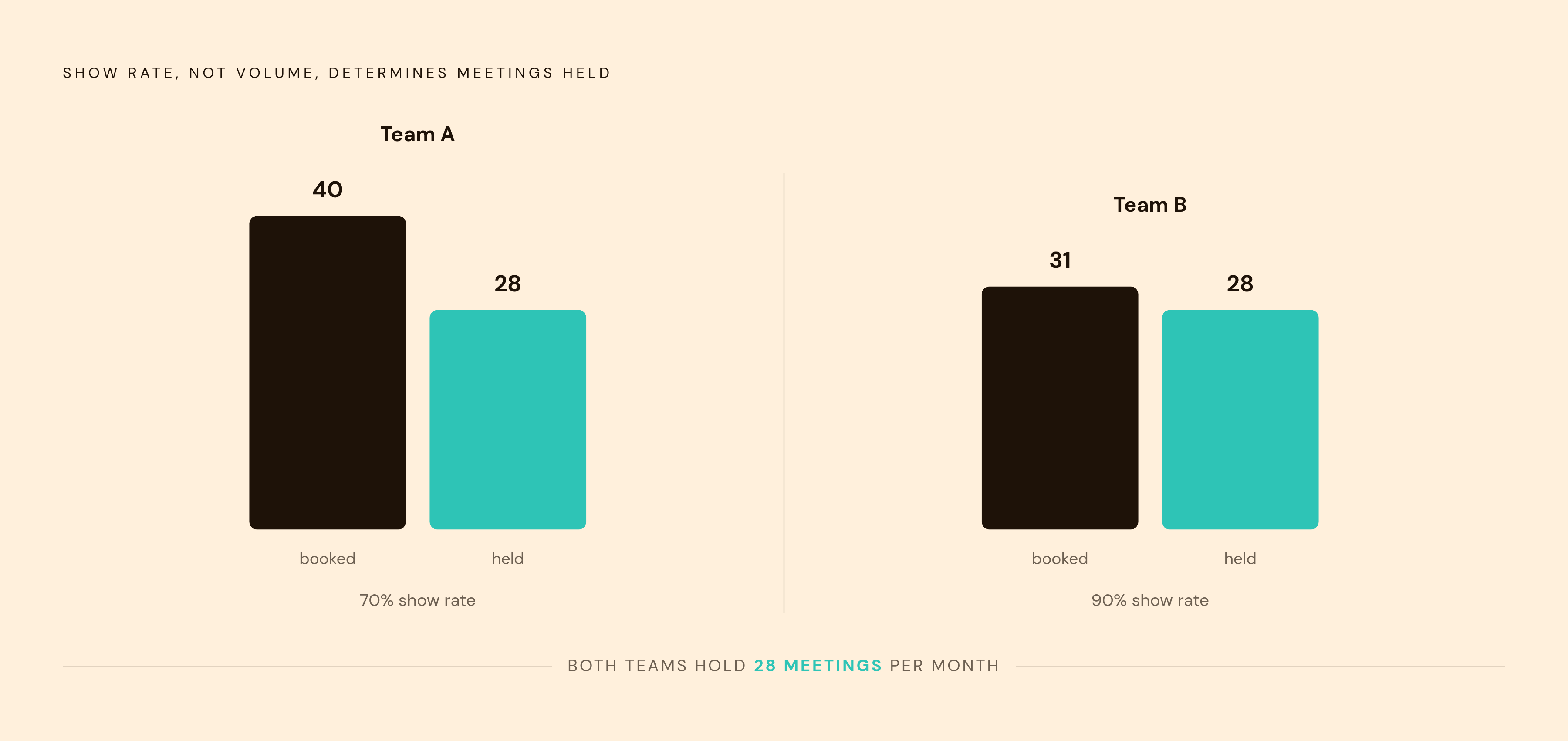
The math punishes teams that ignore it. A team booking 40 meetings a month at a 70% show rate ends up holding the same number of meetings as a team booking just 31 at a 90% show rate. So booking volume is mostly noise. Show rate is leverage, and the gap between the two determines whether a quarter feels frantic or under control.
What actually causes a prospect to skip a meeting they agreed to attend
Four things tend to be at work, and the one most teams ignore is the one that matters most: booking too far out.
Buying intent peaks the moment someone replies to an email or clicks "book a time." Then it cools, fast. Meetings scheduled further out make up a disproportionate share of no-shows, even though they're a small slice of total bookings. By the time the date arrives, the urgency that got the meeting on the calendar has evaporated. Nothing about the deal changed. The prospect's attention just moved on to the next fire.
Sometimes the invite never really landed. It went to a personal inbox instead of a work one, got caught in a spam filter, or sat there unaccepted, so no time actually got blocked off. Sounds small. It isn't, because a meeting that was never really on the calendar was never really at risk of a "no-show" in the first place. It just looks like one in the reporting.
Sometimes the person who booked the call was never the real decision maker. They said yes out of curiosity, or just to be polite, then found out internally they couldn't move the conversation forward. Rather than reschedule or admit it, they disappear.
And often the pre-call sequence just fails to keep the meeting relevant. The original outreach email that convinced them to book gets buried under a hundred others, and by meeting day, the prospect genuinely can't remember why the call mattered to them.
That fourth cause is where gifting does its clearest work, because a gift physically shows up in the prospect's world between booking and meeting day. It sits on their desk. No follow-up email does that. Worth drawing a distinction here, too: a demo booked by someone who just visited the pricing page has real intent, and that meeting usually happens the next day. A cold-outbound meeting agreed to partly out of politeness, sitting 11 days out, is exposed to all four risk factors at once. That's where pre-meeting gifting earns its keep, and it's also where most teams spend the least effort on it. Backwards again, if the goal is actually protecting the pipeline.
One more wrinkle: 41% of B2B meetings now involve three or more people. A gift mailed to the one contact who booked the call doesn't do much to keep the meeting alive on two other calendars that never got touched.
How a physical gift converts a calendar entry into a felt commitment
Why does a gift work when a reminder email doesn't? Reciprocity is the mechanism. Receive something thoughtful, and the natural pull is to respond in kind, and showing up to the meeting is the most obvious form that response takes.
A gift also signals effort. It tells the prospect that time and money went into this before the meeting even happened, which raises the social cost of backing out. Canceling now doesn't feel like clearing 30 minutes off a calendar. It feels like wasting someone's genuine effort, and that's a harder thing to do to a stranger than click "decline."
Physical mail also breaks through in a way digital outreach mostly can't anymore. A tactile object doesn't get buried in an inbox the way a paragraph of text does, which is the whole problem with relying on email reminders alone at this point in the funnel.
There's a practical bonus, too. The "did you receive the package?" follow-up gives a rep a completely natural reason to reach out again before the meeting, without it reading as a nag. It confirms delivery, reopens the conversation, and reinforces the upcoming call, all in one low-pressure message.
Email reminders keep a meeting on the calendar. A physical gift changes how the prospect feels about the person they're about to meet, and that's a different kind of commitment. Timing matters here, too: the gift needs to land before the meeting, not after. Post-meeting gifts are fine for extending a relationship, but if the goal is show rate, the object has to arrive while the prospect can still choose to show up.
Which meetings and accounts justify the investment
Not every meeting deserves a gift, and treating them all the same is where budgets get wasted. Pre-meeting gifting pays off most on Tier 1 accounts: high-value, cold-booked outbound meetings where no-show risk is elevated and deal size makes the spend easy to justify. Typical spend runs $75 to $125 per client. When the opportunity on the table is five or six figures, that math isn't complicated. When average contract value is modest, the calculation looks different, and gifting might not clear the bar at all.
One fintech company selling compliance software to regional banks paired LinkedIn warm-up messaging with a physical gift, a handwritten note plus a small, relevant item, and landed a 28% meeting booking rate. More than triple what cold email alone had been producing.
Format should follow account tier, not convenience. Physical gifts make sense for high-value Tier 1 accounts. eGifts fit broader field lists where speed and scale matter more than a tactile object. For enterprise contacts, check gift acceptance policies before sending anything: plenty of large companies cap allowable gifts at $50 to $100, and a package flagged or returned by compliance does more damage to the relationship than no gift at all.
Meeting type matters just as much as account tier, and here's where most gifting budgets get it exactly backwards. Discovery calls and first demos carry the highest no-show risk, since the relationship hasn't been built yet, yet those are often the meetings teams gift the least, saving the "reward" for later stages that were never actually at risk. Technical validation calls and closing meetings, booked off the back of an already-held meeting, tend to carry more established context and relationship than a cold first meeting. Inbound demo requests from a pricing page come with demonstrated intent that cold-booked meetings typically lack. The gifting budget belongs where the risk actually sits: cold outbound, full stop.
What a pre-meeting gifting sequence actually looks like in practice
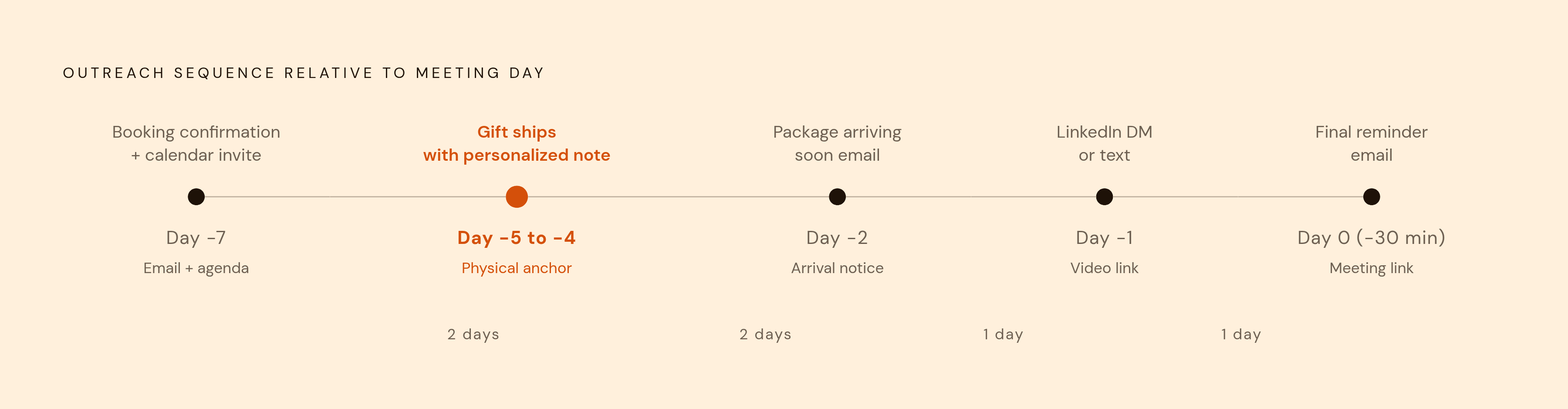
Timing isn't a minor detail here. It's most of the game. The gift should land two to three days before the meeting. Too early and its impact fades before the call happens. Too late and it might not arrive in time to matter at all.
A workable sequence looks something like this:
- Day minus 7 (booking confirmation): an email plus calendar invite with a clear agenda, so the meeting reads as a real commitment with a stated purpose, not a placeholder.
- Day minus 5 to minus 4: the gift ships, with a personalized note referencing the prospect's specific situation, not a generic "looking forward to connecting."
- Day minus 2: a "your package should be arriving" email, which doubles as a delivery check and a soft reminder.
- Day minus 1: a short, direct LinkedIn DM or text with the video link or dial-in included.
- Day zero, 30 minutes out: a final reminder email with the link front and center.
The note deserves as much attention as the gift itself, maybe more. It has to reference something specific: the prospect's role, their industry's current headache, something about their company. A generic note undoes the whole point of sending something personalized in the first place. Companies report notably higher ROI on personalized gifts versus generic ones, which says personalization isn't a nice touch. It's the actual mechanism doing the work.
The same logic extends past first meetings. For deals that have stalled, pairing a short, personalized video acknowledging where the deal sits with a physical package timed to land the same day can help re-engage stalled opportunities. Reactivation runs on the same clock as a first meeting: timing, relevance, and a physical object that shows up at the right moment.
What separates a gift that moves the needle from one that gets set aside
Price is not the variable that matters most here. Relevance is, and that's the part most gifting budgets get backwards by defaulting to "what's impressive" instead of "what's true about this person." A gift chosen because it reflects something real, a stated interest, an industry challenge, a recent company milestone, lands differently than something expensive but generic.
Three things need to be true for a gift to land. It has to be specific, tied to something genuinely known about the recipient rather than a guess. It has to be proportionate, matched to account tier and deal size (a $75 to $125 gift makes sense against a high-value opportunity; overshoot that and it reads as desperate, undershoot it and it reads as an afterthought). And it has to be compliance-safe, checked against the recipient's company gift policy before it ever ships.
Quality beats volume here, consistently. A handful of well-chosen, thoughtfully curated gifts will outperform a stack of cheap, generic ones sent at scale, because the signal isn't about budget. It's about how well the sender seems to know the person on the other end.
Some things reliably fall flat, and branded swag tops the list. Slapping the sender's logo on a gift makes it about the company sending it, not the person receiving it, which is exactly backwards from what the gift is supposed to communicate. Generic gift cards without context feel transactional, more coupon than gesture. Perishables carry real logistics risk when the whole point is a predictable arrival window ahead of a scheduled call.
The note is doing more work than people give it credit for. A generic note can undercut even a genuinely good gift, while a specific, personally composed one multiplies the effect, because it's proof a human being actually thought about this particular person. The end goal isn't gratitude. It's commitment. The prospect should look at what arrived and think: this meeting is worth showing up for.
How to measure whether pre-meeting gifting is actually improving show rates
The core comparison is straightforward: show rate on gifted meetings versus non-gifted meetings, broken out by account tier and lead source. That number tells the real story, not gut feel about whether prospects "seemed to like" the gifts.
Isolating gifting's specific contribution inside a broader pre-meeting cadence is genuinely hard. Gifting rarely runs alone. It sits inside a sequence of emails, reminders, and check-ins, so the honest move is to compare gifted-plus-cadence against cadence-alone, not gifting against nothing. That's exactly why the data needs to live in the CRM rather than in a spreadsheet a rep keeps on the side, and any program that skips this step is guessing, not measuring.
Four metrics worth tracking on an ongoing basis:
- Show rate: meetings held divided by meetings booked, split between gifted and non-gifted.
- Meeting-to-opportunity conversion: did the held meeting actually move the deal to its next stage?
- Deal velocity: are gifted pipeline deals closing faster than ungifted ones?
- Cost per held meeting: total gifting spend divided by incremental meetings held above baseline.
Attribution falls apart fast when gifting data sits outside the CRM. A gift that shipped but never got logged against the opportunity can't be credited for the meeting that followed it, no matter how obviously it helped. That's not a nice-to-have integration. It's the difference between a program that can prove itself and one running on anecdote.
Comp structure is a quieter lever worth mentioning here, too. Paying SDRs on meetings held, rather than meetings merely booked, aligns their incentives with the show-rate goal and makes the gifting program's actual impact visible in rep-level performance data.
Building a scalable pre-meeting gifting program rather than a series of one-off sends
Most gifting efforts fail quietly, and here's why: they depend on individual reps sourcing, funding, and shipping gifts on their own initiative. That approach is inconsistent by design. It's untracked, hard to attribute, and it lives entirely outside the data stack that's supposed to measure pipeline performance. Relying on rep initiative alone is close to not having a program at all, no matter how good any single rep is at picking gifts.
A program that actually scales needs a few pieces of infrastructure in place. A curated gift catalog, matched to account tiers and use cases, removes the decision fatigue that causes reps to either overthink a gift or skip it entirely. CRM-triggered sends matter just as much: a gift should ship automatically once a meeting is booked past a defined account score or deal size threshold, not whenever a rep happens to remember. Centralized budget tracking treats the spend as a revenue investment with a measurable return, not a discretionary line item nobody reviews. And global fulfillment capability matters more than it might seem, since a prospect in a different country or time zone shouldn't get excluded just because logistics got complicated.
AI-assisted gift recommendation is starting to remove the personalization bottleneck that used to make this hard to scale. Platforms can pull from CRM data, call transcripts, and recipient interest signals to suggest a relevant gift in minutes, instead of requiring a rep to research a prospect from scratch every time. That doesn't replace judgment, though. It removes friction. The rep still decides which accounts qualify and what context belongs in the note, while the platform handles procurement, shipping, tracking, and attribution, the part that was always going to break under manual process anyway.
The real test of a scaled program isn't whether gifts go out on time. It's whether the show-rate data two quarters from now can actually tell the difference between the accounts that got gifted and the ones that didn't. If it can't, the program is still running on faith, dressed up as infrastructure.