Measuring Corporate Gifting ROI
Count revenue retained and failed sends—or watch your ROI claim collapse in audit.

Start with the arithmetic, because teams get it wrong in both directions simultaneously.
The core formula is straightforward: revenue impact minus total program cost, divided by total program cost, multiplied by 100. The trouble lives inside how you define each term, and most teams have quietly agreed on definitions that flatter the program.
Revenue impact has three components. Most teams count one. Pipeline sourced covers new opportunities where a gift was the first meaningful touchpoint. Pipeline influenced covers deals that moved faster or closed at higher rates because a gift intervened somewhere in the cycle. And then there's the one that almost always gets skipped: revenue retained. Renewals and expansions tied to gifting activity within the period. Count only closed-won new logos and you're understating impact significantly. You're also making a structural argument to your CFO that gifting is purely a prospecting tool, which is almost certainly not true and will eventually be noticed.
Total program cost is wider than most budgets reflect. Gift spend is obvious. Staff hours for sourcing, coordinating, and chasing deliverability issues are real costs that rarely appear in any line item. Returned and unclaimed packages are too. Exclude those failed sends and your ROI number looks cleaner than it deserves to, until someone audits it. And they do audit it, usually at the worst possible moment.
Undercounting cost doesn't just produce a flattering number. It produces false confidence, and when that confidence gets stress-tested in a QBR, the entire program's credibility absorbs the hit.
To put a concrete anchor on it: Sendoso's ROI model illustrates a campaign generating 75 responses, 40 booked meetings, and 8 closed deals worth $120,000 against $24,000 in total program cost. That's 400% ROI. The number is credible because it traces revenue to specific outcomes and doesn't quietly exclude the sends that went nowhere. That's the standard worth building toward.
The Five-Stage Framework That Maps Gifting Activity to Business Outcomes
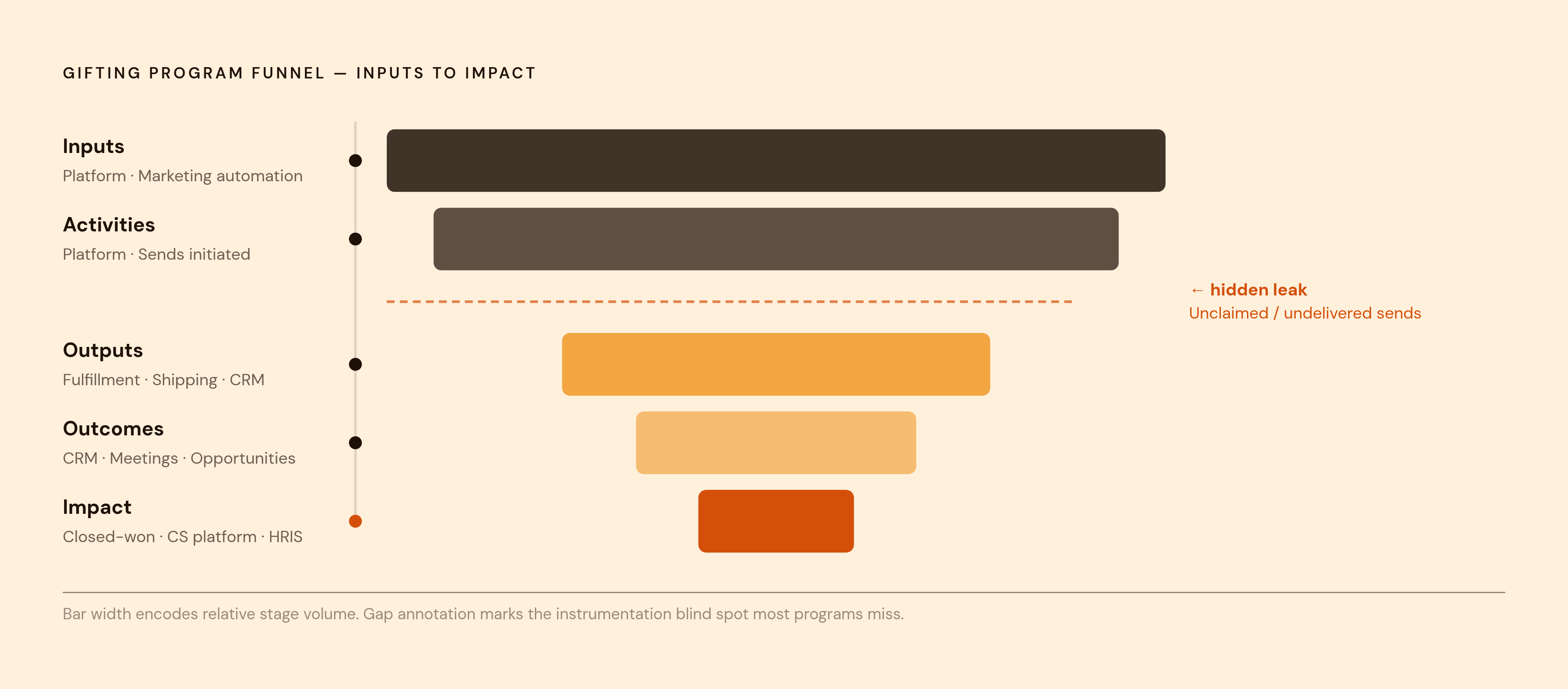
Before you measure anything, you need a shared vocabulary for what you're measuring. "The gift worked" and "the gift produced a meeting" are not the same claim, and conflating them is where most programs lose the thread.
The framework I've found most durable mirrors the funnel in five stages. Inputs: budget allocated, audience list size and quality. Activities: sends initiated, claim invitations delivered. Outputs: gifts actually claimed and successfully delivered. Outcomes: meetings booked, opportunities created, renewals triggered. Impact: revenue closed, retention rate change, the ROI figure that surfaces from all of it.
Each stage needs a designated data source. Inputs and activities come from your gifting platform and marketing automation. Outputs come from fulfillment and shipping data, ideally fed into your CRM automatically rather than via periodic export, because periodic exports introduce the temptation to clean the data before it lands. Outcomes live in CRM opportunity and meeting records. Impact lives in closed-won data, your CS platform renewal records, and HRIS for employee programs.
What breaks this framework in practice isn't the complexity. It's ambiguity in stage definitions. "Meeting booked" needs to mean a calendar hold confirmed, not an email expressing interest. Define that threshold before the program runs. If you define it after, you'll draw the line where the numbers look best, and the measurement loses the thing that made it worth doing.
Without defined stages, teams conflate activity with outcome and have no way to diagnose where a program is actually leaking. Is the problem that gifts aren't being claimed? That claimed gifts aren't converting to meetings? That meetings aren't progressing to opportunities? Each failure point has a different fix. You can't see the failure point without the framework.
The stages also generalize cleanly across program types: prospecting, retention, events, employee recognition. The funnel shape holds even when the specific metrics at each stage differ, and that consistency is what makes the framework defensible across functions when you're presenting to stakeholders who have very different reasons for caring.
The Metrics That Belong in Every Gifting Measurement Stack
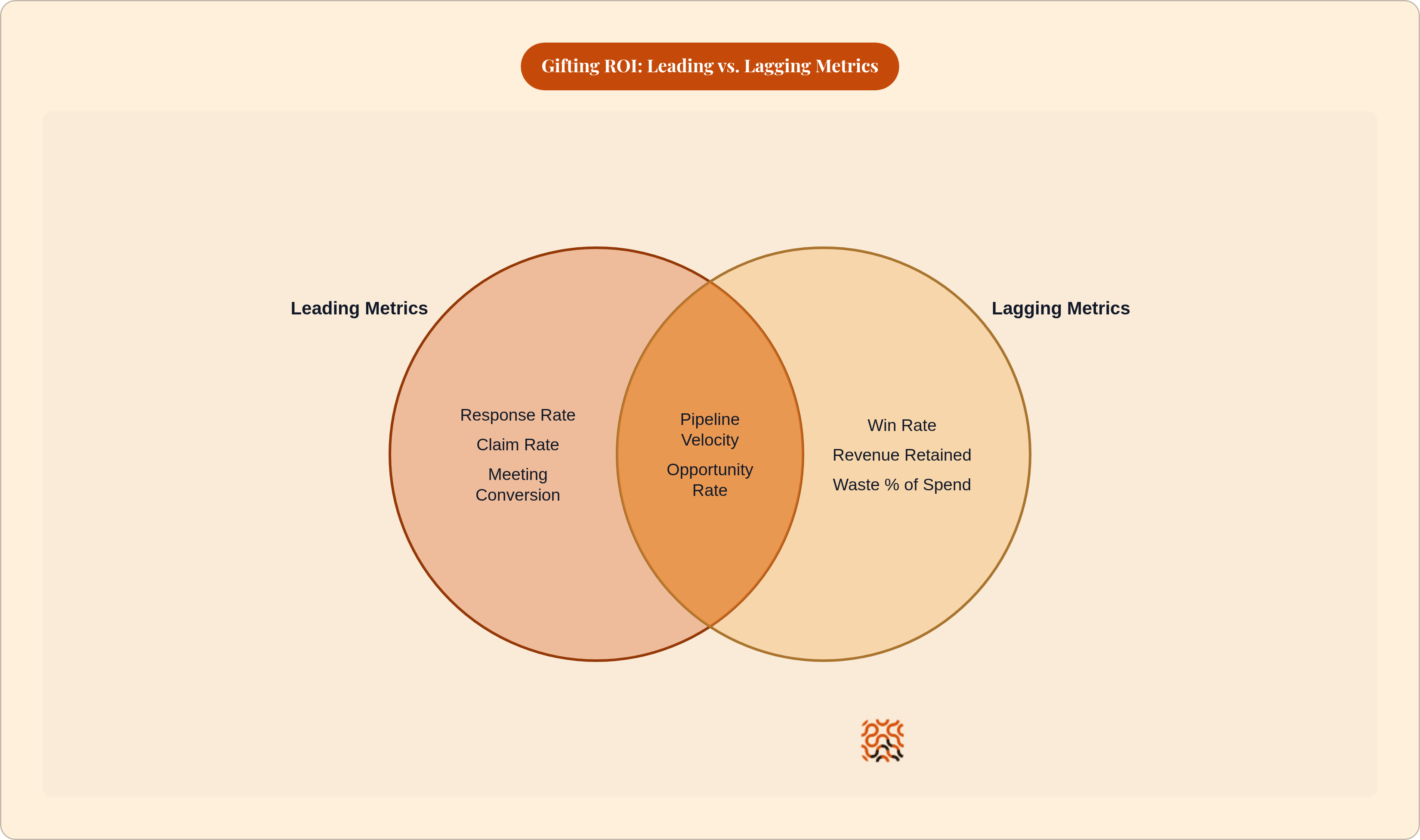
Not every metric belongs at every stage, and trying to track everything at once is a reliable way to track nothing well.
Leading metrics have short feedback loops and give you early reads. Response rate is the percentage of recipients who replied, booked a meeting, or took the intended next action. Meeting conversion rate is, of those who responded, how many converted to a booked meeting. Claim rate is the percentage of digital gift invitations actually redeemed. Low claim rate usually signals a list problem or a timing problem, not a gift problem. If you start blaming the gift before you check those two variables, you will waste money changing the wrong thing. I've seen this happen more than once, and it's an expensive mistake to make twice.
Pipeline metrics show up mid-funnel, where gifting's effect on pipeline velocity becomes visible. Opportunity creation rate among gifted contacts versus non-gifted contacts in the same segment is the most direct read on whether gifting generates new pipeline. Days-to-close for gifted opportunities versus a control group tells you about velocity. Average contract value for deals with at least one gift touchpoint tells you whether gifting is concentrating where it matters.
Lagging metrics are operational health indicators. Delivery success rate tracks the share of sends that reached their intended recipient. Undelivered and unclaimed rate identifies address quality problems before they compound. Waste as a percentage of total spend is the metric that keeps your ROI calculation honest because, without it, you're measuring only the sends that worked.
Retention and expansion metrics apply to customer and employee programs. Renewal rate delta compares retention rates between gifted account cohorts and comparable non-gifted cohorts over a renewal period. NPS or satisfaction score movement following a gifting touchpoint quantifies relationship warmth in a form you can audit. Expansion revenue tied to accounts with active gifting programs is a second revenue lever that frequently goes untracked, partly because it requires a cleaner CRM than most teams actually have.
One signal that cuts across all of this: 2024 research from Giftpack found that 89% of companies report higher ROI on personalized gifts compared to generic ones. That means your engagement metrics will vary sharply by gift relevance, not just send volume. A program that optimizes for scale while ignoring personalization will produce numbers that make the intervention look worse than it actually is, and those numbers will be used to cut it.
How to Run a Control Group Test That Proves Gifting's Incremental Lift
The core measurement problem is that correlation isn't causation. A gifted prospect who closes might have closed anyway. The only way to know whether gifting produced an effect is to compare it against a group that didn't receive a gift but was otherwise identical in every relevant dimension.
Designing the control group properly is where most tests fail before they start. Randomly hold back a subset of contacts or accounts at the same funnel stage. Randomization is what eliminates self-selection bias. If you let sales reps choose who gets a gift, the gifted group will skew toward warmer accounts, and your apparent lift will be an artifact of selection rather than a real effect. Keep all other variables equal: messaging cadence, timing, sales rep assignment. Pre-register your success thresholds before the test runs. Decide in advance that you're targeting at least a 20% lift in meeting bookings, for example, so results can't be reinterpreted after the fact. That discipline feels bureaucratic until the moment you need to defend the result to someone skeptical, who wasn't in the room when you designed it.
Run the test for at least one full sales cycle. Testing for a week inside a program with a 90-day sales cycle produces noise, not signal.
For analysis, compare reply rate, meeting rate, and SQL (sales qualified lead) conversion rate across gifted and control groups. Look at opportunity creation volume and average contract value. Measure win rate and time-to-close. For retention programs, measure renewal percentage.
A valid lift result is a statistically meaningful difference on at least two of those metrics, sustained over the full cycle period.
There is a practical constraint worth naming plainly: small programs with fewer than 50 recipients per cohort lack statistical power. If your program is early-stage, acknowledge that explicitly rather than presenting directional findings as proof. A directional result still has value. "Gifted accounts moved to SQL 15 days faster on average" justifies continued investment while a larger dataset accumulates. The honest approximation is more useful than a precise-looking number built on insufficient data, and your stakeholders will respect the distinction if you raise it before they do.
Retention ROI: The Calculation Most Teams Skip
The economics here are not complicated. Acquiring a new client costs many times more than retaining an existing one, a gap that shows up directly in customer acquisition cost comparisons. Even modest retention improvements compound into substantial profit gains over time. Despite this, most gifting teams apply pipeline metrics designed for prospecting to their retention programs, which produces systematically misleading results and, often, a quiet decision to stop the program because it "isn't performing."
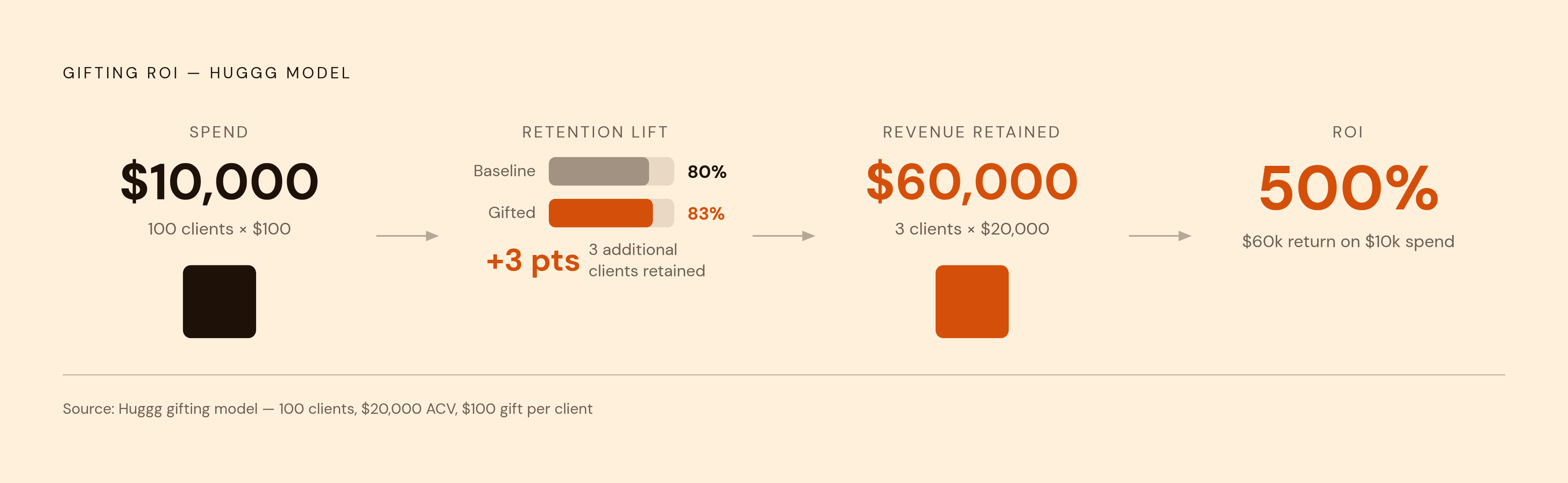
A concrete illustration of what the model actually looks like: 100 clients at a $20,000 average contract value, 80% baseline retention rate, $100-per-client gifting investment totaling $10,000 for the segment. If strategic gifting improves retention to 83%, that retains three additional clients worth $60,000 in revenue. ROI on the $10,000 spend is 500%, per a model from Huggg.
What makes this model useful for internal buy-in is its transparency. You don't need to attribute a closed-won deal to anything. You need to compare retention rates between gifted and non-gifted account cohorts over a renewal period. The causal claim is modest, the numbers are auditable, and the output speaks in language finance teams already use.
Four inputs feed the model: your baseline retention rate from your CS platform or CRM, average contract value of the gifted account segment, total gifting program cost for that segment, and retention rate of the gifted cohort versus a control at renewal. That's it.
Expansion revenue is worth tracking separately. Accounts that receive gifting touchpoints at key milestones, onboarding completion, renewal, usage anniversary, show higher upsell and cross-sell rates. Track that as expansion-attributed revenue distinct from retention. The mechanism is different, and conflating the two obscures both signals in ways that make future decisions harder.
The persistent mistake is forcing prospecting metrics onto a retention motion. A gifted customer at renewal isn't being asked to book a discovery call. Measuring them as if they were produces apparent underperformance that has nothing to do with whether the gifting worked, and real programs get cut for that reason.
Tying Gifting to Pipeline in ABM Programs
ABM changes the unit of analysis in ways that require deliberate adjustment. B2B deals involve an average of 11 stakeholders, according to Salesforce's 2025 State of Marketing research. Individual contact metrics are insufficient when the buying decision is distributed across a committee. You have to measure at the account level. This is obvious in principle and routinely ignored in practice, usually because the CRM isn't set up to make account-level aggregation easy.
Buying committee coverage is the percentage of identified stakeholders in a target account who have received a gifting touchpoint. This matters because a gift to the economic buyer that bypasses the technical evaluator and the champion is reaching only part of the decision. Account engagement rate is an aggregate interaction score across all contacts in the account. Account stage progression tracks movement through defined pipeline stages at the account level, not the contact level.
To separate gifting's effect within a broader ABM program, tag all CRM opportunities influenced by a gift send at the account level. Compare stage velocity for accounts that received a physical send versus those in the same ICP (ideal customer profile) tier that didn't. Measure ACV and win rate separately for gifted accounts.
In high-ACV segments, the ROI math is forgiving. Prospecting kits for deals worth $10,000 or more carry a $30 to $60 per-kit cost that is negligible relative to deal value, and gifting has an outsized effect on deal size in exactly those segments, where relationship investment is proportional to the outcome being pursued.
Intent data adds a timing dimension worth tracking separately. Teams acting on intent spikes, meaning surges in buyer intent data signals, within 24 hours see a 29% lift in opportunity creation compared to slower responders, according to ZoomInfo's 2025 ABM Intelligence Study. If you're sending gifts timed to intent signals, track that cohort separately. If timing amplifies gift ROI, you want to know it as an operational variable you can adjust without increasing spend.
Measuring Gifting ROI at Events: Before, During, and After
Events are already high-leverage. HockeyStack's 2025 study of 198 B2B SaaS companies found that 52% of marketers attribute at least half of their 2024 closed-won deals to events, and event-sourced leads convert to opportunity at 40%. Gifting amplifies that performance at three distinct moments, each with its own measurement logic.
Pre-event, a gift sent to registered attendees before the event creates a relationship frame before any conversation happens. Measure meeting acceptance rate and show-up rate versus non-gifted registered attendees in the same cohort. The control group practically constructs itself: registered attendees who didn't receive a send.
At-event, booth or session incentives drive engagement in real time. Measure badge scans, meeting bookings at the event, and session attendance lift attributable to the incentive. Capture data in real time. Post-event reconstruction is unreliable, and the unreliability is hard to quantify but easy to feel when you're trying to run the analysis three weeks later from memory and incomplete notes.
Post-event, the follow-up send to attendees who engaged is where most programs leave the most value uncaptured. Measure reply rate, meeting conversion rate, and opportunity creation rate versus standard email follow-up sequences. The control group is again natural: comparable attendees receiving only digital follow-up.
Event gifting ROI is easier to prove than program-wide gifting ROI for a specific reason. The audience is bounded, the timeline is defined, and the control group practically builds itself. These conditions are rare in gifting measurement, and you should take full advantage of them when they're available.
The overarching metric across the full event sequence is cost-per-opportunity (CPO) from gifted contacts versus cost-per-opportunity from contacts who received only digital follow-up. That comparison cuts through the complexity and produces a single defensible number.
The CRM Integrations That Make Attribution Work in Practice
Everything described in this article depends on data connectivity. The attribution problem is, at its root, a plumbing problem. Gifting activity lives in a sending platform. Outcomes live in CRM. The two are rarely connected by default, and without the connection, measurement is either manual and error-prone or simply doesn't happen. Most teams choose the latter, then wonder why they can't prove the program's value at budget time.
Your gifting platform needs to integrate with your CRM so that every send creates or updates an activity record tied to the contact and the opportunity. Gift redemption events need to be logged back to the CRM record in real time, not as a periodic manual export. Opportunity records need to be tagged "gift influenced" or "gift sourced" at the time of creation, which is how multi-touch attribution models distinguish sourced from influenced revenue. If you apply that tag retroactively, you'll either miss records or introduce bias in which opportunities you tag, and that bias poisons the analysis in ways that are very difficult to correct later.
Integration with marketing automation matters especially for ABM programs, where gifting is one touchpoint in a coordinated sequence. Without it, you can't isolate gifting's contribution from the rest of the program's activity. You end up measuring the sequence and calling it gifting ROI, which is a different claim, and a less credible one.
When the stack is connected, pipeline influence reports can be automated and segmented by gift type, send timing, or account tier. Retention cohorts can be compared without manual data pulls. Event sequences can be analyzed end to end. The measurement framework described throughout this article becomes a living report rather than a quarterly reconstruction project.
The difference between a gifting program that survives a budget cycle and one that grows is almost always this infrastructure. Not the gifts themselves. Not the strategy or the personalization. Whether someone built the data pipes to prove what the program actually did.