Corporate Gift Strategy for Account Based Marketing
Tailor gifts to each buying committee member's role, not just the champion.

Gartner's 2025 research puts the average B2B buying committee at 11 members. For enterprise technology deals, that number grows: procurement, legal, IT security, finance, multiple business-unit owners, each carrying distinct concerns and a distinct threshold for what counts as meaningful engagement.
Most gifting programs ignore this completely. They find one champion, invest everything in that relationship, and call it ABM. The risk becomes obvious once you look at tenure data: manager and director-level roles in enterprise companies turn over on roughly a 2.5-year cycle. A program built on a single relationship has no redundancy. When that person leaves, you lose the institutional memory they carried about your product and their company's evaluation history, and you're starting from zero inside an account you thought you'd already won.
Multi-threading with gifting means something more specific than sending the same thing to more people. The CFO evaluating your proposal cares about ROI framing. The risk officer cares about compliance exposure. The technical lead cares about architecture and integration complexity. If the gift is identical regardless of recipient, it signals that you built a list, not a strategy. That message lands clearly for both the CFO and the data engineer, whether you intended to send it or not.
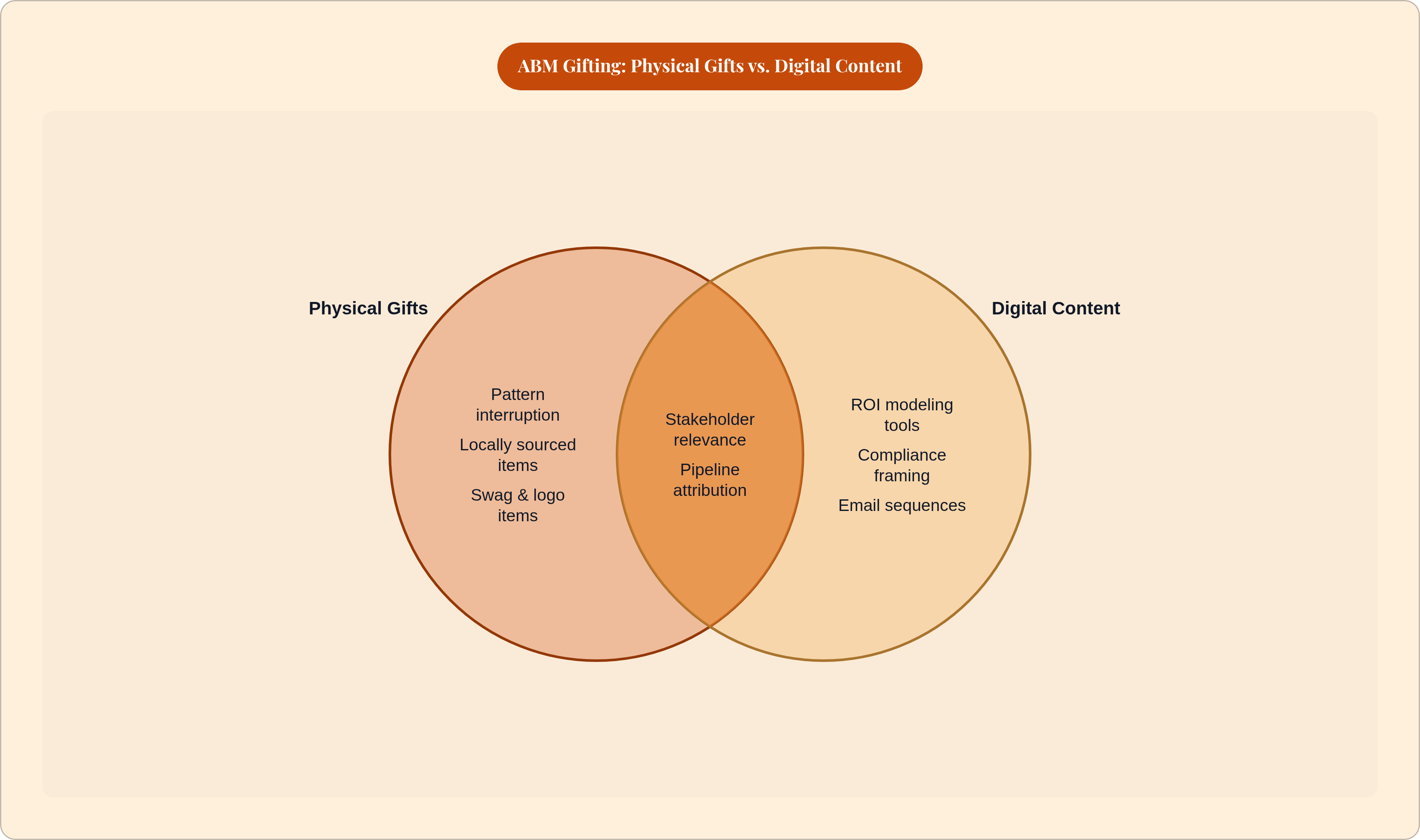
What actually moves committee-level deals is treating the gift as a delivery mechanism for relevance rather than as the gesture itself. Technical content paired with something that reflects a data engineer's working environment. Compliance framing paired with a selection that signals you understand a risk officer's professional context. ROI modeling tools sent to finance stakeholders alongside something that respects both their time and their skepticism. The gift earns the attention; the content does the persuasion. Strip one out and you're left with either a thoughtful item no one engages with or a piece of content that never gets opened.
One-size-fits-all gifts actively undermine multi-threading logic. Not as a philosophical concern, but as a signal problem with practical consequences for how buyers perceive your research capacity before they've agreed to a single conversation.
How to tier accounts and set gifting budgets before choosing a single gift
The account tier structure comes before any gift selection conversation. Choosing gifts without a tiered framework is like pricing a product before understanding your customer acquisition cost: the numbers work out by accident, not design.
ICP definition is the starting point: industry, company size, revenue, growth trajectory, strategic fit with your product's current capabilities. Gifting spend should follow account potential, not relationship warmth or a sales rep's enthusiasm for a particular logo.
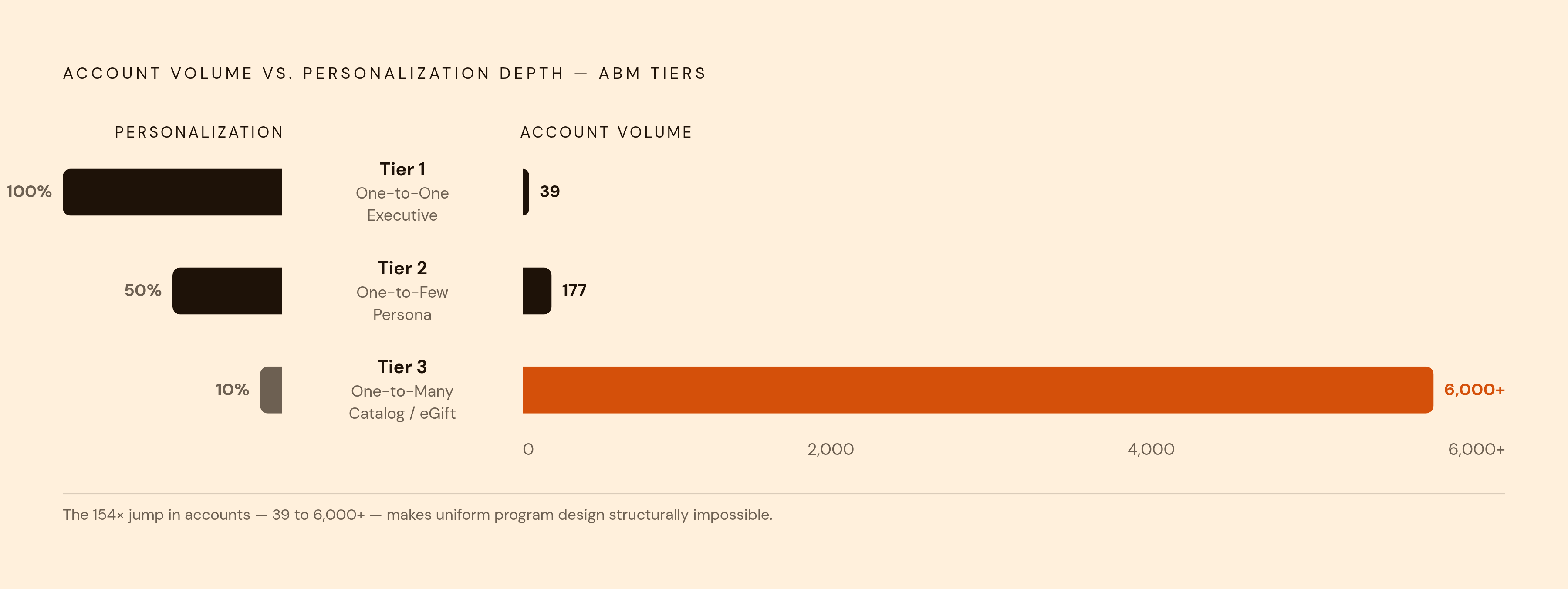
The scale difference across ABM levels requires meaningfully different program designs, not just different budget lines. One-to-one programs at the strategic account level average around 39 accounts, per ABMLA data. One-to-few programs average around 177. One-to-many programs reach over 6,000 accounts. The personalization depth and per-account spend that make sense at 39 accounts become operationally impossible at 6,000, and the attempt to replicate them produces something that feels neither personal nor efficient.
Tier 1 accounts warrant the highest per-recipient spend, fully custom gift selection tied to known account intelligence, and executive-level recipients. These gifts should feel like they required someone to actually think. Tier 2 accounts warrant moderate spend, semi-personalized or choice-based gifts, and persona-level targeting within the buying committee rather than individual-level research for every contact. Tier 3 requires a different model entirely: eGifts, catalog-choice options, or experience-based selections that scale without manual curation.
There's a subtler thing worth naming here. The gift is one line item in an account's total cost of engagement, and it needs to be proportional to deal size and sales cycle length. A $250 gift sent into a $500K deal is a rounding error with strategic intent. The same $250 gift sent into a $12K deal needs a different justification. And a gift sent at the wrong tier signals something unintended about how seriously you're treating the relationship, in either direction.
Prune the account list regularly. Accounts that stall past a defined threshold, or that drift out of ICP criteria as your product evolves, shouldn't keep receiving gifting investment. The resource concentration that makes ABM work requires the discipline to stop investing as readily as to start.
Where in the sales cycle each gift should land and why timing is as important as the gift itself
The most thoughtful selection, sent at the wrong moment, reads as noise. A well-researched gift arriving three weeks before a first meeting, when the recipient has no relationship context for it, creates mild confusion rather than goodwill. The timing question isn't secondary; it's often the variable that determines whether a gift registers as signal or clutter.
The triggers worth formalizing into a cadence: cold outreach and first meeting booking; post-demo thank-you; stalled opportunity re-engagement; contract signing; go-live or project milestone; executive briefing attendance; event follow-up. Each moment carries a different emotional register for the recipient, and the gift should match that register rather than arrive as a context-free gesture.
Re-engagement deserves particular attention because it's where gifting's differentiation from digital channels is most legible. A deal that has gone quiet has often gone quiet because the buyer has learned to tune out exactly the pattern of outreach they've been receiving. Email follow-up, LinkedIn nudges, a calendar link: the buyer recognizes the sequence and filters it without conscious effort. A physical touch breaks that pattern not because it's more persuasive in principle, but because it arrives differently.
Salesforce documented a version of this: a personalized direct mail kit sent to C-level contacts at top accounts, with account-specific messaging and an executive briefing invitation, resulted in 95% of recipients booking a meeting. Dialpad ran a custom e-gifting campaign offering prospects experiences relevant to their interests and saw a 400% increase in meetings booked. Your program's specific account mix and relationship context will produce different numbers. But the mechanism holds: pattern interruption, at a moment when the buyer's attention has already been established by some prior interaction, outperforms another touchpoint in the same format the buyer has already learned to ignore.
A gift that arrives before any meaningful interaction has occurred reads as transactional, occasionally presumptuous. A gift that arrives after something real, a demo, a difficult conversation the deal survived, a product decision the buyer championed internally, signals recognition. It builds on something already in place rather than trying to manufacture goodwill from nothing.
Post-close gifting also deserves its own program logic, not an afterthought. Contract renewals, company anniversaries, significant project wins: these moments prevent the relationship from going dark between deal cycles, which is precisely when a competitor's relationship quietly deepens.
What makes a gift relevant to an individual recipient rather than just appropriate for an account
The failure mode here is well-documented. Snappy's 2025 Holiday Gifting Report found that 70% of employees have received unwanted gifts, with irrelevant, low-value, and impersonal items as the dominant complaints. In a B2B context, an irrelevant gift doesn't just fail to create goodwill; it signals that the sender conducted research at the account level and stopped there, which is precisely what a buyer in a high-consideration deal is watching for.
The relevance signals are available if you look for them. LinkedIn activity and published content reveal what a person is professionally preoccupied with this quarter, not just what their job title says. Mutual connections offer intelligence that no CRM record captures. Discovery calls surface role-specific concerns that translate directly into what will feel seen versus what will feel generic. Locally sourced items, cause-aligned donations for recipients publicly engaged with specific causes, experience-based gifts: these signal genuine research. A logo'd item signals volume fulfillment. That's appropriate at the programmatic tier and actively counterproductive at the strategic one.
For executive recipients specifically, the originality of the selection carries more weight than its monetary value. Executives receive expensive things regularly; they receive thoughtful selections rarely. Spending more doesn't solve the relevance problem; it just makes an irrelevant gift more expensive.
Choice-based eGifts address a different dimension of the problem: the fundamental uncertainty about what any individual actually wants. A CustomInk survey found that 82% of employees would value a gift more if it were personalized, and 52% would prefer the option to choose their own gift. Choice-based models, where the recipient selects from a curated catalog calibrated to their persona tier, solve the personalization-at-scale problem for Tier 2 and Tier 3 accounts without requiring manual curation per contact.
A 2025 corporate gifting report drawn from 1.5 million gift sends found that 70% of recipients reported feeling more valued by the sending company, and 61% reported a more positive brand perception. Relevance is what produces those responses. A gift that misses the recipient produces neither, and occasionally produces something worse.
Compliance, gift limits, and the policies that protect the program's credibility
Most gifting program guides skim compliance. That's a mistake worth examining, because a gift that forces a recipient to disclose it to their legal team, return it, or formally report it under their company's policy does the precise opposite of what it was designed to do. It creates friction, surfaces your company's name in a compliance context, and signals that the sender didn't do basic due diligence. The goodwill you were trying to build becomes the reason someone has an awkward conversation with their general counsel.
Recipients are bound by their employer's gift acceptance policies independent of anything you're trying to accomplish. Financial services, healthcare, government contractors, and publicly traded companies frequently carry explicit dollar limits or categorical prohibitions on certain gift types. Cash-equivalent gifts, meaning gift cards specifically, are often prohibited regardless of value in these environments, even when a physical gift of equivalent worth would be accepted without question. That distinction catches people off guard the first time it surfaces in a deal.
Under current US tax law, the IRS caps deductions for business gifts at $25 per recipient per year. That number is low enough to be surprising, and documentation requirements apply whether or not the gift approaches that threshold.
Anti-bribery frameworks add a layer of exposure for programs touching international accounts. The Foreign Corrupt Practices Act applies when gifting involves foreign government officials; the UK Bribery Act has broader commercial application. Dollar amounts that are entirely routine in commercial ABM can become legal exposure in those contexts, and the line between a relationship-building gift and an improper inducement is not always as obvious in practice as it appears in a policy document.
Practical safeguards worth building into the program itself: maintain a gift registry with business purpose documented per send, require approval above a defined spend threshold, and build recipient-industry flags into the gifting platform workflow so that high-sensitivity accounts trigger a review step automatically. None of this is over-caution. It's the operational infrastructure that keeps a well-designed program from being compromised by a single send that someone didn't think through carefully enough.
Which gifting platforms fit which program types and what to evaluate before buying
The operational threshold for platform investment is roughly 100 sends per year. Below that number, manual gifting with a spreadsheet and a good vendor relationship is workable. Above it, the absence of CRM integration, automation, and warehousing capabilities introduces inconsistency and makes attribution almost impossible to reconstruct after the fact.
The platform landscape consolidated meaningfully in 2024 and 2025. Alyce was acquired in February 2024 and now operates under new ownership. Postal.io was acquired in April 2025. If you're currently evaluating Postal, ask direct questions about the long-term product roadmap before signing anything; the acquisition is recent enough that the integration story is still being written.
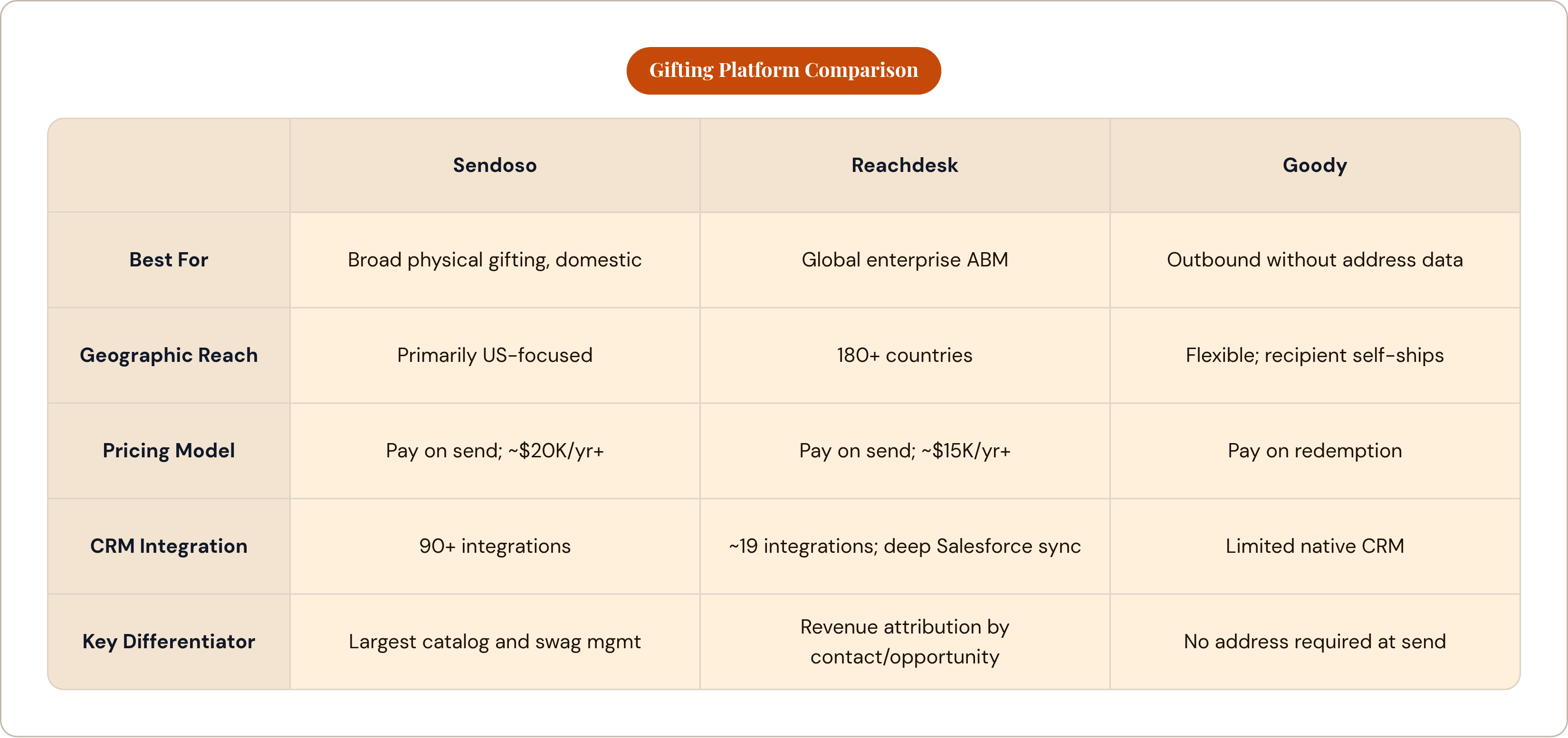
Some platforms hold very large catalogs, with over 90 integrations and strong capabilities for physical gifting and swag management, but are predominantly US-focused. Platform fees in this category start around $20,000 per year with per-send costs on top, making them best suited for teams that need broad physical gifting infrastructure and are primarily running domestic programs.
Some global-focused platforms fulfill in over 180 countries, include a two-way Salesforce sync, and attribute revenue at the contact, opportunity, and campaign level. Starting costs for platforms in this category are typically around $15,000 per year plus per-send costs, with native integration counts that are lower than those in the large-catalog category. For global enterprise ABM programs where attribution fidelity matters more than catalog breadth, that tradeoff often makes sense.
Goody removes the address friction that kills SDR prospecting campaigns. The recipient receives a link, selects a gift, and supplies their own shipping information; no physical address is required at the time of send. For outbound sequences where you're reaching contacts you don't yet have address data for, this solves a real operational problem that other platforms simply don't address.
Snappy is built for HR and employee gifting, not pipeline marketing. It lacks the native CRM infrastructure that makes gifting attributable in a sales context. Using it for ABM is the equivalent of using a consumer email tool for enterprise marketing automation: it will technically send things, but it won't give you what you actually need.
The pricing model difference matters more than most per-item price comparisons when evaluating total program cost. Some platforms charge on send; others, including Goody, charge on redemption. Pay-on-redemption models reduce waste meaningfully on high-volume campaigns where a significant portion of recipients don't engage, and that structural difference compounds across a full program year.
Before signing with any platform, verify integration compatibility with your actual stack: CRM, marketing automation, ABM platform, and outbound sequencing tools. A gifting platform that doesn't connect to your tech stack at send time cannot be attributed retroactively, regardless of how sophisticated its reporting dashboard appears.
How to measure whether the gifting program is actually moving pipeline
Gifting gets categorized as relationship spend, which implicitly means unmeasurable, which implicitly means it gets cut when budgets compress. Programs that were genuinely working have been shut down not because the results weren't there, but because no one had built the infrastructure to surface them when a finance leader came asking. That's a solvable problem, and it's worth solving before you need to defend the budget, not after.
The right platform configuration makes gifting as attributable as any digital campaign. The barrier isn't the nature of the activity; it's whether the program was architected for measurement from the start, a decision made during onboarding, not at the end of a quarter when someone requests a readout.
The primary metrics that connect gifting activity to pipeline outcomes: meetings booked from gifted outreach, pipeline created from gifted accounts, opportunity acceleration measured as days shortened in a given deal stage, and win rate comparison between gifted and non-gifted accounts in the same tier and segment. These are pipeline metrics, the kind a CFO can evaluate using the same framework they'd apply to a paid media investment. That framing is the only one that reliably protects the program's budget in a difficult year.
One level down, the engagement metrics worth tracking: gift acceptance rate, post-gift email open and reply rate, and online actions taken after gift receipt. These don't close the loop to pipeline, but they're useful leading indicators and diagnostic tools when primary metrics underperform and you're trying to understand why.
A 2025 report drawn from 1.5 million gift sends found that gifted email campaigns produced open rates of 85% compared to 39% for standard email, and conversion rates of 56% compared to 3%. Your program's performance will reflect your account selection, your gift relevance, and your timing precision; these numbers won't transfer directly. But the gap between those figures is wide enough that dismissing gifting as untrackable sentiment spend misses the point. The question is whether you've built the measurement infrastructure to know what your program is actually doing.
Attribution requires one non-negotiable configuration decision: gift sends must be logged against the CRM contact and opportunity record at the time of send. Retroactive attribution is guesswork dressed as data, and when the finance conversation arrives, it won't survive scrutiny.
For teams operating without a dedicated platform, a lightweight approach that still yields defensible signal: tag gifted accounts in CRM at the time of send, track stage progression and close dates manually against those tags, and compare outcomes against a matched cohort of non-gifted accounts over the same period. The methodology isn't perfect, but it produces a real comparison rather than a narrative, which is the minimum viable standard for any program you want to protect.
The framing that lands best with executive stakeholders is cost per outcome rather than total program spend. A gifting campaign that generates meetings at lower cost per meeting than an equivalent LinkedIn campaign justifies its budget even when the absolute number looks significant in isolation. Total spend without an outcome denominator is an expense. Total spend divided by a pipeline-relevant outcome is an investment thesis, and that distinction determines whether the program survives the next planning cycle.