Corporate Gifting for Pipeline Acceleration at Deal Close
Thoughtful gifts at the right deal moment break stalls that email alone can't fix.

Late-stage B2B deals stall constantly, and gifting is one of the few tactics built specifically to break that stall. Send the right thing at the right moment and you keep a deal from dying quietly in someone's inbox.
I've sat through more than one postmortem on a deal that went cold right after a great demo. The champion loved it, the use case fit, and then, nothing. Nobody stole the deal out from under us. It just went dark under internal politics, a shifted priority, a procurement process nobody warned anyone about. Most B2B purchases hit at least one stall along the way, so a quiet deal doesn't mean you screwed something up. It means you're running a normal deal, which is reassuring, sure, but it doesn't get you any closer to closed.
Here's the compounding problem: the instinct when a deal stalls is to send another email, make another call. But the vast majority of B2B sales interactions already happen through digital channels, so that instinct just adds noise to a channel already flooded past capacity. Buying groups run four or more stakeholders on most deals now, which means your "just following up!" lands in an inbox next to a dozen others just like it, from a dozen other vendors trying the exact same move on the exact same day. A different channel, one that doesn't have to fight for the same twenty seconds of attention as everything else sitting in that inbox, tends to work better than piling on more volume in the same crowded lane.
What makes gifting a deal-close tactic rather than a goodwill gesture
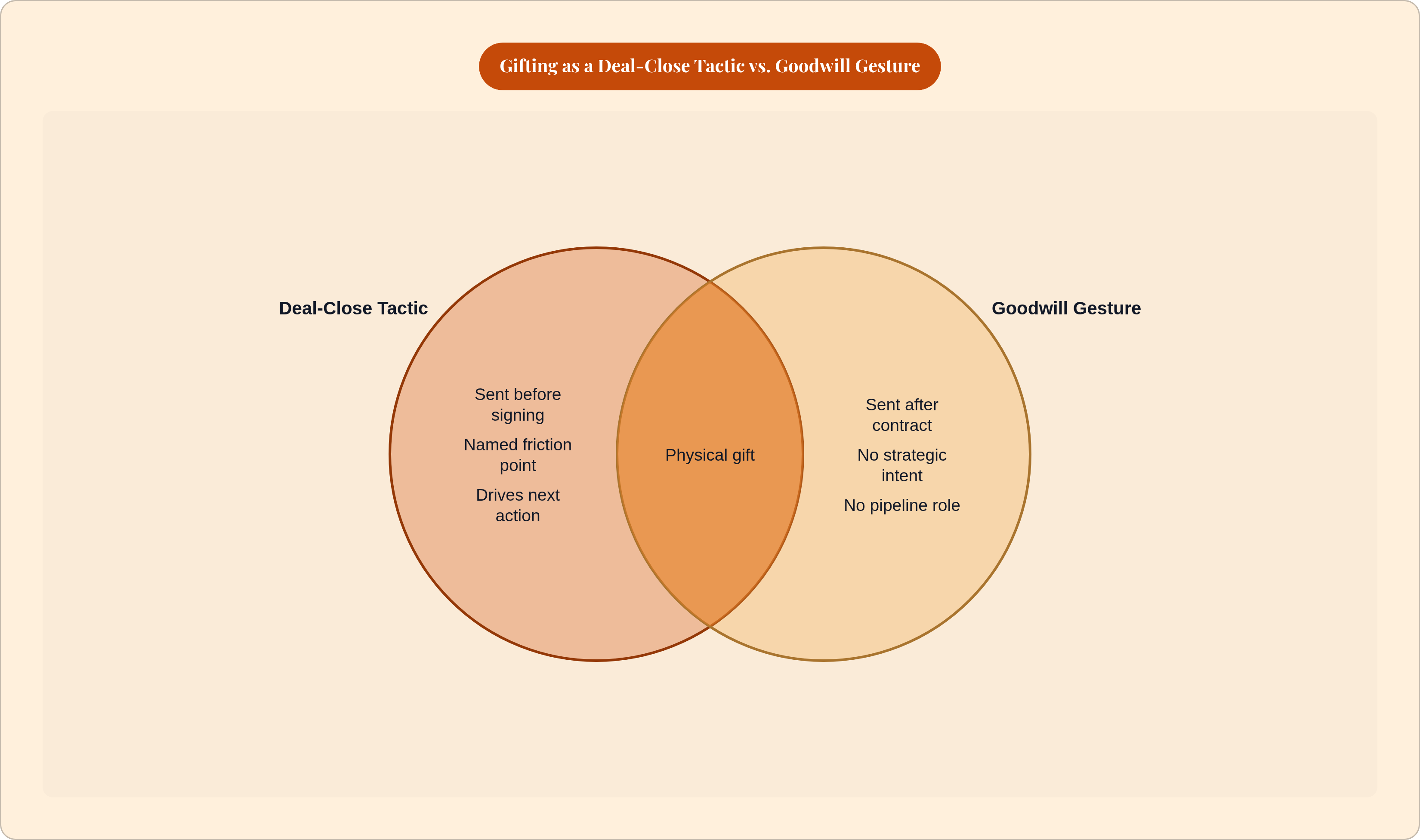
Sending a gift after a contract's signed is old news. Sales teams have done that for decades: a bottle of wine, a nice pen, a card that says thanks for your business. That's a different animal from what I'm describing here.
A goodwill gesture goes out after the ink dries, no strategic intent, no connection to any moment in the pipeline. A deal-close tactic goes out before signing, tied to a named friction point, built to produce a next action. One's a thank-you. The other's a lever. Confuse the two and your gifting program starts looking like discretionary spend instead of a sales motion, which is exactly the label you don't want when finance starts asking questions.
Why does a physical object move a stalled conversation when five follow-up emails couldn't? Part of it is reciprocity: receiving something tangible creates a felt obligation to respond, and that pattern in human behavior predates B2B sales by a couple thousand years at least. Part of it is attention: a package sitting on a desk demands a different kind of presence than a notification swiped away without a second thought. And part of it is signal value, the sense that a thoughtful gift tells the buyer the rep actually did some homework, that there's real investment in the relationship and not just in the commission check waiting at the end of it.
Timing is what separates the tactic from the gesture. Send the wrong gift at the wrong moment and it's just noise with a bow on it. Send a $25 item at exactly the right friction point, though, and it can outperform a $100 gift basket that shows up with no context behind it. Dollar amount matters less than most people assume walking into this. Thoughtfulness and timing carry almost all the weight, and that's the part nobody wants to hear because it means you actually have to pay attention to the deal.
Gifting only becomes a repeatable motion once you know when to send, what to send, and who actually needs to open the box.
The specific late-stage moments when a gift changes deal momentum
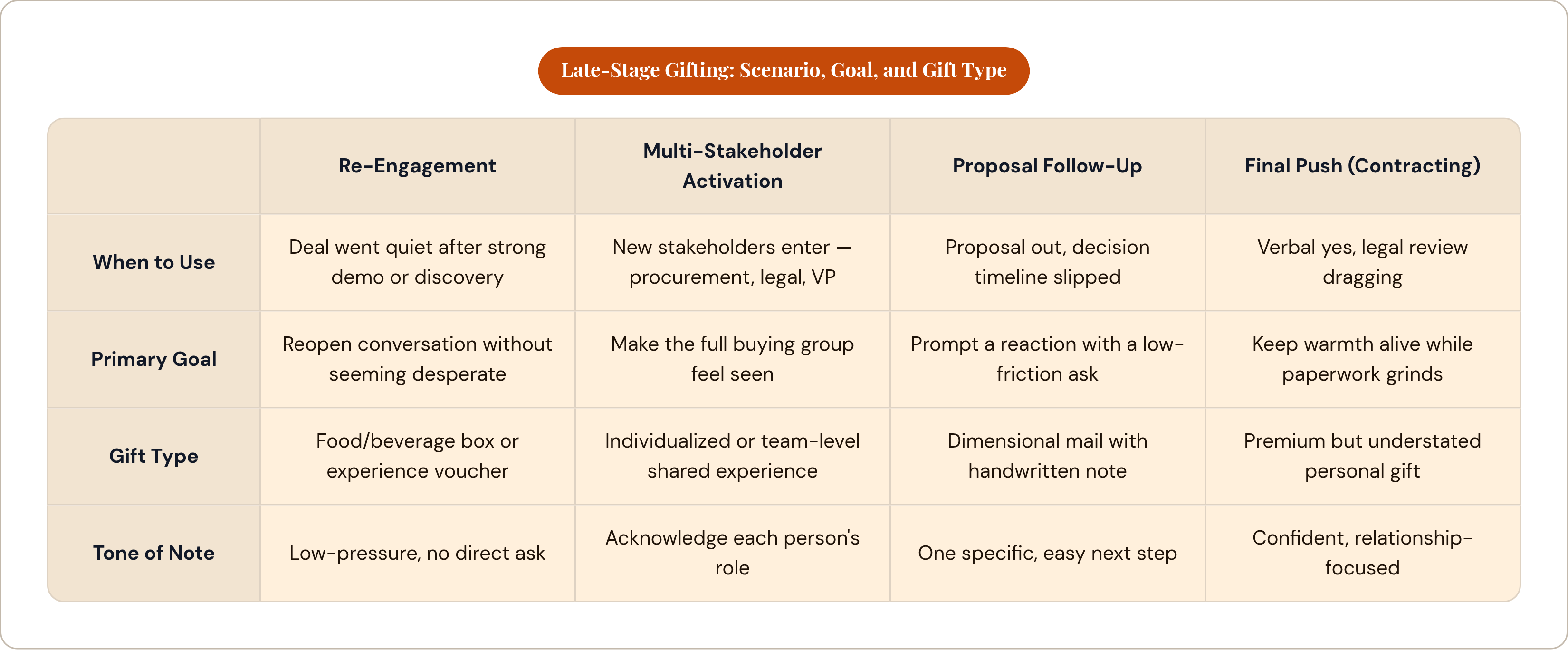
Not every late-stage moment calls for the same move. The gift's job shifts depending on what's actually blocking the deal, so let's name these scenarios individually instead of lumping them into one vague "late-stage" bucket.
The re-engagement send fits a deal that went quiet after a strong discovery call or demo. Champion stopped responding, and the goal is getting back into the conversation without it looking desperate.
The multi-stakeholder activation send handles a different problem. Your champion's sold, but now procurement's involved, legal's weighing in, or a new VP just showed up in the thread out of nowhere. Here the goal shifts toward making the whole buying group feel seen, not just the one person you've already built rapport with.
The proposal follow-up send covers the moment a proposal's out, a decision was supposed to happen by now, and the timeline quietly slipped past everyone. This gift arrives with a clear, low-friction ask attached: open this when you've got five minutes, I'd love to hear your reaction.
The final-push send applies once you've got a verbal yes but contracting's dragging through legal review at its own glacial pace. The goal here is keeping some warmth in the relationship while the paperwork grinds along, rather than trying to force anything closed early.
Each of these needs a different gift type, a different tone in the note, a different follow-up rhythm. One filter to apply before any of that: this tactic performs best on accounts where average contract value clears $50K. Below that line, the math on rep time against gift spend starts working against you fast.
What ties all four scenarios together is simpler than the scenarios themselves. Every send needs a named next step attached to it. A gift with nothing for the recipient to actually do next is just generosity, which is nice but doesn't move a pipeline.
What to send — matching gift type to deal stage and buyer signal
The most common mistake I see reps make is picking a gift based on what they'd want to receive, rather than what the buyer's own signals point toward. Easy trap to fall into: you like good coffee, so you send good coffee. That's about your preferences, not theirs, and buyers can usually tell the difference within about two seconds of opening the box.
Before choosing anything, look at what's actually available. LinkedIn activity and recent posts show what someone's paying attention to right now. Discovery call notes, when a rep bothers taking good ones, often carry throwaway references worth remembering: a kid's soccer team, a marathon someone's training for. Company values and public sustainability commitments matter too, especially for buyers who've built their brand around being eco-conscious. When none of that's available, industry or role-based inference is a reasonable fallback, even if it's a step down in precision from anything personal.
Then match the gift to the moment.
For a stalled deal in re-engagement mode, go low-pressure: a curated food or beverage box, a local experience voucher, a book tied to something the buyer mentioned offhand on a call. Nothing that demands a response. It just keeps the door propped open a crack.
For multi-stakeholder activation, individualized gifts per stakeholder work best when you can manage it logistically. When you can't, a team-level gift, a shared meal delivery, an experience the whole group can use together, still signals you see the full buying committee and not just your one contact in the middle of it.
For proposal follow-up, dimensional mail is the move: a physical package landing at the office, paired with a handwritten note and one specific, easy next step. More on why this format beats digital in the next section.
For the final push through contracting, go premium but understated. You want to signal confidence in the relationship without looking like you're celebrating a win that technically hasn't happened yet.
On spend: most successful gifting programs run $25 to $75 per gift for pipeline acceleration, stretching to $100 or $150 for higher-value accounts. But the sweet spot was never really about the price tag. A $40 gift tied directly to something the buyer said on a call beats a $150 generic basket almost every time I've seen the two go head to head.
A few things worth steering clear of. Logo-heavy branded merchandise as a first touch feels self-promotional, like you're marketing at someone instead of thanking them. Alcohol needs real judgment, since company policy and personal preference both come into play and you rarely know both up front. And anything perishable is only as good as your delivery timing; a fruit basket that shows up wilted is worse than sending nothing at all.
How dimensional mail specifically outperforms digital re-engagement at the late stage
A direct mail piece holds roughly 132 seconds of a recipient's attention. A TV ad gets about 13.8 seconds. That gap is the difference between something glanced at and something actually held in your hands and turned over.
Dimensional mail, meaning boxes, tubes, anything with real physical depth, gets opened at rates close to 100%. Office mailrooms route packages straight to the named recipient. They don't screen the way an inbox filter screens email, and a box sitting on someone's desk doesn't get archived unread the way a follow-up message does after about the third send.
This matters even more once gatekeepers enter the picture. A FedEx or Priority Mail package sidesteps the filtering that kills most cold outreach to executives before a human ever lays eyes on it. That's especially useful the moment a new stakeholder enters a deal: someone with zero relationship history with you, someone whose assistant screens their inbox for exactly the kind of email you were about to send.
The real power shows up once you sequence physical alongside digital rather than swapping one for the other. Coordinate a physical send with a follow-up email or call, and response rates climb higher than either channel produces on its own. The cadence that tends to work: gift arrives, then two to three days later the rep follows up, referencing the package directly. That reference point changes the whole tone of the outreach. It becomes a continuation of something the buyer already touched with their hands, a step up from another cold ask landing in an already crowded inbox.
Execution details matter more here than people expect. A handwritten note inside the box carries weight a printed insert never will, because it signals actual human effort and not a mail-merge job someone ran between meetings. This is achievable at scale too, across a whole buying committee: same gift type sent to five stakeholders, each note personalized to that person's specific role or conversation history.
Step back and run the math on a stalled six-figure deal. The cost of a well-executed dimensional mail send is trivial next to the contract value sitting on the table. The risk calculus isn't close, and it's not supposed to be.
Measuring whether the gift actually moved the deal
A lot of teams gift without any attribution model behind it, which means when budget season rolls around, the gifting line item looks like discretionary spend with nothing backing it up. Easy target the moment someone starts cutting.
Companies increased corporate gifting budgets after the pandemic, largely to strengthen client relationships. But only the teams actually measuring results can defend that spend when someone in finance starts asking pointed questions about where it went.
So what do you track? Time-to-next-meeting after the send is the most direct signal you'll get; it tells you plainly whether the gift reopened the conversation or just landed on a desk and got ignored. Deal velocity is the second piece: count the days a deal spends in its current stage before the send versus after.
Multi-stakeholder engagement is worth watching too. New contacts showing up in your CRM after the gift went out is a real signal worth logging, not a coincidence. Closed-won rate for gifted deals against non-gifted deals is the big one, though you need real volume before that number means much of anything. Even directional data helps build the internal case in the meantime.
None of this works without infrastructure behind it. Every send needs to get logged against the opportunity record. If it's not sitting in Salesforce or HubSpot, it doesn't exist for reporting purposes, full stop. Multi-touch attribution models that account for physical sends give a far more honest picture of what actually moved a deal across the finish line, instead of handing all the credit to the last email sent before signature.
The teams getting the strongest results tend to have better data for targeting and tighter attribution tracking, and those two things feed each other. One tends to make the other better over time.
The pitch to bring to leadership is simple enough: a late-stage gift on a $100K-plus deal costs $50 to $150. Move the close date up by even two weeks and the value dwarfs the spend. Not a hard argument to make once the data's sitting behind it.
The platform infrastructure that makes late-stage gifting repeatable at scale
Manual gifting doesn't scale. I've watched reps try, and it's rough to watch. Sourcing a gift, buying it, packaging it, shipping it, tracking whether it actually arrived: that's hours per send, and multiplying that across a full pipeline kills the tactic before it produces anything worth measuring.
A sending platform handles the parts that don't need a human doing them by hand. Address confirmation happens without the awkward "hey, are you in the office this week?" email, since logistics tools verify delivery details on their own. Gift selection gets easier too, with AI-driven recommendations based on buyer signals instead of a rep staring at a catalog for twenty minutes, paralyzed by too many options. CRM integration logs every send against the opportunity automatically, which is what makes the attribution reporting from the last section actually work instead of just sounding good in theory. Global fulfillment matters for any enterprise deal spanning multiple countries, since the tactic falls apart fast if a platform only ships domestically. Budget controls with approval workflows keep spending in check without slowing reps down at the exact moment they need to move fast.
A few platforms occupy distinct spots in this space. Some are purpose-built sending management platforms with their own fulfillment infrastructure, AI tools for gift selection and message personalization, deep CRM and marketing automation integrations, and fulfillment reach into more than 165 countries. Other platforms lean toward strong regional coverage in Europe with marketplace-based fulfillment, or a lighter, mid-market entry point for smaller teams just getting started. Which one fits depends on your deal volume, your geographic footprint, and how deep the CRM integration needs to run.
Some teams try building this themselves with a Shopify store and a shared spreadsheet. I get the instinct; it feels cheaper on paper, and for the first month it even is. But the hidden costs show up fast: rep time nobody's tracking, attribution gaps that make the whole program invisible to leadership, fulfillment errors that damage a relationship at the exact moment it matters most.
There's a connection worth drawing to account-based marketing here too. Most B2B companies run an active ABM program at this point, and the ones getting the most out of it are the ones whose physical sending sits inside the same tech stack as their digital campaigns, rather than bolted on six months later as an afterthought.
Building a gifting playbook reps will actually use at the late stage
Gifting tactics don't fail because reps think they're a bad idea. They fail because the process demands too much of a rep's time in the middle of a busy close quarter, and busy reps default to whatever's fastest, which is usually another email nobody reads. The playbook has to remove friction, not add it.
Trigger definitions come first: a specific CRM stage, a time-in-stage threshold, something like "no activity for 14 days after proposal sent" that automatically flags a gifting action. That takes the judgment call off the rep's plate entirely.
Next, a pre-approved gift menu. Three to five curated options per trigger scenario, already cleared for budget, compliance, and international shipping, so reps pick from a short list instead of searching the internet from scratch mid-quarter. Message templates need clear personalization slots too: a handwritten note structure with placeholders for the one detail that makes it feel bespoke rather than mass-produced. The template does the heavy lifting; the rep just drops in the specific signal they picked up on the call. And a follow-up cadence has to define exactly what happens 48 to 72 hours after delivery confirms, since the gift opens the door while the follow-up is what actually walks through it.
Compliance can't be an afterthought either. Gift value limits need to match industry norms and recipient company policy, since financial services, pharma, and government accounts often carry strict rules that a generic gifting budget won't account for on its own. Opt-outs need a graceful path too. Some recipients will decline a gift, and the playbook should make that a non-event rather than an awkward moment the rep has to navigate solo.
Before rolling this out to a whole team, pilot it. Pick the 10 to 20 highest-value stalled opportunities sitting in the pipeline right now, run the motion, and track the metrics laid out in the measurement section above. After 60 days, bring the results to leadership. A small, well-tracked pilot builds a stronger internal case than any pitch deck ever will.
Late-stage gifting works best once it's built into the pipeline itself: real triggers, real templates, real measurement, and the infrastructure to support all three. That's what turns it into one of the steadier levers a revenue team has for pulling almost-closed across the line into closed.