Corporate Gifting Strategy for Mid-Market B2B Teams
Tiered gifting based on account fit beats generic sends and moves deals faster than email alone.

Start with the number that matters: 68% of companies raised their gifting budgets in 2024 to support retention and morale. Budgets don't move like that on vibes. Finance doesn't sign off on an increase unless something upstream is already working, so that number is a signal, not a trend piece.
What does it mean if you're the one running marketing or sales at a mid-market company? Gifting stopped being a novelty a while back. A few years ago, sending a client a box just because you thought of them was enough to stand out. Everyone does it now, so standing out means doing it well. Doing it at all doesn't count anymore.
Coresight Research put the U.S. corporate gifting market at $258 billion in 2022, projecting growth to $312 billion by 2025, a 6.5% compound annual growth rate. That number came out of a survey of 300 U.S. buyers Coresight commissioned itself, and it's the most U.S.-specific, primary-sourced figure I've come across after comparing it against the other estimates circulating. I sat with a few of those competing numbers before settling on this one, mostly because the others didn't disclose sample size or methodology, and a market-sizing claim without that backing isn't worth anchoring a budget conversation to.
What that growth actually tells a mid-market team: the bar for "thoughtful" moved. A logo on a mug used to pass for effort. It doesn't anymore, and if your send looks like everyone else's send, it ends up in the same drawer as everyone else's.
How tiered ABM logic should drive which accounts get gifts and when
Account-based marketing runs on one idea: narrow the list, then shape outreach to fit each account's actual situation instead of blasting the same message at everyone. Gifting isn't a bolt-on to ABM. It's another layer of execution inside it, and it needs to follow the same logic as the rest of the motion.
The numbers back this up. Marketers report 76% higher ROI running ABM compared to other strategies, and companies with ABM programs see 60% higher success rates overall. Gifting inherits that lift, but only when you tier it the way the rest of the ABM motion is tiered.
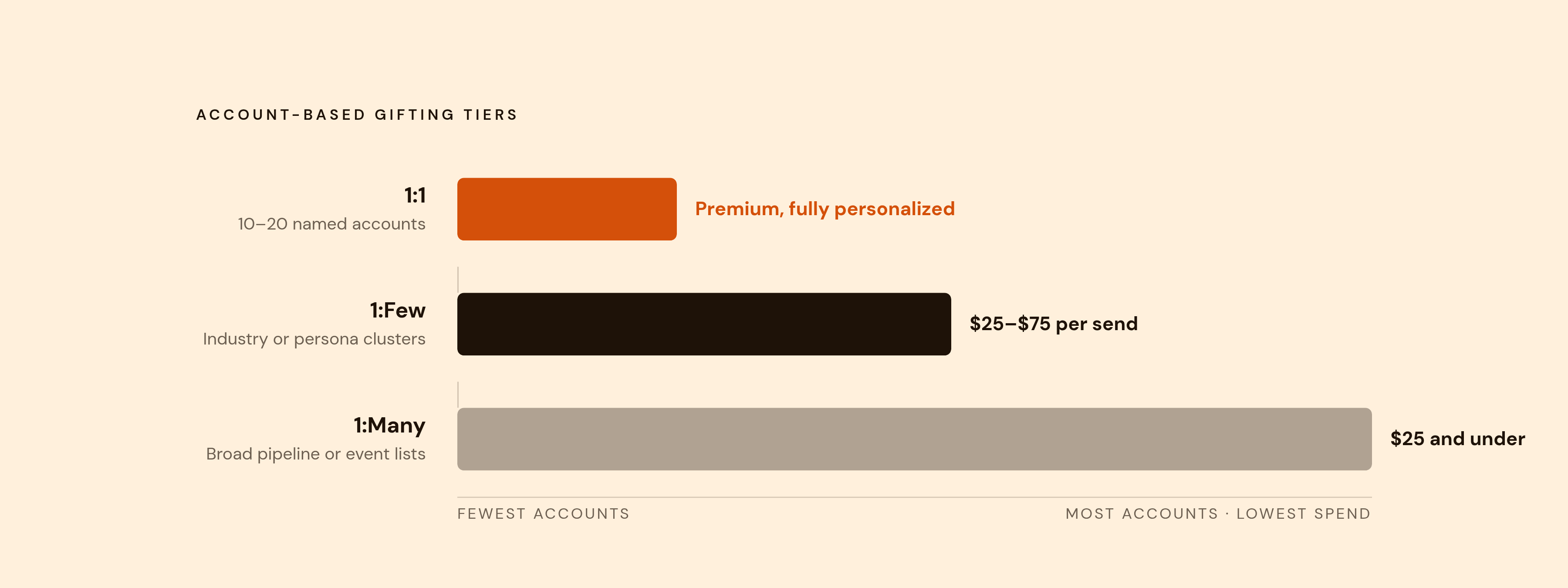
Here's roughly how that breaks down for a mid-market team, based on what I've seen hold up across a few different account structures:
- 1:1 (top 10 to 20 named accounts): high-touch, fully personalized sends, budgeted at a premium per send.
- 1:Few (industry clusters or persona groups): themed sends personalized at the segment level, $25 to $75.
- 1:Many (broad pipeline or event lists): lighter touchpoints sized for volume, $25 and under.
The tier decides the send, not the other way around. Too many teams pick whatever's easy to order in bulk and justify it after the fact, and that's backward. Account fit and deal stage decide what goes out. Every time.
One more thing worth saying plainly: gifting shouldn't run on a calendar. If your only trigger is "it's December," you're missing the moments that actually move deals. Fire sends off account behavior instead, things like engagement crossing a threshold, a deal shifting stages, or a contact gone quiet for two weeks. A mid-market target list is smaller than an enterprise one, so every wasted send costs you more, proportionally. Tiering is what keeps budget away from accounts that aren't ready for it.
The pipeline moments where a physical send changes the outcome
Not every funnel stage gets the same lift from a gift. Some moments are high leverage, and most aren't. Knowing the difference separates a program that actually moves pipeline from one that just spends money and hopes.
A few moments where a physical send earns its cost:
- Cold outreach, after email has already failed. Outbound gifting campaigns report response rates 2 to 3 times higher than email alone.
- Demo confirmation. A $25 to $50 gift card tied to showing up for a discovery call drives significantly higher show-up rates. Ghosted meetings are one of the most expensive problems in a pipeline, and this is a cheap fix for it.
- Post-demo, within 48 to 72 hours. A buying committee's attention scatters fast once the call ends. A send landing in this window keeps the conversation alive before it goes cold.
- Ghosted accounts. A well-placed physical touchpoint says you're still invested, not desperate for a reply. Cognism ran an ABM gifting campaign targeting ghosted leads and hit an 80% response rate against a 20% target, which is the kind of result that makes its own case.
- Proposal and contract stage. Competing on similar terms as another vendor? A send here signals confidence.
- Renewal and expansion. a substantial share of B2B buyers say a thoughtful gift influenced their decision to renew or expand.
Why does gifting outperform email at more than one of these stages? Gartner's 2025 research puts the average B2B buying committee at 9 to 11 stakeholders, and email is a one-to-one channel trying to move a group decision. That's a mismatch from the start. A gift sent to multiple contacts on the same account touches several committee members at once, in a way a single email thread can't.
This matters more for mid-market than it does for enterprise, not less. Fewer active deals in flight means each one carries more weight, which is why cost-per-result should drive the decision here, not cost-per-send. A $50 gift that saves a $200K renewal isn't an expense. It's the cheapest insurance policy on your books.
Personalization is not customization: what actually makes a send land
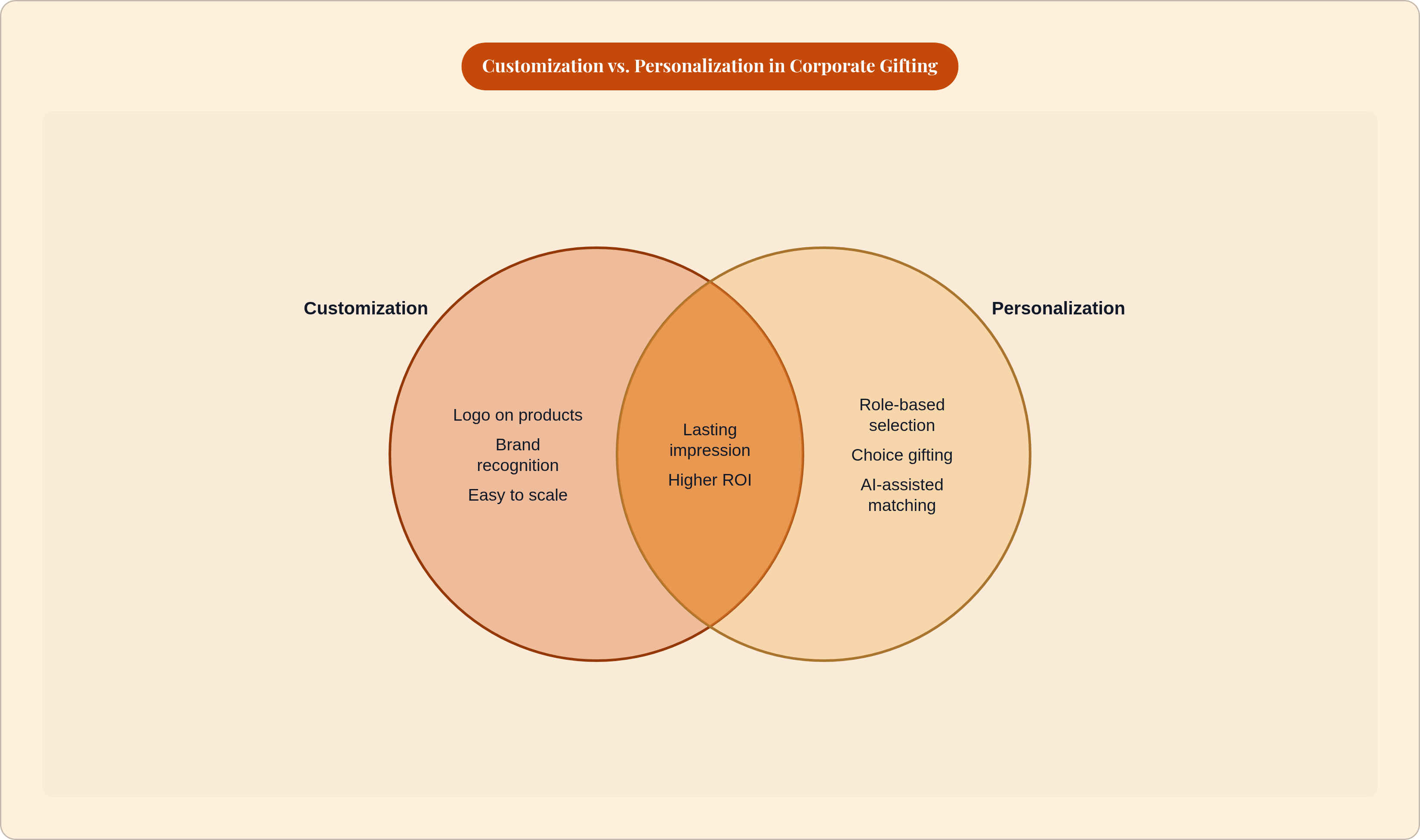
Here's a distinction I see flattened constantly. Customization means putting your logo on something. Personalization means choosing something because of what you actually know about the person receiving it. Those aren't the same motion, and mixing them up is where most mid-market gifting budgets go to waste.
The data backs this hard. Companies report dramatically higher ROI on personalized gifts compared to generic ones, per a 2024 Giftpack and Gifting 101 study. So what's "personalized" actually doing in that comparison? It's not the name printed on the card. It's the whole decision behind the send.
Real personalization needs three things. A gift tied to the recipient's role, industry, or something they've actually said matters to them, not their name slotted into a template. A note that references the real conversation you had, not boilerplate copy. And timing that matches what's happening in the relationship right now, not your fiscal quarter's calendar.
Customized gifts, logo on a mug, that sort of thing, are twice as likely to leave a lasting impression compared to generic items with no branding at all. That's a real gap. It's just smaller than the gap personalization opens up.
There's a simpler fix, too, for teams that don't want to guess: let the recipient choose. A CustomInk survey found 52% of employees say they'd value a gift more if they picked it themselves. Choice gifting sidesteps the guessing game entirely and removes the risk of sending someone a bottle of wine when they don't drink.
AI tools are starting to close the effort gap here. Sendoso's SmartSuite uses CRM data and contact signals to surface gift options that fit the recipient, so personalization at scale doesn't need a researcher sitting behind every single send. I'd still push back a little on how far this can go on its own — a tool can narrow the options, but someone still has to know the account well enough to catch when the algorithm's guess is off.
One caution for mid-market teams specifically: don't chase volume. A short list of sends that are genuinely relevant beats a long list of generic ones, on every metric that matters.
How to set a gifting budget that reflects revenue logic, not gut feel
Industry norms give you a starting range, not a target. U.S. businesses typically spend $75 to $125 per client gift. B2B pipeline gifting runs $25 to $75 for prospecting and $100 to $150 for high-value retention. Annual budgets across companies range anywhere from $5,000 to $200,000, which is a wide enough spread that it tells you more about company size and program maturity than what you specifically should spend.
So how do you land on a real number? Back into it from what a result is worth. What's a meeting worth to your pipeline? What's a renewed contract worth to your revenue line?
Run the math both directions. A $50 send that produces a six-figure opportunity has a cost-per-result no digital channel touches. Meanwhile, a substantial ad campaign that generates zero pipeline is infinitely more expensive on the one metric that actually counts.
One real constraint worth knowing before you build anything: the IRS caps business gift deductions at $25 per person per year. That's a hard limit, and it shapes program design directly, especially if you're sending to the same contact more than once a year.
Budget by tier, following the same structure as the ABM logic above. Your 1:1 accounts get the biggest per-send number, your 1:Many list gets the smallest. Budget follows intent, not whatever happens to be convenient to order in bulk.
Set the per-tier ranges before the program launches, not after the catalog's open and people are already ordering whatever they want. That one decision prevents spend drift and makes your attribution numbers mean something later.
Connecting gifting to your CRM so sends create data, not just goodwill
Here's the problem sitting under most gifting programs: the vast majority of event and gifting teams can't trace ROI back to a specific physical touchpoint. Ask most of them honestly and they'll admit physical sends are influencing deals that never get credited anywhere in the CRM.
For a mid-market team, that's not a minor gap. It's existential to the whole program. Skip attribution, and gifting looks like a cost center the first time budgets get tight, even when it's actually a revenue driver.
Real integration means specific things are happening, not just "we use a platform":
- Every send logged against a contact and an opportunity record, not tracked in a spreadsheet off to the side or trapped inside the gifting tool alone.
- Sync running both directions: send data flows into the CRM, and deal stage changes flow back out to inform when the next send should fire.
- Reporting at the campaign level, so you can see which gift categories, send types, and timing windows actually correlate with deals moving forward.
Personalized URLs, QR codes, unique offer codes, matchback analysis: these are what turn a physical object sitting on someone's desk into a trackable digital signal. Platforms that connect directly into CRM and marketing automation stacks let a send tie back to pipeline movement and deal velocity instead of floating outside the data stack as an offline mystery nobody can explain in the quarterly review. Whether that connection actually gets used well still comes down to the team wiring it up correctly and keeping the CRM data clean enough to trust.
A 2025 industry report on corporate gifting and swag, built on millions of gift sends, found gifted campaigns converting at a dramatically higher rate compared to standard email. That's a striking gap, and I'll admit my first instinct was to be skeptical of a number that wide. But the sample size is large enough, and the direction matches everything else in this piece, that it's hard to dismiss outright. It's only useful to you, though, if your own integration is solid enough to see whether your sends are producing anything close to it. Otherwise you're just reading someone else's report and hoping it applies.
The attribution gap is a design problem, not a technology problem. Teams that wire in tracking from the first send spend a lot less time later defending why the budget exists at all.
Scaling a gifting program without adding headcount to run it
Most mid-market gifting programs don't have a dedicated person running them. It falls to a marketing manager or an SDR, stacked on top of the job they were actually hired to do. That reality shapes what "scalable" even needs to mean here.
Without a platform doing the heavy lifting, things break fast. Collecting addresses turns into manual back-and-forth, especially for remote recipients. Fulfillment gets inconsistent because nobody's centralizing procurement to keep quality and timing steady. Sending internationally turns into a mess of vendors, customs forms, and carrier accounts nobody has time to manage. Reporting just doesn't happen, because someone would have to sit down and manually reconcile data pulled from three different places.
A platform built for this fixes each piece directly. AI-assisted gift selection surfaces relevant options automatically, so nobody's scrolling a catalog for every recipient. Address confirmation workflows let the recipient update their own delivery info, so a stale address never blocks a send. Automated trigger logic fires sends when CRM conditions are actually met, instead of waiting on someone to remember. Centralized fulfillment, handled through dedicated fulfillment infrastructure shipping to more than 165 countries, takes procurement, storage, packing, and shipping off your plate entirely.
Sendoso's own data shows automated gifting can lift response rates 5x and return over 200% on investment. Automation isn't replacing the judgment behind a good send; it's removing the manual friction that kept good judgment from scaling in the first place.
What does "scalable" actually mean at mid-market size? Not thousands of sends a month. A smaller, focused account list getting consistent, well-timed sends, with quality and timing controlled by the platform instead of a person eyeballing every order that goes out the door.
Building the program in phases rather than launching everything at once
Teams that try to stand up every tier, every use case, and full attribution on day one usually end up building none of it well. Phasing isn't slower. It's how you actually get somewhere real.
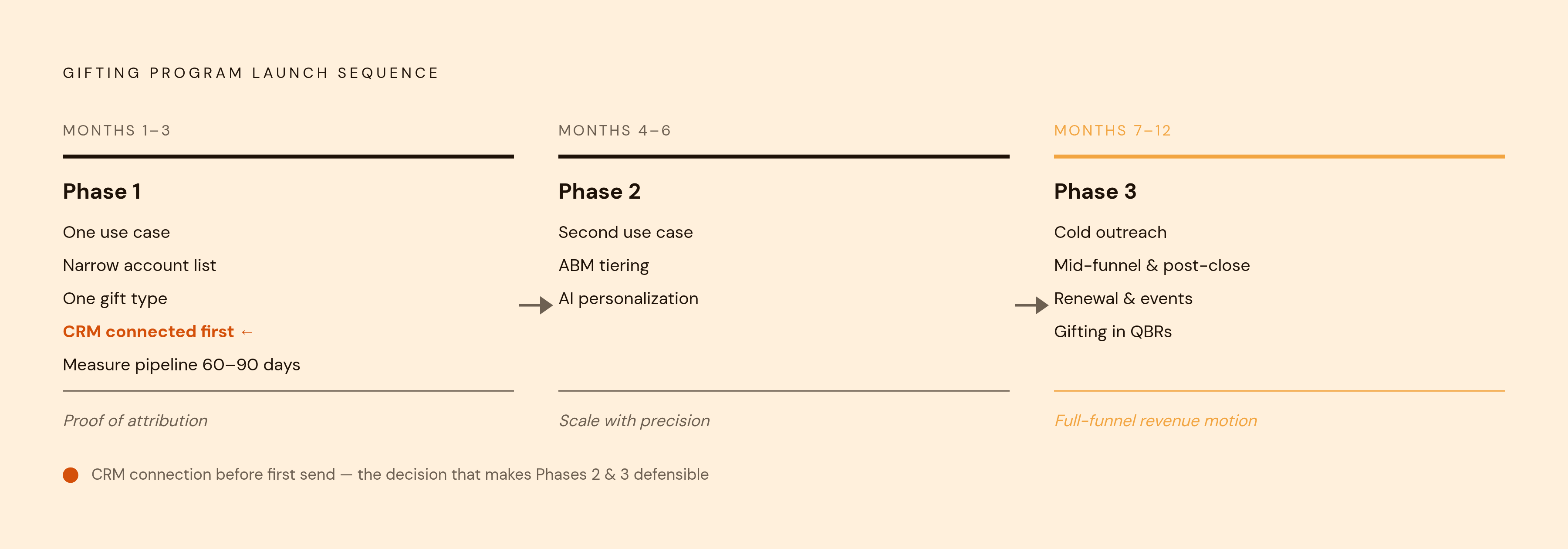
Phase 1, months 1 through 3: prove the motion. Pick one use case, whether that's demo show-up rates, reactivating ghosted accounts, or renewal outreach. Define a narrow account list. Set a per-send budget. Pick one gift type and stick with it. Connect to your CRM before the first send goes out, not after, so attribution is built in from day one. Run it 60 to 90 days and measure what actually happened to pipeline.
Phase 2, months 4 through 6: expand triggers and tiers. Add a second use case based on what Phase 1 taught you. Bring in ABM tiering so sends differ by account priority instead of treating every account the same. Start layering in AI-assisted personalization to cut the manual effort per send.
Phase 3, months 7 through 12: full-funnel program. Gifting now touches every stage: cold outreach, mid-funnel, post-close, renewal. Event sends get folded in, both pre-event engagement and post-event follow-up. Reporting becomes a standing line item in quarterly revenue reviews, with an actual pipeline number attached, not a vague sense that things feel more relational than they used to.
Why phase it at all instead of moving fast? The goal isn't caution for its own sake. It's proof. A mid-market leader who can point to Phase 1 pipeline numbers has an easy time getting Phase 2 funded. A leader who launched everything at once and can't say what worked has a much harder conversation waiting for them.
A platform built to grow along that same arc, from one narrow use case to a full sending program, avoids forcing a team to switch tools halfway through. That continuity matters more than it sounds like it should. Every tool switch costs you a month of momentum you don't get back.