White Elephant Gifts Under 25 Dollars for Work Teams
Gifts that get stolen three times beat ones nobody touches, regardless of price.

White elephant gifts under $25 work when they hit a specific target: something people actually want, safe enough for an office setting, and eye-catching enough to survive the steal round. That's the whole game. Get those three things right and you've done your job as a gift-giver; miss any one of them and your gift sits there unstolen while the fuzzy blanket three seats down gets fought over for the fourth time.
The tradition itself has a strange backstory worth knowing, because it explains why the game is built the way it is. The name comes from the King of Siam, who supposedly gifted actual white elephants to courtiers who'd fallen out of favor. The animals were sacred, so you couldn't get rid of them, but they were also enormous and expensive to keep. A beautiful, impractical burden dressed up as an honor. That's the spirit the modern game inherited: something that looks like a gift but comes with a wink. Some offices call it a Yankee Swap, others Dirty Santa, but the mechanic is identical everywhere. And that mechanic is really what people show up for.
How the steal mechanic shapes what a good gift actually needs to be
Here's the standard setup, in case your office runs a slightly different version: person one unwraps a gift and sets it on the table. Person two can either steal that gift or unwrap something new from the pile. Person three does the same, and so on, until everyone's had a turn. Person one usually gets a final steal if they want it. Most groups cap steals per gift at two or three rounds, and a lot of offices ban the instant revenge steal, meaning you can't immediately take back something that was just stolen from you.
This works best with somewhere between 6 and 30 people, and most office price caps land somewhere in the low-to-mid double digits. Here's the insight that actually matters for anyone shopping, though: the steal cap is the whole benchmark. A gift that gets stolen three times is the one people talk about at their desks the next day. Even a gift with a lot of thought behind it might as well not have been brought at all if nobody touches it.
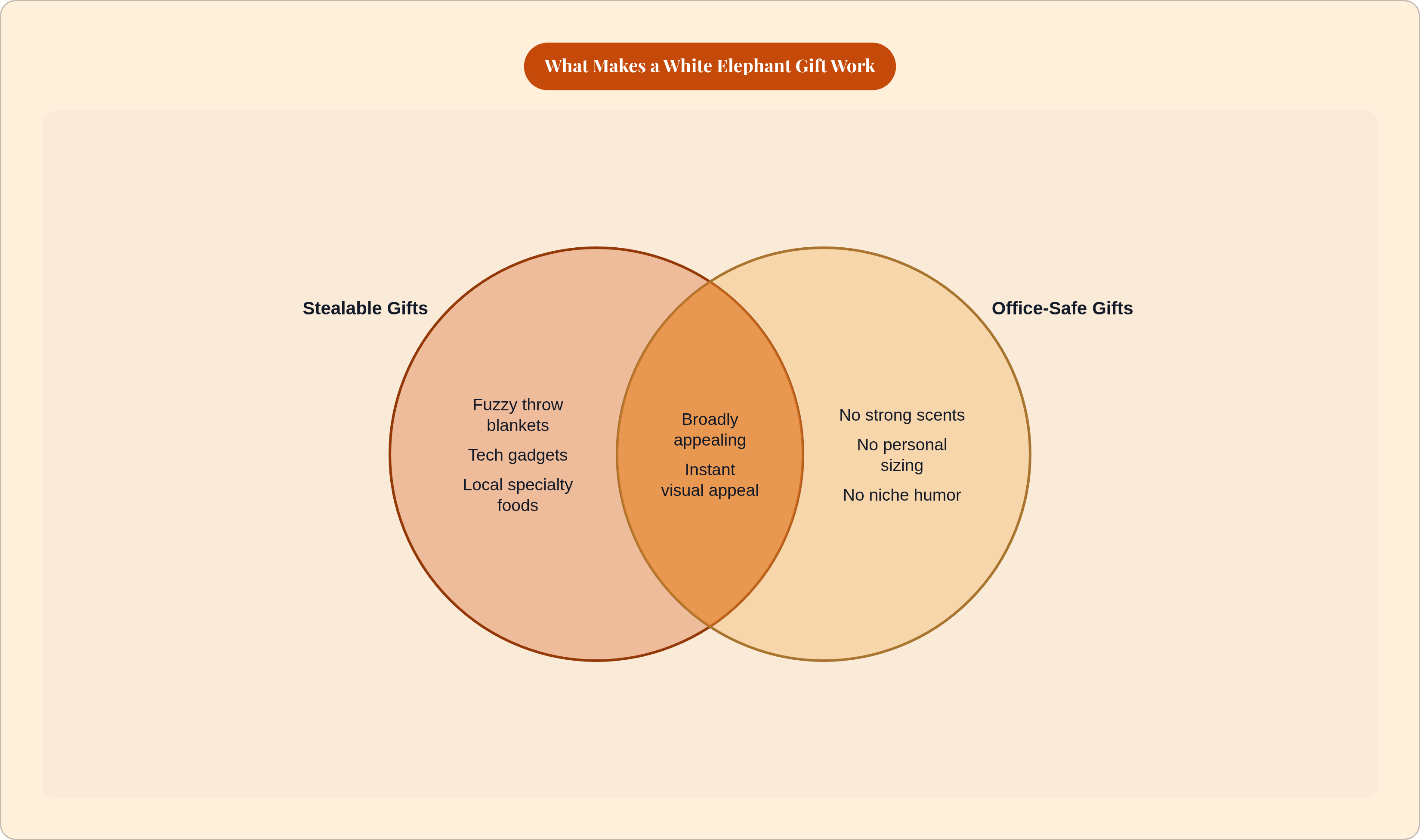
So what makes someone steal a gift in the first place? Visibility, mostly. In a room of 20 coworkers, nobody's got time to hear the backstory behind your carefully chosen item. The gift has to read as desirable the second it's unwrapped, from across the room, with zero context. That's why universally recognizable value beats clever or niche every time. Cozy items, tech gadgets, and good consumables all pass this test instantly. According to research from whiteelephantgame.com, the gifts that get stolen the most consistently are fuzzy throw blankets, decent travel mugs, and local specialty foods like jams and coffee. Books and niche games, by comparison, barely get touched. Worth sitting with that for a second: a book requires someone to know your taste, and a white elephant round gives nobody that luxury.
Why $25 is the right ceiling — and what it means to spend it well
Most office exchanges settle somewhere in a modest price range, with $20 to $30 showing up often enough to be the other common bracket. Matt Graham, who works in corporate gifting at Shadow Breeze, points to $25 as the default when no cap's been set. It's high enough to buy something real, low enough that nobody feels weird about it.
Going higher, to $40 or $50, starts running into equity problems, especially when employees are paying out of pocket rather than the company covering costs. That distinction matters more than people give it credit for: when the company foots the bill, participation goes up across the board. Nobody's quietly deciding whether the gift exchange is worth $30 out of their own paycheck this month. It becomes a perk they show up for instead of an obligation they grudgingly join.
Treat $25 as a ceiling, not a floor; the goal was never to spend as close to it as possible. An $18 Bluetooth karaoke speaker that makes the whole room laugh beats a forgettable $24 item every single time. Spending well at this price point means chasing perceived value over actual cost, picking things that feel like a small indulgence rather than an office supply, and leaning toward stuff people want but wouldn't buy themselves. That last part is the real filter. Ask yourself: would this person buy this for themselves on a random Tuesday? If the answer's yes, you've probably picked wrong.
Tech and gadget picks that earn instant credibility when unwrapped
Per the White Elephant Online 2025 trends report, Bluetooth speakers were the single most dominant gift category in 2024's virtual exchanges, and that dominance makes sense once you think about why tech reads so well in this format. It signals value at a glance, it looks good sitting on a desk, and almost everyone assumes they could use one more gadget, even if they already own three.
A wireless karaoke-style Bluetooth microphone speaker, sitting around $18, hits both notes: it's absurd enough to get a laugh when it comes out of the box, and useful enough that people actually want to steal it. It also doubles as a genuine desk speaker once the novelty wears off. A standard compact Bluetooth speaker is the safer, quieter version of the same idea, good for background music or an impromptu team celebration.
The BestInKits Smart Coffee Mug Warmer, priced around $23, earned Forbes's pick for best office white elephant gift, and I get why. It solves a problem almost everyone has (the coffee that goes cold by 9:15) in a way most people never bother solving for themselves. A portable charger is another safe bet under $30; if you're picking one for this purpose, look for a GaN charger putting out at least 20 to 30 watts. Fast enough to feel like a genuine upgrade, small enough to toss in a bag without thinking about it.
LED strip lights round out the list nicely. App-controlled or remote-controlled ambient lighting looks far more expensive than it actually is, and it transforms a desk or monitor setup instantly. A mini desk vacuum is smaller stakes but works on the same principle: it's satisfying, it solves a problem everyone quietly has, and the novelty lands the moment it's unwrapped. What ties all of these together is that they look like the giver did a little homework. At $25, that impression alone is worth something.
Humor and novelty gifts that are actually office-safe
There's a failure mode here worth naming directly. A gag gift that crosses into genuinely offensive or just baffling territory tends to go home with whoever unwrapped it last, never gets stolen, and leaves an awkward silence where the laugh was supposed to be. Nobody wants to be holding that at 4:45 on a Friday.
The version that works is practicality wearing a costume of chaos. The Genuine Fred Desk Dumpster Pencil Holder looks like a tiny dumpster on fire, comes packaged with over 100 flame-shaped notecards, and still functions as a real desk organizer once the joke's landed. An Excel-themed mug is a great pick if your office skews finance or data heavy; it's funny to the right crowd without needing an explanation, and it's still just a mug someone will use daily.
A tiny puffer jacket can-cooler is, and I mean this as a compliment, absurd in the best way. It keeps a drink cold and looks completely ridiculous doing it, which is exactly the combination that triggers competitive stealing. A Mini Wacky Waving Inflatable Tube Guy desk toy works on the same logic: small enough for a desk, funny enough to earn a laugh, unlikely to raise any HR eyebrows.
Wine Condoms deserve a mention here too, if only because the name alone gets the biggest laugh in the room almost every time. They're genuinely useful (they seal an open bottle airtight), but the name is a judgment call depending on your office's culture. Worth thinking through before you buy. The rule across this whole category: if the joke needs a follow-up explanation, it's the wrong gift. The laugh has to happen the instant it comes out of the wrapping paper, in front of coworkers, not later when someone gets the reference.
Cozy and self-care picks that feel like a treat, not a chore
Cozy gifts win for a simple reason: people want them constantly but almost never buy them for themselves. There's something about a soft blanket or a good candle that feels indulgent in a way a phone stand or a notepad never will.
Throw blankets are, again, among the most-stolen items at any white elephant exchange, and a genuinely soft, well-made one reads as luxurious even at under $25. A hand-poured, small-batch soy candle (something like an Asheville-made option with notes of pine, cedar, patchouli, and spearmint) feels artisan rather than generic, and it usually runs under $20. Korean sheet mask sets are another strong option, especially at lower budget caps; they're affordable, they feel spa-adjacent, and they work across gender lines without any awkwardness.
Dr. Squatch handmade soaps deserve a spot here too. Natural ingredients like coconut oil and shea butter, scents like Cedar Citrus and Cool Fresh Aloe, and enough brand recognition that people know what they're getting before they even open it.
One thing worth flagging: skip perfume, and be careful with anything beyond candles and soap on the fragrance front. Scent sensitivities show up more often in office settings than people expect, and a gift that's genuinely kind in intent can turn into a problem for someone with allergies. Cozy gifts don't need a punchline attached. Their appeal is immediate, which is precisely why they get stolen so often.
Food and drink gifts that disappear fast — in the best way
Consumables are quietly the smartest category in the whole game. They're universally appealing, and they leave zero clutter behind, which sidesteps one of the most common complaints about white elephant gifts in general (nobody wants to take home another thing they'll never use). Local specialty foods, fancy jams, artisan coffee, tend to be some of the most-stolen items out there, partly because "local" adds a story that makes the gift feel more considered.
The Cocktail Box Co. cocktail kit is a standout: one tin makes six servings, and it comes with three bitters, raw cane sugar cubes, a muddler's spoon, and cocktail picks. It feels complete in a way that's rare at this price point. Pocket Latte Coffee Chocolate, caffeinated chocolate treats, made a top food and beverage pick list for office settings, and it's quirky enough to stand out on a table full of predictable gifts. The Nostalgia Tabletop S'mores Maker, at $24, straddles the line between food gift and novelty gadget, with a stainless steel grate, two roasting forks, and removable trays for cleanup. That dual identity is exactly why it tends to get stolen more than once.
One caveat worth sitting with: alcohol-adjacent gifts like the cocktail kit are a judgment call. Most offices are fine with it, but not every colleague drinks, and some workplace cultures lean more conservative than others. A coffee or chocolate option sidesteps the question entirely if you'd rather not think about it.
Desk toys and games that earn a permanent spot on someone's desk
What separates a desk toy from a pure novelty item is staying power. A desk toy gets kept, displayed, used. It becomes part of how someone's workspace looks and feels, rather than getting shoved in a drawer after the party ends.
The Shashibo magnetic puzzle cube is a great example. Think of it like a Rubik's Cube, but harder to solve, better looking, and more satisfying to fidget with during a slow meeting. Every office has that one puzzle person who will absolutely fight for this during the steal round; count on it. A UNO travel tin works differently but just as well: it's a game everyone already knows, packed into a format compact enough to bring anywhere, and the tin itself makes it feel more like a gift than a game night purchase.
LEGO Botanicals Happy Plants, two small plant holders built from LEGO pieces, round out this category nicely. Creative, appropriate for any desk, and carrying the built-in credibility of the LEGO name. What makes all three of these work is the same thing that makes tech gadgets work: they're visually obvious as "good" the second they come out of the wrapping. That's the steal trigger, every time. Steer clear of niche games that need a specific interest or a full group to play properly; they don't survive the moment where one person unwraps them alone in front of a room.
Premium-feel practical gifts that justify every dollar of the budget
At $25, nothing beats a gift that looks like it should've cost more. It makes the person who brought it look resourceful, and it makes the person who steals it feel like they got away with something, which, honestly, is the entire emotional core of this game.
The Karst Stone Paper Hardcover Notebook is a good example of this. It's made from recycled stone, it's waterproof and tear-resistant, and the texture is unlike any regular paper notebook people are used to. Pair it with a Jetstream 0.5mm pen and you're still under $25, but now it feels like a curated set rather than a single item. The HOTO 25-in-1 Mini Electric Screwdriver works on a similar logic. It looks like a sleek piece of tech, but it's a genuinely useful tool, and it'll land well with anyone who's ever assembled furniture and wished they had something better than the free hex key that came in the box.
What makes both of these gifts land is that they solve a small, real problem in a way that feels considered. These are also, worth noting, the gifts most likely to get used and remembered long after the office party wraps up, which might be the best return you can get on a $25 budget.
What to avoid bringing to an office white elephant — and why some well-intentioned gifts backfire
Office white elephant carries more social risk than the version you'd run with friends, and it's worth taking a second to sit with why. The relationships in that room are ongoing. They're professional. A gift that lands badly doesn't just create one awkward minute; it can stick around in someone's memory the next time you're in a meeting together.
Anything too personal is a hard no. Jewelry, clothing, anything with a specific size attached; these items risk reading as inappropriate or misjudging a relationship that's still fundamentally professional, no matter how friendly the office culture feels day to day. Perfume and strongly scented products beyond a candle or bar of soap fall into the same category, given how common fragrance sensitivities turn out to be once you actually ask around an office.
The instinct behind most of these gifts is a good one. Nobody's trying to make things awkward, and the format itself rewards a very specific kind of generosity: something broadly appealing, low-risk, and genuinely fun to unwrap in front of people you'll see again on Monday. Keep that in mind, and the $25 you spend goes a lot further than the price tag suggests.