Client Gifting vs Employee Gifting Strategy
Treating client and employee gifting as the same strategy backfires in opposite ways.

There's a budget line at most companies that reads something like "corporate gifting" or "client and employee gifts," and it quietly funds two completely different relationships. That's where the trouble starts.
When spend lives on one line, the temptation is to apply one logic to both sides of it: same vendor, same cadence, same success metric. I've watched smart, well-intentioned teams do this repeatedly. And the outcome is almost never neutral. A mediocre gift to a long-tenured employee lands worse than no gift at all. A promotional-feeling package sent to a high-value client raises eyebrows instead of goodwill. The failure modes aren't random; they're predictable, and they stem from a single root error: treating client gifting and employee gifting as variations of the same thing.
They're not. The psychological mechanisms are different, the tax rules diverge sharply, the budgeting logic should scale on different axes, and what "personalized" even means differs entirely by audience. The global corporate gifting market was valued at $886.56 billion in 2025, per ResearchAndMarkets. At that scale, a muddled strategy isn't a minor inefficiency. It's an expensive one.
What follows is a side-by-side examination of both programs. Not a defense of one over the other, but an attempt to show where they diverge and why that divergence should drive every downstream decision.
What each type of gifting is actually trying to accomplish
Client gifting has one real job: sustain and deepen a commercial relationship. It signals that the business values the partnership beyond the transaction, that there's a human layer beneath the contract. The moments that trigger it, contract signings, renewals, project completions, milestone celebrations, are all inflection points in a commercial arc. The gift isn't the relationship; it's a marker of it.
Employee gifting is trying to do something else entirely. It's meant to reinforce belonging, motivate performance, and signal that the organization sees the individual, not just the role they fill. Onboarding gifts, work anniversaries, performance milestones, spot recognition: these are moments about personhood, not commercial value. The mechanism is recognition, not reciprocity.
Here's the distinction worth carrying through the rest of this: client gifts fail when they feel sales-driven. Employee gifts fail when they feel generic. Those are mirror-image failure modes, which tells you something important. The risks aren't just different in degree; they point in opposite directions. A branded tote bag sent to a top client feels like a promotional item. That same tote bag sent to a new hire who just relocated feels impersonal and cheap. Neither impulse purchase nor bulk branded merchandise serves either goal, but for entirely different reasons.
What the data shows about client gifting outcomes
The most compelling data point in client gifting is the retention link. Clients who receive thoughtful gifts during the holidays are nearly twice as likely to continue a business relationship. What's worth examining there isn't the gift itself but the mechanism: psychological reciprocity. When someone feels seen by a business partner, they are dispositionally inclined to maintain that partnership. The gift is a trigger for that feeling, not the cause of it.
The acquisition cost context makes this math look different than it first appears. Acquiring a new client costs somewhere between five and twenty-five times more than retaining one. Even a modest retention lift from a gifting program, call it three to five percentage points, can produce returns that dwarf the investment when you run it against that replacement cost. That's why serious gifting programs treat client retention as the North Star metric, not gratitude expressed or sentiment generated.
The 2024 PPAI survey found that 83% of recipients said a thoughtfully chosen business gift made them feel more positive about the sender's company. The operative phrase there is "thoughtfully chosen." The effect hinges on perceived effort, not price. A $60 book that directly relates to something discussed in a client meeting will outperform a $150 generic wine set with a logo on the bag. That's not intuitive to teams who think of gifting as a spend category; it becomes intuitive when you think of it as a relationship input.
What the data doesn't resolve, and it's worth being clear about this, is the gap between sentiment and closed contracts. Gifting improves how clients feel about you. It doesn't directly move deals. Treating it as a sales tool misunderstands the mechanism and, more practically, will make the gift feel sales-driven, which is the very failure mode you're trying to avoid.
What the data shows about employee gifting outcomes
Snappy's 2024 Holiday Gifting Report, with a sample of 1,500 employees, found that 63% of employees said job satisfaction increases after receiving a meaningful holiday gift. More specifically, 38% said the boost lasts between three and six months. That's not a fleeting sugar spike; that's a measurable window of elevated engagement with a clear origin point.
The retention data is the part that reframes the budget conversation most forcefully. Fifty-four percent of employees in that same report said they are more likely to stay with a company that consistently shows appreciation through gestures like holiday gifts. Now hold that against the SHRM figure: replacing a single employee can cost between 30% and 200% of their annual salary depending on seniority. Suddenly, a $75 gift isn't a perk budget line. It's risk mitigation.
The failure mode here is concrete and costly in a way that has no real analog on the client side. Forty-four percent of employees in the Snappy data said they feel unappreciated when they receive a poorly chosen gift. A bad employee gift actively damages the relationship it was meant to strengthen. That's not true in the same way with clients. A client who receives a forgettable gift is more likely to attribute it to vendor oversight or budget constraints. An employee who receives a forgettable gift knows the company had their name, their tenure, and their role, and still couldn't manage something meaningful. The interpretation of effort is harsher because the context is intimate.
How budgeting logic should differ between the two audiences
The common benchmarks are these: companies generally spend somewhere between $75 and $125 per client gift, and around $50 per employee annually. Nearly 40% of HR professionals set per-employee budgets in the $50 to $100 range. Those numbers aren't wrong, but they're also not the right starting point for either audience if applied uniformly.
Client budgets should scale with account value and relationship stage. An early-stage prospect warrants something simple and low-pressure; a long-term account generating significant revenue justifies meaningfully higher spend. The logic is proportionality, not generosity for its own sake. The gift should feel commensurate with the depth of the relationship, not aspirational toward a relationship that doesn't yet exist.
Employee budgets should scale with tenure and milestone significance. Work anniversary gifts in the range of $50 to $75 make sense at year one. At ten years or beyond, the range commonly reaches $150 to $300 or more. The asymmetry isn't arbitrary; it reflects the accumulating weight of loyalty. A flat-rate approach treats a decade of tenure the same as three months of employment, which is precisely the kind of signal that makes long-tenured employees feel interchangeable.
The Incentive Research Foundation found average annual spend per person on non-cash rewards fell from $1,090 in 2023 to $921 in 2024. Economic caution is real, and no framework should pretend otherwise. But cutting the wrong line carries measurable downside. If the recognition budget gets trimmed to protect other spend, the retention math above doesn't become less true; it just becomes a problem you'll pay for later through turnover costs.
One principle holds for both audiences: a smaller, well-chosen gift consistently outperforms a larger, generic one. The definition of "well-chosen," though, differs entirely. For clients, it means professional relevance: something that reflects attentiveness to the relationship. For employees, it means personal resonance: something that acknowledges who they actually are.
Tax treatment of each gift type — where the rules diverge sharply
This is where the two programs stop merely feeling different and become legally distinct in ways that should shape format decisions before you ever pick a gift.
For client gifts, businesses can deduct no more than $25 per recipient per year under IRS Publication 463. That limit hasn't changed since 1962. Most corporate gifting programs quietly exceed it without accounting for it correctly, which means real deductibility is often far lower than teams assume. The practical implication: client gifting above the $25 threshold isn't a deduction you're taking; it's relationship spend you're absorbing. Many finance teams are comfortable with that framing once it's made explicit, but it should be explicit.
There's a useful carve-out worth knowing. Incidental costs like engraving, custom packaging, and shipping are excluded from the $25 cap if they don't add substantial value to the gift itself. That gives programs some room to personalize without sacrificing deductibility. Gifts made to a company broadly, rather than to a specific individual, are fully deductible; gifts that primarily benefit one named person fall under the cap.
On the employee side, there's no fixed spending cap for deductibility. The governing principle is the de minimis fringe benefit rule: low-value, infrequent items like branded merchandise, gift baskets, or company-branded drinkware are deductible and not taxable to the employee. That's the straightforward scenario.
Here's where many HR teams get caught off guard. Gift cards, regardless of amount, are classified by the IRS as cash equivalents and are taxable income to the employee. A $25 gift card to a coffee chain must appear on the employee's W-2, the same as a $200 one. This rule applies to digital gift cards with the same force as physical ones. That single rule reshapes a lot of format decisions; it's why companies that want to give something flexible often move toward curated choice platforms or physical goods rather than straight gift cards, or build in gross-up to absorb the tax impact.
The practical steer from the tax code: client programs are nudged toward experiential or physical gifts, accepted as relationship spend beyond the deduction line. Employee programs are steered away from gift cards unless the tax treatment is planned for and communicated.
Personalization works for both audiences but means different things in each context
For clients, personalization means demonstrating familiarity with the relationship. Referencing a shared project, acknowledging a company milestone, connecting to an industry interest the client has mentioned. It signals attentiveness, not intimacy. The goal is to convey: we pay attention. We remember what matters to you professionally. That's a different register than knowing someone's personal tastes.
For employees, personalization means acknowledging the individual. Their specific contribution, their tenure, their preferences. A moderately priced gift accompanied by a handwritten note that references what they actually did this year will outperform an expensive gift with a form letter. Sixty-nine percent of employees, per the Snappy 2024 data, say they would prefer to choose their own gift. For large employee populations, that finding argues for choice-based or catalog gifting over top-down curated selections, which is a meaningful operational implication.
Over 34% of gift orders in 2025 included custom embroidery, laser-engraved branding, or bespoke packaging. Heavy branding, though, reads differently depending on who receives it. For employees, a highly branded gift can feel like the company gifted itself. For clients at the high-value end of the relationship, it can feel promotional rather than personal. The broader market shift is toward quality products with minimal or refined branding, and that shift serves both audiences, though for somewhat different reasons.
Sustainability and digital gifting as execution considerations for each audience
Nearly 56% of corporate buyers prefer eco-friendly gifts, per Business Research Insights (2025). For client programs, sustainable gifting signals brand value alignment; it says something about how the company sees itself in the world. For employees, that same gift reinforces stated cultural commitments, which matters a great deal to employees who are evaluating whether the company practices what it preaches. Interestingly, the same gift can carry different meaning depending on who receives it and what frame they bring to it.
Roughly 40% of corporate gifts end up in landfills, per Giftly (2025). That's a practical argument for quality over volume regardless of audience, and a compelling reason to reconsider bulk orders. A smaller quantity of well-chosen, durable items produces less waste and creates more goodwill than a large quantity of forgettable ones.
Digital gifting has grown significantly; eGift cards and online vouchers increased by 24% between 2022 and 2024, per Market Reports World (2025), driven in meaningful part by remote and hybrid workforce logistics. For employee programs at scale, digital gifting solves a genuine operational problem. But the IRS gift card rule applies to digital gift cards with exactly the same force as physical ones. "We sent it by app" is not a meaningful distinction to the tax code.
For client programs, digital gifting is lower friction but carries a perception risk at the higher end of the relationship. A $200 e-gift card to a key account contact feels less considered than a curated physical gift at the same price point. The digital format, at its best, conveys convenience; it rarely conveys effort.
About 47% of companies had adopted AI-based gifting solutions by 2024 to automate selection and personalization, per Business Research Insights (2025). That capability is useful at scale. The risk is that automation optimized for efficiency produces results that feel automated, which directly undermines the personalization logic both programs depend on. The tool is only as good as the brief it's given.
A side-by-side decision framework for allocating across both programs
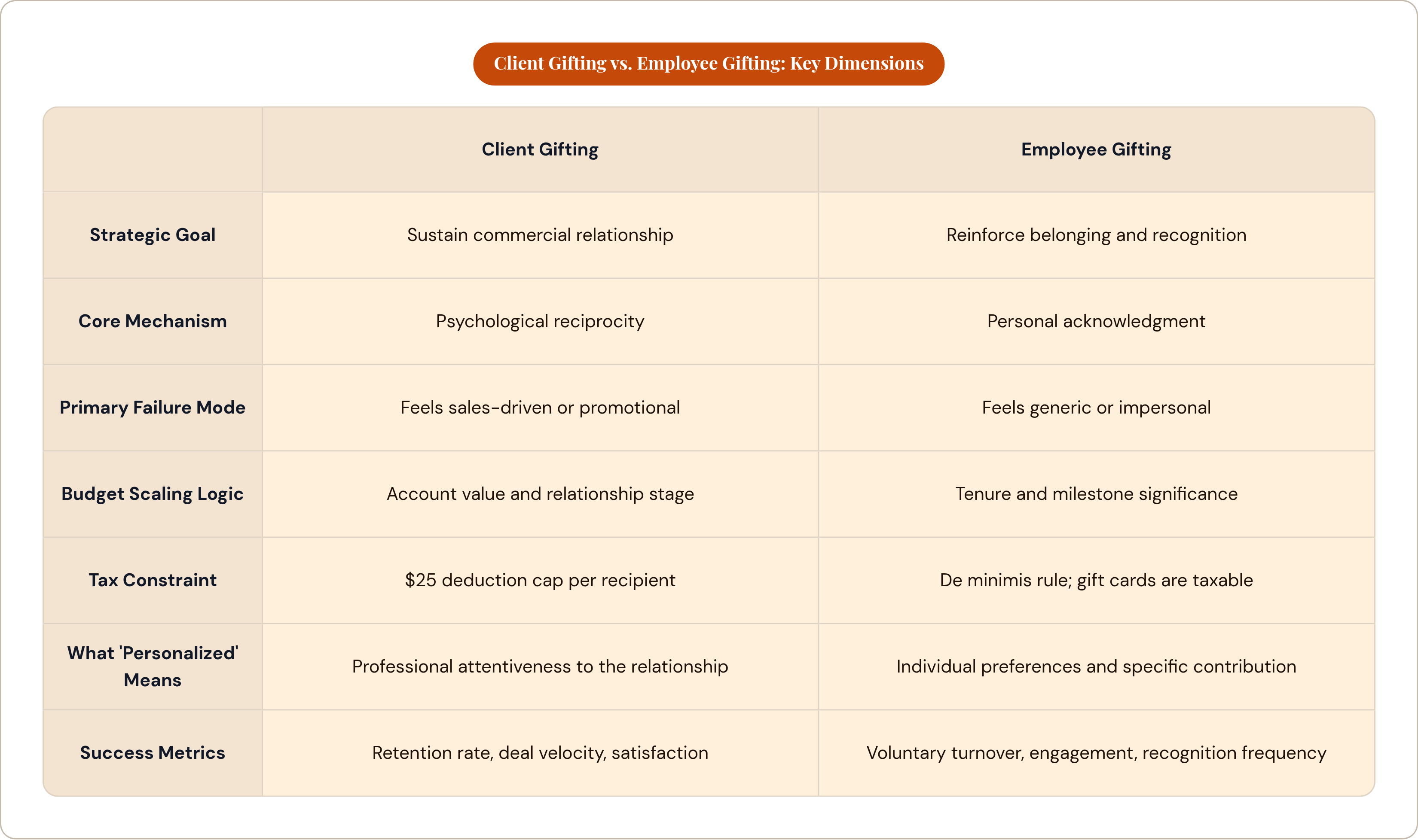
Five dimensions should be planned separately for each program: strategic goal, success metric, timing triggers, per-recipient budget logic, and tax and format constraints.
For client programs, the success metrics are relationship retention rate, deal velocity, and client satisfaction scores, not gift spend and not direct attribution to closed revenue. For employee programs, the metrics are voluntary turnover, engagement survey results, and recognition frequency. Companies with gifting programs see meaningfully lower voluntary turnover; the effect is real and measurable when tracked against a baseline.
Timing for client programs should map to relationship moments: renewals, project completions, milestones, significant pipeline transitions, not just the holiday calendar. Ninety-one percent of corporate gift buyers expect gifting frequency to increase or stay the same, per Coresight Research/GiftNow (2022), which reflects the shift toward year-round programs that treat gifting as an ongoing practice rather than a December obligation.
For employee programs, Giftsenda's 2024 Employee Gifting Report found that unexpected recognition gifts generate stronger appreciation than purely milestone-driven ones. The implication is structural: build some discretionary budget for spontaneous recognition alongside the programmatic gifts. The surprise is part of what makes it land. A milestone gift is anticipated; an unexpected one signals that someone was paying attention on an ordinary Tuesday.
Before any gifting spend gets approved, there's one question worth asking first: is this gift meant to sustain a commercial relationship, or is it meant to recognize a person's contribution to the organization? The answer to that question should determine every downstream choice, the format, the value, the occasion, and the message. When teams skip that question and reach for a vendor catalog instead, they often end up with the right gift for the wrong audience, which is usually worse than doing nothing.
The two programs share a budget line. They shouldn't share much else.