Annual Corporate Gifting Calendar
Intentional gifting with proper lead time cuts acquisition costs and boosts retention measurably.

Before mapping anything, let's talk about what's actually at stake, because "corporate gifting calendar" sounds like an administrative nicety until the numbers surface.
Replacing a salaried employee costs somewhere between half and twice their annual compensation. That figure accounts for recruiting fees, onboarding time, and the productivity gap while a role sits vacant or gets covered poorly by whoever was already stretched thin. A thoughtful work-anniversary gift, even a generous one, is a rounding error by comparison. The client-side math is similarly stark: acquiring a new B2B account costs five to seven times more than retaining an existing one. A renewal gift to a top account costs less than one lost contract. These are financial arguments, not sentimental ones, and they are the arguments that get budgets approved.
Personalization compounds this further. Companies report substantially higher ROI from personalized gifts versus generic ones. Most say structured gifting has improved relationships with both employees and clients. That finding holds across the data and across the programs I've watched work, and fail.
What the numbers don't argue for is gifting more. They argue for gifting intentionally. More spending without structure behind it doesn't move these metrics. One company I've watched closely spent aggressively on Q4 gestures for three consecutive years, expensive hampers, rushed swag drops, last-minute wine shipments, and saw almost no measurable change in either retention or renewal rates. The money was there. The system wasn't. The calendar is what converts gifting from a cost center into something that actually does the work.
How to Read Lead Times Before Mapping Any Specific Month
Here's the rule that everything else depends on: fix the delivery date first, then count backward to the order date. Not the other direction.
I know it sounds obvious. It isn't, in practice. Nearly every gifting crisis starts with someone doing it in reverse, picking a gift, placing an order, and then hoping the timing works out. It usually doesn't, and by then there's no good option.
Pre-configured kits ship in roughly five to ten business days. Fully custom programs, the kind involving custom sourcing, multiple decoration methods, and variable-data personalization, need three to six weeks minimum. Large-scale kitting programs can stretch to six or eight weeks. Digital and gift card programs are faster on the production side, but budget approval cycles still require about four weeks of internal runway. That last constraint isn't a production problem; it's an organizational one, and it surprises people because they forget that getting sign-off takes time even when nothing physical needs to be built.
Work anniversaries and birthdays are specifically where automation pays for itself. Connect your gifting program to your HRIS and let the system trigger the send. For remote and hybrid teams, there's no ambient office awareness that today is someone's five-year mark. Without automation it gets missed, awkwardly, and with a kind of silence that communicates something you didn't intend.
The backward-planning logic applies to every section from here: a February delivery for Employee Appreciation Day means January is your last comfortable order window. A November holiday gift means October is the hard deadline. The specific months change; the discipline doesn't.
January and February: Planning Infrastructure, New Hires, and the Year's First Recognition Moment
January has one job on a gifting calendar: make every subsequent month easier. Lock in the full-year occasion list. Confirm vendor relationships. Set budgets by category rather than waiting to approve them incident by incident. Decisions deferred past mid-January start compressing Q1 lead times, and that compression is exactly where the reactive cycle begins.
Q1 is also peak hiring season, which means new hire welcome kits need to be ready to ship within days of a start date, not ordered after the person arrives. The instinct runs backward here. Organizations treat the welcome gift as a response to the person showing up, when it actually functions as a signal sent before the employee has done anything to earn recognition. That framing matters. A functional item, a planner, a branded desk kit, something with immediate use, lands differently in the first week of an unfamiliar environment than it does at the three-month mark, when the initial uncertainty has already settled one way or another.
February is operationally quiet but important. There's no dominant corporate gifting occasion, which makes it the right window to finalize custom branded items for March. A three-to-four-week production timeline puts the February order deadline squarely in line with an early March delivery. The month does less visible work than any other on this calendar. That's precisely why it matters.
One clarification worth making: new hire gifting is an evergreen trigger, not a January-only event. January is when you build the system that handles it year-round.
March: Employee Appreciation Day and the Case for Treating It as a Calendar Anchor, Not a Checkbox
Employee Appreciation Day falls on the first Friday of March. Fixed, predictable, completely plannable. Also, year after year, either skipped entirely or executed in ways that feel more obligatory than genuine.
The engagement data sitting behind this occasion is discouraging. Global employee engagement dropped from 23% to 21% in 2024, only the second decline in twelve years. Employee Appreciation Day won't fix disengagement in isolation; anyone suggesting otherwise is selling something. But it is a lever organizations actually control, and most either ignore it or send a company-wide email so generic it signals the opposite of what appreciation is supposed to communicate.
What employees actually want from recognition is instructive: more than 70% want to choose gifts that are meaningful to them specifically. When recognition reaches a full workforce rather than concentrating at the top, engagement odds improve substantially. The implication is direct. A single standardized item sent to the entire company carries a different message than a choice-based approach, not because people are ungrateful, but because "we see you as an individual" and "here is the same thing we sent everyone else" are legibly different signals, and recipients can tell which one they're receiving.
The best programs use Employee Appreciation Day as a prompt for year-round practices rather than a once-annual discharge of obligation. The day has real value as a forcing function, but only if it's treated as a beginning of something rather than a conclusion.
Order deadline: custom items targeting a March 1st delivery need to be placed by mid-February. Pre-configured kits can extend to the first week of March, but not much past it.
April and May: Administrative Professionals, Industry-Specific Recognition Windows, and the Conference Ramp-Up
Administrative Professionals Day has been on the calendar since 1952. It falls on the Wednesday of the last full week in April. Managers still miss it with a regularity that says something about whose work gets noticed.
The recipient scope is wider than most people default to: receptionists, administrative assistants, office clerks, the broader category of support staff who functionally keep operations running for everyone else. Individual gift budgets typically run $40 to $75 per person; coworker contributions to group gifts are usually $15 to $25. Neither number is large. What matters is whether the occasion is noticed at all, because being noticed when everyone else isn't paying attention registers differently than being included in a mass send.
May opens two industry-specific windows worth paying attention to. Nurses Week runs May 6 through May 12. Teacher Appreciation Week occupies roughly the same window. For companies with healthcare or education clients, a gift timed to a client's own professional recognition week does something a generic quarterly touchpoint can't: it signals that you know their world, not just their contract terms. That kind of specificity is disproportionately valuable in professional services relationships, where the difference between a vendor and a partner is often a perception question.
Conference and trade show season ramps in late spring, and this is consistently where lead-time failures happen. The show date is on every calendar in the organization. The production window before it is invisible until it's gone. Event gift bags, speaker gifts, and VIP attendee kits that aren't in production during this window get ordered the week before the show. The results reflect that.
June and July: The Deliberate Gap and Why Gifting in Summer Actually Stands Out
Summer is where most corporate gifting calendars go quiet. That quiet is the opportunity.
A gift to a client that arrives in July lands when no competitor is sending anything. The contrast alone is memorable in a way that December gifts, surrounded by everyone else's December gifts, rarely are. Novelty increases impact, and summer gifting is novel almost by default. The same gesture reads differently when the recipient's desk isn't already full of packages. It gets attention it wouldn't earn in any other month simply because it's alone.
The specific triggers for June and July include intern welcome kits, since most cohorts start in June; summer wellness or flexible Friday gifts for employee programs; mid-year performance milestones for both employees and top accounts. None of these require a named national occasion. The opportunity is in the absence of competition, not in a calendar designation.
July also carries an operational function for companies with fall conference schedules. Gift bags and VIP kits ordered in July arrive ready for August and September events. Wait until September to order for a September event, and you're delivering to the hotel with whatever a vendor managed to pull together in two weeks, hoping it holds up.
August and September: Back-to-School Energy, HR Professionals Day, and the Two Workforce Dates Most Companies Ignore
Back-to-school season shifts workplace energy in a way that's easy to observe and almost never acknowledged by employers. For organizations with meaningful populations of working parents, this transition is real, visible in behavior and focus, and largely invisible in most recognition programs. A practical, family-oriented gift during this window acknowledges the full context of someone's life rather than only their job title. It's a small thing. It doesn't land small.
Working Parents Day falls on September 16. Unlike role-specific occasions, this one cuts across every department and seniority level simultaneously. It's among the few September dates that can reach an entire workforce with a single program, without anyone being excluded by function or rank.
HR Professionals Day is September 26. It belongs on this calendar because HR coordinates recognition for everyone else in the organization and is, consistently, the team most overlooked for its own. The routing of this gift matters as much as the gift itself: it should come from company leadership directly, not looped back through HR for self-distribution. That routing choice is the difference between a meaningful acknowledgment and a slightly absurd one.
September also carries operational urgency beyond its own occasions. It is the last comfortable window to order Q4 custom items before holiday lead times compress. Companies that wait until October are already behind, even if nothing feels urgent yet.
October: The Holiday Window Opens and Why the Order Deadline Is Now, Not December
The holiday timing rule is not complicated: to ship by the end of November, lock the order by the end of October.
The December 21 through January 2 window is a carrier reliability dead zone. Volumes spike, timelines slip, and recipients are unavailable. A gift ordered late arrives after the moment has passed, and no apology email recovers a holiday gift that lands in January. The organizations that understand this place their orders in Q3. For everyone else, October is the line, not because vendors won't accept later orders, but because later orders produce worse outcomes.
October's practical action list: finalize recipient lists, verify addresses with particular attention to remote employees who move more frequently than most coordinators track, confirm budgets by category, and place custom orders before the month closes. A substantial proportion of businesses now focus on personalized gifts that include recipient names, logos, or personal messages. That level of personalization is unachievable in two weeks at scale. It requires lead time, which means the decision to personalize has to happen in October, not as a panicked November addition.
November: Veterans Day, the Pre-Holiday Send, and the Experiential Shift in How People Want to Receive Gifts
Veterans Day is November 11, fixed and operationally straightforward. For companies with veteran employees or clients in military-adjacent sectors, it's a meaningful occasion that requires almost no lead-time complexity if you've been running the calendar correctly up to this point.
November is also the primary delivery month for holiday gifts in a well-structured program. The reasoning is partly logistical, partly perceptual. A gift that arrives in November lands before inboxes and mailrooms fill up. It arrives before the noise. Clients who receive corporate gifts during the holiday period are nearly twice as likely to continue a business relationship, and a November arrival means the gift gets remembered rather than buried in a pile that takes two weeks to clear.
The experiential shift in gifting preferences is worth flagging here because it carries planning implications. Holiday experiential gifting grew meaningfully year-over-year in 2024. Experiences, subscriptions, and choice-based gifts are gaining real ground over physical objects. Choice platforms and digital experience vouchers have no production lead time, but they still require budget approval and platform setup. The decision needs to happen on schedule, even when the fulfillment doesn't.
December: What to Send, and What to Avoid, in the Most Crowded Gifting Month of the Year
December is the highest-intent and lowest-impact delivery month simultaneously. Everyone is sending. Carriers are strained. Recipients are managing their own year-end obligations, half-distracted by travel and closures and everything else that stacks up in the last three weeks of the year. A gift that would have stood out in October disappears in December without being any less thoughtful in its conception. The gift didn't fail. The timing did.
The practical December gift is digital, immediate, or experience-based. Anything requiring production and shipping should already be in transit before December starts. If it isn't, something failed upstream, and December is where the failure surfaces, not where it originates.
That said, December does generate specific gifting triggers worth honoring. Deal closings, contract renewals, and project completions accumulate at year-end. These are milestones, and a gift tied explicitly to the milestone does more work than a generic holiday basket sent alongside it. "We closed a significant deal together" and "it's the holidays" are both true in December. The one you lead with signals what you actually wanted to acknowledge.
Avoid scheduling deliveries between December 21 and January 2, regardless of what a carrier promises during that window.
December is also when you audit the year honestly. Which occasions landed well? Which were missed, and why? Where did lead times fail, and at what point in the decision chain? That review feeds directly into January's planning session. The system either compounds or it slowly erodes, and the difference usually comes down to whether December gets treated as a conclusion or a handoff.
The Occasions That Don't Appear on Any Calendar but Drive Some of the Highest-Impact Gifting
Work anniversaries are among the most underutilized recognition moments in most organizations. They represent something specific: an employee's active decision to stay for another year. That choice is not passive. It usually gets a system-generated email at best, which is a response so low-effort it almost draws attention to itself.
Spot recognition operates differently from everything else here. A gift given immediately after exceptional work is often the most powerful gifting moment precisely because it's spontaneous and specific. You can't schedule it, but you can be ready for it, which means a standing budget line and a small curated inventory of appropriate gifts so the moment can be seized rather than routed through a three-week approval process. The gift that arrives six weeks after the accomplishment it's supposed to honor is technically a recognition gift. It doesn't function like one.
On the client side, the relevant triggers are deal closings, contract renewals, referrals, and project completions. These are events, not dates, and a gifting system needs a way to act on them in real time. For most teams, that means a simple internal process where account managers can flag milestone moments and trigger a send without escalating through multiple layers of approval and losing the timing that made the gesture meaningful.
Client onboarding belongs in this category too. A gift at the start of a new engagement signals that the relationship matters before the first deliverable is due. The logic mirrors the new hire welcome kit exactly: investment before performance, attention before it's been earned. That signal, when it lands correctly, stays with people longer than they'd expect.
Automation is what makes the evergreen layer scalable. Work anniversaries and birthdays connected to an HRIS don't require anyone to remember; they just run. For remote and hybrid teams especially, where there's no ambient office awareness of tenure or milestones, automation is the difference between a system that runs and a system that runs only when someone happens to think of it.
Turning the Calendar Into a Repeatable Annual System
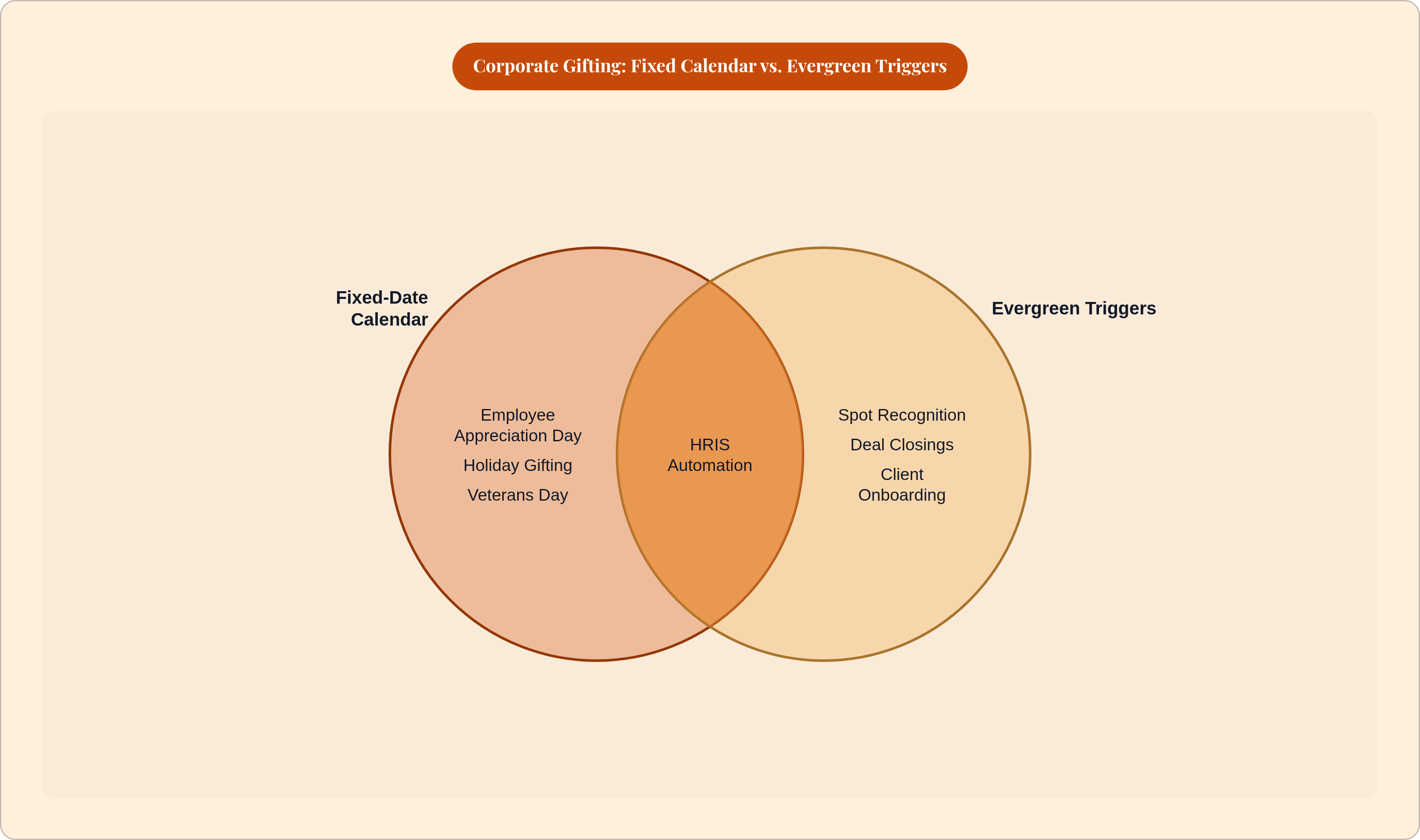
The complete structure operates on two distinct layers, and both need to exist for any of this to function. The first is the fixed-date calendar, Q1 through Q4, with known occasions, known recipients, and known lead times built in advance. The second is the evergreen trigger layer: onboarding, anniversaries, milestones, spot recognition. One is planned by date; the other is planned by process. They require different infrastructure and the same underlying commitment.
Three decisions determine whether any of this actually runs in practice. First, recipient lists built and maintained in advance, with addresses verified for remote employees who relocate more frequently than most coordinators account for. Second, budgets set by category, employee versus client, fixed occasion versus trigger, rather than approved per incident. Per-incident approval is where the reactive cycle quietly re-enters, and suddenly you're back to panicked November messages wondering whether there's budget to do anything at all. Third, vendor relationships confirmed before busy seasons. A vendor you're calling for the first time in November is a transaction under time pressure. Transactions under time pressure produce generic results, which defeats the purpose.
Lead time is the variable that collapses first. Most missed occasions aren't budget failures. The money was there; the planning window wasn't. That distinction matters when you're diagnosing what went wrong, because the fix for a budget problem and the fix for a planning problem are completely different interventions.
The January planning session is where the system becomes real or stays aspirational. Review what worked. Update recipient lists. Confirm vendor capacity. Set the fixed-date orders. One meeting, done with actual attention rather than treated as a calendar formality, shapes how the next twelve months run. Personalization and sustainability will continue to reshape what recipients notice and what they don't. Generic bulk orders are losing ground to choice-based and environmentally considered options. Building that flexibility into vendor selection now, rather than retrofitting it when recipients start noticing the gap, is what makes the program durable past the first year.