Unique Gift Ideas for Male Clients and Prospects
Matching gifts to your client's role and personality beats the one-size-fits-all approach.

I've sat through enough budget reviews to know the question that kills a gifting line item every time: "What did we get for that?" If nobody can answer, the budget gets cut. This piece is about making sure you can answer it, starting with how you pick the gift in the first place.
Most vendors default to the same move when picking a gift for a male client: grab something safe, send it to everyone on the list, hope it lands. I get the instinct. But it's also why so many corporate gifts end up re-gifted or shoved in a drawer without a second look. The gifts that actually work get picked with real information: role, seniority, what the guy's into, where he sits in the relationship. Skip that step and you're just guessing with a bigger budget.
About half of vendors send the same item to every client on their list, based on platform data from gifting providers I've worked with. Read that number again, because differentiation isn't hard to find; it's just sitting there unclaimed because most teams never think past "safe."
And "safe" tells the recipient something specific the second he opens it: that you didn't know enough about him to pick better. A VP of Engineering and a CFO aren't the same guy walking through the same door. They don't want the same gift, and pretending otherwise sends its own message, whether you mean it to or not.
So here's how I actually sort through this: role, seniority, interest, relationship stage. Four variables, and they narrow hundreds of options down to a short list fast. Everything below builds off those four.
The two male-client personas that matter most in B2B gifting
Seniority and personality shape how a gift lands almost as much as the category does. Before I open a catalog, I sort male B2B contacts into two rough buckets.
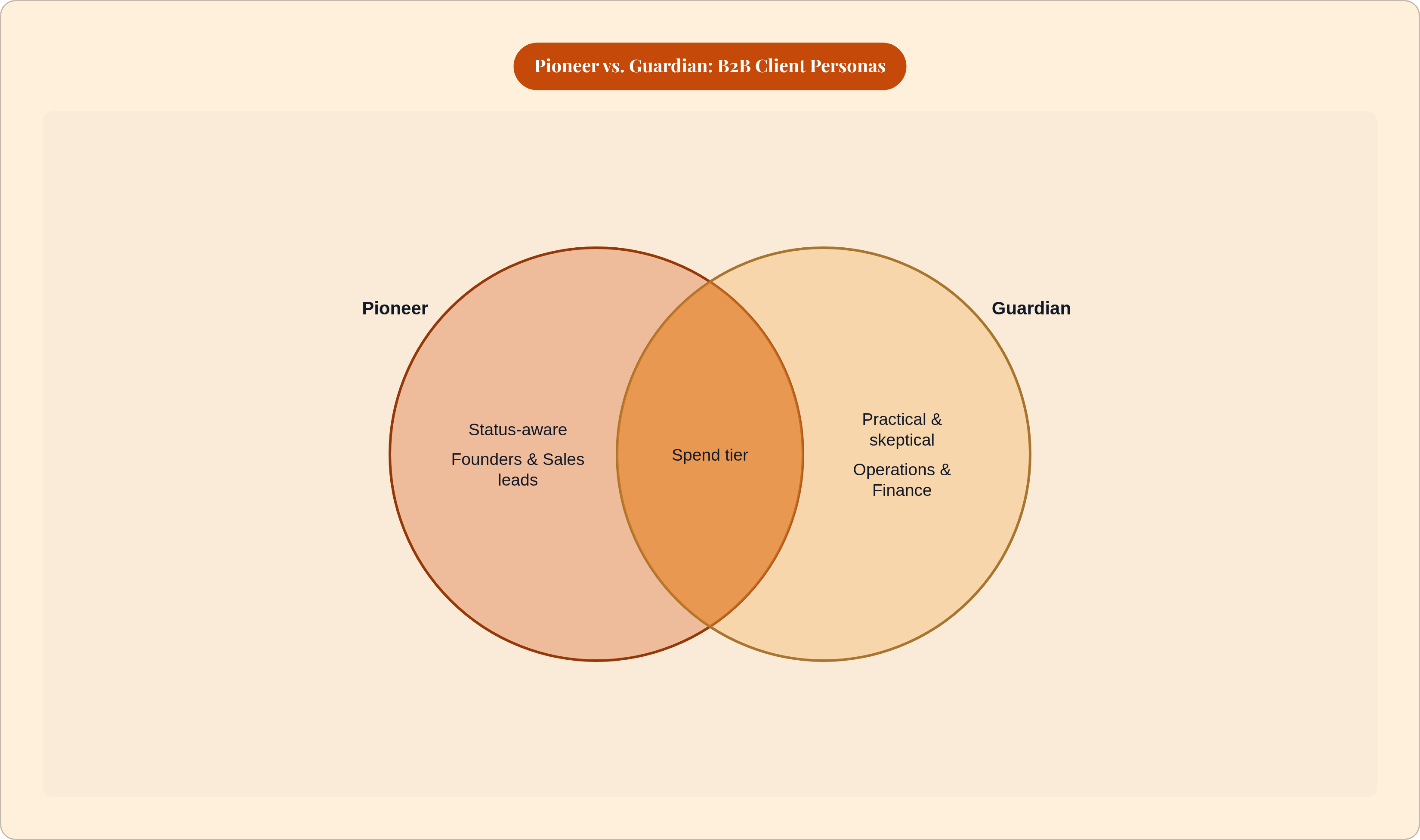
The Pioneer is exploratory. He's status-aware, open to novelty, and likes a gift with a story attached, something he'd bring up with a colleague later. Sales leaders, founders, business development heads: this is usually their crowd. Concert tickets, a tasting experience, an adventure voucher, that register works on him.
The Guardian is practical. He's relationship-focused, a little skeptical of flash, and wants something he'll actually use without feeling sold to. Operations, finance, procurement, IT leaders tend to sit here. Noise-canceling headphones, a coffee subscription, a well-made mug, that's his lane.
Seniority stacks another layer on top of persona. A junior contact and a senior decision-maker have very different thresholds for what feels appropriate versus over the top. If you're trying to reach a C-suite exec who ignores your emails, skips your LinkedIn message, and declines every webinar invite, you need something physical that can't be filtered or archived. That's when spending more per head actually pays off: a premium, high-relevance item earns the cost back. Postal's platform data backs this up: gifts over $75 pull a notably higher acceptance rate, versus a meaningfully lower rate for anything under $25. That gap is real enough to justify the higher tier once the target is senior enough to warrant it.
Figure out which persona you're dealing with before you touch a gift list. Everything downstream gets easier once you know that.
Tech and audio gifts — the category with the highest acceptance rates
Electronics and tech accessories pull the highest acceptance rate of any physical gift category, per Postal's numbers. Tech also holds the biggest slice of the corporate gifting market, somewhere around 22 to 25%.
Why does tech work this well on male professionals specifically? The payoff shows up immediately, since quality is easy to judge at a glance with no guessing involved. And the thing slots straight into someone's workday instead of sitting on a shelf collecting dust.
A few picks that hold up:
- Noise-canceling headphones or wireless earbuds, used the moment they're opened, whether someone's remote or back in an office
- Portable Bluetooth speakers for conference calls, genuinely handy for anyone stacked with back-to-back meetings
- Wireless charging pads or multi-device stations, low effort, constant use
- Smart notebooks like Rocketbook, which bridge a preference for pen and paper with a digital workflow. Good fit for the Guardian.
- Eco-friendly tech accessories, biodegradable cord organizers or phone stands, a smart pick if the recipient's industry leans sustainability-minded
For account-based outreach, I've seen a small kit of two or three quality items work as a door-opener before a first meeting: a premium notebook, a water bottle, a pair of Bluetooth earbuds, personalized with the prospect's name and a note from the account exec.
Leather goods, apparel, and accessories — gifts that project craft and consideration
No single number dominates this category the way tech's 90.8% does, but accessories and jewelry sit at a high acceptance rate and apparel not far behind, per Postal. Both clear the baseline for cheap items by a wide margin.
Why does this land? Leather goods and well-made apparel read as considered. Someone picked this out on purpose, and that's a different signal than ordering the same case of items for everyone on the list.
A few directions I'd point you toward:
- Custom leather goods: a portfolio, a cardholder, an embossed notebook cover. Durable, professional, with a little built-in status.
- Quality belts or wallets with subtle personalization, initials rather than a logo. The kind of thing men actually keep using for years.
- Branded outerwear or a performance jacket, which reads as higher-value than a polo and fits senior relationships better.
- Branded polo shirts or quarter-zips for ongoing client relationships where a little brand presence is welcome, especially useful for field sales gifting mid-funnel contacts.
- Quality branded hats, casual, wearable, an easier entry point than anything more formal.
Personalization matters a lot here. Customized gifts are roughly twice as likely to leave a lasting impression as generic ones, and the production cost gap between a monogrammed leather notebook and a plain one is small enough not to matter. The Guardian responds well to functional leather goods; the Pioneer leans toward standout outerwear or something limited-edition.
One caution worth repeating: apparel sizing and personal style are risky guesses to make for someone you don't know well. Lean toward outerwear, where one size covers a range of builds, or leather goods, where sizing never enters the picture.
Food, drink, and experience gifts — what male clients actually say they want
Ask clients directly what they'd want, and the answers cluster: wine or spirits (the top pick), coffee, gift cards, fun activities like game tickets, and charitable donations (each chosen by a notable share), according to Postal's survey data. Consumables and experiences dominate that list over gadgets or apparel.
Food gifts paired with a personalized message pull an 81% redemption and open rate. The personalization lift shows up here just as hard as anywhere else.
A few ideas worth working from:
- A curated wine or whiskey selection, best used when you actually know the recipient's taste, paired with a handwritten note for the strongest effect
- A premium coffee subscription or specialty coffee kit, broadly safe, used daily, works across both personas
- Artisan snack or charcuterie boxes, shareable in an office, which stretches the brand impression past just the one recipient
- Experience vouchers: game tickets, concert tickets, a round of golf, a cooking class. These build a memory tied to the relationship instead of the transaction, and they hit hardest with the Pioneer.
- A charitable donation made in the client's name. This resonates with senior execs who've already gotten one too many branded mugs and would rather see purpose than another product; a meaningful share of clients name this as their top pick.
Gift cards deserve their own mention. They pull an exceptionally high acceptance rate, nearly matching electronics, and work best when tied to a specific brand or experience the recipient actually values rather than a generic retailer nobody asked for.
Timing matters too. Send food and experience gifts outside the November-to-January holiday rush, and they face less competition from the pile of personal gifts already arriving that month. An off-cycle send marking a QBR, a contract anniversary, or a deal close tends to carry more weight than one more package showing up during the holidays.
Wellness and drinkware gifts — the everyday-use category that keeps giving
Drinkware might be the most underrated category on this whole list. Around 53% of U.S. consumers own a branded mug, bottle, or cup, and that number climbs to 61% in the Pacific Northwest. More than half of consumers in the Pacific and West regions say they're more likely to do business with a company after receiving drinkware from them. That's a behavior shift, not just a nice feeling.
Drinkware works on male clients specifically because it's unambiguously useful, fine at any seniority level, and carries none of the risk that comes with guessing sizing or taste.
A few solid picks:
- Premium insulated tumblers or travel mugs, Yeti, Stanley, or something at that quality tier, recognizable without being showy
- Custom engraved whiskey or cocktail glasses, which turn a standard category into something kept rather than passed along to a kid or a coworker
- Branded water bottles carrying a wellness message, a good fit for health-conscious recipients or industries where wellness culture already runs strong
Wellness itself has grown into a credible gifting lane on its own merits. A meaningful share of employees say they're interested in wellness programs, and gifting has followed that interest closely.
Worth considering here:
- Meditation app subscriptions, Calm or Headspace, delivered digitally with zero shipping friction, good for remote or international recipients
- Ergonomic desk accessories, standing desk mats or lumbar cushions, practical wellness that appeals to the Guardian specifically
- Fitness-adjacent kits: resistance bands, a journal paired with a wellness book, or a quality bottle bundled with an electrolyte subscription
Fulfillment platforms that handle branded drinkware and wellness kits at scale can cover personalization, storage, and on-demand shipping, so nobody on your team ends up sitting on a garage full of boxes.
How spend level, timing, and relationship stage change what gift is right
The average sales-driven corporate gift budget runs $75 to $100 per recipient, according to the Promotional Products Association International. That's a useful benchmark, though not a ceiling, especially for a senior-account ABM play where the deal size makes $100 look cheap.
Here's how spend tiers tend to break down in practice:
- Under $25: functional, branded, right for event giveaways or large prospect lists where you're playing an awareness game. The acceptance rate reflects the lighter investment.
- $30 to $75: quality branded items or curated consumables, well-suited to mid-funnel nurture, post-meeting follow-up, onboarding touchpoints.
- Over $75: premium and personalized, right for late-stage deal acceleration, senior executive outreach, renewals, expansion plays. That 90.1% acceptance rate lives here.
- $100 to $1,000 per prospect: appropriate when a single account justifies real investment, particularly senior executives who won't download a white paper or sit through a webinar but might open a well-built physical package.
Timing changes the math too. November through January is peak gifting season, but it's also peak noise: your gift competes with every other vendor's gift, plus every personal gift the recipient's already getting from friends and family that month. ROI tends to run lower here. High-signal moments outside that window work better: new client onboarding, right after a QBR, a contract anniversary, a deal close, a promotion announcement. Sending a personalized kit before a first meeting, for instance, tends to produce response rates several times higher than cold digital outreach on its own.
Relationship stage filters everything else on top:
- Prospect, still cold: lower spend, something curiosity-driving, nothing that feels like it comes with strings attached. A well-picked modestly priced item can open a door a cold email never would.
- Active opportunity: higher spend, tied directly to the prospect's role or challenge, timed to build momentum toward a decision.
- Existing client: personal, relationship-reinforcing, ideally referencing shared history or a specific milestone you've built together over time.
There's a well-known finding out of the University of Zurich that a small gift offered at the start of negotiations can more than double the eventual revenue outcome. It's a strong argument for timing the gift to the sales moment itself, not just picking the right item and hoping the timing works out.
Making personalization scalable — how to send thoughtfully without building a gifting team
Here's the tension running through everything above: personalization is the whole point, but most sales and marketing teams send to dozens or hundreds of contacts at once. Nobody on a five-person sales team has the hours to hand-pick a gift for every name on a list of 200.
The data says most teams already know this. a large majority report higher ROI on personalized gifts compared to generic ones, and yet roughly half of vendors still send the same item to everyone. Everyone already agrees personalization works, so the gap is execution, plain and simple.
What does personalization at scale actually require? A gift selection system that pulls in recipient data, role, industry, seniority, past interactions, and narrows the choices down automatically instead of demanding manual research on every single send. A way to confirm delivery without already having the prospect's home or office address on file, since that's one of the most common blockers in outbound gifting. CRM integration, so every send gets logged, attributed, and shows up in pipeline reporting instead of disappearing into a spreadsheet nobody opens again. Fulfillment that handles procurement, storage, packing, and shipping without anyone on your team babysitting boxes in a closet.
Some platforms run AI against gift recommendation, address confirmation, and message personalization, which lets a rep send something genuinely relevant in minutes instead of hours, across a whole list, without each send turning into its own research project. Some platforms ship to more than 165 countries and have powered tens of millions of sends, so the infrastructure for a global ABM gifting program already exists. Logistics doesn't have to be the thing that stalls it.
In practice: a rep spots a prospect's persona, Pioneer or Guardian, pulls from AI-surfaced options that fit that profile and the right spend tier, confirms delivery without knowing the exact address, and watches the send log itself in Salesforce or HubSpot automatically. One workflow, start to finish.
Impact.com ran a targeted gifting program and booked 250 meetings off it, tracking a 625x return on their initial gift spend. That's what happens once personalization gets built into the process instead of left as a thing everyone nods along to in a meeting.
Tying every send to a measurable outcome
None of this matters if you can't tell whether it worked. This is where most gifting programs quietly fall apart: the gift goes out, maybe it earns a thank-you reply, then it disappears into a black hole with no link back to a meeting booked, a deal that moved, or a renewal signed.
The fix isn't complicated, though it takes discipline most teams don't bother with. Tie every send to a reason: a pipeline stage, a QBR, a deal close, a renewal window. Log it in your CRM, note the persona and spend tier you picked, then watch what actually happens next: did the meeting get booked, did the deal move, did the account renew.
Do that consistently, and gifting turns into a line item with a return you can point to in a budget review, same as an ad spend number or a conversion rate. Skip it, and you're stuck defending a nice gesture with nothing to back it up.