White Elephant Gift Ideas for Office Parties
The steal reveals whether your gift works: aim for absurd and useful, not generic or forgettable.

The original white elephant was, by design, a punishment. Legend holds that Southeast Asian monarchs gifted rare albino elephants to courtiers they disliked, knowing the animal was too sacred to work and too expensive to maintain. Merriam-Webster has since softened it: "an object no longer of value to its owner but of value to others." That history is useful context. You are not trying to impress a room. You are trying to give someone something worth wanting, dressed in enough novelty to make the steal feel inevitable.
What makes office white elephant specifically treacherous is the audience composition. You are not buying for your college roommate or your sister-in-law. You are buying for a room that contains your direct supervisor, a new hire who has been there three weeks, a colleague you have interacted with exclusively through Slack emoji reactions, and someone from a department you cannot fully name who got pulled into the holiday invite by proximity. That relational spread is vast, and the professional layer sitting on top of it turns instincts that work fine among friends into real liabilities.
Alcohol is where I see the most consistent miscalculation. It conflicts with HR policy in many organizations, it excludes people for a variety of reasons they do not publicize, and choosing it requires you to make assumptions about a room of professional acquaintances you simply do not have enough standing to make. Political gag gifts are obviously out. Risqué humor that lands perfectly at a birthday party reads very differently when your department head is seated three feet away and has to decide whether to laugh or quietly flag it. The relevant test is not whether something is funny. The test is whether it raises anyone's HR antennae.
Budget discipline matters more here than most people anticipate. Bringing a fifty-dollar gift to a twenty-dollar-limit party is a social disruption in any setting; in a professional one, it applies visible pressure to everyone in the room and signals, before anyone has even opened a gift, that you did not read the room. If the organizer has not set a number, twenty-five dollars is a defensible anchor. If you are organizing the exchange, state the spending limit and a brief work-appropriateness note in the invite itself. Doing it in writing means nobody has to be corrected in front of colleagues on the day.
The game also has regional variants worth knowing before you assume everyone is playing the same version. White elephant, the most widespread, skews toward humor and novelty and is common across the West Coast and Midwest. Yankee Swap, the New England iteration, prizes utility. Dirty Santa, the Southern version, rewards competitive stealing and higher-value items. Mechanics are largely consistent across all three: everyone brings one wrapped gift, draws numbers, and takes turns either pulling from the pile or stealing something already opened. The first player drawn gets a final turn after everyone else. Steal limits, typically two or three per gift, keep the game from becoming adversarial.
What Makes a Gift Get Stolen: The Difference Between a Crowd-Pleaser and a Dead Gift
The steal is the signal. A gift that circulates through multiple sets of hands is the game's clearest measure of success. A gift that gets opened, receives a polite laugh, and never moves again is a failure, regardless of how much deliberation went into choosing it.
There are two failure modes, and they are almost exact opposites of each other. The first is the dead gift: something so generic it produces no reaction whatsoever. Novelty items with no actual utility land here consistently. Nobody fights over them, nobody mentions them again, and the person who ends up holding one at the end of the night goes home slightly deflated. The second failure is the pure gag: something funny for about four seconds and then just an object you have to carry home and store somewhere. A whoopee cushion is the canonical example. The laugh is immediate and completely hollow.
What actually works is the gift that is simultaneously ridiculous and desirable. It produces a genuine room reaction, the kind where someone across the room says "wait, I actually want that," and it is still something the winner will use after the party ends. Uncommon Goods' Banana-Saving Hats do this: they look absurd, they serve a real function, and they land exactly on the humor-utility line that makes a gift worth stealing.
Customization raises steal appeal considerably, though it requires you to actually know the group. A generic mug is unremarkable. A mug printed with a phrase your team director uses in every all-hands, or a running department in-joke, becomes something closer to a tribal artifact. Everyone in the room understands the reference. The person who walks away with it is not just taking a mug; they are taking a signal of membership. That kind of specificity works beautifully when you know the group and becomes a liability when you are guessing.
Before committing to anything: Would someone across the room notice it and want to know more? Will it be useful or entertaining for most people in the office after the party? Does it cross any professional lines? Those three questions are most of the filtering work.
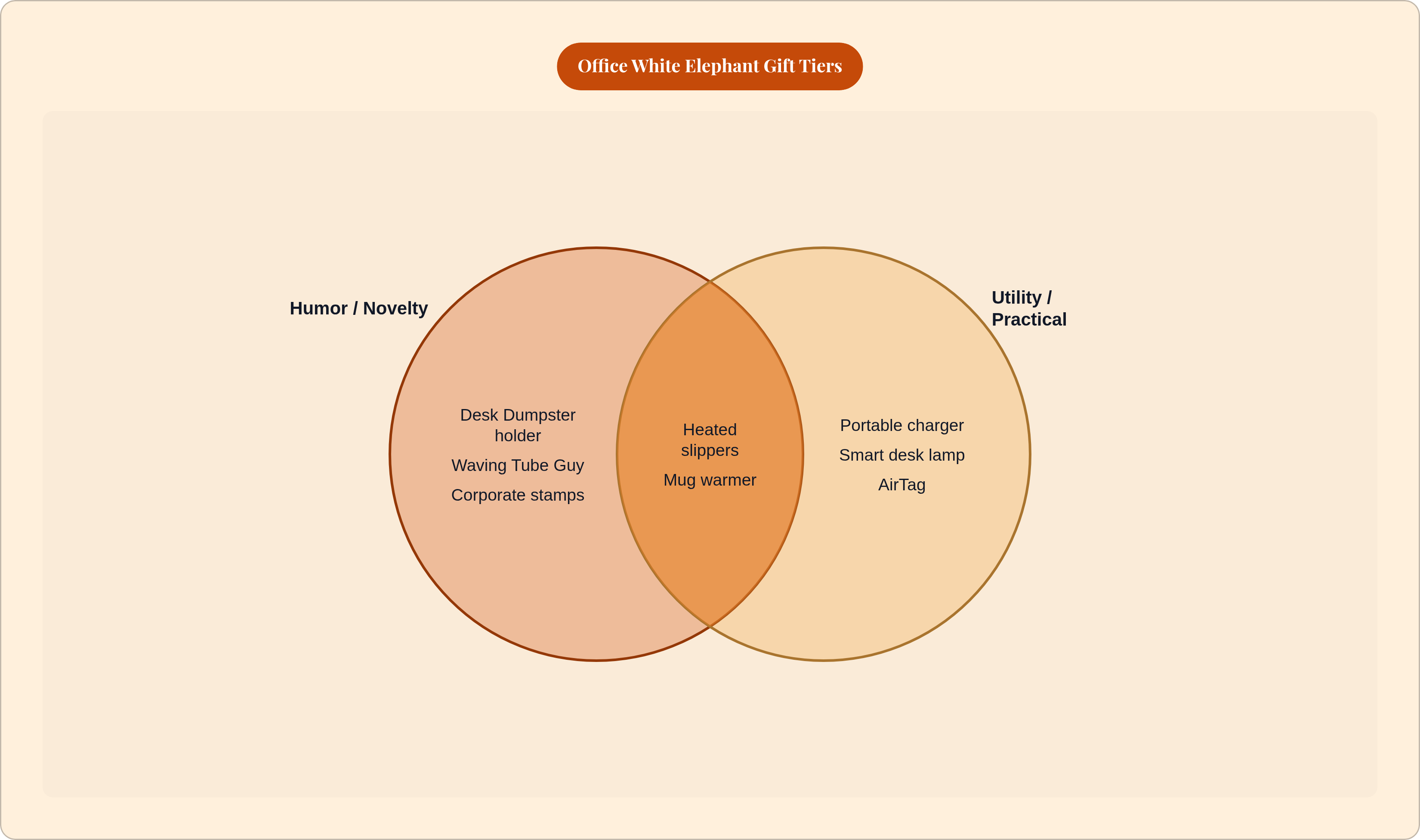
Tech and Practical Gadgets: The Most Reliably Stolen Tier
Tech gifts dominate office white elephants for a reason that is almost embarrassingly simple: they feel like a score. There is no consolation-prize feeling attached to a portable charger. Even the person who loses the steal ends up with something they will actually use.
The Charmast portable charger is a strong pick at this budget level: slim, roughly half a pound, six outputs and three inputs. It solves a problem everyone has, which is why it never feels like a boring practical gift; it just feels like a practical one, which is different. A coffee mug warmer, the BestInKits version runs around twenty-three dollars, addresses a real desk grievance and works equally well for tea. A wireless Bluetooth microphone speaker at around eighteen dollars pitches itself as office karaoke hardware before anyone has pressed a button, which gives the gift a layer of humor alongside the utility.
A dimmable smart desk lamp with adjustable color and brightness is the kind of upgrade most people have been meaning to buy themselves and have not gotten around to. The Owala Sway water bottle, the newer iteration of the FreeSip design, is dishwasher-safe, has a substantial handle, and lands on most people's "I've been meaning to get one of those" lists. That position is the sweet spot for steal appeal: the item someone would have purchased eventually, which makes taking it feel completely justified rather than competitive.
USB rechargeable heated slippers for desk workers hit the ridiculous-and-desirable mark in a clean way. The premise is absurd. The utility in a cold office is real. An Apple AirTag is low on humor and high on utility; it is small, comes in under thirty dollars, and solves a problem broad enough that most people in the room will not shrug at it.
Desk Toys and Office Humor Gifts: When the Laugh Is the Point
The line that matters here is this: office-safe humor is universally relatable, not directed at any individual, and not edgy. The target is "everyone in this building has experienced this," not "roast of a specific colleague." That distinction feels obvious stated plainly. It is still surprisingly easy to miss in execution.
The Mini Wacky Waving Inflatable Tube Guy desk toy is absurd, completely inoffensive, and produces a genuine room reaction without requiring any setup. The Genuine Fred Desk Dumpster Pencil Holder looks like a dumpster fire, includes flame-shaped notecards, and organizes pens; it is functional office humor, which is exactly the formula worth pursuing. Thinking putty, elevated fidget material for adults, markets itself at people who need something to do with their hands during Zoom calls. That premise requires no translation in any office.
Funny rubber stamps with corporate phrases, "This could have been an email," "Per my last email," land immediately in a room of people who have sat through too many meetings. No explanation required, which is the point. A tabletop mini vacuum is small, oddly satisfying, and useful for crumb-covered keyboards; the humor is in how mundane and perfect it is at the same time. A mini desktop Zen garden with a cat rake instead of a traditional one makes a calming object funny through a single, well-chosen substitution.
Avoid anything directed at a specific person, anything with adult or political humor, anything whose joke requires context or a setup. If you have to explain it, it will not land across a room of mixed relationships.
Food, Drink, and Consumable Gifts: The Crowd-Pleaser That Sidesteps Taste Entirely
Consumable gifts sidestep the most persistent gift failure: the mismatch between what the giver finds appealing and what the recipient actually wants in their home. Nobody has to worry about storage. Nobody has to perform gratitude about an object that does not suit them. Good food gets enjoyed at the party or shortly after, and then it is finished, which removes most of the pressure attached to physical gifts.
A specialty coffee or tea sampler set is premium enough to feel like a treat and broad enough to suit most offices. A hot sauce collection or globally inspired condiment set is conversation-starting, shareable during the party itself, and the kind of thing most people would not purchase for themselves, which makes receiving it feel like a small discovery. A high-quality chocolate assortment or artisan snack box is a reliable steal at most office exchanges; the recipient can share at the party or take it home without any awkwardness attached. A gourmet popcorn tin in multiple flavors is a classic because it is communal, festive, and varied enough that most dietary assumptions are avoided without requiring advance research.
One practical note worth taking seriously: check for known allergies or dietary restrictions before defaulting to food. A gift heavy on nuts can inadvertently exclude a colleague, and that is a memorable way to be remembered. Labeling matters. Consumables also tend to look more expensive than they cost, which makes them particularly effective in the twenty to twenty-five dollar range.
Skip alcohol in most office contexts. If you want the "treat" feeling without the complications, a premium sparkling juice or a well-assembled mocktail kit delivers a similar effect.
Cozy and Self-Care Gifts: The Steal-Worthy Comfort Tier
This category steals reliably because the underlying desire is broadly shared. Everyone wants to feel more comfortable, and these gifts show well, which raises steal appeal before anyone knows the price.
A plush or weighted lap blanket works at the desk or at home, and it reads as luxurious in a way that is hard to resist regardless of age or role. An aromatherapy or candle set lands well if the scents stay on the neutral, fresh end; heavily floral or extremely sweet notes can divide a room faster than you expect. A sleep or relaxation kit, eye mask, earplugs, pillow mist, is funny in an office context specifically because the implied message is one everyone in the room has felt but rarely says out loud, and it is also useful afterward, which is the combination worth looking for. Nice hand lotion or a lip product has high perceived value relative to cost and is used by most people; the Ogee Sculpted Lip Oil, noted by Forbes as a practical pick in this budget range, is worth knowing as a specific option. Quality fuzzy socks or novelty socks are inexpensive, universally sized, and consistently stolen at office exchanges across budget levels. That observation holds up year after year, which is worth taking at face value.
This category performs especially well at the lower end of the budget range. A twenty-dollar cozy gift feels considered. A twenty-dollar tech gift can look visibly like it is straining against its own price point. That gap between perception and cost is the practical argument for this tier when the budget is tight.
How to Choose Between the Tiers Based on Your Specific Office
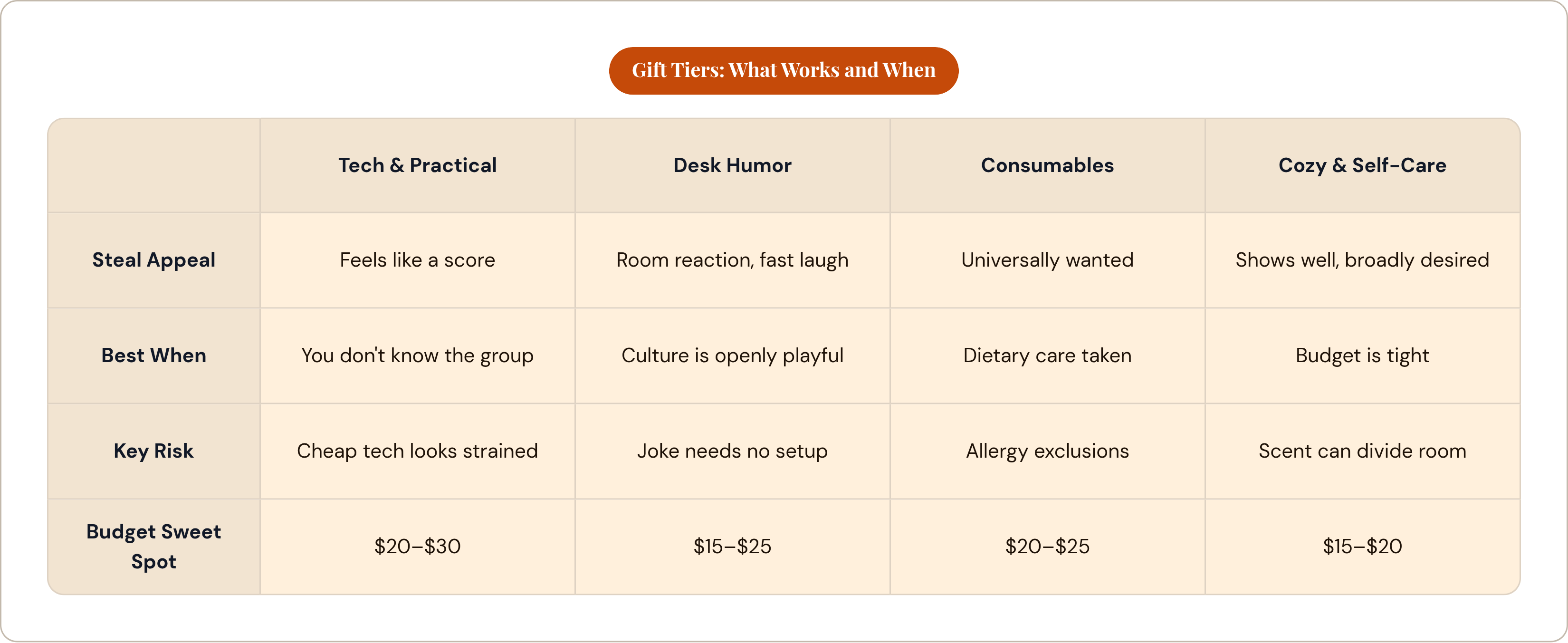
Three variables determine the right direction: the spending cap, the culture of the office, and how well you actually know the room.
If you do not know the group well, go consumable or practical gadget. Both are nearly impossible to misread for a professional audience. If the culture is openly playful and the game tends to get competitive, the desk humor and cozy comfort tiers will generate the most stealing energy. If the budget is closer to twenty dollars than thirty, consumables and cozy items read as more generous than their price; tech at that level can feel like it is working against itself. If you want to stand out without taking on risk, a well-chosen practical gadget, a mug warmer, a portable charger, signals thoughtfulness without requiring you to know anyone's sense of humor or personal taste.
One thing that is easy to overlook: wrap it well. Presentation signals effort and raises steal appeal before anyone in the room knows what is inside. A modest gift wrapped with care gets opened with real anticipation. A careless package around something expensive tends to deflate the room slightly before the reveal.
For teams that run this exchange annually, rotating the theme keeps it from feeling like a formality: gag gifts one year, practical the next, food-only the year after. The game rewards the gift people actually fight over. Figuring out which category is most likely to produce that in your specific office, with your specific group, is where most of the real work lives.