Dietary and Lifestyle Restrictions in Gift Selection
Medically critical and personal preferences require different handling precision.

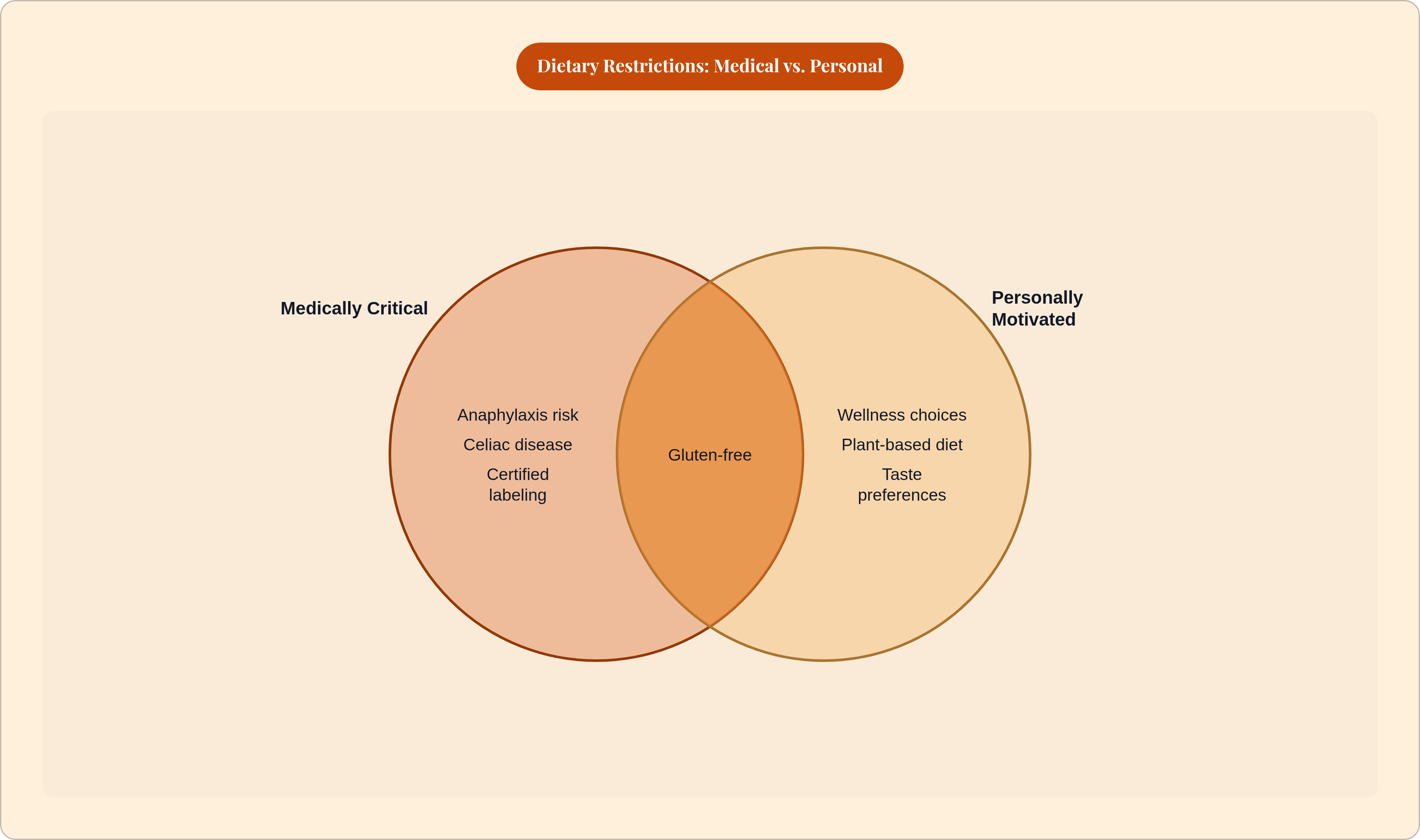
Not all restrictions carry the same weight, and conflating them is its own kind of mistake. The distinction between medically non-negotiable and personally motivated isn't academic; it changes what the program actually has to do. But what if your program is treating these two categories as interchangeable? A recipient who avoids dairy for wellness reasons has a different risk profile than someone who will go into anaphylaxis from cross-contaminated equipment. Both deserve accommodation. They require very different precision.
Allergens
Allergens are the highest-stakes category, and the one most likely to produce genuine harm if mishandled. Common triggers (nuts, shellfish, eggs, soy) affect a non-trivial share of the adult population, and unlike preferences, allergic reactions don't scale with intent. A product processed in a shared facility can cause serious harm even when the offending ingredient doesn't appear on the label. Certified labeling and strict avoidance are the only reliable responses here.
Celiac Disease and Gluten Sensitivity
Between one and seven percent of people globally have celiac disease or non-celiac gluten sensitivity, and roughly a third of Americans are actively limiting gluten. It's one of the most common dietary signals a gifting team will encounter at any real scale. It also co-occurs with other sensitivities, particularly dairy and eggs, which compounds the difficulty of finding a compliant option quickly.
Kosher and Halal
Approximately 6.8 million Jewish Americans are concentrated heavily in the same professional markets where B2B gifting programs are most active: New York, Los Angeles, Miami, Chicago. Kashrut governs not just ingredients but equipment, production processes, and third-party supervision. A product made from technically compliant ingredients in a non-certified facility does not meet the standard. This is where most well-intentioned programs quietly break down: someone reads the ingredient list, sees nothing obviously prohibited, and moves on. That raises an important question — if the ingredients look fine, why isn't the product compliant? Because certification marks are the only reliable proxy. You cannot infer compliance from a label.
The same logic applies to halal. Pork and alcohol are prohibited, certification from an accredited bureau is required, and the Muslim professional population in the U.S. is distributed widely enough that halal observance is a recurring consideration in any national gifting program, not an edge case someone will deal with eventually.
Vegan and Vegetarian
About five percent of Americans identify as vegetarian or vegan, and plant-based food sales grew roughly twenty percent year over year between 2024 and 2025. The harder problem with vegan gifting isn't the obvious exclusions. It's the non-obvious animal derivatives: gelatin in gummy confections, honey in "natural" products, certain food colorings derived from insects. These appear routinely in premium gift sets that nobody on the gifting team would think to scrutinize.
Alcohol and Sobriety
Wine and spirits function as a default "premium" signal in many gifting programs. They're also a landmine for recipients observing religious restrictions, anyone in recovery, and a wide portion of the general population who simply doesn't drink. The harder problem is that sobriety is almost never captured in CRM data, because people don't volunteer that information to a business contact. The restriction is invisible right up until a bottle of Scotch shows up on someone's desk.
The Overlap Problem
These categories don't sort neatly, and the program that treats them as isolated checkboxes will still misfire at scale. A single recipient is halal-observant, gluten-sensitive, and alcohol-free simultaneously. A gourmet charcuterie and cheese set (one of the most popular corporate gift formats) fails that recipient on three separate dimensions at once.
How Restriction Blindness Shows Up at Events and in Large-Scale Sends
Events are where restriction blindness becomes most visible, and most expensive, because the failure happens in real time and in front of people.
Industry planners have reported for years that roughly a third of event attendees request special meals, and that figure has climbed sharply as dietary awareness has risen. Planners who have been doing this long enough to compare their current workload against what it looked like a decade ago describe gluten-related accommodation requests as having undergone a complete transformation. What was negligible is now one of the largest logistical variables in food service planning.
The cost differential is concrete. A standard entrée at a corporate event can nearly double in price when a halal-certified equivalent is required. Programs that don't budget proactively end up overspending reactively, pulling from other line items at the last moment.
The more systemic problem is what I think of as the list-of-thirty-plus problem. Any planner who has managed a large corporate event has hit a moment where the accumulated restriction list (collected late, in no standardized format) begins to eliminate almost everything on the proposed menu. That's not a shortage of compliant options. That's a planning infrastructure failure. Restrictions were gathered too late, categorized inconsistently, and never tiered by severity, so allergy-level requirements and mild preferences arrive in the same unstructured email thread, indistinguishable from each other.
Large-scale corporate sends face the same root problem with far less visibility. A batch of gourmet gift boxes shipped to three hundred employees or prospects with no restriction data attached doesn't generate an obvious failure event. The failure is quiet: recipients who can't eat the gift simply don't engage with it, and some of them note privately that the sender didn't bother to know them. At enterprise scale, a single undifferentiated food gift deployed across a large account is functionally the same as sending to an anonymous crowd. The relationship signal you intended to send gets reversed.
Both contexts share the same underlying cause. Restriction data was never systematically collected, so the program defaults to the "most people" assumption. That assumption is wrong often enough to constitute a real strategic liability.
Collecting Restriction Data Before Selection, Not After a Complaint
The most common mistake is the open-ended free-text field: "Please list any dietary restrictions." That format produces inconsistent, unstructured data that no CRM field can reliably hold and no automation can act on. A short, specific intake prompt outperforms it every time. Give recipients a defined list to select from: vegetarian, vegan, gluten-free, halal, kosher, dairy-free, nut-free, pescatarian, alcohol-free. Then ask a separate question about severity: is this a medical requirement, a religious observance, or a personal preference? That single follow-up question changes how strictly the program has to honor the selection.
A third question is worth adding: are individually packaged items required? For allergy-level restrictions, shared platters and mixed assortments create cross-contamination risk even when the primary ingredient is absent. That's a fulfillment-level variable, and you want to know it before the order is placed.
When to Ask
Event registration is the earliest and most natural moment. Embed the question in the registration form itself, not a follow-up email that a third of attendees won't open.
New employee onboarding captures restrictions before the first recognition moment rather than in response to a misfired anniversary gift six months in. For high-ACV accounts where one-to-one gifting is planned, a brief preference survey is proportionate to the relationship investment. You're already spending meaningfully on that account; two minutes asking about their preferences is not a burden.
Some gifting platforms can trigger address and preference confirmation steps automatically before fulfillment, removing the manual burden from the sender entirely.
Where to Store It
Restriction data is only useful if it lives where gift decisions are made: in structured CRM fields, not in a spreadsheet that someone has to remember to check. Tied to a contact record, a restriction flag travels with the recipient across campaigns, events, and gifting programs without requiring anyone to re-ask. That's the operational argument for gifting platforms that integrate natively with CRM and HRIS. Restriction data collected once becomes a durable input to every subsequent send.
One more thing: asking about restrictions signals respect, not administrative overhead. Frame the question as "we want to get this right for you," because that is, in fact, what it means.
Gift Categories That Reduce Restriction Risk Structurally
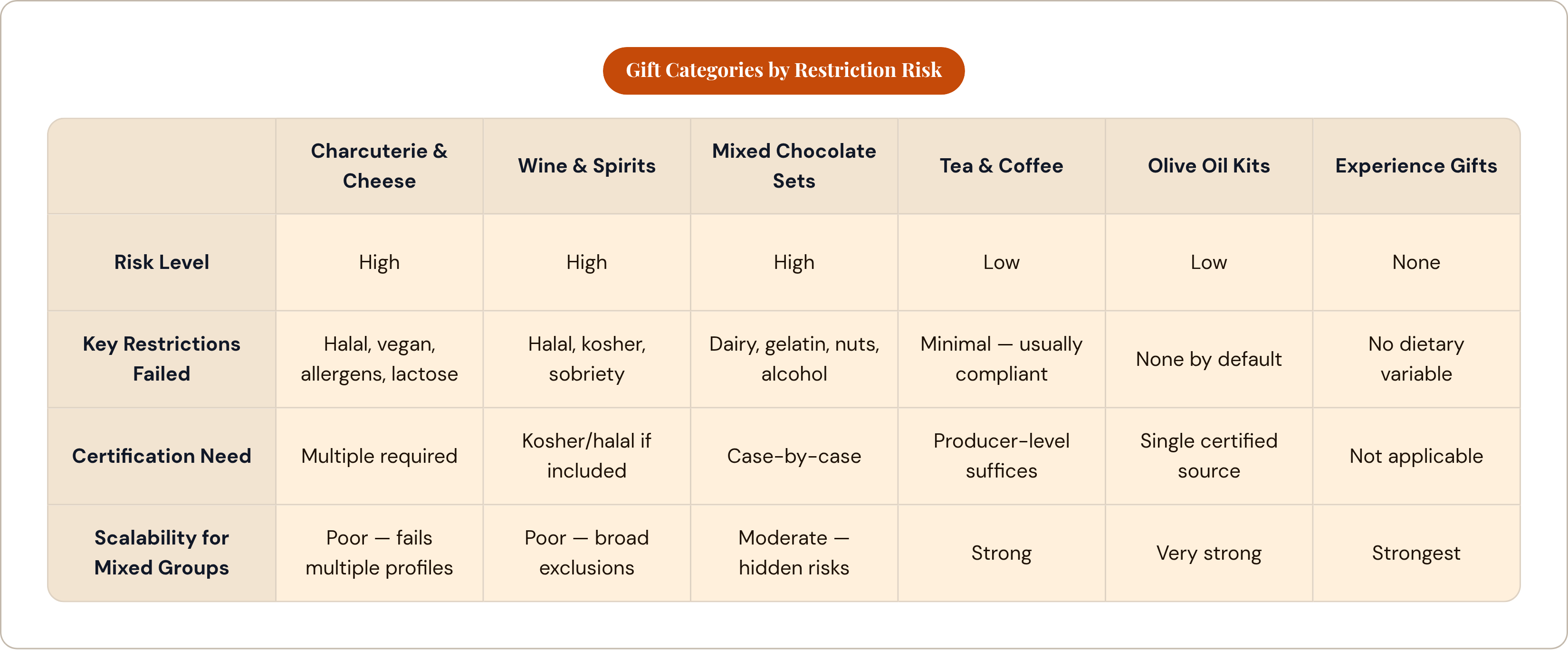
Some gift categories carry inherent restriction risk by their nature. Others are structurally inclusive. Building a gifting catalog with that distinction in mind reduces the operational burden of accommodation because the accommodation is already embedded in the product selection.
High-Risk Categories
Charcuterie and cheese sets are among the most popular corporate gift formats and among the most restrictive. Pork components fail halal. Dairy fails lactose-intolerant and vegan recipients. Shared production environments create allergen risk. A single SKU can fail four distinct recipient profiles simultaneously, which is a remarkable amount of exposure for a product that reads as universally appealing.
Wine and spirits fail halal, kosher unless certified, recipients in recovery, and a wide range of personal preferences. The problem isn't that these gifts are bad; it's that they're deployed as defaults at scale, in programs with no restriction data, to recipient populations that include all of the above.
Mixed chocolate and candy sets carry a wide restriction surface area: dairy, gelatin, tree nuts, alcohol flavoring in liqueur chocolates, artificial colorings with animal-derived origins. The more premium the set, the more likely it contains at least one of these.
Lower-Risk Categories
Specialty tea and craft coffee are naturally free of the most common allergens, vegan-compliant, and typically kosher and halal-compliant when sourced from certified producers. They travel well, present well, and carry genuine artisanal premium without requiring separate certified SKUs for different recipient profiles.
Olive oil tasting kits are worth naming specifically. Gluten-free, nut-free, dairy-free, and vegan by default, and when sourced from a certified producer, they satisfy kosher and halal requirements simultaneously. A single product covering nearly all common restrictions at a premium price point is a real operational asset.
Experience gifts (virtual cooking classes, wellness sessions, curated learning subscriptions) remove the food allergen variable entirely while offering genuine personalization. The customization lever shifts to interest rather than dietary profile, which sidesteps the entire category of restriction complexity.
Non-food gifts (branded merchandise, books, charitable donations in the recipient's name) eliminate the dietary variable completely. For programs where restriction data simply isn't available, this is not a lesser option; it's often the correct one.
On Certification
When food gifts are the right choice, certification is the variable that cannot be negotiated around. For kosher and halal recipients, a product that uses compliant ingredients but was processed in a non-certified facility doesn't meet the standard. Vendors that specialize in certified products are more reliable than mainstream producers who maintain a small certified line as an afterthought; the latter have inconsistent oversight and limited SKU availability within the certified segment.
Allergen labeling is a floor, not a ceiling. Any food gift in a scaled program should include full ingredient and allergen information, giving recipients the ability to make their own safety determination rather than relying entirely on the sender's due diligence.
Letting Recipients Choose as a Structural Solution to Restriction Complexity
There is a point at which the complexity of matching gifts to recipient restrictions at scale exceeds what any data collection process can cleanly manage. Recipient-choice models are the structural answer to that problem, and they work because of an obvious fact that gifting programs often overlook: the person with the most accurate information about their own dietary restrictions, cultural context, and personal taste is the recipient.
Shifting the matching burden to them doesn't abdicate the sender's responsibility. It locates the decision with the party best positioned to make it. Dietary restrictions are handled because the recipient selects what they can actually consume. Cultural fit is handled because they can choose something that aligns with their observances. Personal taste is handled because they're not guessing what you thought they'd like. The sender retains brand control and budget control; the recipient gets something relevant.
Building a Choice Menu That Works
Five to eight curated options is the right operational range. Enough variety to cover the major restriction profiles, tight enough to maintain brand coherence and stay within the budget tier. Each option should be pre-vetted for the most common restrictions: allergen status, certification, alcohol content. That way, any selection the recipient makes is a safe pick, and the sender isn't creating a scenario where the recipient still needs accommodation after choosing.
Price parity across options matters. Recipients should not feel that they're selecting the economy tier because the certified or plant-based option costs less to source. If the catalog can't support parity, consolidate options until it can.
It is also worth considering how the delight mechanic shifts in an interesting way. The moment of engagement moves from opening a box to choosing a gift. A recipient who selected their own gift is already invested in receiving it before it arrives. That produces a more durable brand interaction than passive receipt.
The Trade-Off
Brand control is genuinely reduced when recipients choose. The sender can't guarantee every recipient receives the flagship item the program was designed around. That's a real trade-off, and one worth naming to stakeholders before a choice model is deployed rather than discovering it mid-program.
The mitigation is to brand the choice experience itself: the landing page, the confirmation message, the packaging regardless of which option was selected. If the sender's identity is present at every touchpoint of the selection flow, the brand interaction holds even when the contents vary.
Certain gifting platforms enable this workflow natively. Recipients receive a link, select from a curated set, confirm their shipping address, and fulfillment proceeds without manual intervention downstream. For large-scale sends, all-hands gifting programs, or event follow-ups where collecting individual restriction data at volume is operationally unrealistic, this architecture isn't just convenient. It's often the only model that actually works.
Operationalizing Restriction-Awareness Across a Full Gifting Program
The shift from "we check restrictions before each send" to "restrictions live in our system and follow every recipient" is what separates a mature gifting program from an ad hoc one. The former depends on individual discipline. The latter depends on infrastructure. Only one of those scales.
CRM as the Source of Truth
Restriction flags stored as structured CRM fields (not notes, not spreadsheets, not email threads) become filterable and actionable. You can query: show me all contacts in this account segment where the primary contact has flagged halal observance. That query is only possible if the data was captured in a structured format to begin with.
When a gifting platform integrates with CRM, those flags surface at the point of gift selection, not after the order is placed. That's the right moment for the constraint to appear. And because every send is tied to a contact record, restriction compliance becomes a traceable variable in your program's performance data.
Program Governance
Restrictions change. Adulthood-onset allergies, evolving religious observance, sobriety. These are not static data points. Someone needs to own periodic re-verification, and that ownership should be documented in the program's governance structure, not assumed to happen organically.
Gifting platform workflows can trigger preference re-confirmation prompts after a defined interval, automating the update cycle without waiting for the recipient to volunteer new information. That's a better default than assuming the intake form someone completed at onboarding is still accurate two years later, because often it isn't.
Vendor and Catalog Governance
For programs using a consistent gift catalog, restriction profiles should be documented at the SKU level and maintained there, not reconstructed by each sender at the point of selection. Certified products should be sourced from vendors whose certification is verified on a defined annual cycle, not assumed to carry forward indefinitely. Certifications lapse. Production facilities change hands. A vendor that was reliably kosher-certified two years ago is not necessarily so today.
Restriction-awareness as a program feature is not meaningfully more complex than any other data hygiene practice a mature gifting operation already maintains. It requires the same things: structured collection, a defined owner, a home in the system where gift decisions are made, and a refresh cadence that reflects how often the underlying reality changes. The piece that trips most programs up isn't complexity; it's that restriction data has been treated as someone else's problem for so long that nobody ever formally claimed it.