Recipient Preference Collection Methods
Explicit preference data now outperforms inferred behavior as privacy walls rise.

Something quietly broke in email marketing over the last few years. Third-party cookies started disappearing. Apple introduced Mail Privacy Protection, then App Tracking Transparency. Link tracking got restricted. And just like that, a significant portion of the behavioral data marketers had come to treat as reliable evaporated or became actively misleading.
The industry scrambled, but the scramble revealed something instructive: most marketers hadn't been collecting preference data so much as inferring it. There's a meaningful difference between those two things, and understanding that difference is the entry point to this whole conversation.
The 2025 Braze Global Customer Engagement Review found that 99% of marketing executives said their advanced personalization plans had been impacted by data privacy concerns. That's not a statistic about a niche problem. That's almost everyone in the room raising their hand.
So what data actually remains?
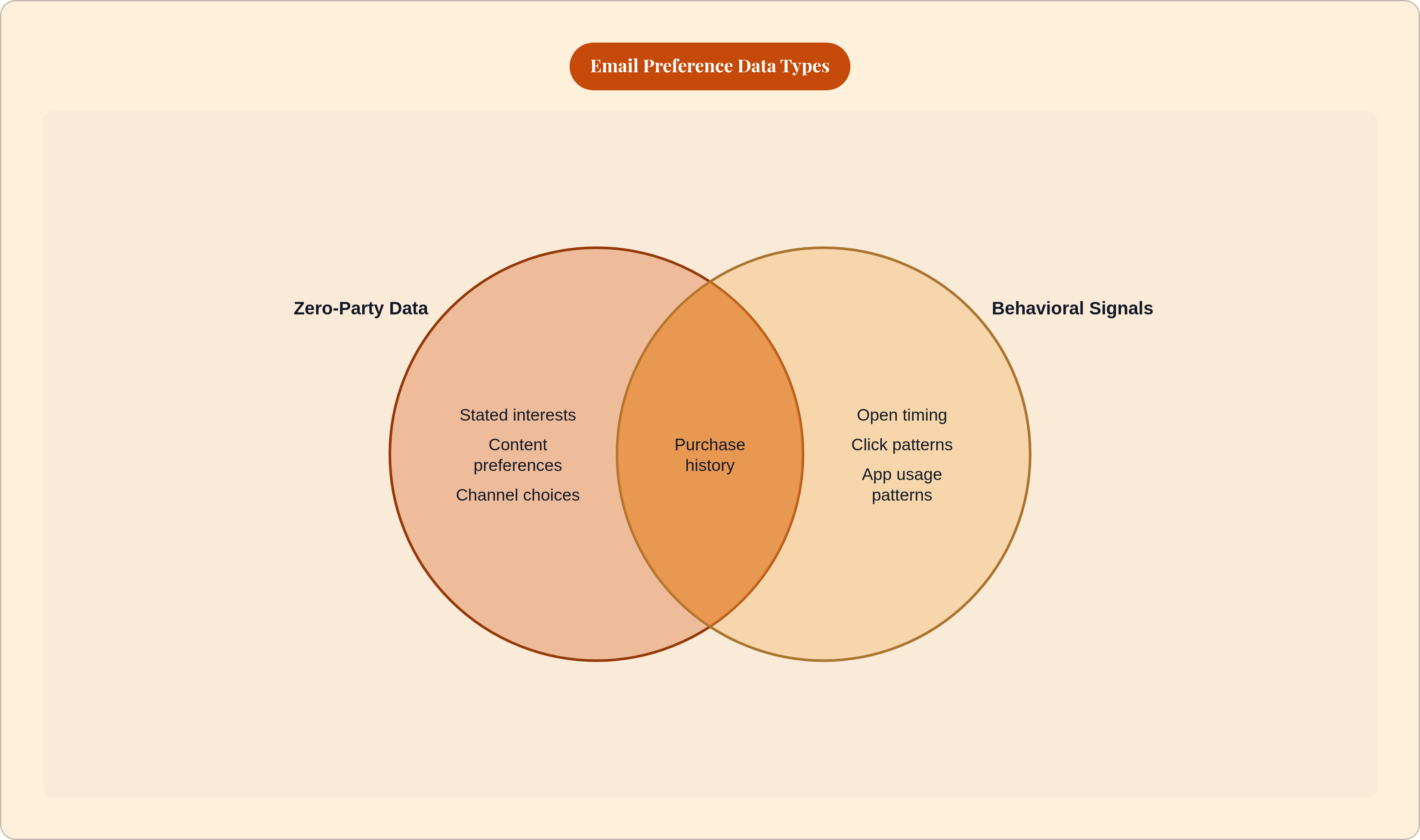
There are three types worth distinguishing. Zero-party data is what a subscriber explicitly volunteers: stated interests, content preferences, intended purchase timing, channel choices. It isn't inferred. It comes straight from the source, which is exactly why it's the most accurate. First-party data is observed from behavior on channels you own: website visits, click patterns, purchase history. It's accurate, but it's indirect. You're watching someone act and drawing conclusions. Behavioral signals, sometimes used interchangeably with first-party data but worth separating conceptually, are the real-time engagement patterns that machine learning and send-time optimization tools use to infer what a subscriber wants right now.
Here's why the distinction matters practically: preference centers and progressive profiling yield zero-party data. Behavioral signals yield first-party data. Each belongs to a different part of the toolkit and answers a different question.
One data point worth sitting with: according to 2025 research cited by Marketing Tech News, 48% of consumers report greater comfort with brands that collect zero-party data. That's not just a legal compliance story. Consent-forward data collection has become a trust signal in its own right. GDPR aligns most cleanly with zero-party and first-party approaches because explicit consent is baked into the act of sharing. CCPA operates more as an opt-out framework focused on transparency and the right to restrict data sale, but it similarly favors approaches where the subscriber understands what's being collected and why.
Gmail and Yahoo's February 2024 bulk sender requirements added another layer of urgency. One-click unsubscribe via RFC 8058 became mandatory, spam complaint thresholds tightened, and the mechanics of how unsubscribes function changed. Microsoft followed in May 2025, extending the same authentication and unsubscribe baseline to Outlook, Hotmail, and Live.com. Preference collection stopped being purely a personalization tactic. It became foundational to list health, deliverability, and regulatory standing simultaneously.
Which means getting it right matters more now than it ever has.
What preference centers actually collect and how to design one that works
A preference center, at its most straightforward, is a control panel you hand to your subscribers. What it offers is the question worth designing carefully, because a preference center that asks for preferences you can't actually honor is worse than not having one at all.
The core options a well-built preference center can surface: content type (newsletters, product updates, promotional offers), topic or interest categories, send frequency (daily, weekly, monthly), location, seasonal or holiday opt-ins, channel selection (email, SMS, push), and a pause or snooze option for subscribers who need a break but aren't ready to leave entirely.
Multiple sources, Digioh among them, cite preference centers as capable of reducing unsubscribes by as much as 30%. That figure lines up with what you'd expect intuitively: most people who unsubscribe aren't rejecting a brand, they're rejecting a specific cadence or content type that doesn't fit anymore.
There are a few design principles that separate functional preference centers from performative ones. No login should be required to update preferences; friction at that moment is exactly backwards. Pre-fill whatever you already know about the subscriber so they're updating, not starting from scratch. Only offer frequencies and content types you can reliably deliver; promising a weekly curated newsletter and sending a daily promotional blast is a broken promise dressed up as a preference. And include a clear, single-action way to unsubscribe from everything, not a grid of checkboxes a subscriber has to manually clear.
That last point connects directly to the post-Gmail compliance landscape. The RFC 8058 one-click unsubscribe in the email header must execute immediately. A preference center cannot be a required intermediate step before the unsubscribe processes. What it can do: appear in the email body as an alternative to full unsubscribe, and surface on the confirmation page after someone has already opted out. The sequence matters. The preference center can follow the unsubscribe; it cannot gate it.
A few examples illustrate what good design looks like in practice. Spotify allows subscribers to choose both content topics and delivery channel, effectively making the preference center a channel management hub, not just a content selector. J.Crew surfaces frequency reduction and product category options at the moment of unsubscribe, turning what would otherwise be an exit into a retention opportunity. MATCHESFASHION promotes its preference center in the welcome series and shows subscribers which days each email type sends, setting expectations before anyone has had a chance to feel overwhelmed.
The best touchpoints to surface the preference center: the email footer on every send, the welcome email, re-engagement campaigns, and a dedicated promotional email to your list once or twice a year. The footer presence matters more than people give it credit for, because it makes the preference center feel like a standing offer rather than a one-time ask.
How progressive profiling builds richer profiles without overwhelming subscribers
Progressive profiling is the recognition that a relationship has stages, and that asking for everything at once is both inefficient and off-putting. The profile deepens as the relationship matures. The alternative, a long intake form at signup, is where most marketers have learned this lesson the hard way.
2024 HubSpot Research put a number to the cost: each additional required field reduces B2B form conversion by an average of 7%, and forms with more than seven fields see bounce rates roughly double compared to three-field forms. That's not a small leak. That's a significant portion of your interested prospects leaving before they've said yes to anything.
The compounding benefit runs in the other direction. The Marketing Psychology Survey from 2025 found that users who initially provided only their email address were 320% more likely to share deeper data in a later interaction: budget range, purchase timeframe, specific product interests. The foot-in-the-door effect, the principle that a small initial commitment increases willingness to make a larger one later, turns out to be measurable.
The B2B Content Experience Report published by the Content Marketing Institute in 2025 found that 78% of B2B decision-makers hesitate to share complete contact information in a first interaction. That makes the gradual approach not just preferable but structurally necessary for anyone marketing to a professional audience. You cannot argue people out of that hesitation with a better-designed long form. You have to respect the stage of the relationship.
Oracle draws a useful distinction here: preference centers are the right tool for long-term, stable preferences, the kind of thing that doesn't shift week to week. Progressive profiling, delivered via polls, in-email questions, or follow-up forms, is better suited to preferences that shift on shorter cycles. What a subscriber wants to read this month differs from what they wanted at signup. Progressive profiling is how you stay current without re-asking everything from scratch.
IBM research from Q1 2025 adds a lever worth noting: 71% of B2B buyers are willing to share more personal data when a company communicates a transparent data policy. Transparency about intended use isn't just a compliance checkbox. It actively increases data yield. That's a finding worth building into every progressive profiling touchpoint.
Implementation in practice: collect one or two fields at signup. Ask for more context via follow-up emails or in-app prompts at natural moments in the relationship, 30, 60, or 90 days in. Each ask should feel relevant to where the subscriber is, not like a leftover form field from onboarding.
Surveys, quizzes, onboarding forms, and exit polls as targeted collection moments
The methods in this section share a structural feature: each is a discrete collection moment with a clear value exchange. The subscriber gives something; they get something in return. Relevance, a result, a better-calibrated experience. When that exchange is explicit, the friction drops significantly.
Interactive quizzes and multi-step forms at signup can gather preference data before the first email is sent. A quiz that asks about style preferences before surfacing a product recommendation, or a setup wizard that asks about goals before suggesting a content track, creates personalization from email one. The important design note: if subscribers' interests shift, they need a path back to update those initial responses. A preference center that can accept and override quiz answers is the natural endpoint.
Website pop-up polls work when the question matches the context. A question about shoe type on the footwear section of a site is low friction because the visitor is already there; the poll just names what they're looking at. The same question on the homepage is generically intrusive. Context is what separates a useful in-the-moment signal from an annoying interruption.
Onboarding forms, when a user creates an account, deserve more investment than they typically get. Research consistently finds that the large majority of customers expect a personalized experience during onboarding and are disappointed when they don't receive one. That moment is when a subscriber is most motivated, most attentive, and most willing to engage with setup questions. Treating it as friction to minimize means leaving preference data on the table precisely when it's easiest to collect.
Exit and unsubscribe surveys are underutilized. A single optional question at the point of departure, asking why someone is leaving, produces actionable segment-level insight over time. Not every individual response is meaningful, but patterns across a cohort can surface real problems: too many emails, irrelevant content, changed circumstances. That data informs list strategy, not just individual relationships.
Gamification changes the psychology of data collection in a useful way. A quiz with a result, a preference center framed as "build your experience," makes sharing feel like participation rather than extraction. The form is identical; the framing changes what it feels like to fill it out.
What behavioral signals can and cannot tell you about subscriber preferences
Behavioral signals deserve both credit and skepticism, sometimes simultaneously.
The signals available from owned channels are useful: email open timing, click-through patterns, content category engagement, purchase history, website browsing sessions, app usage patterns. They can surface interest in a topic a subscriber has never explicitly named. They can identify frequency tolerance, where declining open rates signal over-sending before the subscriber consciously registers the problem. They enable timely sends based on recent activity without requiring a subscriber to log in and make a deliberate choice.
The accuracy gap is real, though. Behavioral observation infers preference; it doesn't record it. A single click on a category can look like sustained interest when it was casual browsing. An email open, post-Apple Mail Privacy Protection, may reflect image pre-loading by the mail client rather than any human action at all. A subscriber who visited a product page during a lunch break while thinking about a gift for someone else looks, behaviorally, like someone with personal purchase intent. The signal and the reality aren't the same thing.
AI-powered tools can generate dynamic subject lines and content recommendations from behavioral patterns, and they can do so at scale in ways no human team could manage manually. But the underlying inference is only as reliable as the signal quality, and signal quality has degraded meaningfully over the last few years for exactly the reasons this piece opened with.
There's a ceiling on what behavioral data can tell you, and it's worth being specific about where that ceiling sits. When a subscriber visits a preference center and states a preference, that declaration supersedes any behavioral inference. Declared intent is more reliable than observed pattern. The behavioral signal is useful for generating hypotheses. The explicit ask is how you confirm them.
The best practice that follows from this: use behavioral signals to surface a hypothesis, then close the loop with a direct question. A re-engagement email that says "we've noticed you've been exploring X lately; would you like more of this?" bridges implicit and explicit collection in a way that feels like attentiveness rather than surveillance. It also gives you confirmed, zero-party data to work from going forward.
Choosing when to use each method and how they work together
These methods are not interchangeable, which is the most practical thing to internalize about the whole system.
Preference centers handle stable, long-term choices. Progressive profiling handles relationship-stage-appropriate data collection, asking what makes sense to ask given how long and how well you know this subscriber. Surveys and quizzes handle discrete, purposeful collection moments. Behavioral signals handle real-time inference between explicit touchpoints, filling the gaps between the moments when subscribers are actively telling you things.
A sensible lifecycle sequence looks like this: an onboarding form or quiz at signup collects the first layer. The welcome email introduces the preference center and establishes that the subscriber has an ongoing option to adjust. Progressive profiling questions arrive in follow-up emails at natural relationship milestones. Behavioral signals run continuously in the background, refining send timing and content between explicit asks. A re-engagement campaign, triggered by declining engagement, uses the preference center as a retention tool before suppression.
The failure mode is stacking every method at once. A quiz at signup, a detailed preference center in the welcome email, and a pop-up survey on the first site visit all together signals distrust and creates friction. It feels like an interrogation, not a conversation. The goal is to feel like a conversation, and conversations have pacing.
Adidas offers a clean example of the simpler end of the spectrum: asking subscribers directly about the sports and styles they care about, then segmenting accordingly. No elaborate multi-tool architecture. Just a stated-preference approach executed with discipline. That scales.
One check worth building into any preference collection program: zero-party data ages. A subscriber who opted into weekly product updates six months ago but hasn't engaged with one since is showing you something. The behavioral signal, declining engagement, is an argument to re-surface the preference center and ask whether the stated preference still holds. Zero-party data from explicit collection and behavioral signals from passive observation work best when they're in dialogue with each other, each checking the other's assumptions.
The through-line across every method is the subscriber's perspective. Every one of these approaches works better when framed as giving the subscriber more control over their experience, because that framing also happens to be the most accurate description of what good preference collection does. You're not extracting data. You're building a shared understanding of what this relationship should look like. The methods are just different instruments for the same conversation.