Personalized Gift Messaging and Branding
Combine personal messaging and polished branding to make corporate gifts actually memorable.

There's an intuition that runs through most corporate gifting programs, and it sounds reasonable enough until you've watched it fail repeatedly: a good gift speaks for itself. Put something thoughtful in a box, ship it to the right person, and the gesture does the work. That logic holds when you're sending one gift to someone who already knows you well. It collapses in a B2B context where recipients are fielding sends from multiple vendors inside the same quarter.
But what if the gift arrives without a clear message and coherent brand presentation? The recipient appreciates the quality, then spends a moment trying to remember which company sent it. If the packaging is generic, if the note opens with "On behalf of the team at," if there's no visual throughline connecting the send to a specific relationship, the moment dissolves. Physical sends are expensive-per-touch investments. Losing the signal quality they generate because the message layer was treated as an afterthought is a real, calculable cost that rarely shows up in the post-mortem.
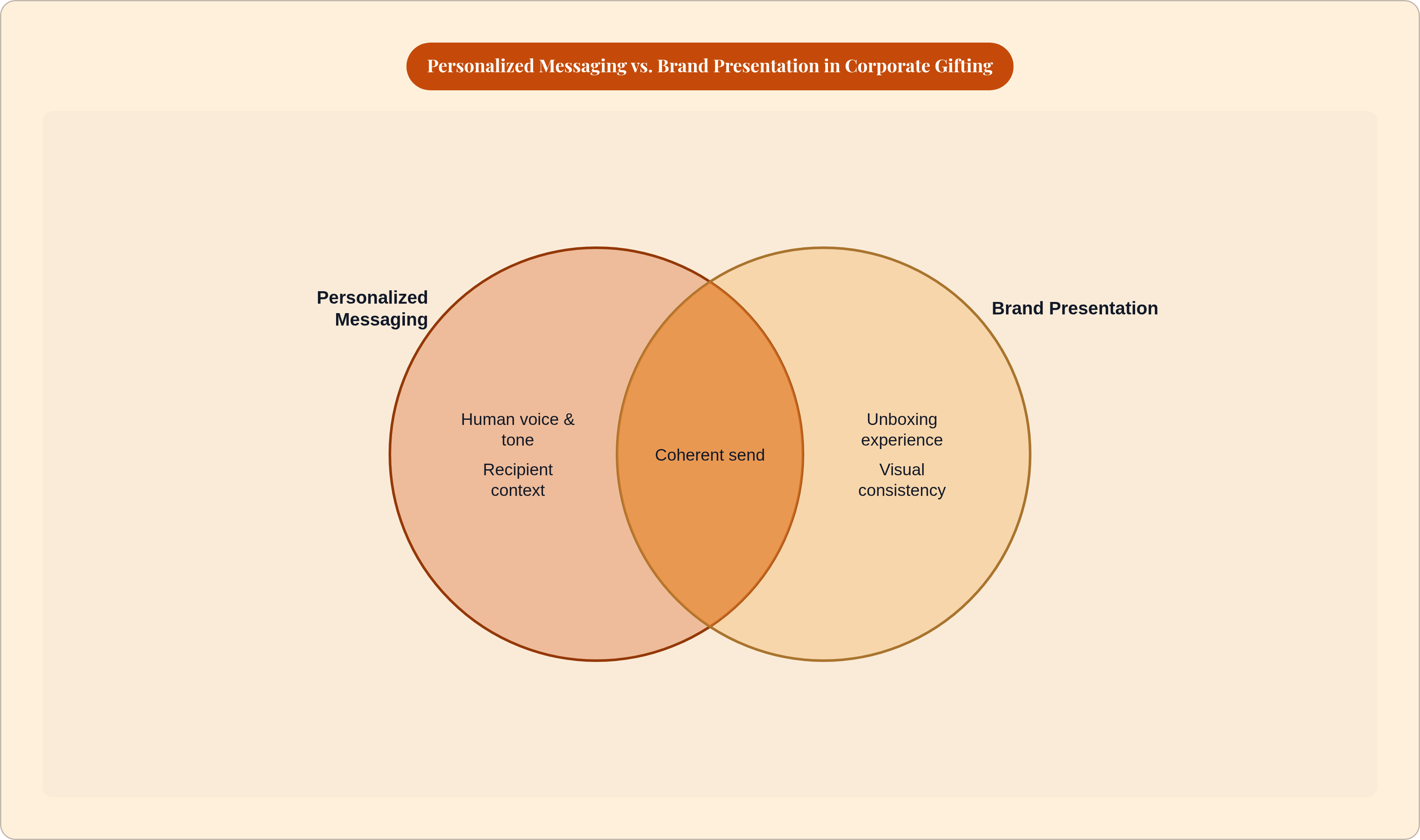
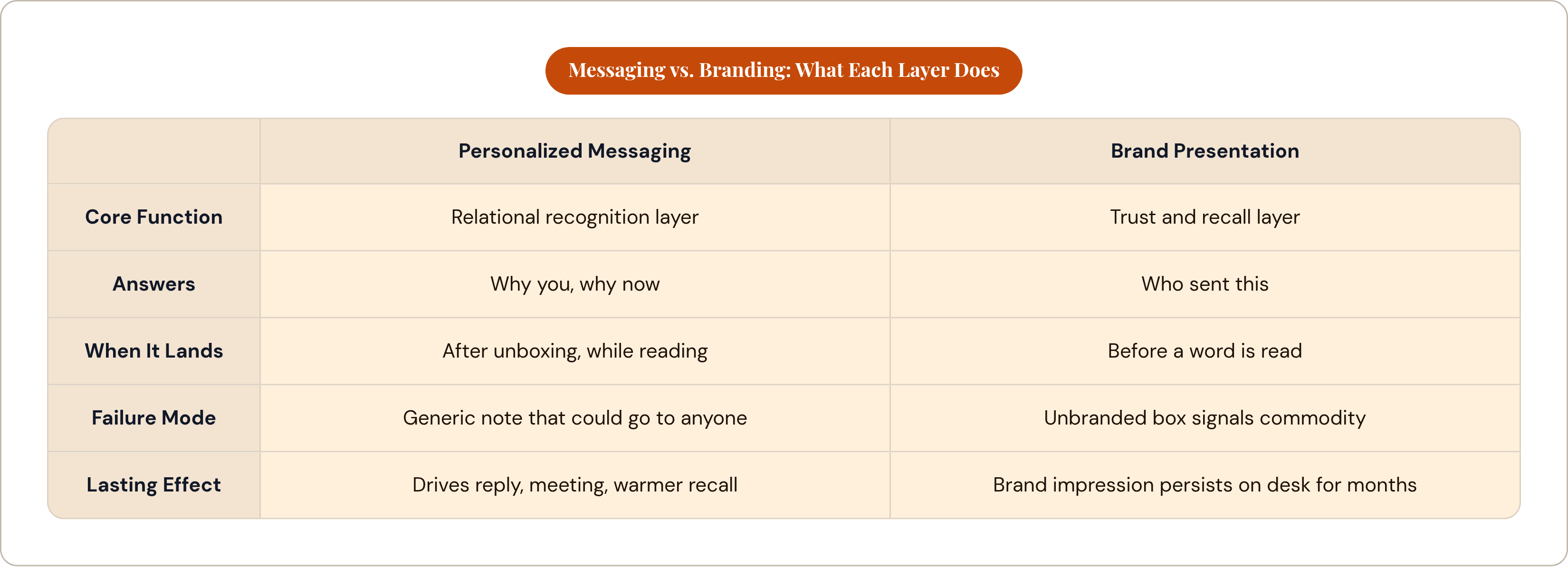
Personalized messaging is the relational layer. It answers "why you, why now" with enough specificity that the recipient feels recognized rather than catalogued, and that feeling is what drives the next action: the reply, the meeting acceptance, the warmer association with a name they'll see again in their inbox.
Branding is something else entirely. It's the trust and recall layer. It answers "who sent this" before the recipient has read a single word. How the box feels in hand, what the internal presentation looks like, whether the logo appears in a considered or intrusive way: these signals communicate quality standards and intentionality before language enters the picture. A branded gift lives on someone's desk for months. It keeps working as a brand impression long after the message has been read and forgotten.
Where the two interact is where most programs quietly fail. A well-branded package with a cold, generic message is a coherence failure; the recipient registers the gap between the investment the sender clearly made in the physical presentation and the absence of effort in the note. A warm personal message inside a generic, unbranded box underdelivers in the opposite direction: the sincerity of the words gets partially undermined by presentation that signals a commodity experience. The goal is for message tone, gift quality, and brand presentation to feel like one coordinated decision. When they do, the recipient finishes the interaction knowing who sent it, why, and what the sender values. That's a branded relationship moment. Everything else is just shipping.
What Makes a Gift Message Feel Personal Rather Than Templated
Customization and personalization get collapsed in practice, and they're distinct operations. Customization is inserting a first name into a template. Personalization is referencing something specific to this person: their role's current pressures, a recent milestone, a conversation you actually had. One is a mail merge. The other requires knowing something real about the recipient. That raises an important question worth sitting with: how often do gifting programs actually capture that knowledge before the send goes out?
A message that works has a few things in common. A specific trigger, meaning some answer to why this is arriving now, whether that's a deal stage, an event the person attended, a contract renewal, a work anniversary. A human voice, written as one person to another rather than one company to a contact record. A brief, natural connection between the gift and the recipient's context: "I thought you'd appreciate this because..." is a short sentence that does significant relational work. And a close that doesn't feel like a CTA button dressed up as a sentence.
What kills the personal feeling is equally consistent and, once you've read enough corporate gift notes, depressingly familiar. Boilerplate openers signal immediately that this message was written for a list. Formal language that doesn't match how the sender actually speaks to this person creates a tonal dissonance recipients register even if they can't articulate it. Most fatally: a message that could have been sent to anyone, because it essentially was.
Handwritten notes occupy their own category here. The physical handwriting signal carries an authenticity that printed personalization cannot fully replicate. Even when produced at scale through services that simulate handwriting, the format itself communicates effort in a way printed cards don't. The medium, in this case, is part of the message.
It is also worth considering context calibration, which matters more than most programs account for. A note to a VP of Sales at a company navigating a merger requires a different register, level of brevity, and emotional tone than a note to a customer success manager celebrating a renewal. The situation has to be legible in the message, not just the name and title.
How Branding Choices Shape What the Recipient Feels Before They Read a Word
The unboxing sequence is a brand touchpoint that operates before language enters the picture at all. Box weight, material texture, the quality of the closure: these signals arrive first, and they get processed as a rapid read on whether the company behind the send is premium or commodity, intentional or perfunctory. This isn't abstract consumer psychology. It's what happens when a busy buyer is sorting through a credenza of mail between calls and makes an instant judgment about whether something deserves attention.
Internal presentation carries its own signal. Tissue paper, considered arrangement of items: all of it communicates care before the note card is even found. Custom packaging versus a generic shipping box isn't only an aesthetic question. One announces that this was built for a specific person. The other arrives as a logistics event.
Logo placement is where branding choices most commonly misfire, in my experience. On exterior packaging, tissue, and branded inserts, a logo works: it attributes the experience to the sender without intruding on it. On the gift item itself, particularly when the item is personal, a wellness product, a food item, a book, the logo converts a gesture into marketing collateral. The recipient stops feeling like they received a gift and starts feeling like they received a sample. Brand the experience, not the object.
Visual consistency across the package matters more than teams usually invest in. Color, typography, and presentation quality should feel like the company's website and sales materials arrived in box form. When they don't, when the gift packaging looks disconnected from everything else the recipient has seen from this company, it registers as a fragmented identity. Not offensive, just forgettable. And forgettable is a real outcome with real costs, even if nobody puts it on the dashboard.
A neuromarketing study conducted in partnership with the USPS found that physical materials generate deeper emotional processing and stronger memory encoding than digital equivalents. The brand impression created by a physical send is more durable than its cost suggests, which is precisely why the quality of that impression carries consequences that compound across a relationship over time.
How Gift Messaging and Branding Do Different Work at Different Stages of the Buyer Journey
The relative weight of messaging versus branding shifts across a relationship, and gifting programs that treat every send identically leave real performance on the table.
In cold outreach, brand does more work. The recipient doesn't know the sender yet, so visual quality and presentation establish credibility before trust has any basis to exist. The message at this stage must earn the right to ask for anything, arriving with genuine curiosity about the recipient's world rather than pressure toward a next step. Sendoso has documented meeting acceptance rates improving from 58 percent to somewhere between 85 and 93 percent after teams integrated sending touchpoints into outreach sequences. That range is telling: the brand and message pairing is what makes the send feel worthy of response rather than dismissible.
Mid-funnel, after a demo, during a stalled deal, at proposal stage, the calculus shifts. Relationship context now exists. The message can reference specific conversations, because that specificity is what distinguishes this send from every other competitive touch the prospect is fielding. Brand still matters, but the personal note carries increasing weight, and the gift's relevance to the recipient's stated priorities becomes, in effect, part of the message itself.
At deal close and onboarding, brand presentation reaches its highest stakes. This gift sets the standard for the relationship going forward. The tone should be celebratory and explicitly forward-looking, naming the partnership rather than gesturing at it. How this moment lands shapes how the customer interprets everything that follows. That's a lot of pressure to put on a box, but it reflects what a first physical impression actually does to a relationship's trajectory.
Renewal and expansion is where gifting programs most consistently underinvest in message quality. By this point the relationship data is rich: shared milestones, specific outcomes, named conversations. A generic note at renewal is a significant missed opportunity, because the material for a resonant message already exists in the CRM. Using it signals that the relationship has been paying attention. Leaving it unused signals, quietly but clearly, that it hasn't.
Why Scaling Personalized Messaging Is the Operational Problem Most Gifting Programs Fail to Solve
A message that feels personal takes real effort to craft. A gifting program running at account-based scale requires dozens or hundreds of sends per quarter. Those two facts resist each other, and most programs never actually resolve the tension; they just manage it badly.
What breaks at scale is predictable, because I've seen it break the same way in program after program. Reps default to templates because the blank page is a time cost they can't absorb between calls. Message quality drops, and the personal feeling disappears with it. Brand presentation becomes inconsistent when different team members are sourcing, packing, and ordering independently, each making slightly different calls about materials and presentation. Most critically, there's typically no system for capturing the contextual information a good message requires: the recent conversation, the recipient's stated concern, the upcoming event. Without that capture mechanism, even motivated reps are writing from memory and guesswork.
The ABM context makes this tension particularly acute. Roughly 94 percent of B2B marketers use account-based approaches per Huble's research, but only about 17 percent have what those surveys characterize as a mature strategy. That gap between adoption and maturity runs directly through execution quality. Message and brand consistency at scale is one of the clearest lines of separation between programs that compound over time and programs that remain a recurring line item someone questions at every budget review.
The cost of getting it wrong isn't neutral, either. A poorly written, obviously templated message inside an expensive gift actively damages trust. The recipient registers the mismatch between the quality of what was sent and the absence of effort in the note, and that inconsistency communicates something about how the sender actually values the relationship. Nothing flattering.
A solved version of this looks like a system where recipient context flows from the CRM directly into message drafting, gift selection is informed by what's actually known about the person, and brand presentation is handled by a fulfillment infrastructure that doesn't depend on individual rep judgment or whatever supplies happen to be on hand that day.
How AI-Assisted Tools Handle Personalization at Scale Without Degrading Message Quality
To understand why this works, we must first look at what AI actually does in this context. When it's working well, it is not writing generic copy faster. It pulls CRM signals — deal stage, last interaction, company news, role, stated priorities — and generates message drafts calibrated to that specific relationship context. The blank-page problem that causes reps to default to templates disappears because a draft arrives with the relevant details already incorporated. The rep's job becomes refinement rather than origination, which is a faster and more honest ask.
Gift recommendation engines work similarly. Per ImprintEngine's 2024 data, 47 percent of companies adopted AI-powered corporate gifting solutions that year, using recipient data from CRMs and platforms like LinkedIn to recommend gifts with actual relevance to the individual rather than defaulting to catalog selections that could go to anyone on the list.
The model that actually preserves quality is human-in-the-loop: AI drafts, rep refines. The rep's edit adds voice and relational nuance that only someone who knows the relationship can supply. This isn't automation displacing craft. It's automation solving for the specific failure mode that causes craft to disappear at scale.
There's also an underappreciated operational blocker that AI-assisted tools address: address confirmation. A well-crafted, well-timed message that sits undeliverable because an address was unverified is a program failure that's easy to prevent and surprisingly common. Removing that friction point matters more than it sounds, particularly in programs running high send volumes where individual verification would consume meaningful rep time.
Some platforms integrate AI-powered gift selection, message personalization assistance, and address confirmation so a rep can execute a relevant, on-brand send in minutes. Because sends flow through a single platform with standardized fulfillment infrastructure, brand presentation stays consistent across every package, regardless of which rep placed the order or what quarter it is.
Connecting Message and Brand Performance Back to Measurable Outcomes
One might argue that personalized messaging and brand presentation are soft variables — qualitative investments in relationship warmth that resist clean measurement. But they're measurable. And the measurement is what separates a gifting program that builds compounding institutional knowledge from one that renews its budget on faith every cycle.
Response rate by message type, comparing well-personalized approaches against templated sends, reveals what the message itself is contributing. Meeting acceptance rates correlated with send quality and context, with documented ranges from a 58 percent baseline to 85 to 93 percent with integrated sending, show the combined effect of the brand and message pairing. Opportunity-to-close rate changes when gifts are deployed at specific stages give a pipeline-level view of what the physical send is actually doing to deal velocity.
The holdout group method is the cleanest way to isolate what message and brand quality contribute. Assign accounts to gifted and non-gifted cohorts, hold all other outreach constant, and measure the delta. What moves is attributable to the send. The variation within gifted cohorts, between well-executed and poorly-executed sends, reveals what the message and brand layer specifically are worth. It's not a complicated experiment. Most programs just never run it, which is a choice that gets made by default rather than intention.
Brand impression durability is also a legitimate measurement variable that rarely appears on dashboards. A physical item with brand presence has an active lifespan on a desk that no digital impression can match. The cost-per-impression calculation, amortized over the item's visible presence in the recipient's space, often looks quite different than it does on a line-item budget. Worth running the numbers before writing it off as unmeasurable.
Programs that treat message and brand as tracked variables, A/B testing message approaches, auditing brand consistency across sends, correlating gift timing with pipeline movement, build genuine institutional knowledge about what works for their specific buyer profile. Programs that don't run the same spend every quarter and wonder why results feel inconsistent. The data points in a consistent direction: personalized messaging and intentional branding aren't finishing touches. They're what determines whether a physical send produces pipeline and retention outcomes that make the whole investment defensible. The gift gets you in the door. The message and the brand determine what happens next.