Psychographic Segmentation for Client Gift Tiers
Personalize gifts based on how clients actually think and decide, not just what they spend.

Most B2B gift programs sort clients by company size and contract value, then hand out gifts based on spend band. That's firmographic segmentation, and it explains why a sustainability-focused CEO and a hard-nosed CFO at similarly sized companies end up with the same branded gift box on their desk. Psychographic segmentation sorts clients by what they actually value, and once you start looking at your accounts this way, you can't really unsee it.
What psychographic segmentation actually means in a B2B context
Say "psychographics" out loud and most people picture lifestyle quizzes, the "which vacation are you" content mill, the whole consumer-marketing circus. The B2B version is narrower and less fun to talk about at a party: it's about how a decision-maker thinks and what their company stands for, apart from what they do on weekends.
A handful of things build a profile worth acting on.
Personality shows up in how someone actually decides, not in what their title says they should decide. Some contacts want every scenario mapped out before they'll commit to anything. Others read your one-pager and give you a yes or no in the same meeting. That trait alone changes how you should be talking to them from the first call.
Values and beliefs are trickier, because there's a gap between what a company says matters on its website and what the individual actually won't budge on when the deck's in front of them. Sustainability, innovation, community investment, operational efficiency: this stuff shows up in mission statements, sure, but it shows up faster and more honestly in how a buyer reacts mid-pitch.
Attitudes get at how someone views vendors in general. Some clients want the transaction done well and nothing else, thanks. Others want a partner who remembers their kid's name and their last three quarters of business, and treats those as roughly equal in importance.
Interests and lifestyle signals are the professional footprint: which conferences they show up at, what they post about, which causes they've put their name behind. Social identity is a level up from that, how someone sees their own company against the field. Category leader, careful follower, scrappy challenger with something to prove. That self-image shapes what a gift needs to say back to them.
Here's the plain distinction, as best I can put it: firmographic data tells you a prospect's title and revenue band. Psychographic data tells you how they think and what earns their trust. B2B buying doesn't run on pure logic, whatever the spec sheets pretend. Risk appetite, organizational values, and the temperament of whoever's holding the pen shape outcomes more than a feature comparison does. I've come across research pointing to psychographic segmentation as a more effective targeting approach than demographic or behavioral segmentation on its own, which lines up with what I've seen on the ground: nobody's impressed by generic personalization anymore, if they ever were.
None of this is free, though. Building real profiles takes research hours somebody has to actually spend. The case for doing it has to rest on what changes in how clients respond, not on how the segmentation model looks in a slide deck.
Four psychographic profiles that commonly appear across B2B client bases
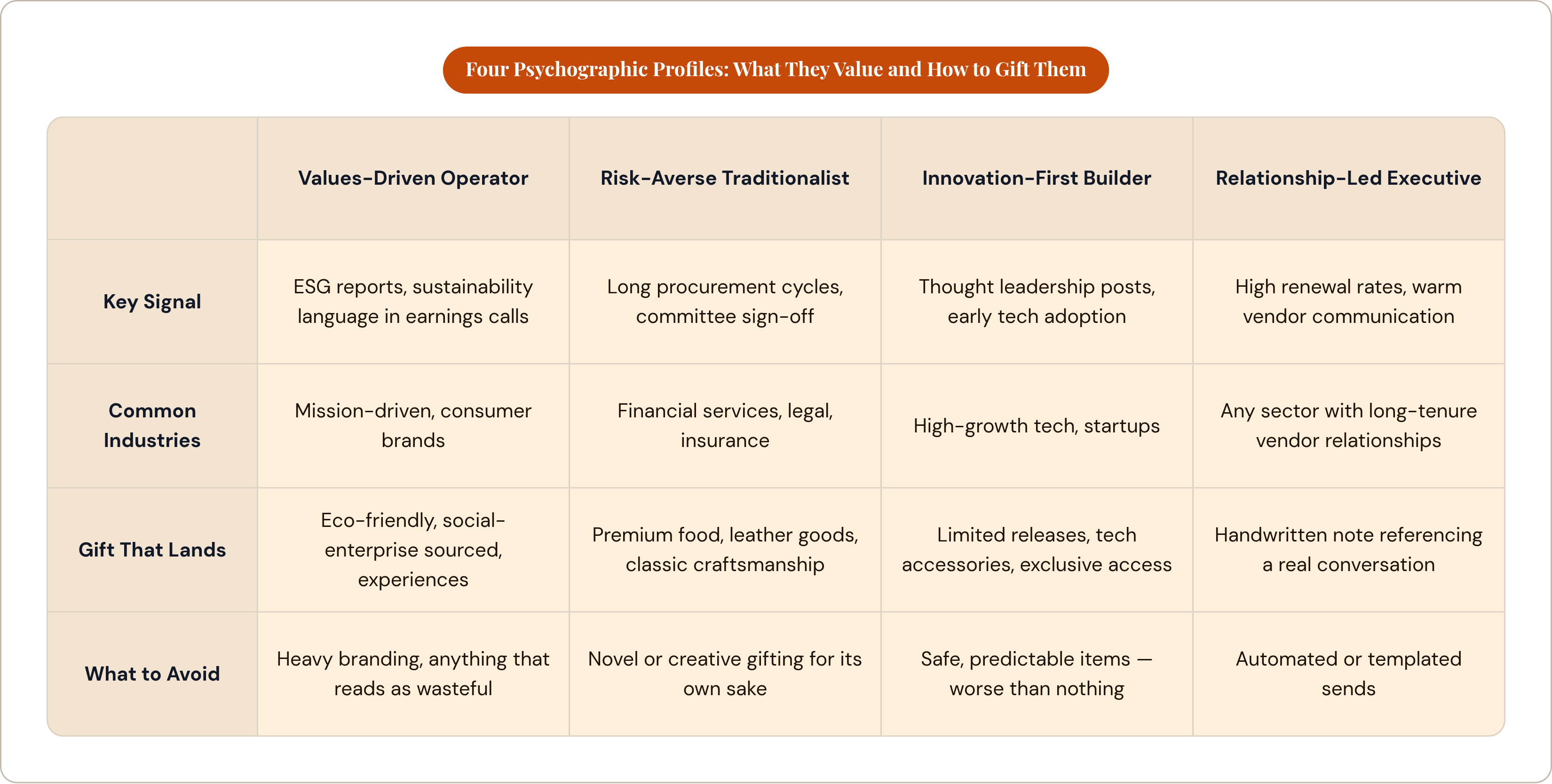
These aren't a closed list, and I'd be suspicious of anyone who hands you one that claims to be. Your own client base will throw you people who don't fit neatly into any bucket below. Treat these as starting templates, not a filing cabinet.
The Values-Driven Operator. Look for sustainability language in earnings calls, ESG reporting, DEI baked into vendor selection criteria before a contract's even on the table. This client responds to eco-friendly products, gifts sourced from small or social-enterprise makers, experiences over more stuff to own. Heavy branding backfires here. So does anything that reads as wasteful, even at a high price point, maybe especially at a high price point. Companies built around sustainability messaging tend to prioritize eco-friendly gifts over alternatives, because alignment with their values matters more than the price difference.
The Risk-Averse Traditionalist. Long procurement cycles, committee sign-off, a strong pull toward vendors they've used before and trust for exactly that reason. Common in financial services, legal, insurance, the industries where nobody gets fired for picking the safe option. Classic items with real craftsmanship land well: premium food and drink, leather goods, things with some history behind them. Skip anything that feels like you're trying to prove how creative your gifting vendor is; that instinct to default to what's tried and tested carries straight over into how they'll receive a gift.
The Innovation-First Builder. High-growth, tech-forward, leadership that posts thought pieces and adopts new tools before anyone asks them to. This client wants something novel: limited releases, tech accessories, early access to something exclusive. A safe, predictable gift actually reads worse here than sending nothing, because it tells them you don't get what they're building.
The Relationship-Led Executive. Long tenure with vendors, high renewal rates, warmth in how they write their emails back to you. Wants a handwritten note that references an actual conversation, not a templated card with the name mail-merged in at the last second. Automated sends are the fastest way to lose this person's trust. The personal touch matters more here than the dollar amount ever will, full stop.
One account can show traits from two of these at once, easily, and often does. The sharpest profiles get built at the individual stakeholder level. Slapping one label on a whole account is how you end up back at firmographics wearing a disguise.
Where to source psychographic signals when you don't have a research team
You probably already have most of this sitting in your CRM right now. The signals are there. The gap is that nobody's reading them with gifting in mind, because nobody's been asked to.
Start with conversation history. Word choice in emails, what a client brings up unprompted on a discovery call, the thing they keep circling back to three calls running. It's sitting in a notes field somewhere, mostly ignored, waiting for someone to treat it as data instead of clutter.
LinkedIn tells you more about someone's professional identity than their job title ever will. What do they share, comment on, publish under their own name instead of their company's? Company materials do the same work at the org level: mission statements, sustainability reports, press releases, even job postings. Values show up in language well before they show up in behavior you can actually watch happen.
Your CSMs and AEs are sitting on a pile of psychographic intuition nobody's ever bothered to write down. Ask them. A fifteen-minute debrief beats a research project you'll never get budget for.
Event behavior counts too. Which sessions did a client attend at your last user conference? What did they download? Which webinar did they watch live instead of catching the recording three weeks later, half-attention, playing in the background of something else?
Worth mentioning: research has found large language models can pull psychographic value segments out of large volumes of text at a fraction of what traditional primary research costs. That puts this kind of work within reach of teams with no research budget at all. And because the models keep updating as new text comes in, the profiles don't calcify the way old-school segments used to. A psychographic profile shifts. It's worth revisiting on a schedule, not filing away once and calling it done.
HubSpot's research on B2B segmentation found the average company already runs somewhere around three and a half segmentation criteria at once. So psychographics doesn't need to win a turf war with firmographics or behavioral data. It works best layered on top of what you're already doing.
How to build gift tiers that layer psychographics on top of firmographic foundations
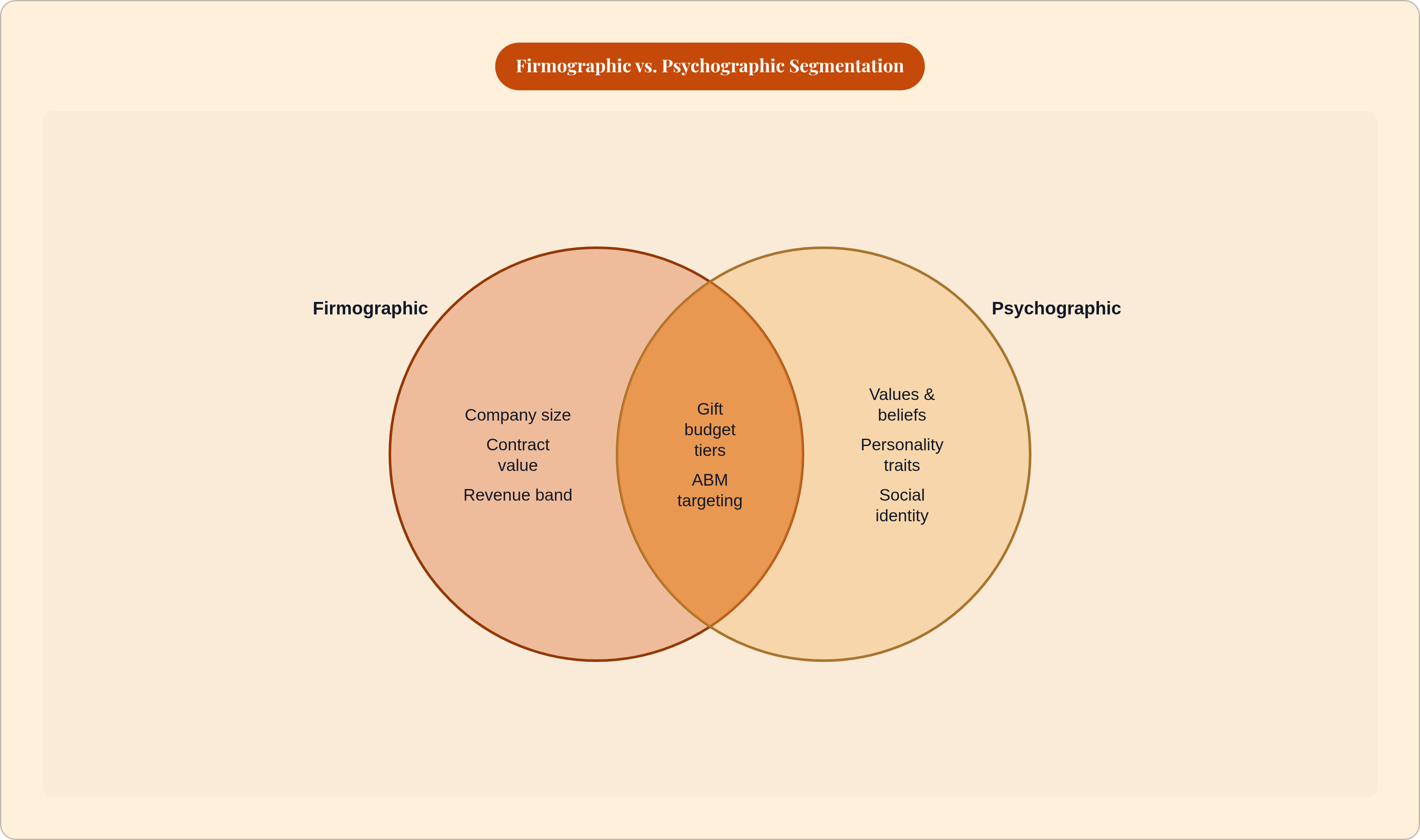
Firmographics still sets the budget. Contract value, account size, strategic weight, that math isn't going anywhere and shouldn't. Psychographics decides what actually fills the box once the budget's locked in.
This maps onto the standard three-tier ABM structure cleanly enough. Tier 1 covers your highest-value accounts, the ones getting one-to-one, consultative attention. These deserve fully custom gifts built around each stakeholder's specific profile. The research time is worth spending because the accounts are worth that much. Tier 2 covers strong-fit accounts with room to grow, and here you build segment-level themes instead of individual customization: a sustainability cohort gets one gift path, an innovation cohort gets another, both inside the same budget band. Tier 3 is your programmatic tier, served at scale, where the psychographic signal still shapes the category of gift (experience versus object, eco-friendly versus classic-premium) even without one-to-one customization.
In practice, this means defining two or three psychographic "lanes" per tier: values-driven, relationship-led, innovation-first, whatever shows up most in your base. Build a gift set for each lane. Let your CSMs pick within the lane that fits instead of defaulting everyone to the same box out of convenience, which is what happens the moment nobody's watching.
Format matters too. Fully curated physical packages take the most effort and land the biggest impact, so save these for Tier 1, where you actually know the profile well enough to justify the work. Choice-based sends, where the recipient picks from a short curated list, cut your risk of a miss when the profile's still fuzzy. That makes them a solid fit for Tier 2. eGifts move fast and skip the address problem entirely; they fit moments when speed beats ceremony, or a profile that clearly prefers efficiency over a big gesture.
One more wrinkle worth sitting with. B2B deals now involve an average of 11 stakeholders, according to Salesforce's State of Marketing 2025 Report. Inside a single Tier 1 account, your economic buyer, your champion, and the legal reviewer signing the contract can each carry a completely different psychographic profile and need a different approach entirely. Multi-threaded deals close at rates 42% higher than single-threaded ones, and yet 78% of accounts still run on just one active contact, which is a strange gap when you sit with it. Psychographic tiering actually builds the case for multi-threading: once you see your champion and your economic buyer think nothing alike, sending them the same gift box stops making any sense. Separately, engaged C-suite relationships raise upsell potential by 189%, per Ebsta and Pavilion's 2025 research, which on its own is reason enough to treat executive profiles as their own design input, apart from whatever their direct reports are getting.
When to send and what to trigger — matching psychographic tiers to pipeline moments
Calendar-driven gifting has a timing problem, and it's a simple one to spot once you've seen it. A holiday card lands the same week as every other vendor's holiday card, and whatever psychographic thought went into picking it gets buried under seasonal noise nobody has the bandwidth to sort through.
Trigger off pipeline moments instead. Send shortly after a demo or discovery call, while the client's stated priorities are still fresh, so the gift references something they actually said rather than something you guessed at a week later. A stalled deal is another good trigger: send something aimed at that specific stakeholder's profile, so your innovation-first exec gets something that signals you understand what they're chasing, not a generic re-engagement gesture. Contract renewal windows are prime territory for the relationship-led profile, where a personal acknowledgment of the partnership's history beats any generic premium item, every time I've seen it tried. Milestone events, a funding round, a product launch, an industry award, give you the strongest lever available, because a gift tied to a real milestone speaks directly to how that client sees its own professional identity.
Speed compounds with relevance here. ZoomInfo's 2025 ABM Intelligence Study found teams that act on intent spikes within 24 hours see a 29% lift in opportunity creation over teams that respond slower. When the trigger is behavioral, fast and on-target reinforce each other instead of trading off against one another.
CRM-triggered gifting handles delivery timing automatically while leaving gift selection to a human who actually knows the client's profile. The psychographic lane lives as a field in the record and surfaces the moment the trigger fires. By one recent count, 84% of marketers already report using AI and intent data to sharpen personalization inside ABM campaigns. Intent data answers when to send. Psychographic profile answers what to send. Neither one replaces the other.
For the values-driven profile specifically, timing a send around a company's public sustainability milestone, a new ESG report, a certification announcement, does more than a generic thank-you ever could. It tells them you were actually paying attention, not just watching the calendar tick over.
Making psychographic-tier gifting measurable and iterable
Only 52% of companies measure ROI on their ABM programs at all, per revnew.com's compilation of ABM statistics. Gifting tucked inside those programs usually inherits the same blind spot, which means nobody can say whether the psychographic lane is earning its keep or just feeling good.
Measure differently by tier, because a single metric across all three will hide more than it shows. For Tier 1 custom sends, track deal velocity (days between the send and the next meeting booked), close rate before versus after introducing psychographic tiering, and expansion revenue tied specifically to milestone sends. For Tier 2 segment-themed sends, compare response rates by lane: does the sustainability lane outperform the innovation lane in a given industry? That's a real finding you can act on, worth more than a vanity number on a slide nobody questions. For Tier 3 programmatic sends, watch meeting acceptance rate and re-engagement rate on deals that had gone quiet.
Structure the ROI conversation around three buckets: pipeline sourced (the gift as the first real touchpoint), pipeline influenced (deals that moved faster because of a send), and revenue retained (renewals and expansions tied back to a gifting touchpoint). Run every tier's psychographic sends through all three. Don't just pick the one that flatters the program.
Platforms like Sendoso that plug directly into your CRM and marketing automation stack matter here, because they tie every send back to pipeline and retention data, letting teams trace it to an outcome later rather than leaving it as an offline activity. The psychographic tier becomes a field on the record, something the whole team can see, rather than a fact only one CSM happens to remember from a call six months back.
Iterate after that. After each cycle, ask which lane got the best response and which gift category inside a lane fell flat. That answer refines your tier design without forcing a full re-segmentation project every quarter, which nobody has time for anyway.
For leadership buy-in, most marketers who actually measure ABM ROI already report it outperforms nearly every other channel they run, and gifting is a physical extension of that same logic. Show that psychographic tiering beats firmographic tiering on the metrics that matter, tier by tier, lane by lane, and let that comparison do the convincing for you.