Behavioral Segmentation for Employee Gifting Occasions
Skip the calendar dates and gift based on what employees actually do at work.

Behavioral segmentation means gifting people based on what they actually do at work, not the date sitting on a calendar. A gift tied to a one-year anniversary means something different than one tied to a tanked engagement score, and that gift means something different again from one tied to the biggest deal of someone's career. Same envelope, three different letters inside. Send the wrong one and people notice, even if they can't say exactly why.
What behavioral segmentation actually means in an employee context
Marketers figured this out a long time ago. You group people by what they do, not who they are on paper. Who opened the email, who sat through the whole webinar instead of bailing at minute four, who pulled the pricing sheet three times in one week: that tells you more about intent than a job title ever could.
The same logic works inside a company, and it barely shows up in practice. I've spent enough time around HR and recognition programs to find that strange. Someone finishes a certification. Someone takes on a stretch project nobody else wanted. Someone who was your loudest voice in every meeting for a year goes quiet on the last two engagement surveys. Those are real signals about where a person stands right now, and they carry more weight than a tenure bracket pulled off an HR spreadsheet.
So what's actually worth watching? Four categories keep coming up once you dig into how companies handle people data:
- Tenure patterns: the anniversary itself, plus the engagement trend leading up to it
- Performance cues: a quota hit, a project wrapped, a training path finished
- Role transitions: promotions, lateral moves, a new manager, a return from leave
- Engagement milestones: a first big contribution, or a bounce-back after a slump
None of this data is exotic, either. HRIS platforms already track tenure and role changes. Performance tools already log goal completion. Engagement platforms capture survey scores, and learning systems record certifications on their own, no extra lift required. The gap isn't the data. It's whether anyone routes it toward a gifting decision at all.
Try this on your own program. Does a title change register anywhere as gifting-relevant information? For most companies I've looked at, it doesn't even show up on the radar. That's the whole gap, right there.
The four signal types that should map to distinct gifting moments
Each of these four signals runs on its own logic, and treating them the same flattens the exact thing that makes each one worth acting on.
Tenure is the obvious trigger, but the interesting part happens before the anniversary date shows up. Watch the engagement trend leading into it. An employee whose scores have climbed for a quarter, closing in on year three, is telling you something entirely different than one whose scores have been sliding over that same stretch. One gift should reinforce momentum. The other has to function as a retention move, and there's no way around that distinction. Send the same item to both, and the anniversary becomes a stand-in for how someone actually feels about the job, which sells the moment short.
Performance cues are the sharpest signal you'll get, because they're pinned to a specific action with a specific timestamp: a closed deal, a finished certification, a record quarter. Timing isn't a nice-to-have here, it's the entire point. A gift landing within 48 hours of the win reads as recognition. The same gift three weeks later reads as paperwork that finally cleared HR. Personalized gifts consistently outperform generic ones on ROI in the research I've come across, and performance context is exactly what makes that personalization land instead of feeling bolted on after the fact.
Role transitions create an identity shift, and most programs give that shift less attention than it deserves. A promotion means someone stepping, often nervously, into a new version of their working self. That's a bigger deal than a pay grade update. Give a first-time manager something that acknowledges the actual weight of managing people, instead of a mug with the company logo on it, and they feel seen in the role they're stepping into. HRIS systems are the cleanest source here, since role-change fields already come with reliable timestamps built in.
Engagement milestones are the hardest to catch and the most rewarding when you catch them anyway. A first real contribution. A comeback after a documented rough patch. Quiet, steady participation in something nobody else noticed. These take more data literacy to spot, and they're also the ones most likely to earn a genuine "wait, how did they know that."
How to connect behavioral data sources to gifting triggers in practice
Here's the actual problem: the information lives across four systems that were never built to talk to each other, let alone to a gifting workflow.
Look at what each one already surfaces on its own:
- HRIS tools like Workday, BambooHR, or Rippling flag role changes, tenure dates, and returns from leave
- Performance platforms such as Lattice, Culture Amp, or 15Five track goal completion, rating cycles, and peer recognition
- Learning management systems log course completions and certifications
- Engagement platforms capture survey participation, eNPS movement, and recognition activity
None of that matters much if it stays locked in its own silo. A gifting platform with native HRIS connectors picks these events up the moment they happen. Without that connection, somebody's pulling spreadsheets manually every quarter, and by the time the list gets compiled, the moment that made the signal meaningful is long gone.
Sales teams solved a version of this problem years ago. A deal stage changes in Salesforce or HubSpot, and a gift fires without anyone touching a keyboard. The same architecture works here: a role-change event fires in the HRIS, a send goes out, no manual step in between.
What does the trigger logic actually look like? Something along these lines holds up:
- Role change equals true and transition type equals promotion: trigger a premium send within 48 hours
- Tenure milestone hits one year and engagement trend reads improving: trigger a celebration send
- Certification completed equals true: trigger a same-day recognition send
- eNPS score drops below a set threshold: flag it for a manager to send something personal, not automated
That last line carries more weight than it looks like on paper. Automation should own the when and the who. The what, especially anything touching a sensitive moment, needs a human making the call. Collapse those two jobs into one system, and that's usually where behavioral gifting programs go sideways. Platforms built to integrate with people-stack tools let triggered sends fire off real events instead of a coordinator's calendar reminder from three weeks ago. That keeps timing tight without hiring another person just to babysit a dashboard.
Why the gift item itself must follow the signal, not the occasion category
Getting the timing right only gets you halfway there. Send a generic item at exactly the right second, and it still reads like a process running in the background, not a person paying attention.
The signal should shape both what gets sent and how it gets framed:
- A performance win calls for something celebratory or shareable, the kind of thing that amplifies the feeling instead of just marking it
- A role transition calls for something useful in the new job, or something that acknowledges the shift itself: a kit built for a first-time manager, a real step up from a water bottle with a logo on it
- A re-engagement moment calls for something warm and understated, a quiet signal that someone noticed, not a trophy
- A long-tenure milestone calls for something with real weight to it, not filed in the same tier as a 90-day welcome gift
AI-driven recommendation is changing the scale of this problem. Instead of defaulting to a catalog page, a platform can pull in role, location, past sends, and inferred preference to surface something actually relevant to that one person. Adoption of AI-powered gifting tools grew notably in 2024, and companies using them report meaningfully higher ROI than standard catalog selection. The personalization effect shows up in the numbers, not just the pitch deck.
But what happens when the item misses anyway? That's the failure mode nobody plans for. A well-timed gift that doesn't fit the person can land worse than no gift at all, because it tells the employee the company clocked the moment without knowing anything real about who they are. Platforms like Sendoso handle this by using AI to recommend gifts based on recipient data and context, cutting out most of the guesswork while still leaving room for a manager to write their own note. None of it matters, though, if the item itself is cheap. Thoughtful, higher-quality sends beat high-volume, low-cost ones pretty consistently, and behavioral gifting only pays off if what shows up at someone's door actually clears a real bar.
Building a segmentation matrix: matching signal type to send tier and message
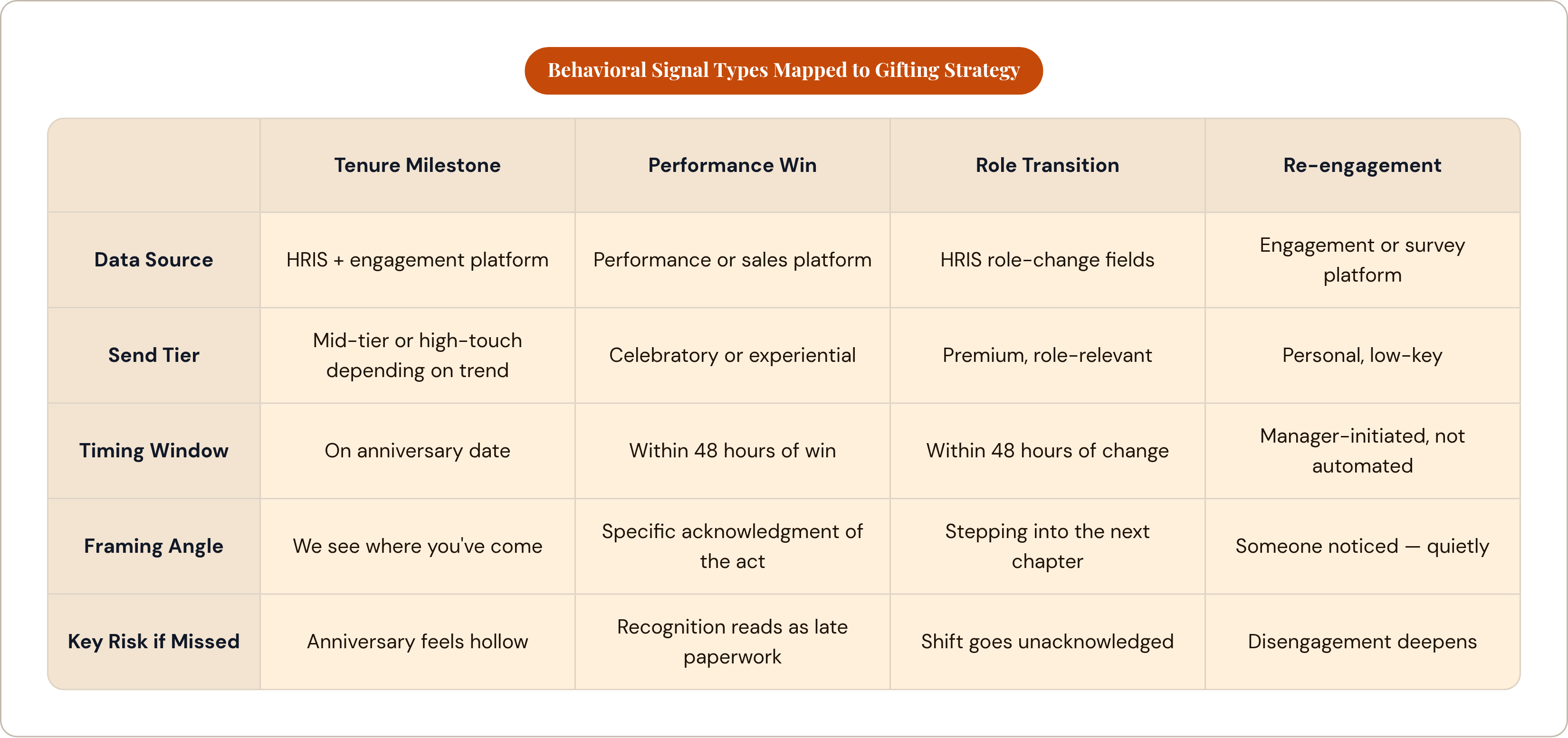
A segmentation matrix forces three questions onto the table at once: who's receiving this, what triggered it, and how much the company should actually spend on this particular moment.
Laid out plainly, it might look something like this:
- Tenure milestone with improving engagement: mid-tier celebration send, framed around "we see where you've come"
- Tenure milestone with declining engagement: high-touch, personal send, framed around "we want you here," deliberately more understated than a branded company kit
- Performance win, whether quota, project, or certification: celebratory or experiential send, with immediate and specific acknowledgment of what they actually did
- Promotion or role change: role-relevant premium send, framed around stepping into the next chapter
- Re-engagement after a documented low period: personal, low-key send, ideally written by the manager directly, kept far from anything that reads corporate
Why bother building this instead of just reacting case by case? Without it, budget spreads evenly across moments that don't deserve equal weight, and the moments that actually matter get the same treatment as the ones that don't. A matrix forces prioritization that an ad hoc program never quite manages on its own.
Here's something worth sitting with: internal gifting is already the bigger half of corporate gifting overall, since most corporate gifts go to employees, not clients. The real question isn't whether the budget exists. It's whether that budget runs on any strategy at all. For global teams, the matrix itself travels fine across regions, though the items and delivery logistics need to localize. A platform with broad international fulfillment reach lets that structure scale without rebuilding the whole thing market by market.
Measuring whether behavioral gifting is working
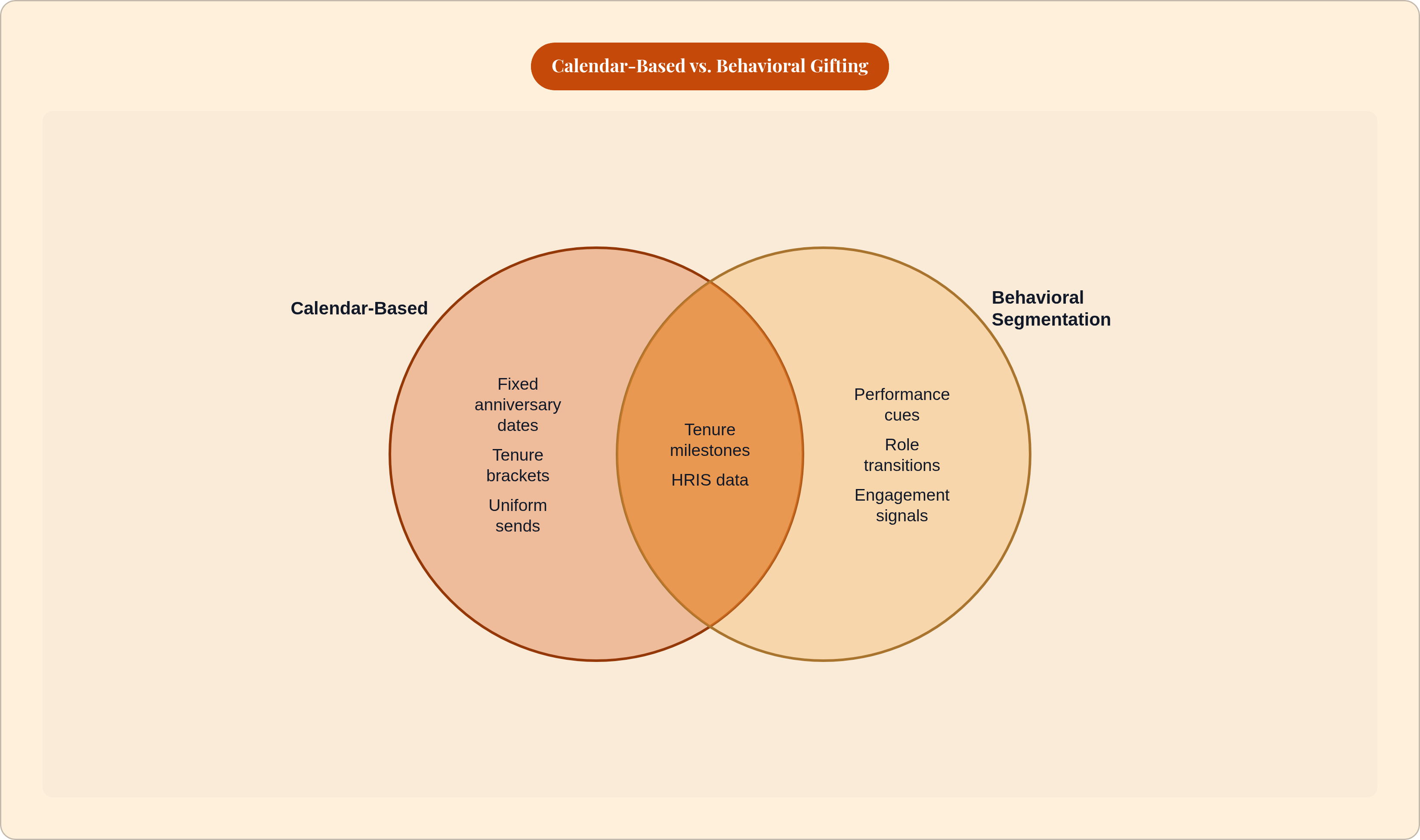
Calendar-based gifting gives you almost nothing to measure beyond a delivery count. Behavioral gifting is different, because every send ties to a specific event with a real before and after around it.
What's worth tracking, broken out by signal:
- Tenure signals: 90-day retention after the milestone, and how engagement scores move post-send
- Performance signals: whether recognized employees repeat strong performance at a higher rate than a comparable unrecognized group, and how fast they hit their next win
- Role transitions: ramp time in the new role, 180-day retention after a promotion, early performance indicators
- Re-engagement sends: eNPS movement, survey participation rates, and whether managers report a real shift in sentiment
This is the same discipline sales teams already apply to gifting: compare a gifted group against a matched control, track what happens afterward, tie the gift to an outcome instead of a delivery confirmation. Measurement is still thin across the industry, thinner than it should be given how much money moves through these programs. Roughly half of companies track ROI on gifting and account-based programs at all, and the internal side lags even that number. The companies that close this gap turn gifting from a line item into a figure leadership can actually defend in a budget meeting.
None of this works without a platform that logs sends back into the people stack instead of just a shipping label. Otherwise the data sits in two systems that never talk, and nobody can connect a send in March to a retention number in September.
Set a quarterly rhythm for reviewing this. Look at what actually moved, cut the triggers that didn't earn their keep, and put more weight behind the ones that did. There's a real difference between a report that says gifts went out and one that says retention moved because of them. Only one of those holds up when someone asks what the program is actually for.