Gift Personalization for Multi-Stakeholder Enterprise Accounts
Buying committees are now too large for one-size-fits-all gifting to work.

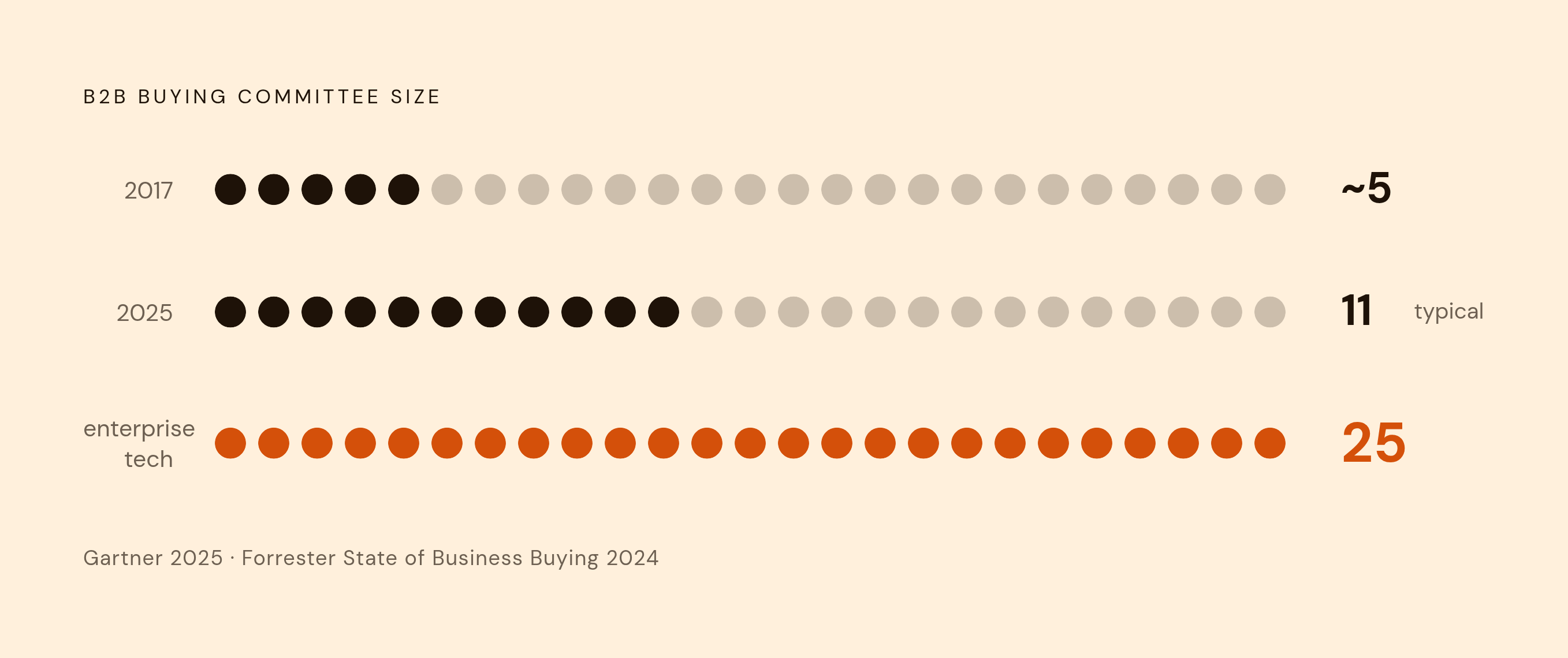
Buying committees have roughly doubled in size since 2017. Gartner's 2025 research puts the typical B2B purchase at 9 to 11 stakeholders, climbing to 25 for enterprise technology deals; Forrester's State of Business Buying 2024 pegs the average at 13. A gift sent to one champion, or a generic box shipped to the whole account, treats a room full of different people like they're one person. Champion-only gifting leaves the people most likely to hold veto power entirely unaddressed, which creates real risk late in the deal cycle.
A CFO evaluating total cost of ownership and a VP of Engineering worried about integration complexity are not reading the same deal. Neither shares risk tolerance, success metrics, or gift preferences with the other. Once a committee runs 13 names deep, personalization has to mean something bigger than a tactical tweak. It means rethinking who gets addressed and how.
The common failure modes when gifting into complex accounts
Three mistakes show up again and again, and they are not equally damaging.
The mildest is the one-size-fits-all send: same item, same message, mailed to every name regardless of role. It's efficient, but blind to the fact that a Head of Security and a VP of Finance are weighing completely different risks.
Champion-only gifting is worse, by a wide margin, and deserves recognition as one of the biggest problems in enterprise gifting today. All the warmth and all the budget go to the one contact who answers emails fastest, while the economic buyer who signs the check and the procurement gatekeeper who can stall the contract never hear from the vendor at all. A blocker who never felt acknowledged can quietly undermine a deal the champion believed was already won. By the time anyone notices, no gift fixes it.
Timing mismatch is the third failure. A gift lands on some arbitrary date, unconnected to where that stakeholder actually sits in their own evaluation. Too early, it reads as noise. Too late, it reads as an afterthought.
Why do these mistakes survive year after year? Mostly operational friction, since researching and personalizing for 13 or more people across one account feels like a mountain of manual work without a repeatable system behind it, so teams default to the easy version even when they know it's wrong.
Worth being precise about what personalization actually means, then. The gift category, the message, the timing, and the channel all need to calibrate to one individual's role and what's actually keeping them up at night about this deal. A name printed on a shipping label doesn't get there on its own.
How to map a buying committee before choosing a single gift
Mapping the committee has to happen before anyone picks a gift, not after. Reverse that order and every gift downstream is a guess, and guessing at this scale gets expensive fast.
Start by naming every stakeholder with an actual role attached: economic buyer, technical evaluator, end-user champion, legal or procurement gatekeeper, executive sponsor. For each one, document what they've said they care about, what objection they're likely to raise, and what a win looks like from their seat at the table.
A few sources carry real signal here:
- LinkedIn activity, which reveals what someone posts, shares, and comments on, and by extension what they value professionally
- Earnings calls and press releases, which show what pressure the economic buyer is under to deliver
- CRM interaction history: meeting notes, email threads, any prior sends already sitting in the record
- Intent data from ABM platforms, showing which topics a given contact has actually been consuming
That last point matters more than it looks. As of 2025, 71.2% of organizations run ABM strategies, and the strongest programs treat every contact at a target account as a distinct persona, with distinct content and distinct outreach. Gifting should follow that same logic. There's no good reason it should lag behind the rest of the go-to-market motion.
The practical output of all this mapping is a one-page account brief, something every rep and marketer touching the account can reference. This is what stops two people from the same vendor gifting the same contact twice in one quarter, which happens more often than most sales leaders would like to admit.
Account-level intelligence (funding news, headcount, product launches) covers one layer; individual-level intelligence (this person's tenure, career path, what they post about on weekends) covers another. Both matter, and a strong program tracks them side by side.
Segmenting stakeholders into gifting personas that guide selection
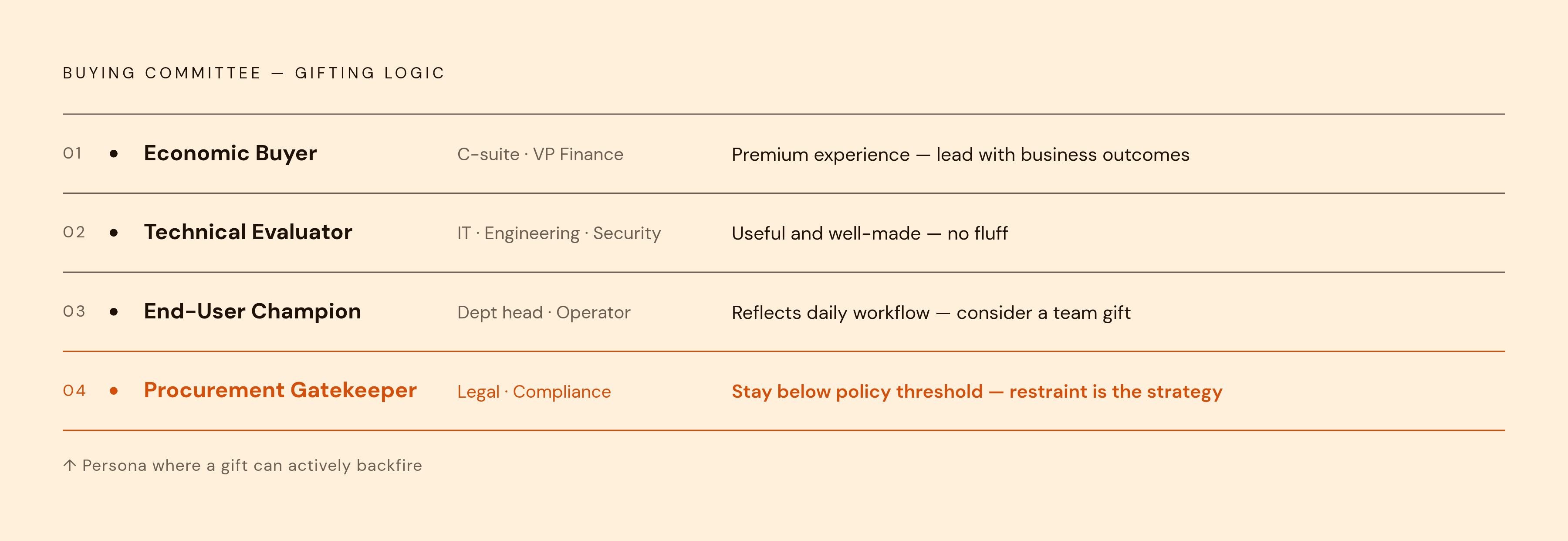
Not every stakeholder needs a gift built from scratch. That's what personas are for: they let a team apply real personalization at scale without reinventing the decision every single time.
Four archetypes cover most of the enterprise committee:
- The Economic Buyer (C-suite, VP Finance): responds to gifts that respect their time and status. Premium, understated, often experience-oriented. The message should reference business outcomes, not product features.
- The Technical Evaluator (IT, Engineering, Security): skeptical of anything that smells like fluff. Responds to gifts that are genuinely useful and well-made, items that feel earned rather than transactional.
- The End-User Champion (department head, day-to-day operator): usually the most emotionally invested person in the room. Responds to gifts that show real understanding of their daily workflow, sometimes a team-level gift rather than an individual one.
- The Procurement or Legal Gatekeeper: often wary of gifts entirely, for compliance reasons. Better served by relationship touchpoints that stay well below any policy threshold: a handwritten note, a small branded item, something that can't be mistaken for a bribe.
Persona is a starting point, not a finish line. A CFO who posts about marathon training is a different opportunity than a CFO who only posts about quarterly earnings, and this is exactly where most teams get lazy: they build the persona framework, then stop looking at the actual person in front of them.
The C-suite tier deserves particular attention. ABM marketers report that ABM roughly doubles engagement with C-suite executives, which suggests executive-tier personalization moves the needle in a way broader outreach doesn't. Gifting happens to be one of the few channels that reliably earns that group's attention in the first place.
Personas reduce the cognitive load on the rep, and that's the real win. Nobody has to sit down and decide, from a blank page, what category of gift makes sense for a Head of Security, because the framework already answered that question before the conversation started.
Timing gifts to the moment that matters for each stakeholder
Stakeholders don't pay attention to a deal on the same schedule. Their engagement rises and falls at different points in the funnel, and a gift that lands off-beat mostly gets ignored.
The economic buyer leans in at the business-case stage and again at contract signature; the demo itself rarely holds their attention. The technical evaluator peaks during the proof-of-concept and security review, the parts of the process everyone else tunes out of. The end-user champion is engaged early during discovery, then again near close, when they're the one selling the deal internally. Procurement enters late, and gifting toward that group should already exist as a relationship habit. Introducing it late as a pressure tactic tends to backfire.
A few trigger moments are worth mapping for every stakeholder, individually:
- A pre-meeting nudge, which lifts show rates before a high-stakes call
- Post-demo acknowledgment, which reinforces the conversation before internal deliberation starts
- Stalled-deal re-engagement, where a well-timed, relevant send can restart a conversation that's gone quiet
- Proposal submission, where a gift arriving alongside the proposal keeps the relationship in view, not just the price tag
- A contract milestone, where the champion and the economic buyer get acknowledged separately, since their roles in getting there weren't the same
Physical gifts land a 4.4% response rate against digital outreach, and that edge is sharpest when the send arrives at a genuinely high-attention moment, rather than as background noise the recipient half-notices and forgets.
Most programs fall into the same trap here: treating gifting as one neat sequence, applied the same way to everyone, when a 13-person committee has different people sitting at different stages at the same time. The program has to run parallel tracks, because a single timeline just doesn't hold.
Gift selection principles that hold up across different roles and seniority levels
Once timing and persona are settled, four levers control the actual gift, and each one moves independently.
Category comes first: experiential, physical, consumable, or digital, matched to both the persona and whatever compliance environment that company operates under. Quality tier comes second, signaling respect for the recipient's level; a premium item suits a C-suite contact in a way it wouldn't necessarily suit an early-stage technical contact, who might respond better to something practical instead. Message is the third lever, and it's easy to underrate: a generic congratulations note defeats the entire purpose of personalizing anything else. Relevance signal is the fourth, and it's really the test of whether the first three worked. Does the item prove someone researched this person, or does it read like a template with a name dropped in?
The data backs specificity over spend, and this is worth sitting with. Companies report 89% higher ROI on personalized gifts versus generic ones, meaning how carefully a gift gets chosen matters more than how much it costs. Budgets should follow that logic, not just the gift selection itself.
Compliance deserves its own mention at the enterprise tier, because it carries more weight here than it typically does with smaller accounts. Many large organizations cap gift value or ban certain categories outright, and knowing the policy before selecting anything isn't a nice-to-have. A rejected gift does more damage than no gift at all.
Branded merchandise still has a place, just a narrower one than most teams assume. It works best when it extends a relationship that already exists, rather than trying to open one. A prospect who's never engaged doesn't want a tote bag with someone's logo on it, though a champion three quarters into an active relationship might genuinely like one.
Experiences tend to beat objects for senior buyers who already have everything money can buy: dinners, live events, skills workshops. They create a shared memory instead of another item on a shelf. Where a company has publicly committed to sustainability, eco-conscious or locally sourced gifts carry extra weight, because the choice visibly aligns with something that company already said it cares about. That alignment is its own form of personalization.
How AI and CRM integration make stakeholder-level personalization executable at scale
Doing all of this by hand is possible, just limited, since a skilled rep can research and personalize gifts for only a handful of priority accounts. AI extends that same depth of attention across an entire account list, without multiplying headcount to match.
In a working gifting workflow, AI tends to handle a specific set of jobs: pulling CRM data, LinkedIn signal, and interaction history to recommend gift categories that match a recipient's profile; drafting message copy that reflects someone's role, recent activity, and stage in the deal; flagging address confidence issues before a shipment goes out, so a gift doesn't bounce to a contact who left the company eight months ago; and surfacing the best send timing based on deal stage and engagement so far.
Adoption is moving fast. Adoption is moving fast, and the operational edge AI creates is turning into a baseline expectation rather than a novelty that sets one vendor apart from another.
Deep CRM integration, most commonly Salesforce or HubSpot, is what actually separates a gifting program from a gifting experiment. Every send gets logged, tagged to a contact and an opportunity, and becomes traceable against whatever happens to the pipeline afterward.
Judgment still has to sit at the center of this, and it shouldn't get designed away. AI narrows the options and drafts the first version of the message, while a rep or marketer still confirms the send. That combination is what keeps the whole thing feeling authentic instead of automated in a way the recipient can smell.
The real unlock is time compression: cutting selection time from hours down to minutes per recipient. Without that, the labor cost of true personalization outweighs whatever pipeline benefit it produces, and the program dies in budget review before it gets the chance to prove itself.
Coordinating sends across a committee without creating chaos or duplication
Here's a familiar scenario: marketing sends a gift to the economic buyer, sales sends a separate gift to the champion, and neither team knows the other send happened. The account ends up with mixed signals and, sometimes, two gifts within a week of each other.
A few governance habits fix most of this. One person owns gifting coordination per account, usually the AE or the ABM lead, so decisions don't get made in five places at once. A shared gifting log, ideally housed right in the CRM against the opportunity record, stays visible to everyone touching that account. Clear rules define who can send to whom, at what spend level, and at which stage of the deal. Budget gets allocated by stakeholder tier rather than by channel, so executive contacts get appropriate spend without early-stage contacts accidentally eating the same pool.
Across dozens of accounts, centralized platform management with role-based access keeps rogue sends from happening and keeps brand consistency intact across every touchpoint, every account, every rep.
The account brief built during the mapping stage earns its keep again here. Kept current in real time, it doubles as the coordination document, and it keeps the whole team aligned without adding another recurring meeting to everyone's calendar.
There's a real tension worth naming, though. Centralized control produces consistency, but too much of it strips a rep's ability to respond to something happening in the relationship right now. The programs that work best build structured flexibility: a looser set of guardrails that still leaves room for judgment in the moment.
Measuring what actually worked across a buying committee
Standard gifting metrics still apply here, just broken down at the individual stakeholder level instead of the account level.
Worth tracking, per persona: whether meeting acceptance rates lifted after a send, which stakeholder tier responded fastest and most consistently, whether accounts running multi-stakeholder gifting programs closed faster than comparable accounts that didn't, and how much pipeline movement ties back to a tagged send in the CRM.
Retention tells its own part of the story. Among B2B buyers, a significant share report that a thoughtful gift influenced a decision to renew or expand. Gifting to the committee after close is measurable in retention terms and in net revenue retention, not just in the initial close. That's an argument for not stopping the program the day the contract gets signed.
Multi-touch attribution matters more here than almost anywhere else in the funnel. A deal that closes might have involved sends to four different stakeholders across five different moments, and crediting the whole thing to the champion's final gift understates what the program actually did.
Building an account-level gifting influence report, tracking which stakeholders received sends, at what stage, and what happened to the opportunity in the 30 to 60 days after, turns anecdotal impressions into something a budget conversation can actually use. Companies broadly report increased sales after launching corporate gifting programs, a majority by some accounts, but it's the teams that can prove the effect at the individual-stakeholder level who tend to get the budget to keep scaling it.
So what happens to the data once it's collected? It feeds straight back into the mapping and persona work from earlier. If sends to technical evaluators at the proposal stage keep accelerating deals, that stops being a one-off experiment. It becomes a standing step in the playbook, tested and repeated rather than reinvented every quarter.