Gifting Platform Security Certifications and Compliance Checklist
Verify these three certifications before trusting a gifting platform with your data.

Corporate gifting stopped being a discretionary line item years ago. The global market hit roughly $920 billion in 2025, on track toward $1.25 trillion by 2029, and over 79% of businesses now weave gifting into HR, marketing, or sales strategy as a matter of course, per TSSL Lab research from GiftAFeeling. Most buyers still pick a gifting platform the way they'd pick out a nice card, and that's the wrong lens entirely. What's actually running underneath is closer to a payments processor with a bow on it, and it deserves the scrutiny you'd give one.
Think about what a modern gifting platform actually touches. It holds recipient personal data: names, addresses, emails, sometimes dietary notes or gift preferences. It processes payment data: corporate cards, budget pools, reimbursement flows. It plugs directly into CRM and marketing automation systems, often with live access to Salesforce, HubSpot, or Marketo records, platforms like Sendoso, a B2B direct mail and gifting automation platform, are built around exactly this kind of deep CRM integration, and if the platform supports onboarding or recognition programs, it's handling HR data too. That's four categories of sensitive data sitting inside one vendor relationship. Most procurement teams still review it like a swag order instead of a data processor, and that mismatch is the actual problem this piece is about.
IBM Security's 2024 report put the average cost of a data breach at $4.88 million. That number should reframe vendor selection as a financial risk decision with a dollar figure attached, one that arrives well before any compliance checkbox somebody fills out after the contract's already signed. What follows is a structured way to evaluate a gifting platform against the certifications and controls that actually matter, separate from whatever reads well on a sales page.
How the core certification stack maps to what gifting platforms actually do
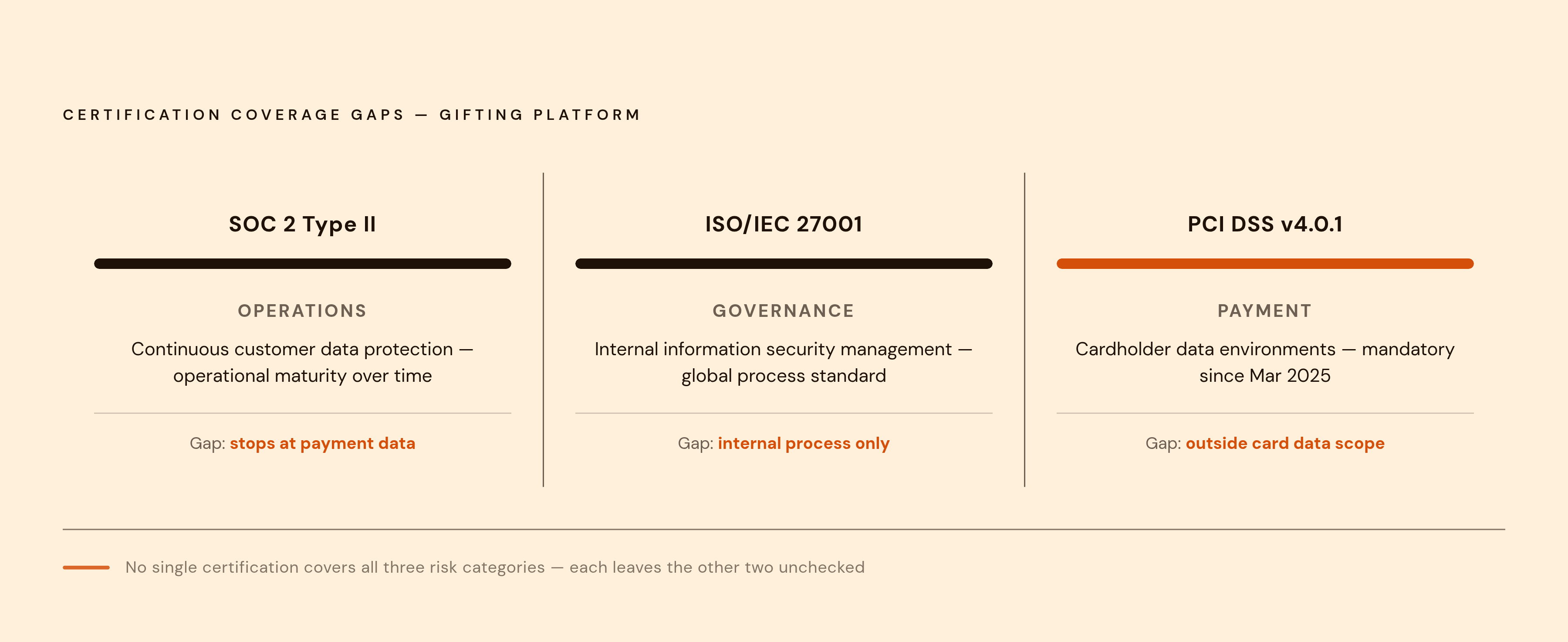
Three certifications show up again and again in enterprise vendor reviews, and each covers a different slice of risk. Confuse them, and you'll walk away satisfied with a report that answers the wrong question. That confusion is the single most expensive mistake in this whole process, because it lets a vendor look covered when they're covered for something else entirely.
SOC 2 Type II validates how a vendor protects customer data continuously over time. That's the whole point of the distinction from SOC 2 Type I, which only confirms controls existed on one specific date. Type II requires an auditor to confirm those controls operated effectively across a sustained window of time. Most enterprise security teams will only accept Type II as real evidence of operational maturity. So if a vendor offers Type I as a substitute, take that as the answer: they built the scaffolding but haven't proven it holds weight.
ISO/IEC 27001 is a different animal. It validates a vendor's internal information security management system and shows up almost by default in regulated industries like finance, healthcare, and telecom. Buyers sometimes treat ISO 27001 and SOC 2 as interchangeable, and they aren't: ISO 27001 covers internal process and gets recognized globally, while SOC 2 covers how customer data specifically gets protected and dominates among U.S.-based SaaS vendors. A platform serving international enterprise accounts should carry both. Checking for just one isn't enough if you're buying for a global program.
Then there's PCI DSS, which governs cardholder data environments. Any platform processing, storing, or transmitting payment information falls under its scope. As of December 31, 2024, PCI DSS v4.0.1 is the only active version, and as of March 2025, it's fully mandatory. The new requirements are worth knowing by name: multi-factor authentication for anyone accessing the cardholder data environment, not just admins, phishing resistance, web-skimming prevention, and explicit obligations around supply-chain security. Ask a vendor which version they're assessed against. Hesitation is usually the answer.
No single certification covers everything here. A platform certified for one of these three can carry real gaps in the other two, and the buyer who stops at "they're SOC 2 certified" hasn't actually checked anything. If I'm sitting across the table from a vendor, this is the exact spot where I push back hardest, because it's also the spot where most reviews quietly end.
The privacy regulation layer that certifications alone do not cover
Certifications tell you a vendor has controls. Whether the vendor complies with the specific privacy laws governing your recipients is a separate question, and it's the one most buyers skip entirely.
GDPR applies to any platform processing personal data of EU recipients, regardless of where the sending company sits. The penalty structure isn't subtle: up to €20 million or 4% of global annual turnover, whichever is higher. A mid-sized gifting program touching EU recipients can create legal exposure that dwarfs the cost of the gifts themselves.
The U.S. landscape moved fast too. Eight state privacy laws took effect in 2025 alone, nearly doubling the enforceable count from just two years before. By early 2026, comprehensive consumer privacy laws are active or taking effect in at least 20 states, including California, Virginia, Colorado, Connecticut, Texas, Oregon, and Montana. California's CCPA/CPRA deserves a specific callout: PCI DSS compliance puts a company in a better position to meet CCPA obligations, but it doesn't satisfy them on its own. Those are two separate boxes. Treating one as covering the other is the mistake I see most often, because the two frameworks sound like they overlap more than they actually do.
Here's where it gets interesting. SOC 2 has a Privacy trust service criterion, and vendors vary in whether they include it in scope. If a platform processes EU or California personal data, that criterion needs to be in scope, because it's what gets audited: privacy notices, consent mechanisms, data subject rights like access and deletion, vendor agreements addressing privacy, retention and disposal practices. A SOC 2 Type II report that leaves Privacy out is incomplete for any gifting program with international or California reach, even if every other criterion checks out clean. I'd treat that omission as disqualifying, full stop, not as a minor gap to note and move past.
So the sharper question goes beyond "are you SOC 2 certified?" to which trust service criteria are in scope. That answer tells you whether privacy got built in from the start or bolted on after the fact, and those are two very different vendors wearing the same badge.
Why third-party and supply-chain risk deserves its own line on the checklist
A gifting platform is almost never a single vendor. It's a chain: payment subprocessors, logistics providers, warehousing and fulfillment partners, third-party integrations stacked on top of each other. The platform's own certification only covers its own front door, and that's the gap most reviews never check.
PCI DSS v4.0 makes this explicit. Companies now have to ensure, and actively monitor, that partners and service providers comply with the updated standard, and the obligation flows downstream to everyone the platform works with. Verizon research has found that fewer than half of businesses maintain full PCI compliance year over year, which means a platform's own compliance status tells you nothing about whether its vendors are keeping pace.
So what do you actually ask? Does the platform maintain a published subprocessor list, and are those subprocessors bound by data processing agreements that mirror the platform's own commitments? How does the platform monitor subprocessor compliance on an ongoing basis, not just when the relationship starts? When a subprocessor fails a review, does the platform have a documented process, or does it just hope for the best?
For platforms shipping to 100 or more countries, common at the enterprise tier, the subprocessor footprint gets large fast. I'd argue the logistics layer accounts for at least half of any real compliance review, and it's the half most teams skip, not because it's low-risk, but because it's tedious. The financial stakes back this up: PCI DSS violation penalties start at $100,000 and can climb past $500,000, with per-card penalties stacking on top. A subprocessor breach flows back to the platform, and from the platform, it flows back to you.
The structured checklist: what to verify before signing a gifting platform contract
Break this into five categories and work through them in order, before any contract gets signed.
Core certifications. Confirm the SOC 2 report is Type II, not Type I, and ask for the most recent report date; certifications need annual renewal to stay meaningful. Confirm ISO/IEC 27001 if you operate in finance, healthcare, or telecom, or if your own procurement policy requires it. Confirm PCI DSS v4.0.1 compliance, mandatory since March 2025, and check that MFA coverage extends past administrators into the full cardholder data environment.
Privacy and data law coverage. Get a GDPR data processing agreement covering data subject rights, consent, and retention if you have any EU or UK recipients. Get CCPA/CPRA documentation if you have California senders or recipients. Ask directly whether the platform's privacy program accounts for the 20-plus state laws now on the books, and confirm the SOC 2 Privacy trust service criterion is explicitly in scope, not assumed.
Technical controls. Ask for the actual encryption standard used in transit and at rest, not a yes-or-no answer, and confirm multi-factor authentication covers all access to sensitive environments, per PCI DSS v4.0. Check that role-based access controls scope user permissions and that those scopes are auditable, and ask what gets logged, how long logs are kept, and who can see them.
Data governance. Get the disclosed retention and disposal policy: what's kept, for how long, how it's destroyed. Confirm, in writing, that the platform doesn't sell or share recipient data with advertisers or data brokers, and get the subprocessor list. Make sure it's current, not a stale document from onboarding two years ago.
Incident preparedness. Ask for evidence that an incident response plan exists and has actually been tested, not just drafted. Confirm breach notification timelines meet GDPR's requirements and whatever U.S. state laws apply to your recipients, and ask for a named point of contact for security inquiries. A platform that can't name one is telling you something.
If a platform can't produce disclosed PCI DSS compliance status, stated data retention periods, and clear terms on third-party data sharing, that's the floor. Below that, walk away.
How to read a vendor's security documentation without a legal team in the room
Most vendors will hand you a security trust page or an FAQ first. Treat that as a starting point, useful only once it links to an actual report rather than a paragraph of reassurance.
Ask for the full SOC 2 Type II report, not a summary letter. If the report is more than 12 months old, ask for the bridge letter, which confirms controls kept operating in the gap, and check the ISO 27001 certificate's scope statement carefully; a certificate that excludes the business unit actually running the gifting platform tells you nothing useful. For PCI DSS, ask for the Attestation of Compliance, since there's a real difference between a third-party-verified Report on Compliance and a Self-Assessment Questionnaire the vendor completes themselves. It matters which one you're looking at.
Watch for specific red flags. "We're working toward SOC 2 certification" carries a different weight than "we have SOC 2 certification," no matter how it's phrased in a sales deck, and a Type I report offered when you asked for Type II deserves a direct follow-up: why isn't Type II available? Vague or evasive answers about subprocessors usually mean the vendor hasn't actually mapped its own data flows, and that should worry you more than a clear "no" would. No named security contact, no DPA template on request: privacy compliance there is likely aspirational rather than operational.
On a vendor security call, three questions do most of the work. When was the last penetration test, and can they share findings and remediation steps? What's the breach notification timeline, and which regulatory frameworks govern it? How specifically, not generally, do they monitor subprocessors' ongoing compliance? Enterprise buyers in regulated industries should route whatever SOC 2 report they get to their own internal security team, because what a platform covers may not map cleanly onto what your organization requires. That gap is worth finding before signing, not after.
Security as a signal of platform maturity, not just a procurement hurdle
Here's the part worth sitting with: a platform that has sustained SOC 2 Type II, PCI DSS v4.0.1, and active GDPR and CCPA compliance has already built the operational infrastructure those certifications demand. Audit logs, scoped access controls, documented processes: that's the same infrastructure that makes gifting reliable at enterprise scale. Treating it as procurement paperwork misses what it's actually telling you.
CRM integration is table stakes now. Salesforce, HubSpot, Marketo, Outreach, Salesloft: enterprise gifting programs run through these pipelines as a matter of course, and those pipelines are exactly what security certifications exist to govern. A platform without them is asking for deep access to your CRM without having shown it can protect what it touches once it's in there. That's a trade most buyers shouldn't take, no matter how good the integration demo looks. If a vendor leads the pitch with integration depth and buries the security documentation two links deep on their site, read that as a sequencing problem, not an oversight; it tells you what they think matters, and it isn't the part that protects your data.
The payoff for getting this right is real. Personalized gifts drive an 89% higher ROI compared to generic ones, per 2024 research from Giftpack and Gifting 101, but personalization at that level runs on CRM data. A platform has to earn the right to that access through demonstrated security practice, not a sales pitch about integration depth.
Global reach only raises the stakes further. A platform shipping to 100-plus countries touches data privacy regimes across dozens of jurisdictions at once, and certification depth tends to track with the compliance infrastructure a vendor actually needs to operate there without creating legal exposure for the sender.
Use the checklist as a shortlist filter, not a last-minute formality tacked onto the end of a sales cycle. A platform that keeps its security documentation current, specific, and easy to find is showing you the same operational transparency you should expect from its actual gifting execution. A platform that can't answer these questions clearly will create that same friction later, in fulfillment, in reporting, in every integration that comes after the contract's signed. The documentation is a preview of how the whole platform runs, and it rarely lies about that.