Automated Gift Sending Workflows
Build workflows around specific triggers, deep CRM integration, and measurable outcomes.

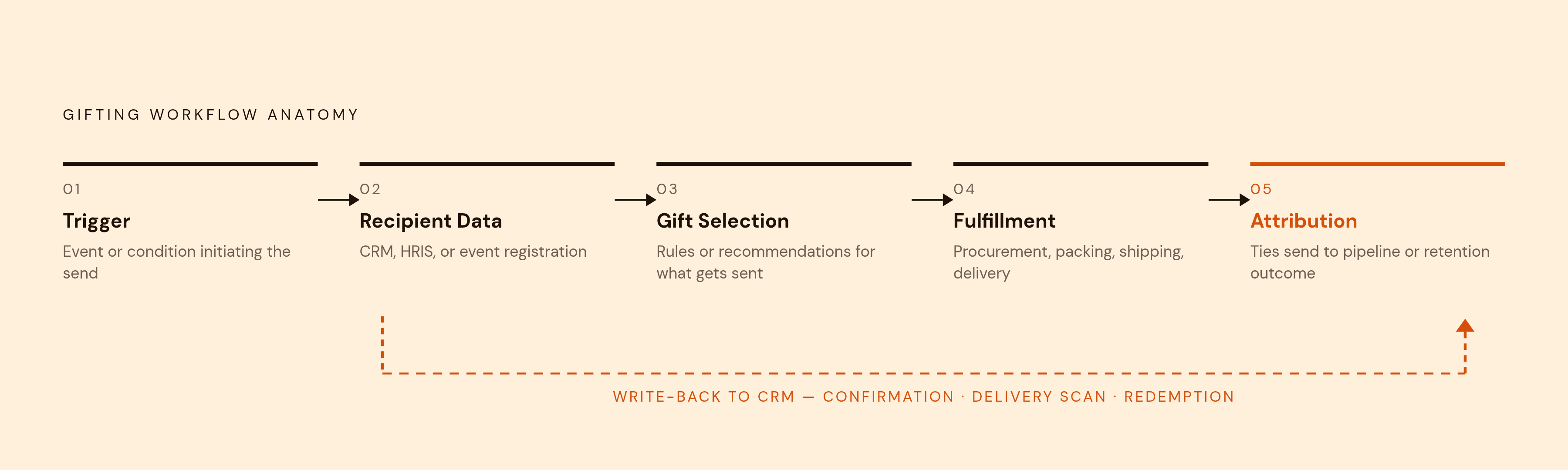
Strip away the platform names and the pitch decks, and every functional gifting workflow has the same core components. A trigger: the event or condition that initiates the send. A recipient data source, typically a CRM record, an HRIS entry, or an event registration, that supplies contact information and context. Gift selection logic, meaning the rules or recommendations that determine what gets sent. Fulfillment execution, covering procurement, packing, shipping, and delivery confirmation. And an attribution layer that ties the send back to a pipeline or retention outcome.
These components connect in sequence. The trigger pulls from the recipient data source. Selection logic runs against that data. An integrated platform executes fulfillment. Every status event, the send confirmation, the delivery scan, the recipient redemption, writes back to the CRM.
What varies across organizations is which use cases those components serve. A post-demo gift meant to accelerate a deal has a different trigger, a different selection model, and a different outcome metric than an employee work anniversary send or a pre-event mailer designed to drive attendance. The infrastructure is shared; the logic is specific to each case.
Getting this architecture right before building anything isn't pedantic. It's the difference between a workflow you can troubleshoot and a black box you can only observe. But what if you skip this step entirely? You'll end up with something that runs but can't be explained, audited, or improved.
Choosing the Triggers That Connect Gifting to Buying Behavior
Trigger selection is where most programs make their first significant error, and the error is almost always the same one: choosing something too vague to be actionable. That raises an important question: what makes a trigger specific enough to be worth building around?
There are a few broad categories worth knowing. Stage-based triggers fire when a deal moves to a new CRM stage, "Proposal Sent" queuing a dimensional mailer to arrive 48 hours before the follow-up call. Behavior-based triggers respond to what a prospect actually does: booking a demo, attending a webinar, visiting a pricing page twice in a single week. Time-based triggers are calendar-anchored, covering contract anniversaries, renewal windows, and tenure milestones. Inactivity triggers operate as pattern interrupts, physical mail queued after a defined number of days without a digital response. Intent data triggers use third-party signals to surface prospects actively researching your category.
Timing precision matters as much as category selection. When physical mail arrives two to three days before a rep's follow-up call, outbound connect rates improve. That window isn't arbitrary; it's the point where the package is fresh enough to prompt a conversation but not so recent that it hasn't been processed. If your fulfillment SLA is five days and your trigger fires the same day as the scheduled call, the gift arrives to a meeting that's already over.
The more seductive error is over-indexing on early, vague signals. Not every page view warrants a send. Not every webinar registration is a buying signal. Each trigger should be tied, before you build anything, to a single measurable outcome it's designed to move: a meeting booked, a renewal signed, an NPS response submitted. If you can't name that outcome specifically, the trigger isn't ready.
One structural point that gets overlooked: trigger logic should live in your CRM or marketing automation platform, not in the gifting platform. That's what makes the sequence auditable and repeatable when someone inherits the workflow a year from now.
Integrating a Gifting Workflow with CRM and Marketing Automation
Integration is not a feature to evaluate after the workflow is designed. It's a prerequisite for the workflow being worth designing at all.
A gifting platform that doesn't write back to your CRM produces sends that are invisible to your revenue team's reporting. You're spending real money on a motion that doesn't exist in the data stack. Leadership can't fund what they can't see, and sales managers can't replicate what they can't track.
A properly integrated workflow looks like this in practice: the CRM record supplies recipient name, address or triggers an address-confirmation flow if that field is empty, deal stage, and any personalization fields you've configured. The gifting platform receives a trigger event via native integration or webhook. Send status, delivery confirmation, and recipient redemption events write back to the contact or opportunity record. The sales rep gets a notification when the gift is delivered, which becomes a natural prompt for a follow-up call, and that call happens with the specific context that the prospect just received something physical from your team.
Integration depth determines measurement quality. Platforms that push sends outbound but don't return delivery and engagement data leave the attribution problem entirely unsolved. You know the workflow fired; you have no idea what happened next.
Incomplete or outdated CRM address fields are one of the most common reasons workflows stall in practice, and it's worth calling out directly. An address-confirmation step, automated through a branded landing page or a brief email prompt, should be built into the sequence rather than treated as a manual task someone handles when they notice the problem. In my experience, teams consistently underestimate how much bad address data they're sitting on until the first workflow fires and a quarter of the sends bounce back.
Gift Selection Logic: Rules-Based, AI-Assisted, and Recipient-Choice Models
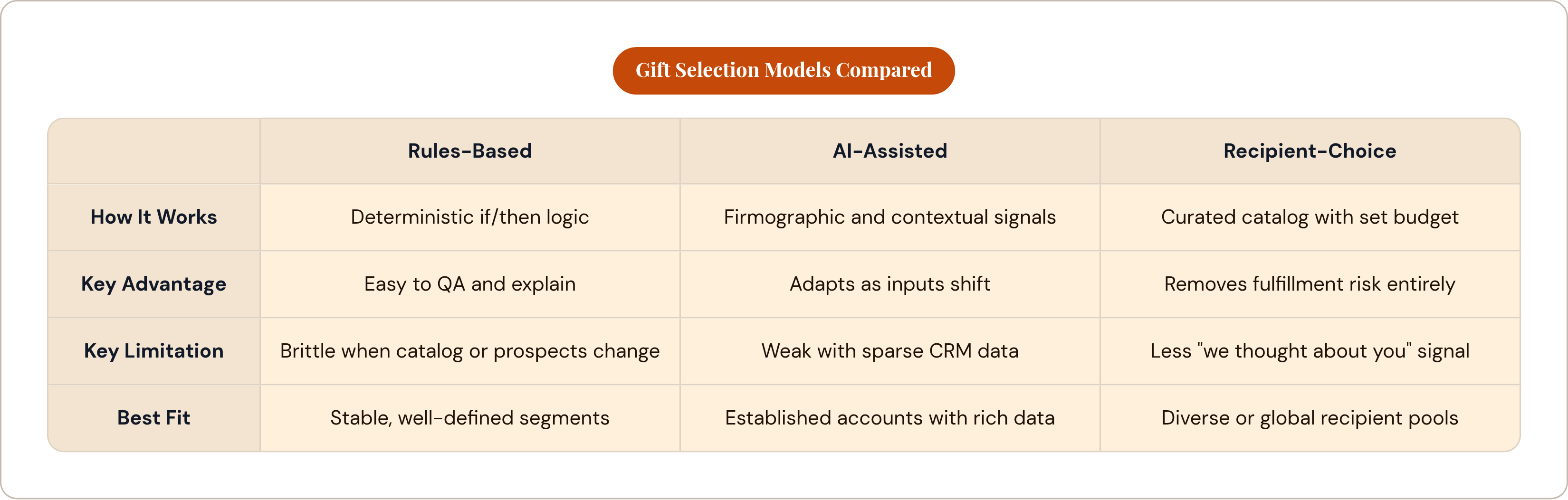
Once the workflow fires, something has to decide what gets sent. Three approaches exist, each with a different tradeoff profile, and none of them is obviously correct for every situation. It is also worth considering how your prospect mix and catalog depth should shape which model you choose before you default to whichever one your platform makes easiest.
Rules-based selection is deterministic: if deal size exceeds a threshold and vertical matches a category, send a specific item. It's easy to QA and easy to explain to stakeholders. It's also brittle. When the catalog changes or your prospect base diversifies, the rules need manual updates, and they rarely get them on schedule.
AI-assisted recommendation models factor in firmographic data, cultural context, past interactions, seasonal signals, and catalog constraints to surface relevant options. The advantage is reduced curation overhead and adaptability as inputs shift. The limitation is data dependency: these models perform better for established accounts than for cold prospects with sparse CRM records. A model that doesn't have much to work with will make recommendations that reflect that sparsity, and you'll end up with generic selections anyway, just generated by an algorithm instead of a spreadsheet.
Recipient-choice models, often delivered as a gifting link with a curated catalog and a defined budget, let the recipient select their own item. This removes fulfillment risk from the sender entirely and resolves the personalization problem by outsourcing the selection decision. The tradeoff is signal: there's less of a "we thought specifically about you" quality to it, though a thoughtfully curated catalog at the right budget conveys genuine care in its own right.
The research finding that 89% of companies report higher ROI on personalized gifts compared to generic ones gets cited often, but the implication usually gets glossed over. Defaulting to a single SKU for everyone because it's operationally convenient actively undermines the program's effectiveness. The investment in selection logic isn't a differentiator; it's table stakes.
Funnel stage should also influence gift type. Early on, a lower-cost brand-forward item creates awareness without overcommitting. Mid-funnel, something tied to a prospect's known business challenge signals that your team did real homework. Post-close, a higher-value onboarding kit or premium experience cements the relationship at the exact moment when churn risk is often highest.
Global programs add real complexity. Cultural appropriateness, import restrictions, and local product availability require either localized catalog curation or AI systems sophisticated enough to factor in recipient geography. Sending a food item to a region where it's restricted, or a gift that carries an unintended cultural connotation, undermines the entire program regardless of how cleanly the trigger fired.
Fulfillment as a Workflow Variable, Not a Logistics Afterthought
This is where the gap between a gifting platform demo and a production gifting program becomes most visible.
Fulfillment is not a vendor selection decision you make once and revisit at contract renewal. It's an active variable in workflow design, because delivery timing, packaging quality, and tracking visibility all determine whether the gift lands at the moment it was designed to support. A workflow that ignores carrier lead time fires the send at the wrong moment by default. This is a workflow design failure, not a logistics failure, and the distinction matters because the fix belongs in the trigger configuration, not the vendor contract.
A competent sending platform should abstract away from your team the procurement, warehousing, kitting, branded packaging, carrier routing, and real-time tracking. It should also provide a resolution path for failed deliveries and undeliverable addresses. That last item is consistently underrated. Automated workflows need a defined handling process for packages that are refused or returned, because those events happen at scale, and without a resolution path, they become manual exceptions that slow down everything downstream.
The 2 to 3 day pre-call arrival window only holds if you know your fulfillment SLA and have built transit time into your trigger configuration. Worth mapping out before the first send goes out, not after you realize the first batch of packages arrived to meetings that had already happened.
For global programs, shipping to international destinations involves customs documentation, regionally restricted item categories, and last-mile carrier variability that compounds with every new market. A platform that handles this well abstracts the complexity from the sender. One that doesn't forces your team to manage customs paperwork alongside their actual jobs.
The unboxing experience carries signal. Branded packaging, a handwritten note option, thoughtful presentation: these are the physical equivalent of an email subject line. If the package looks like it came from a fulfillment warehouse rather than from your company, the personalization signal is already diluted before the recipient sees what's inside. And if your packaging is inconsistent across markets, you've created a two-tier experience that recipients notice even if they never quite articulate why.
Building Attribution Into the Workflow From the Start
Most gifting programs spend first and ask questions later, if they ask them at all. They have a budget line and a general sense that the sends are appreciated. But how does that approach hold up when finance asks for the ROI analysis? It doesn't. That's not a measurement framework.
Attribution architecture should be instrumented before the first send goes out, not retrofitted after someone in finance asks for the ROI analysis.
Every send should be logged as a timestamped activity on the relevant CRM opportunity or contact record. Delivery confirmation and recipient redemption events should be captured as discrete data points, not just confirmation emails that live in someone's inbox. Unique landing page URLs or claim links tied to each campaign segment allow digital follow-through to be attributed back to the send. And each workflow needs a defined primary outcome metric before it launches: meetings booked, opportunities created, renewal rate, expansion ARR, eNPS. One metric per workflow, measured consistently, not all of them simultaneously.
Lift testing is the cleanest attribution method available for gifting programs. Send to a test group, hold back a matched control group, compare conversion rates on the target metric. This isolates the gifting variable from the ambient noise of other concurrent marketing activity, which in B2B contexts is substantial.
The PatientPop case study, documented in Sendoso's published results, illustrates what attribution enables at scale: an automated direct marketing campaign generating seven-figure pipeline monthly and 292% year-over-year ROI. Numbers like that are only legible because the sends were connected to tracked pipeline outcomes. Without the attribution infrastructure, those sends are indistinguishable from the ones that generated nothing.
Measure at the campaign level first: did this specific trigger-gift sequence move the needle on its target metric? Roll up to program-level ROI only after you understand which individual workflows are performing. Averaging across dissimilar workflows obscures the signal that would tell you which ones to double down on.
Where Automated Workflows Underperform and How to Correct Them
The failure modes in gifting workflows cluster into a recognizable pattern. Each one looks like a platform problem from the outside. Almost none of them are.
Wrong trigger timing produces gifts that arrive after the moment they were designed to support. The fix is building fulfillment lead time into the trigger configuration, not renegotiating the carrier SLA.
Generic gift selection means the automation fires correctly but the gift has no relevance to the recipient. The workflow works; the premise doesn't. The fix is investing in selection logic or shifting to a recipient-choice model, not tuning the trigger.
Missing CRM write-back means sends fire and leave no data trail. The program is invisible to leadership and cannot be optimized because there's nothing to optimize against. Requiring bidirectional integration as a launch prerequisite, not a future enhancement, is the only real answer.
Over-triggering turns a differentiating touchpoint into noise. If the same recipient receives three sends in six weeks, the signal value of each diminishes. Suppression logic and send-frequency rules need to be configured explicitly; most platforms don't enforce them by default.
Budget without a primary metric is perhaps the most common and least visible failure mode. Gifting spend grows, the team feels productive, and no one can say what outcome the program is accountable to. The answer is the specific objective set before the workflow is built, which connects directly back to trigger selection.
The underlying pattern across all of these failure modes is the same: teams treat the gifting platform as the solution when the real work is in workflow design, CRM data quality, and outcome definition. One might argue that a better platform would compensate for weak targeting discipline — but automation without that targeting discipline doesn't replicate results; it executes the wrong motion faster and at greater cost. If the goal was to make gifting feel personal at scale, running a poorly targeted workflow at high volume achieves the opposite.
Scaling a Gifting Workflow From a Single Sequence to a Full-Funnel Program
The instinct to build the full program first is understandable and consistently counterproductive. Start with one workflow. Pick the trigger with the clearest outcome connection, instrument it fully, run it for a quarter. The post-demo send tied to meeting-to-opportunity conversion rate is a common starting point because the logic is tight and the measurement window is short enough to generate real signal before anyone asks you to justify the budget.
Once that first workflow proves its metric, the expansion path has a structural advantage: the CRM integration and attribution infrastructure are already built. Each new workflow reuses what exists. The marginal cost of adding a second use case, a customer success renewal sequence or an HR new-hire onboarding kit, is primarily the trigger logic and gift selection work, not the infrastructure.
A mature full-funnel program has a distinct workflow for each stage, each with its own trigger and its own outcome metric, sharing infrastructure but operating independently enough that a failure in one doesn't contaminate the others.
Cross-functional alignment becomes a genuine structural question at this scale. Marketing typically owns top-of-funnel and event sequences. Sales owns pipeline sequences. Customer success owns retention and expansion sends. HR owns employee milestones. A shared sending platform with role-based access makes this feasible without fragmenting the data, which is the compounding advantage of building on a single infrastructure from the start.
Over time, each workflow's CRM data improves trigger precision for future campaigns. You learn which sends actually moved the metric and which ones were well-intentioned noise. That accumulation of evidence is what separates programs that survive budget scrutiny from programs that get cut: the ones that survive have documented outcomes, and the ones that get cut have a vague feeling that people liked the swag.