Corporate Gifting Platform Onboarding and Rollout
Set up the right governance and integrations before your first gift ships.

Before a gifting platform can deliver on its promise, it has to survive its own implementation. That sounds obvious. It isn't. The graveyard of stalled gifting programs is filled with companies that signed contracts, got through the technical setup, and then watched the platform sit mostly idle because nobody had resolved the foundational questions before configuration began. The $839.6 billion global corporate gifting market recorded in 2024, projected to climb to $919.9 billion in 2025, tells you this has become a normalized enterprise motion. Normalized means your buyers are already receiving gifts from your competitors. It means execution quality is now the differentiator, not access to a catalog. And it means a stalled rollout carries a real cost: license fees accruing on an underused platform, coordinator time absorbed by manual workarounds, and deal moments passing because the system wasn't ready when the signal appeared.
What follows isn't a checklist. It's a connected sequence where each decision enables the next. Miss one, and the steps downstream get harder.
Defining what success looks like before a single gift ships
The most expensive onboarding mistake isn't a bad integration or a weak catalog. It's configuring the platform before anyone has aligned on what the program is actually supposed to accomplish. This happens more often than it should, because the people closest to the technical setup, the admin, the marketing ops specialist, are not always the people who own the business outcome. And so the platform gets built around assumptions that haven't been tested against stakeholder expectations.
Revenue teams typically need to define success across several use cases simultaneously: sales prospecting, pipeline acceleration, customer retention, event follow-up, employee recognition. Each has different metrics. Each has a different owner. Running them together without separating the objectives is how programs become impossible to evaluate.
The questions to answer before anyone touches the platform configuration are operational, not philosophical. Who owns this program, is it marketing, sales ops, RevOps, HR, or some combination? Which motion does gifting serve first? What does "working" actually look like at 30, 60, and 90 days, measured in response rate, meetings booked, deal velocity, or retention rate? What is the send budget per use case per quarter, and who has authority to approve both catalog items and spend limits?
Consider the competitive context: more than 68% of mid-to-large enterprises worldwide were offering corporate gifts at least once per year in 2024. Your prospects are not ungifted. They're already receiving things in the mail from other vendors. Differentiation, at this stage, requires intentionality, not just the ability to ship something.
The output of this phase should be a one-page program charter. Use case priorities. Success metrics. Team ownership. Budget guardrails. It doesn't need to be a formal document. It needs to be a shared artifact that becomes the north star for every subsequent configuration decision, so that when the catalog question comes up, or the integration question, or the spend limit question, the answer isn't a new debate. It's a reference back to what was already decided.
Assembling the internal team that will actually run the program
Three distinct roles must be identified before configuration begins, and they are rarely the same person. The platform administrator manages integrations, user permissions, spend controls, and the catalog; this person typically lives in marketing ops or RevOps. The program owner sets strategy, approves use cases, and monitors performance; this is usually a marketing or sales leader. The day-to-day senders, the reps, CSMs, or HR partners who will actually initiate sends, are a third group entirely, and their workflow constraints need to be understood before enablement is designed, not after.
Beyond those three roles, cross-functional alignment at launch requires involvement from sales, marketing, HR for employee-facing use cases, legal for gifting policy and compliance, and finance for budget codes and purchase order processes. Skipping legal early is a recurring mistake. Anti-bribery policies, per-recipient gift value limits, and international sending rules around customs, import duties, and prohibited items by country need to be resolved before the catalog is built, not after a rep tries to send a bottle of scotch to a regulated-industry prospect in a country that prohibits it.
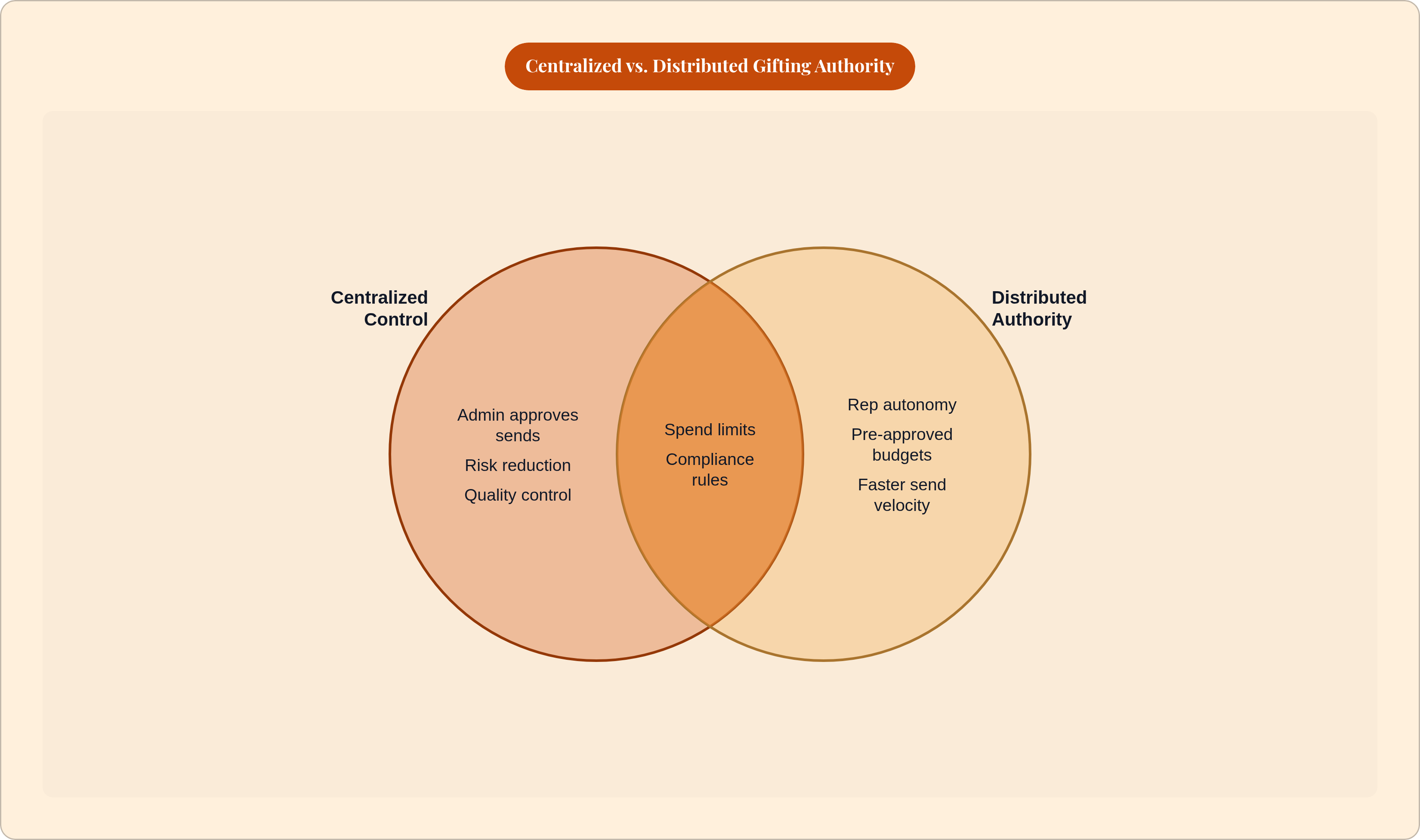
The budget governance decision deserves particular attention because it shapes platform configuration significantly. Is spending authority centralized, meaning an admin approves each send, or distributed, meaning reps have pre-approved budgets and can send autonomously? Neither is inherently better. Centralized authority reduces risk and ensures quality control; distributed authority increases send velocity and reduces friction for the senders who need to act quickly on deal signals. The right answer depends on how much trust the organization has in its sender population and how sensitive the compliance environment is.
A Forrester Total Economic Impact study found that manual gifting processes consumed the equivalent of two full work-weeks of three marketing coordinators' time per campaign. That figure makes the case for formalizing platform ownership without needing further argument. Ad hoc coordination isn't just inefficient; it's an invisible tax that most teams don't measure until someone runs the numbers.
Connecting the platform to the CRM and marketing stack before the first send
The integration sequence matters in a specific order: CRM first, then marketing automation, then intent data and other signal sources. Each layer adds triggering capability and attribution depth. Getting this out of sequence, connecting intent data before the CRM is logging sends as activities, means you'll have signals firing without anywhere clean to capture the outcome.
CRM integration is the foundation. It enables logging every send as an activity on the contact and opportunity record, triggering sends from deal stage changes or inactivity thresholds, pulling contact data to inform gift selection and personalization, and closing the attribution loop by comparing gifted versus non-gifted deal velocity and win rates using actual pipeline data. Without that, a gifting program runs on intuition. With it, it runs on evidence, which is the only way to defend the budget at the end of a quarter.
Adobe Marketo Engage research has found that when data isn't unified across systems, a meaningful portion of touchpoints go unattributed entirely. A gifting program that lives outside the CRM will almost certainly fall into that category, making ROI defense functionally impossible at budget review time. This isn't a hypothetical risk; it's the reason programs get cut after twelve months despite actually working.
Marketing automation integration connects sends to nurture sequences and account-level orchestration, allowing gifting to function as one coordinated step in a multi-touch sequence rather than a one-off gesture. Intent data integration elevates this further: when a target account crosses a buying-signal threshold, a physical gift can fire automatically. ZoomInfo's 2025 ABM Intelligence Study found that teams acting on intent spikes within 24 hours saw a 29% lift in opportunity creation, and automated gifting triggered by intent signals is one of the cleaner ways to operationalize that responsiveness without relying on rep awareness and timing.
For people teams, HRIS integration enables automated milestone sends, work anniversaries, new hire onboarding kits, promotion recognitions, without manual tracking, which is where milestone programs consistently break down over time.
Before going live, test the full trigger flow. Send a test gift through the CRM trigger, confirm the activity logs correctly on the contact record, confirm the recipient record updates, and confirm the spend is captured against the correct budget code. These are small checks that prevent large embarrassments.
Building the catalog — choosing what to offer, what to restrict, and what to feature first
The catalog is the gift experience from the recipient's perspective. Everything upstream, the integration, the trigger, the timing, can work perfectly and the program still fails if the gift itself is generic or low quality. Research has consistently found that companies report substantially higher ROI on personalized gifts compared to generic ones, with some analyses putting the gap at close to 90% of respondents reporting better returns from personalized sends. The catalog's job is to make personalization operationally achievable, not just theoretically desirable.
Catalog architecture during onboarding involves several layered decisions. Use-case tiering matters: prospecting gifts should have lower spend thresholds and broader appeal; deal-acceleration gifts should be higher spend and more personalized; VIP or executive gifts at the highest tier should be individually curated. Recipient-choice gifting, where the recipient picks from a pre-approved selection, reduces waste and increases satisfaction. Curated sends signal more intentionality and prior research. Neither is universally superior; the right choice depends on the relationship stage and the use case.
The question of branded merchandise versus third-party gifts versus experiential options also maps to relationship stage. Branded merchandise is appropriate for awareness and early relationship building; it starts to feel presumptuous at the executive level. Experiential gifts, a curated tasting, a skill-building experience, signal investment in the relationship itself rather than the brand. International catalog coverage requires its own verification: confirm which items can ship to the geographies your program will target, because some categories are customs-restricted or cost-prohibitive to ship internationally, and discovering this on a live send is a credibility problem.
Spend controls to configure into the catalog include per-send limits by role, per-recipient annual limits for compliance, and category restrictions. Alcohol is a standard example: it requires explicit opt-in by the recipient in many contexts and is outright prohibited in others. These aren't details to configure later.
Start narrower than feels comfortable. A focused catalog of high-quality, considered options will consistently outperform a sprawling one where reps default to the cheapest or most familiar item. Commit to reviewing catalog performance at 60 and 90 days, retiring items that rarely get chosen or generate low recipient response, and adding items based on rep feedback and recipient data. The catalog is a living artifact of what your audience actually values, not a static inventory.
Enabling the senders — what reps, CSMs, and HR partners need to actually use the platform
The most common reason gifting platforms underperform after launch isn't a technical failure. It's that the people expected to send were never shown when to send, what to say, or how to connect a send to the conversation they're already having. Training on platform mechanics alone doesn't close that gap. It teaches someone how to click; it doesn't teach them when clicking is the right move.
Enablement needs to cover three things. When to send: trigger moments mapped explicitly to the sales or customer journey, after a demo no-show, when a deal goes dark at stage three, 30 days before renewal, on a work anniversary. What to send: guidance on gift selection by persona, industry, or relationship stage, not "log in and browse." And what to say: message templates and framing language for the note accompanying the gift, because the message is often as important as the gift itself. A gift without a resonant, clear note is just a package.
Format matters for retention. Live training combined with a short recorded walkthrough and a one-page send playbook, covering when, what, and what to say, gives senders something to reference after the kickoff energy fades. And platform access should be embedded in existing workflows: if reps live in Salesforce, the gifting action should be surfaced there, not require a separate login or context switch.
SDR and AE enablement differs meaningfully from CSM or HR enablement. Sales-focused enablement should center on prospecting sends and pipeline-stall recovery, tied to specific deal signals. Customer success enablement should emphasize renewal signals, QBR follow-up, expansion plays, and loyalty moments. HR and people teams need enablement around milestone automation, onboarding kits, and recognition programs tied to HRIS data.
Set a 30-day adoption target: a specific number of sends per active user in the first month creates accountability and surfaces friction early. It's far better to discover that a rep doesn't know how to use the address confirmation tool in week two than in week eight.
Running the first campaign as a controlled learning experience
The first campaign should be scoped to succeed and to teach. That requires picking one use case, one audience segment, one clear trigger, and one measurable desired outcome. A sprawling multi-team launch as the inaugural campaign is a structural way to make learning impossible.
Good candidates include cold outreach re-engagement, targeting a segment of accounts that went dark after initial contact, using a gift as the pattern interrupt. Post-event follow-up with a defined attendee list and a clear next action, booking a demo or registering for a webinar, works well because the list is bounded and the timing is natural. Pipeline-stall recovery, targeting deals stuck at a specific stage beyond a defined number of days, is another strong first campaign because it maps directly to a measurable pipeline outcome.
Build in a holdout group from the beginning. Randomly assign a portion of the target list to receive no gift, keep all other outreach identical, and compare response rate, deal velocity, and win rate at the end of the campaign window. Without this, there is no clean way to isolate gifting's contribution from other variables in the motion. This is the step most teams skip because it feels like reducing the program's reach. In practice, it's what makes the ROI case defensible.
Metrics to track for the first campaign: delivery rate, response rate, pipeline influenced or sourced in dollar value, and deal velocity for gifted accounts compared to the holdout group. Document what broke. Address verification failures, catalog items that shipped slowly, message templates that felt tonally off. These become the first iteration list for the 30-day review, and having them documented rather than remembered is the difference between a systematic improvement process and a guessing game.
Reviewing the first 30–60 days and deciding what to scale
The 30-day review should answer four specific questions. Which sends drove measurable pipeline activity and which didn't? Where did senders get stuck or skip sending entirely? Which catalog items were selected most frequently and generated the strongest response? Did the platform integrations log data cleanly enough to answer the preceding questions?
Common findings at this stage each carry a specific diagnostic signal. Low send volume despite training usually means trigger moments weren't concrete enough, or the workflow wasn't embedded in the tools senders already use. High delivery rate but low response rate typically means the gift and message aren't landing with the right audience, or the call to action in the note is absent or unclear. Strong response rate with no CRM attribution means the integration is incomplete, pipeline impact is invisible to leadership, and the program is vulnerable at the next budget conversation regardless of how well it's actually performing.
The holdout group comparison is what converts send data into the pipeline language a CFO or VP of Sales will respond to. Gifted accounts advanced through pipeline at what rate compared to ungifted accounts? What was the win rate differential? How did average deal cycle length compare? These are the metrics that justify expanding the program, and building that comparison from the first campaign means the 60-day stakeholder review has evidence rather than anecdote.
Scale what worked. Add sender groups only after the first cohort's workflow is genuinely smooth. Expand catalog depth in categories that performed; trim what didn't move. The 60-day review is also the natural moment to begin international expansion planning: confirm which countries in the target account base require catalog or logistics adjustments, and what compliance or customs considerations apply before those sends go live.
Building the operating rhythm that turns a launch into a long-running program
A gifting program without an operating rhythm degrades. The catalog goes stale. Senders revert to ad hoc behavior. Attribution gaps accumulate. The program loses organizational credibility not because it stopped working, but because nobody maintained the infrastructure that made it legible.
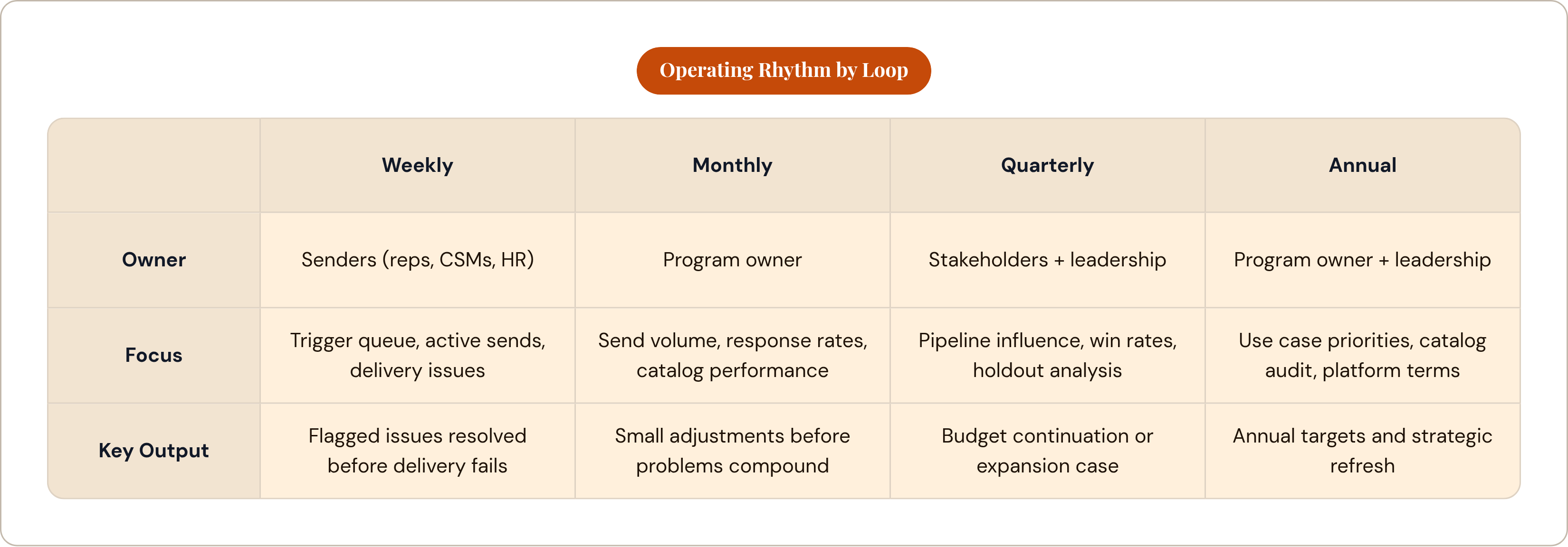
The operating rhythm runs on four recurring loops. A weekly loop for senders: reviewing the trigger queue, confirming sends in motion, and flagging any address or catalog issues before they become delivery failures. A monthly loop for the program owner: reviewing send volume by team, response rate by use case, and catalog performance, then making small adjustments before small problems compound. A quarterly loop for stakeholder review: presenting pipeline influence data, win rate comparisons, and the holdout analysis, then making the case for budget continuation or expansion with evidence drawn from actual CRM data. And an annual loop for strategic refresh: reconsidering use case priorities, auditing catalog depth and quality, renegotiating platform terms based on actual usage, and setting targets for the year ahead.
The practical difference between a program that runs for three years and one that gets cut after the first renewal cycle is almost never product quality. It's whether someone owns the rhythm. Ownership means someone's job it is to notice when send volume drops in a given team segment, to ask why, and to fix the enablement or workflow issue before the pattern becomes entrenched. That person doesn't have to be dedicated full-time; they need a defined cadence and the organizational authority to act on what they find.
The gifting platforms that generate sustained pipeline impact aren't running on better catalogs or more sophisticated triggers, though both matter. They're running on programs where the onboarding decisions were made sequentially, where the team was assembled before configuration began, where the integration was tested before the first live send, and where someone is still paying attention six months after the launch celebration. That's the program worth building.