Gifting Automation for Customer Success Teams
Automate relationship gifts at key customer moments without sacrificing personalization or intent.

"Automation" gets misused enough in CS circles that it's worth being precise about what it actually means here. Gifting automation is rules-based or AI-assisted logic that fires a physical send when a customer hits a defined milestone, behavior, or lifecycle stage. Not a blast campaign. Not a seasonal swag drop. The underlying logic is relational, not promotional, and most gifting programs that fail do so because someone conflated the two.
For any of this to work, a few things need to be in place. The system needs trigger data: contract close dates, health score thresholds, product activation events, renewal windows, support ticket closures. Most of that already lives in your CRM, your CS platform, your product analytics. It's just not wired to anything yet. Then you need send logic, the rules governing what goes to whom and when. That's where personalization lives, where the human intent behind a send gets preserved even as the logistics run themselves. And finally, a fulfillment layer handles procurement, packaging, shipping, and tracking. No CSM chasing down a home address and an expense approval on a Friday afternoon.
But what if automation actually made the sends feel more impersonal? That's the assumption most people bring to this conversation. What surprises them, once they actually see this running, is that it doesn't work that way. A customer who receives a well-timed, thoughtfully chosen gift doesn't experience the infrastructure behind it. They experience the gesture. That's the whole point.
What this is not: spray-and-pray swag, generic holiday boxes shipped to the install base, volume outreach dressed up as relationship investment. Those belong to a different category, and treating them as equivalent poisons the conversation before it gets anywhere useful.
How the customer lifecycle maps to natural gifting trigger points
Try thinking about the customer lifecycle as a gifting map. Every stage has a predictable set of relational moments where a physical touchpoint lands with disproportionate impact. Predictable means automatable. That's the premise.
At contract close, a welcome gift arriving before the customer has touched the product establishes the vendor's posture before any friction has occurred. Most software onboarding involves stumbling, waiting, confusion at some point. A vendor who has already signaled warmth before any of that starts is drawing from a fuller reserve of goodwill when the first hard conversation arrives.
In early adoption, sends tied to first meaningful product actions catch customers at peak enthusiasm. A customer who has just configured their first integration or run their first meaningful report is energized. That's when recognition lands hardest.
During ongoing engagement, the trigger map expands: customer anniversaries, usage milestones, role changes at the account, QBR prep sends. These are the months between formal touchpoints, chronically underserved in most CS programs, where relationships either deepen or quietly erode.
At renewal, a proactive send sixty to ninety days out signals that the relationship matters independently of the transaction. At expansion, recognizing the champion who drove a new seat or product addition rewards the person most likely to drive the next one.
The at-risk signal functions differently from all of these and warrants its own treatment.
None of this is arbitrary. These moments follow a pattern, and the CRM already knows most of them. The gap has long been connecting that data to an execution layer that doesn't depend on a CSM remembering.
Onboarding sends and why the first 90 days set the retention trajectory
CS practitioners are nearly obsessive about time-to-value in the first ninety days, and for good reason. Whether the customer gets to a meaningful outcome quickly or stumbles through implementation is one of the stronger predictors of whether they're still a customer two years out.
A welcome gift at contract close, before the customer has touched the product, reframes the relationship before friction has a chance to define it. That goodwill isn't abstract. When the first rough implementation call happens, and it usually does, the customer is already holding a different baseline impression of the vendor.
The milestone send is the more operationally interesting moment. When a customer completes their first significant product action, acknowledgment actually means something then. Not a generic congratulations. A message that references their specific use case, their team's goal, what this milestone actually represents for them. The gift is a vessel for that acknowledgment; the message is what makes it land.
What you send matters more than most people budget for. Gifts priced above a modest threshold achieve notably higher acceptance rates, and electronics tend to top the category rankings. Those figures reflect something intuitive: quality signals consideration. A forgettable low-cost item communicates the opposite of what you're trying to communicate, at precisely the moment when first impressions are still forming.
The systemic argument for automating this phase is direct. Without automation, the welcome send happens for accounts whose CSM had bandwidth that week. With it, every customer gets the same signal regardless of who's carrying that book of business. The relationship trajectory gets set consistently, not selectively based on calendar availability.
It is also worth considering what silence communicates. A silent onboarding establishes a transactional relationship from day one. If that framing never gets corrected, expanding or retaining the account later becomes harder work than it ever needed to be.
Keeping relationships alive between formal touchpoints
Most churn doesn't announce itself. It accumulates quietly, through months of missed connection and silence. A customer who stops feeling the relationship doesn't typically call to say so. They just become easier to poach.
The gap problem in CS is structural. CSMs engage customers formally at QBRs, check-ins, and renewal time. The months between are the underserved territory, and that's where the relationship either deepens or slowly erodes.
The trigger map for this phase is broader than onboarding. A customer anniversary recognizes loyalty without any commercial agenda attached. A usage milestone, the customer crossing a threshold signaling materially deeper adoption, is a natural moment for recognition. A promotion or role change at the account, surfaced through CRM enrichment or a LinkedIn signal, is an invitation to acknowledge a stakeholder who is gaining influence over the next renewal decision. A QBR prep send arriving a week before the quarterly review sets a relational tone before the business conversation begins.
Renewal and expansion decisions involve multiple stakeholders, and a relationship that exists only with the primary contact is fragile by design. Automation makes it feasible to maintain presence across several people at an account simultaneously, not just the one on the standing call.
The tone for sends in this phase should be appreciative and deliberately stripped of promotional subtext. The moment a customer senses that a relationship gesture is actually a sales motion in disguise, the gesture is done. The goal is maintenance, not pressure.
Using health score data and at-risk signals to trigger intervention sends
CS platforms generate health scores that flag accounts showing disengagement, declining usage, or support friction. Most teams respond with email sequences, outreach tasks, or escalation calls, all appropriate. But a health score drop is also a relationship signal, and the right response to a relationship signal is a human gesture.
The trigger logic is specific: when an account drops below a defined health threshold, a personalized gift and a handwritten-style note from the CSM queue automatically. The send should feel like a spontaneous check-in, not a retention alarm. It should not reference health scores, engagement metrics, or the fact that a system flagged anything. It should feel like someone noticed.
That authenticity places real demands on gift selection. A generic or poorly matched gift at a fragile relationship moment does more harm than no gift at all. The recipient who receives something irrelevant experiences it as evidence that no one actually knows them. AI-assisted gift recommendation helps close that gap, surfacing options based on inferred preferences and redemption behavior across large datasets, which improves the probability that the send lands as intended rather than misfires at the worst possible moment.
The support escalation is a closely related use case. A customer who has just come through a difficult support experience is at a relationship low point. An automated send after ticket resolution, a simple acknowledgment of their patience, turns that moment into a repair opportunity. It doesn't erase the friction, but it signals that someone noticed.
Research from 2024 cited by Forbes indicates that companies using AI to analyze customer sentiment can reduce churn meaningfully. The gifting send is one execution layer of that insight: the system identifies that a relationship is at risk, and it dispatches a human gesture accordingly. The intervention is systematic; the experience is personal.
Building the renewal and expansion gifting motion
Pre-renewal gifting is not a last-minute gesture. By the time a renewal is sixty to ninety days out, the customer is already forming their opinion about whether to continue. A send that arrives in that window communicates that the vendor's investment in the relationship exists independently of the commercial outcome. That posture, counterintuitively, tends to make renewal more likely.
The trigger lives in the CRM. Contract end date minus sixty to ninety days is a calculation, not a judgment call. No manual initiation required once the rule is set.
Champion recognition in expansion moments deserves separate attention. When a customer adds seats, a new product module, or expands to a new team, someone inside that organization advocated for it. That person deserves to feel acknowledged, not only because it's the right thing to do, but because they are the most likely driver of the next expansion. A closed-won expansion opportunity in the CRM can fire sends to both the economic buyer and the champion, with messages calibrated to their respective roles and stakes.
The buying committee point applies here as well. Expansion decisions rarely involve a single person, and a gifting motion that touches only the primary contact misses the full relationship network shaping future decisions.
One way to frame this for internal budget conversations: gifting at the renewal and expansion stage is an investment in the advocates who drive net revenue retention upward. The measurement infrastructure covered in the next section is what makes that case with actual numbers behind it.
What makes a gifting send actually land with a customer
Automation handles timing and logistics. What it can't resolve on its own is whether the send actually lands, whether it produces a genuine moment of recognition or gets quietly set aside. That comes down to what you send and what you say.
Gift relevance is the primary variable. A gift that feels relevant signals that someone knows something about the recipient as a person, not just as an account. The inverse is equally true: a generic gift, regardless of how well-timed, signals that no one considered the individual. And here's the part that trips people up — the timing being right can actually make a poorly chosen gift land worse, not better, because it reveals that the system fired but no one thought it through.
The personalization signals available in a CS context are genuinely rich. Role and seniority matter; a VP of Engineering and a Customer Marketing Manager have different preferences and different contexts. Past engagement history, if captured in the CRM, tells you what resonated before. Interests noted during onboarding or in account notes are direct signals. Industry context matters too.
AI gift recommendation is improving at synthesizing these signals at scale, surfacing options based on inferred preferences and redemption behavior across large datasets, which helps close the gap between what a CSM intuitively knows about a customer and what a system can operationalize across an entire book of business.
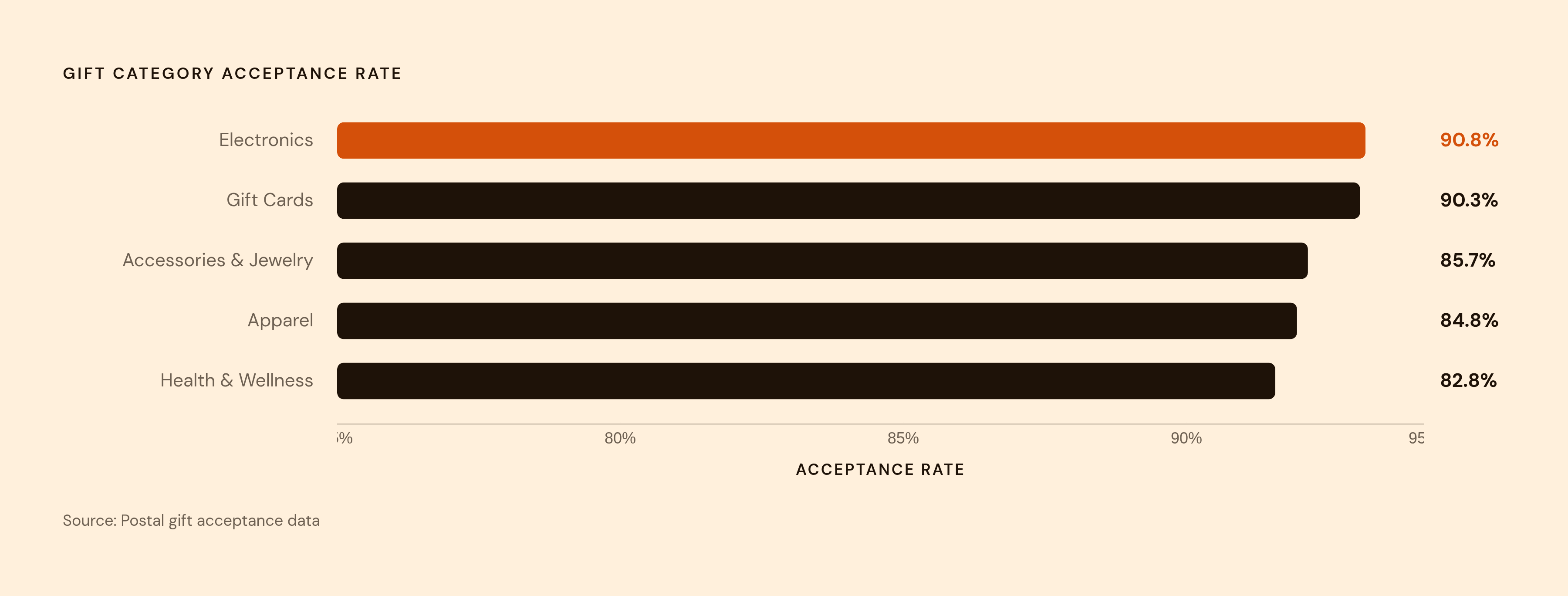
Category data from Postal is instructive here. Electronics achieve a 90.8% acceptance rate; gift cards come in at 90.3%; accessories and jewelry at 85.7%; apparel at 84.8%; health and wellness at 82.8%. Why exactly does category choice matter this much? Because category is a proxy for consideration. A high-acceptance-category gift chosen for a relevant reason is a materially different proposition from a default swag item.
The message deserves as much attention as the gift itself. A specific note referencing the recipient's actual situation, goal, or recent milestone outperforms a generic template by a wide margin. Often it's the message the recipient remembers, not the gift. One premium, considered send does more for a relationship than four forgettable ones scattered across a quarter.
Connecting gifting sends to CRM data and measuring what moves
Gifting automation becomes a revenue discipline, rather than a relationship nicety, when sends are logged in the CRM and tied to outcomes. Without that data infrastructure, gifting is an offline activity. You can't attribute it, you can't optimize it, and you can't defend the budget for it when pressure arrives.
There are three areas worth tracking: retention influenced, meaning renewals where a gifting touchpoint appeared in the account timeline in the prior ninety days; expansion influenced, meaning upsell or cross-sell deals where gifting was part of the engagement sequence; and engagement recovered, meaning accounts flagged at-risk that returned to healthy status after an intervention send. These connect gifting activity directly to the outcomes CS is already accountable for.
Platform integration is the prerequisite. The gifting platform needs to write send events back to Salesforce or HubSpot, and to the CS platform, whether that's Gainsight or something comparable, so that CSMs see a complete relationship timeline in one place. If a gift was sent two weeks before a renewal conversation, that event should be visible in the account record, not siloed in a separate system.
Research cited by Postalytics from SG360° in 2025 found that sixty-four percent of marketers who reported direct mail didn't deliver their best conversion rate weren't tracking its conversion contribution at all. That raises an important question: how many CS gifting programs are underperforming on paper simply because no one instrumented the sends? The measurement failure precedes the attribution failure. CS gifting programs that don't instrument sends will appear to underperform relative to programs that do, regardless of actual impact.
The cohort comparison is straightforward: compare renewal rates, NPS movement, or expansion rates for accounts that received lifecycle gifting against those that didn't, controlling for other variables. Over time, that comparison builds the case for program investment.
Gift acceptance rate, tracked by segment, trigger type, and category, is the leading indicator. Low acceptance in a particular trigger or category tells you something is off before it shows up in lagging retention metrics, which gives you a feedback loop for continuous refinement rather than a program that launches and then calcifies.
What a phased implementation looks like for a CS team starting from scratch
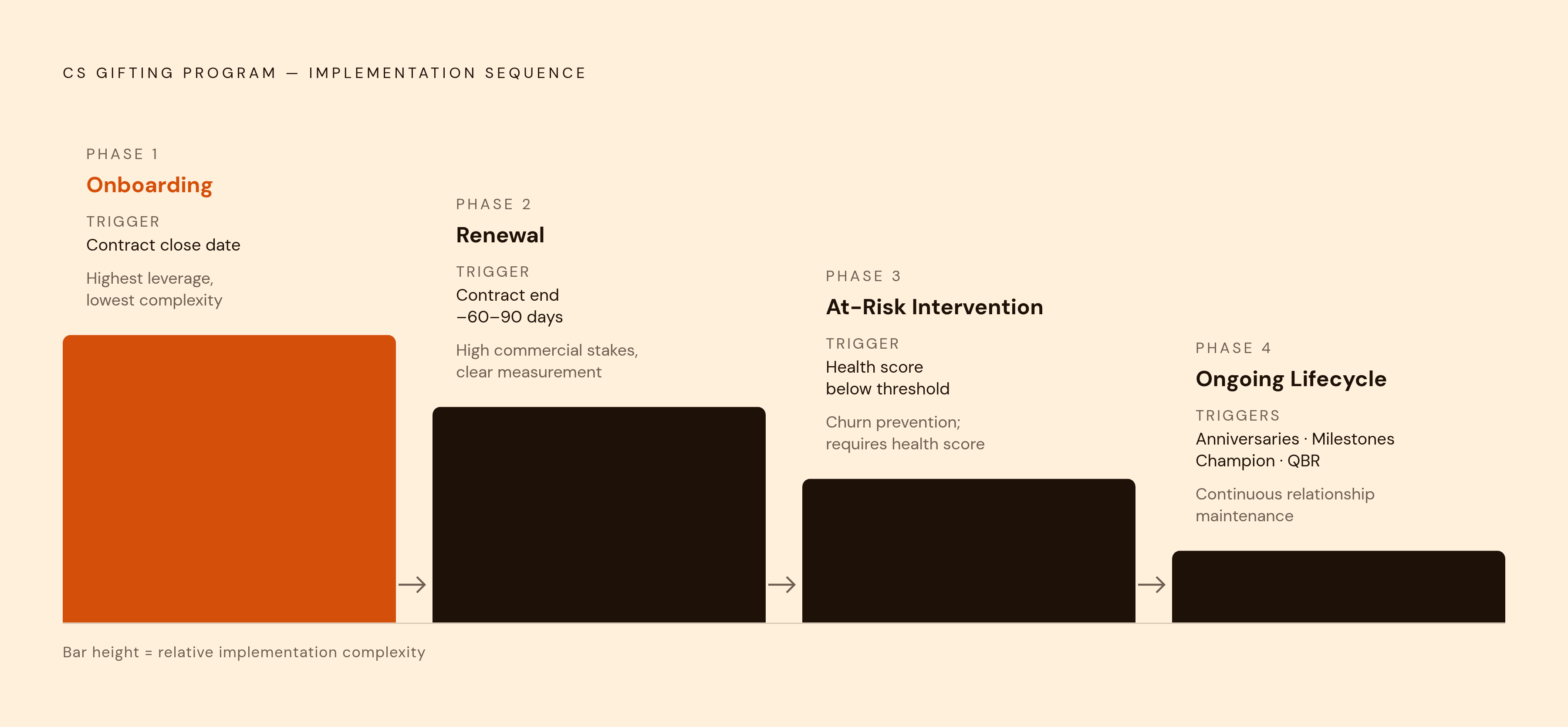
The full lifecycle gifting motion doesn't need to be built all at once. Trying to stand up every trigger simultaneously is a reliable way to create an initiative that stalls before it ships.
Start with onboarding. It has the highest leverage, the lowest complexity, and the clearest trigger. Contract close date is already in the CRM. The send logic is simple. The outcome is measurable. Get this running first, get clean data from it, and then expand.
Renewal is the natural second phase. The commercial stakes are high, the trigger is already in your data, and a defined measurement methodology gives you a second proof point relatively quickly.
At-risk intervention is third. It requires health score integration, which adds technical complexity, but it delivers the most direct signal on churn prevention. By this point you should have enough data from the earlier phases to justify the additional investment with something more than intuition.
The full ongoing lifecycle motion, anniversaries, usage milestones, champion recognition, QBR prep sends, adds relational depth once the foundational triggers are running and producing results.
A few operational prerequisites apply before any phase launches. CRM fields need to be clean: contract dates, renewal dates, health scores, all populated and accurate. Address confirmation should be handled by the gifting platform, not by CSMs chasing down shipping details. The gift catalog should be pre-approved and compliance-vetted for relevant industries and geographies, particularly in sectors with strict gifting policies. And send events should be configured to write back to the CRM from day one, so attribution data accumulates from the first send rather than requiring retroactive reconstruction.
The goal isn't a gifting program that runs without CSMs. It's a gifting program that handles the moments that don't require human judgment, so CSMs are present for the ones that do: the complex escalation, the strategic review, the expansion conversation where reading the room actually matters.