Corporate Gifting Platform Comparison
Consolidation reshapes the gifting platform landscape—know which tools actually drive ROI.

If you've spent any real time inside a B2B marketing or sales team, you know the gifting conversation almost always starts in the wrong place. Someone pulls up a listicle comparing Sendoso, Alyce, and Postal. They screenshot the pricing tables. They forward it to the team. And at least two of those three companies no longer exist as independent products.
That's the first thing worth getting straight before anything else.
What most comparison content still treats as three separate competitors is now, legally and operationally, one entity: Alyce was acquired in February 2024, and Postal.io was acquired in April 2025. Teams doing research today using articles written before mid-2024 are not just working with outdated information; they are evaluating a market structure that no longer exists. That's an important distinction.
The broader market context helps explain why this category is consolidating so aggressively. The corporate gifting industry overall was valued at $886.56 billion in 2025, per The Business Research Company. But that number is almost entirely gift spend, physical goods, food, and experience purchases. The software platform segment that B2B buyers are actually shopping sits at $34.2 billion in 2025, per Dataintelo, projected to grow to $74.8 billion by 2034. The gap between those two figures tells you something useful: most of the "market" is what goes inside the box, not what powers the send. That shapes how buyers should think about total cost of ownership, and it shapes how platforms compete.
What follows is an evaluation of the five platforms worth considering in 2026 against the criteria that actually determine whether a gifting program generates revenue. Not a feature checklist. A decision framework.
The four criteria that separate gifting platforms from gifting vendors
Most buyers default to comparing catalogs and pricing tiers. That's understandable. It's what the platforms put in front of you. But the decisions that actually determine ROI are upstream of catalog depth.
Four criteria consistently separate high-performing gifting programs from underperforming ones.
First: fulfillment infrastructure. Does the platform own its logistics, or broker it? Ownership determines reliability, speed, and accountability when a gift goes missing or arrives wrong.
Second: CRM and marketing stack integration. Can every send be tied to a pipeline record, or does gifting data live in a silo disconnected from everything else? Integration depth is what determines whether the program survives a budget review.
Third: personalization capability. Is personalization a UI feature, meaning the sender picks from a menu, or is it an AI-driven engine that learns from recipient signals? The difference shows up in response rates at scale, not at low volume where any thoughtful send performs reasonably well.
Fourth: global reach and redemption economics. Can the platform deliver in the countries where your accounts actually are? And perhaps more importantly, who pays for gifts that go unclaimed?
A fifth consideration cuts across all four: pricing model transparency. Platform fees, gift charging timing (charged at send versus charged at redemption), and hidden fulfillment costs can change the effective cost of a campaign by fifteen to thirty percent. That's not a rounding error on a high-volume program.
The weight each criterion carries shifts depending on the use case. An enterprise ABM program running hundreds of sends per month into a mix of domestic and international accounts cares intensely about fulfillment infrastructure and redemption economics. A small field marketing team running a single conference gifting motion probably cares most about ease of use and CRM writeback. The framework holds regardless; the priorities shift.
Fulfillment infrastructure: what "global reach" actually means in practice
Every platform in this category claims global reach. That claim requires translation.
The marketing version is "ships to X countries." The operational version is whether the platform warehouses inventory locally in key regions or routes everything through a single origin country with international shipping. Those are fundamentally different product realities, and they produce fundamentally different recipient experiences.
Local warehousing versus cross-border shipping matters for three concrete reasons. Delivery speed and reliability, especially for time-sensitive sends tied to events or deal stage triggers. Customs and duties, because cross-border sends to the EU, UK, or APAC can incur unexpected costs and delays that arrive, sometimes visibly, with the package. And undeliverables: the USPS Office of Inspector General found that 4.3% of all mail volume is undeliverable-as-addressed, costing the mailing industry roughly $20 billion annually. Platforms without robust address verification bake that waste into every campaign.
One platform in this category operates owned fulfillment infrastructure in the US, UK, EU (out of Dublin), and Australia. That means localized warehousing, local procurement, and in-house packing and shipping across its major markets. When something goes wrong, there's a clear accountability chain.
Reachdesk operates warehouses across five regions and claims local fulfillment access in more than 180 countries. The coverage is genuinely broad, and the regional infrastructure is a meaningful differentiator for EMEA-heavy GTM teams.
Goody takes a structurally different approach to the undeliverable problem: recipients enter their own shipping addresses at acceptance, rather than requiring senders to have that data in advance. This solves a real operational headache for remote-first or privacy-sensitive lists. The tradeoff is that it transfers timing control from the sender to the recipient, which matters when sends are tied to a specific moment in the sales cycle.
Postal's long-term infrastructure roadmap is genuinely uncertain post-acquisition. Teams with multi-region needs should ask pointed questions about product continuity before committing budget.
The two questions worth asking in any evaluation: Does the platform own the warehouse the gift ships from, or is it coordinating with a third-party fulfillment broker? And what happens operationally when a gift is undeliverable?
CRM integration depth and why gifting data in a silo kills ROI
Here's a scenario I've watched play out more times than I can count. A marketing team runs a gifting campaign that performs well by their internal metrics. Open rates are up. A few reps report positive conversations. Budget review comes around, and finance asks for influenced pipeline numbers. The team opens their gifting platform dashboard, exports a CSV, tries to match send records to Salesforce opportunities by hand, and presents something that looks approximately right. Finance is not impressed. The program gets cut.
The challenge isn't finding a gifting tool. It's integrating gifting data with the rest of the stack so attribution isn't a manual reconstruction exercise after the fact.
Genuine CRM integration looks like this: a two-way sync that writes send events, redemption data, and engagement signals back to the opportunity or contact record in real time, and that can trigger sends based on deal stage changes or CRM activity. The rep can see in Salesforce that a contact accepted a gift on Tuesday. Marketing can see that three accounts in the gifting campaign moved to next-stage within thirty days.
A "Salesforce integration" checkbox, by contrast, often means a one-way push of contact data from Salesforce into the gifting platform. Nothing comes back. Attribution requires manual work. Reporting stops at delivery confirmation.
Sendoso has more than ninety native integrations across Salesforce, HubSpot, Outreach, Salesloft, Marketo, Gong, Calendly, and a range of others. Its AI agent, called Oso, surfaces campaign performance, team spend, and engagement rates inside the platform without requiring exports or dashboard switching.
Reachdesk runs a two-way Salesforce sync with closed-won ROI reporting at the contact, opportunity, and campaign level. Its integration breadth is narrower, around nineteen native connectors, but the depth on the revenue-attribution side is strong. For a team whose primary integration need is Salesforce and whose primary reporting question is "did this program influence closed-won revenue," Reachdesk's approach is well-designed for that specific question.
The metrics that justify gifting program spend to a finance leader go beyond cost-per-box. Engagement uplift, meaning the percentage of recipients who interact with a follow-up after receiving a gift, matters. Pipeline influenced, meaning deals in motion that moved faster or further than comparable non-gifted accounts, matters more. Retention delta, the difference in retention rate between gifted and non-gifted accounts in customer programs, is often the most compelling number for leaders thinking about net revenue retention.
Teams running gifting inside a mature Salesforce or HubSpot instance should pressure-test, in the evaluation call, exactly which objects the integration writes to and whether attribution is automated or requires manual reconciliation.
How personalization capability at scale actually works — and where it breaks down
Personalization is the variable most correlated with response rates in the gifting context. Per Reachdesk's State of Corporate Gifting and Swag 2025 report, which analyzed 1.5 million gift sends, gifted email campaigns achieve 85% open rates and 56% conversion rates, compared to 39% and 3% respectively for standard outreach. Those numbers are striking.
The operative question is whether they hold when a team is running hundreds of sends per month, not dozens.
At low volume, sender-driven personalization works reasonably well. A rep who knows a prospect listens to a particular podcast, runs marathons, or just closed a Series B can pick a gift that lands. That judgment scales to perhaps twenty or thirty thoughtful sends per month per sender before it breaks down. Beyond that, personalization degrades into a default catalog browse, and the gift that arrives feels generic because it is.
AI-driven personalization operates differently. The platform analyzes recipient signals, job title, company size, industry, CRM activity, call transcripts, inferred interests, and past redemption behavior from similar profiles, and recommends gifts most likely to resonate. The quality of that recommendation is only as good as the data the platform can access.
One platform's SmartSuite, launched in September 2025, is the most comprehensive implementation of this model currently available. SmartSend generates AI gift recommendations drawing on Gong call signals, recipient interest profiles inherited from the Alyce acquisition, and CRM activity. SmartMessage generates personalized note copy. SmartDelivery automates address verification and, in its first ten thousand sends, exceeded 85% accuracy on high-confidence addresses. Two additional modules are forthcoming: SmartSignal, which uses real-time intent data to trigger sends at buying moments, and SmartCampaign, which allows a user to define a goal and audience while the platform builds the campaign structure, message, and gift strategy.
Reachdesk offers AI-powered gift recommendations as a platform feature. The approach is signal-based, but it doesn't draw on the same proprietary interest-profile dataset inherited through the Alyce acquisition. That's a structural data advantage worth noting, not because Reachdesk's recommendations are poor, but because the depth of the underlying model differs.
Per the U.S. Chamber of Commerce, 47% of firms plan to integrate AI for personalized corporate gifting. AI-driven recommendation will shift from differentiator to table stakes within the planning horizon of most current buyers. Teams evaluating platforms today should ask not just whether AI personalization exists, but what data sources power it and whether those sources can connect to the team's existing tools.
Global reach and redemption economics: the hidden cost variable most teams miss
Two fundamentally different charging models exist in this market, and most buyers don't discover which one they're on until they're already mid-campaign.
Charge-on-send: gift cost, shipping, and handling are charged the moment the send is initiated, regardless of whether the recipient ever accepts.
Pay-on-redemption: charges only trigger when the recipient actually accepts the gift. Reachdesk operates on this model, and per its own data, the approach can reduce waste by fifteen to thirty percent on high-volume campaigns.
The practical implication is direct. If a team is sending at scale to a cold or semi-warm list, every unaccepted gift under a charge-on-send model is a sunk cost. The platform's address verification quality and gift recommendation accuracy directly affect how much money disappears without generating any pipeline signal. Under a pay-on-redemption model, unaccepted gifts don't hit the budget. Redemption rate becomes a quality signal rather than a cost driver.
On global reach: both of the leading enterprise platforms cite delivery in more than 180 countries. The differentiating variable is local warehousing, already covered in the fulfillment section, and whether localized gift catalogs exist in key markets or senders are limited to US-origin products shipped internationally. Snappy supports gifting in 176 countries. Goody reaches more than 140 countries using recipient self-reported addresses.
Platforms without regional warehousing in EMEA or APAC may technically deliver globally. But the recipient experience, including customs delays, visible duties charges, and longer lead times, often doesn't match the domestic standard. That gap matters when the gift is supposed to be creating goodwill.
On pricing structure: enterprise platforms in this category operate on annual contracts with platform fees starting in the five-figure range, before any gift spend. Goody and some lighter-weight tools offer no platform fee entry points, which makes them accessible for smaller teams or programs still proving their value internally. Thnks operates entirely in the digital space, sending coffee, meals, and experiences via email or text with no physical logistics at all. It's a different product category, but relevant for teams whose use case is speed and zero logistics complexity over physical impact.
The question to ask in every evaluation: what is the total cost of a send that goes unredeemed, including gift cost, shipping, handling, and any fulfillment fees?
How the five leading platforms map to specific use cases
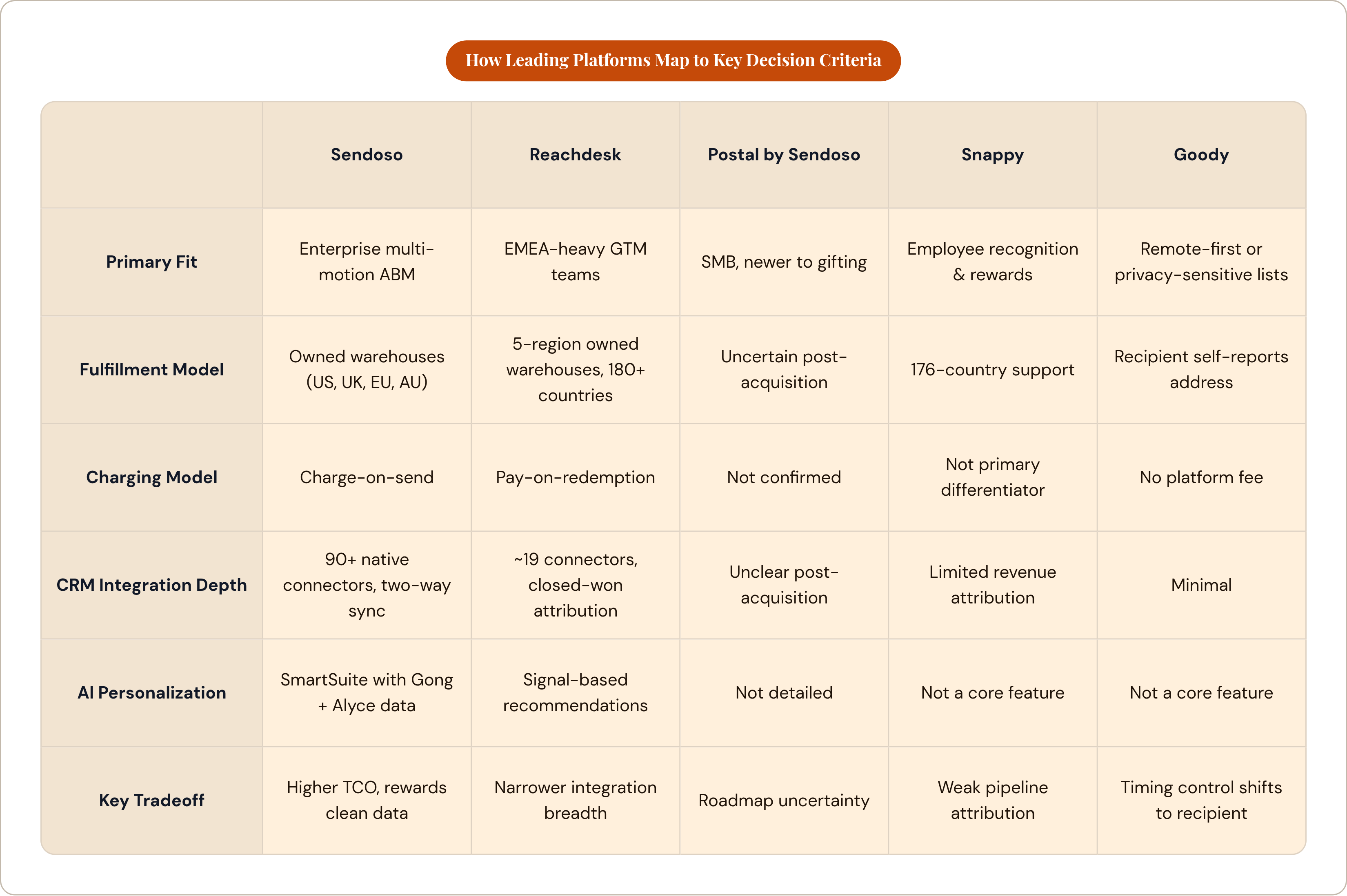
No single platform dominates on all four criteria. The right choice depends on the primary use case and the existing stack.
Sendoso is the strongest fit for enterprise or growth-stage B2B teams running gifting across multiple motions simultaneously: ABM, field events, direct mail, employee recognition, customer marketing. The platform's breadth of integrations (more than ninety connectors), its product surface (eGifts, physical goods, swag, direct mail, event kits), and its AI capability via SmartSuite make it the most comprehensive option in the market. The tradeoff is real: charge-on-send economics and five-figure annual platform fees mean total cost of ownership is higher for teams with low redemption rates or poor recipient address quality. Sendoso rewards teams that have their data in order.
Reachdesk is the strongest fit for enterprise GTM teams with significant EMEA or multi-region presence who prioritize TCO transparency and need closed-won attribution reporting that holds up in a finance review. Pay-on-redemption economics and two-way Salesforce sync with opportunity-level ROI reporting are its core strengths. The narrower integration breadth, around nineteen native connectors, and smaller product surface compared to the broader enterprise options are the tradeoffs to evaluate.
Postal by Sendoso is positioned for small-to-mid-sized businesses newer to gifting who need a simpler, more accessible starting point. The critical caveat is that it was acquired in April 2025 and its long-term product roadmap is currently uncertain. Evaluate it with that in mind, and ask direct questions about where the product is heading before committing.
Snappy is the natural fit for employee recognition, rewards, and customer appreciation programs where recipient choice and a consumer-grade experience carry more weight than CRM attribution depth. Its 176-country support is broad. It is less suited to complex sales pipeline motions where attribution back to revenue is the primary accountability metric.
&Open serves a distinct positioning: brands where the quality and curation of the gift is itself the message. Luxury, high-touch client gifting, programs where the unboxing experience needs to communicate something specific about the sender's brand. It's not an ABM tool; it's a relationship investment vehicle.
For teams with lighter needs or specific constraints: Goody solves the address problem cleanly for remote-first or privacy-sensitive recipient lists, with no platform fee. Thnks handles situations where the use case is speed, digital delivery, and zero logistics friction, not physical impact.
What a confident gifting platform evaluation actually looks like in practice
Most gifting platform evaluations are shaped by whoever schedules the demo first. A rep books thirty minutes, walks through the catalog, shows the Salesforce logo in the integrations slide, and the buying team walks away with a positive impression of something they haven't actually tested. That's how teams end up on platforms that look right and perform poorly.
A confident evaluation works backward from the use case. Before talking to any vendor, the buying team should be able to answer four questions clearly.
What is the primary motion this platform needs to support? ABM, field events, employee recognition, customer gifting, or some combination? The answer should determine which criteria get the most weight in evaluation.
What does the existing tech stack look like, and what does integration actually need to do? Not "does it connect to Salesforce" but "which Salesforce objects need to receive data, and does attribution need to be automated or is manual reconciliation acceptable?"
What is the realistic send volume, and what mix of domestic versus international recipients does the program involve? Volume and geography together determine whether fulfillment infrastructure and redemption economics are material considerations or secondary ones.
What does success look like in the first ninety days, and who internally will be accountable for proving it? The answer shapes what reporting capabilities actually matter versus what looks good in a dashboard screenshot.
Armed with those answers, the evaluation becomes a structured pressure test rather than a feature showcase. Ask each vendor to walk through what happens when a gift is undeliverable. Ask to see, specifically, what gets written to a Salesforce opportunity record when a recipient accepts a gift. Ask what the total cost is of a send that goes unredeemed, line by line. Ask who owns the relationship when something goes wrong with a cross-border shipment.
The platforms that answer those questions specifically and without hedging are the ones worth shortlisting. The ones that redirect to the catalog are showing you something important about the post-sale experience.
The corporate gifting platform market in 2026 is smaller, more consolidated, and more capable than it was three years ago. The consolidation means fewer vendors to evaluate but also more concentrated risk if a buyer chooses based on a platform's pre-acquisition identity rather than its current product reality. The capability increase, particularly in AI-driven personalization and CRM integration depth, means the ceiling for what a well-run program can produce has risen considerably.
The ceiling only matters, though, if the platform is chosen for the right reasons. And those reasons start with the four criteria above, not the catalog.