Address Verification Tools for Global Gift Fulfillment
Bad addresses kill international gifting programs before the box ever ships.

Corporate gifting has a math problem hiding behind a nice story. The gift lands, the relationship warms up, the deal closes: that's the pitch. None of that happens if the box never gets there, and a surprising share of the time, it doesn't. This piece is about the specific, fixable reason gifting programs stall out once they cross a state line or a border: bad address data. And the more this industry grows, the more that single point of failure matters, since more packages moving through more postal systems means more chances for one wrong digit to kill a moment that took months to set up.
What failed deliveries actually cost a gifting program
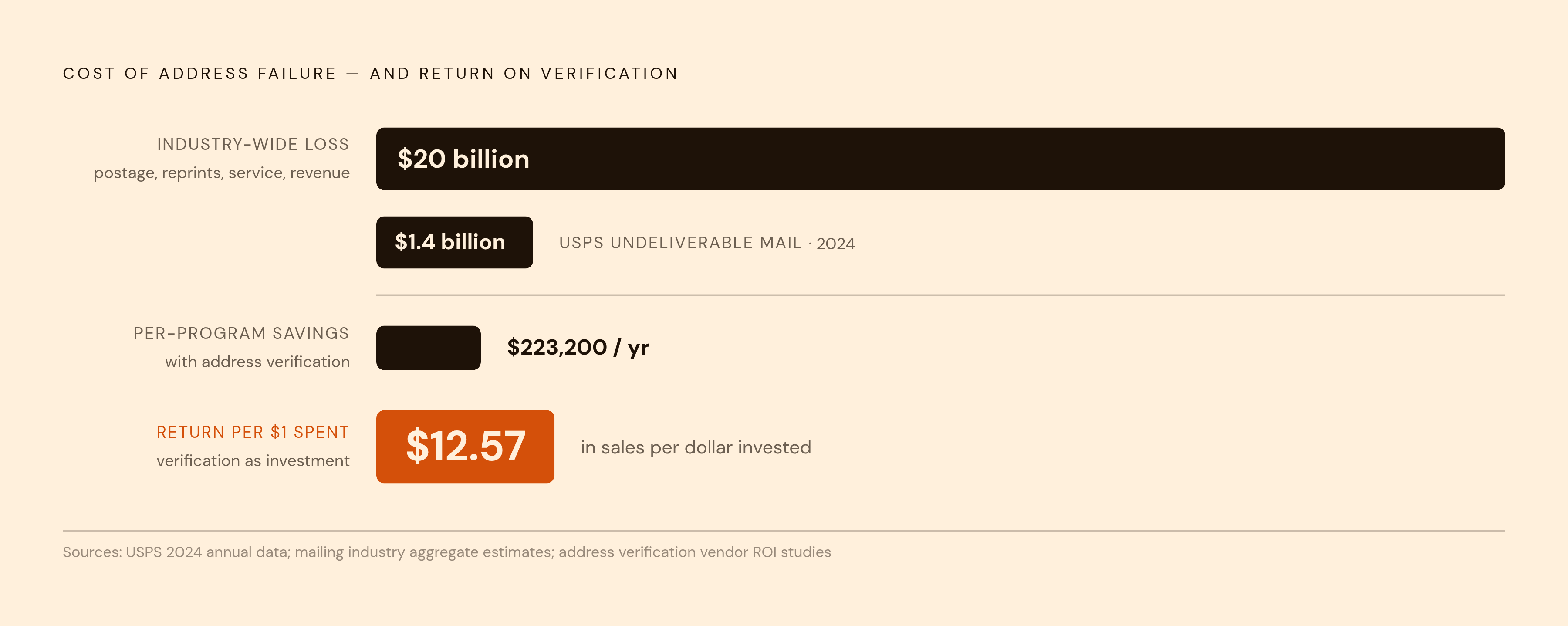
Start with the scale of the problem industry-wide. USPS spent $1.4 billion in 2024 just handling mail it couldn't deliver, according to GrayHair Software. Widen the lens to postage, reprints, customer service calls, and lost revenue, and the number for the broader mailing industry tops $20 billion.
Now shrink it to the size that matters to a gifting manager: one shipment. GrayHair's 2024 data shows 3.38% of First-Class Mail came back undeliverable. Shippo's failure tracking for the same year found 30% of failed shipments came down to one boring, preventable cause: an incomplete address, usually a missing apartment or street number. Someone hit submit on a form without a unit number, and that single gap accounted for nearly a third of all failures.
Gifting carries its own version of this. DataLadder found that 41% of deliveries built on bad data get delayed, and 39% fail outright. A delayed gift is the annoying kind, arriving sloppy and late. A failed one is the dangerous kind, because it stays silent. The onboarding kit that never arrives is a missed signal at the exact moment a company was trying to say something important to a new client or a new hire.
Here's the part most programs get backwards: they track delivery rate as the key metric, when the number that actually matters is revenue. BirdsEye Post found businesses running address verification save as much as $223,200 a year and see $12.57 in sales for every dollar spent on direct mail. Delivery rate tells you whether the box arrived. It doesn't tell you what the failure just cost you.
Why international gifting makes address errors harder to catch and costlier to fix
Domestic mistakes are bad enough. International ones are a different animal, and the timing couldn't be worse: growth is happening exactly where address formats get complicated. Cognitive Market Research puts North America at 39.05% of the global corporate gifting market in 2025, but Asia-Pacific is growing faster than anywhere else, with China, Japan, and India each carrying real, rising weight.
So what happens when a program built for U.S. mailing addresses tries to send into that region? Every country runs its own postal logic: field order, transliteration rules, postal code structure, district hierarchy. None of it holds still from one country to the next.
Here's where it breaks in practice, and it breaks the same handful of ways every time. Some markets use address field conventions that differ fundamentally from Western order, so a form built on U.S. logic drops the pieces into the wrong slot; required sub-locality or province codes get dropped because the sending system never asked for them in the first place; names and streets get romanized inconsistently, so the same address shows up two different ways across two records; and office deliveries in certain countries need building-specific identifiers a plain street address can't capture, with P.O. Box rules stacking another wrinkle on top of that.
Fixing a failure like this costs more, too. Return shipping across a border adds its own costs, and anything re-entering through customs layers on fees and delay on top of that.
There's a compliance layer a lot of gifting teams don't think about until it's already a problem. In Europe, data accuracy obligations under privacy regulation turn address verification into something closer to regulatory infrastructure than a nice-to-have. Add in the compliance and operational costs that scale with verification volume across different postal jurisdictions, and the cost conversation stops being just about postage.
The two modes of address verification and when each applies
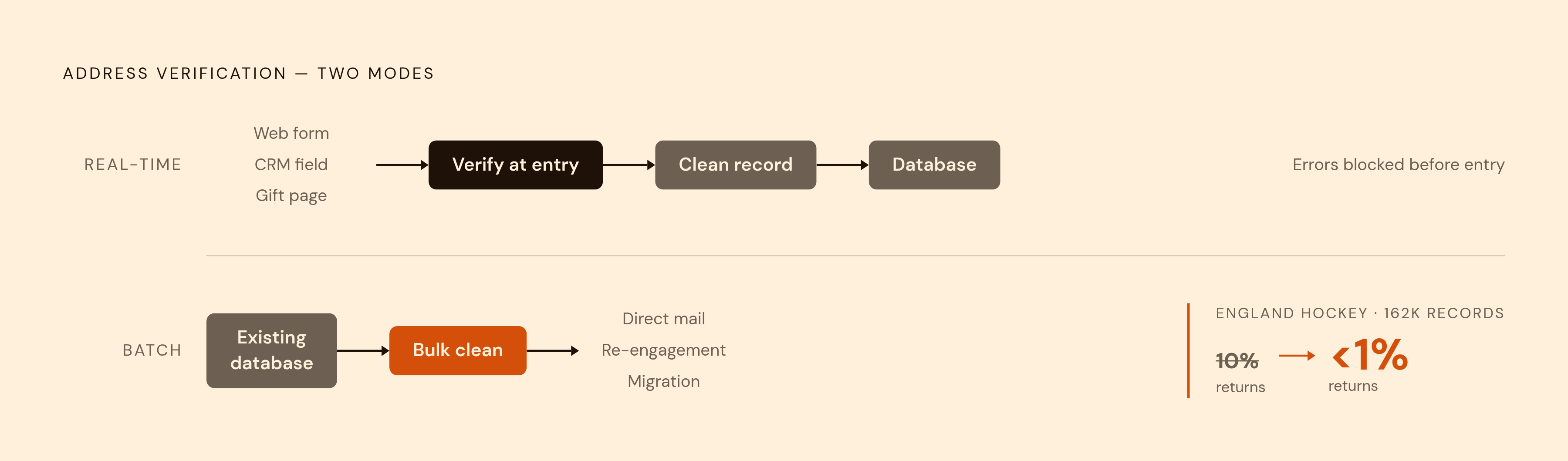
Address verification comes in two basic flavors, and most people only budget for one of them. Everyone remembers to check a new address as it comes in. Almost nobody goes back and cleans out what's already sitting in the database. That neglected half is where the real damage accumulates, quietly, for years.
Real-time verification checks an address the moment someone types it in, whether that's a web form, a CRM field, or a gift acceptance page, catching the error before it ever enters the system. Batch verification works the other direction: it cleans addresses already sitting in a database, which matters enormously before a big direct mail push, a re-engagement campaign to an existing account list, or any kind of data migration.
A program needs both, and here's the reasoning: real-time keeps new data clean going forward, but it does nothing about the mess that's already there. Most CRMs carry years of drift: people change jobs, offices relocate, nobody circles back to update the record. Run real-time checks alone, and the database still sits on a pile of rot that simply stops growing without ever getting cleaned out.
England Hockey makes the case for batch on its own. The organization had more than 162,000 unverified addresses sitting in its CRM, full of inconsistent formatting and duplicates. After putting WinPure's Address Verification tool to work on that list, mailing returns dropped from 10% down to under 1%. That's what a batch cleanup does at real institutional scale, not just on some small mailing list.
One baseline worth knowing for any U.S.-focused program: CASS certification, the USPS Coding Accuracy Support System. Software has to be CASS-certified to qualify for postal discounts, and It represents the minimum credible bar for any domestic send. A tool that isn't CASS-certified is a red flag worth asking about before anyone signs a contract.
Standalone address verification tools worth knowing
Some teams manage their own fulfillment stack or run gifting alongside a broader direct mail operation. For those teams, the right conversation is about API-layer and data-quality tools built specifically for address accuracy, not general-purpose CRM add-ons.
PostGrid runs as a cloud-based API that verifies addresses across more than 240 countries and territories and standardizes them to local postal rules. It plugs natively into Salesforce, HubSpot, Zapier, and Dynamics 365, so verification slots into a workflow a team already runs instead of forcing a rebuild.
WinPure is the tool behind the England Hockey result above. Its real strength sits in enterprise deduplication and large-scale data cleaning, with address validation across a wide range of countries.
DataLadder builds its platform around address matching, deduplication, and enrichment, designed to catch the kind of variation that exact-match tools miss. That matters most when consolidating records pulled from several different source systems.
Some specialist tools focus entirely on international addresses, covering formatting, transliteration, and validation for teams whose real complexity is cross-border volume rather than domestic scale.
Some multi-carrier shipping APIs include address verification as a built-in feature, which makes them a low-friction option for teams already using them to shop carrier rates.
UK-specific verification tools built on Royal Mail postal data, with autocomplete widgets that drop into web forms, are worth shortlisting for any gifting program sending real volume into the UK.
Smarty offers address verification services for teams that need an address confirmed at the point of entry.
Choosing between these comes down to a short set of questions. Does the country coverage match where the program actually ships, and does the team need real-time, batch, or both? How deep does it need to integrate with the existing CRM, and what does the postal licensing cost structure look like at the program's actual volume? For U.S.-heavy programs, is the tool CASS-certified?
How modern gifting platforms solve the address problem upstream
Step back and look at where most address errors actually start. The sender is expected to know the recipient's address, which is a strange thing to expect in a world where people move, change offices, and switch jobs constantly. That expectation is baked into how gifting has traditionally worked, and it's a structural gap that better spreadsheets alone won't close. No amount of form validation fixes a sender who's simply wrong about where someone lives now.
Some platforms have started solving it by removing the assumption entirely. Some platforms remove the assumption entirely by letting the recipient provide their own address at the point of acceptance, so the error never enters the system in the first place, because the one person who actually knows the correct address is the one providing it. That's the stronger model, and it's worth saying plainly: designing wrong data out of the process beats catching it after the fact, every time, because catching it after the fact still requires a return label, a customer service ticket, and a second attempt that might also fail.
Other platforms build a confirmation step into the send flow itself, verifying a recipient's address right before a gift ships so an outdated or incomplete record gets caught at the last possible moment, before it turns into a return-to-sender label. It's a reasonable second-best when the sender-entry model isn't available, but it's still catching the error rather than preventing it.
AI is starting to show up in this layer too. SmartDelivery, part of the SmartSuite platform, automates address verification inside the gifting workflow itself. It is designed to provide a solid operational baseline for a program sending at real volume. SmartDelivery sits within a broader platform that includes modules for gift recommendations and personalized messaging.
Integration matters as much as the verification technology itself. A gifting platform wired into a CRM and marketing automation system can pull address data straight from existing records, flag entries that look stale, and trigger a re-confirmation step once a record hasn't been touched in a while. For programs sending into dozens of countries, verified data only solves half the equation; someone still has to execute the send through a logistics network built to actually reach each of those markets.
Building an address verification practice into a gifting program rather than bolting it on
The teams that don't fight constant address failures aren't lucky. They made a decision early about where errors could enter their system, and then they closed that door by design.
That design decision breaks into a few concrete habits. Capture clean at the source: put real-time verification on every form and CRM field where an address gets entered, so bad data never gets a foothold. Audit before every campaign: run batch verification against the target list before a gifting push goes out, not after the returns start coming back, since job changes and office moves erode a list every single month, quietly. Match verification to actual geography: a domestic CASS-certified tool stops being enough the moment a program goes international, and coverage needs to line up with real send volume, especially across APAC markets where formatting complexity runs highest. Close the loop with the CRM: an address verified outside the system of record, and never written back into it, just drifts wrong again within a few months.
The financial case isn't subtle. BirdsEye Post's figure of $12.57 in sales for every dollar spent on direct mail, among businesses running address verification, is what turns verification from a line item into the thing that makes the rest of the spend actually pay off.
The relationship case might matter more still. Gifting only works as a signal because it's physical and personal; that's the entire premise of the thing. An unverified address is the operational failure that makes the signal go quiet before the recipient ever hears it. No amount of good creative or perfect timing fixes a box sitting in a warehouse in Ohio.
Whether the fix is a standalone API, a confirmation step built into the send flow, or an AI layer doing the checking on its own, the pattern holds. Programs that treat address accuracy as a real capability, something built into the system on purpose, keep compounding as they scale. The ones that treat it as an afterthought are the ones that stall out right at the border.