Gifting Platform API Capabilities for Enterprise Integrations
Connect gifting to your CRM and sales stack without manual work.

Gifting inside most sales orgs still runs on manual labor. A rep picks a gift, logs the send in a spreadsheet, emails a prospect to ask for a shipping address, then follows up blind because nothing tells them whether the box ever showed up. That works fine for one person sending ten gifts a month. Try coordinating an account-based send across three hundred target accounts at once, and the whole thing falls apart.
Here's the core issue: gifting sits outside the systems that run everything else in revenue. No trigger fires it. No record captures whether it worked, and nothing feeds back into the CRM, so a gift that closed a six-figure deal looks, on paper, identical to one that got tossed in a mail room. So what would it take to make gifting behave like an email sequence or ad retargeting: triggered on its own, tracked by default, tied to a number a CFO will actually read? The answer sits in the API layer, and it's worth taking apart piece by piece.
What a gifting platform API actually does at the architectural level
An API takes whatever a gifting platform can do and exposes it as something other software can call directly. A CRM, a marketing automation tool, an HR system, a sales sequencing platform: any of them can tell the gifting platform to start a send, check its status, or pull a report, without a human logging into a separate dashboard.
That's the whole point. It removes the login, the CSV upload, the one-off email to a platform admin begging for a rush send. Every one of those steps adds lag, and every human hand-off is a place where something gets forgotten.
A few things separate an API built for enterprise use from a bare-bones one. REST endpoints flexible enough to take a trigger from any upstream system, not just one specific CRM. A real sandbox, separate from production, so a team can test integration logic without risking a live send to an actual customer. Dashboards showing send status, delivery confirmation, and claim rates as they happen. Webhook support, so a downstream system gets pushed a status update instead of polling and asking "did it send yet?" every few minutes. Budget limits and approval logic built into the API itself, not stapled on as a manual review step after the fact.
Platform-agnostic design matters more than it sounds like it should. A gifting API built well plugs into a CRM, an HRIS, a marketing automation tool, and a homegrown internal system without forcing the buyer onto one stack. Documentation quality and how fast API support answers a ticket, that's what separates a platform ready for enterprise use from one that isn't; so is whether the sandbox is a real, separate environment or just a warning label slapped on production.
Procurement is the part nobody talks about, and it matters just as much as the code. Giftogram, for instance, supports PunchOut integration, which connects gifting straight into a company's existing purchasing approval workflow. For a large org, that's often the difference between finance signing off in a week and finance sitting on the request for a quarter.
How CRM integration turns gifting into a triggered revenue motion
Here's the shift that actually changes behavior: gifting stops depending on a rep remembering to do something, and starts firing off a condition someone already tracks. A deal moves to a new stage. An opportunity crosses an age threshold it shouldn't have crossed. An account's intent signal, tracked through a platform like Bombora, crosses a defined level. Any of those can be the trigger.
Walk through the mechanics: a target account crosses that Bombora intent threshold, the gifting platform queues a curated send on its own, and the activity gets logged straight back into Salesforce against the opportunity record. No rep has to decide anything at any point in that chain.
The depth of that sync is where platforms actually pull apart from each other. A one-way push tells the CRM only that a send happened. Two-way sync writes delivery confirmation, claim status, and recipient engagement back into the deal timeline, so anyone looking at the opportunity record sees the gifting activity sitting right next to every other touch, without opening a second tool.
Attribution granularity is the piece finance actually cares about, and this is where most programs get it backwards. User-level tracking answers a narrow question: did someone receive a gift? That's the metric most teams default to, because it's the easiest one to pull. Contact, opportunity, and campaign-level attribution answers a different question: did this send move the deal? Only the second kind gives revenue ops something a CFO will accept as evidence. If a platform can only report the first kind, treat that as a real gap, not a footnote to overlook during evaluation. Sendoso, for instance, is a B2B direct mail and gifting automation platform built around writing send activity back to CRM opportunity records at this level.
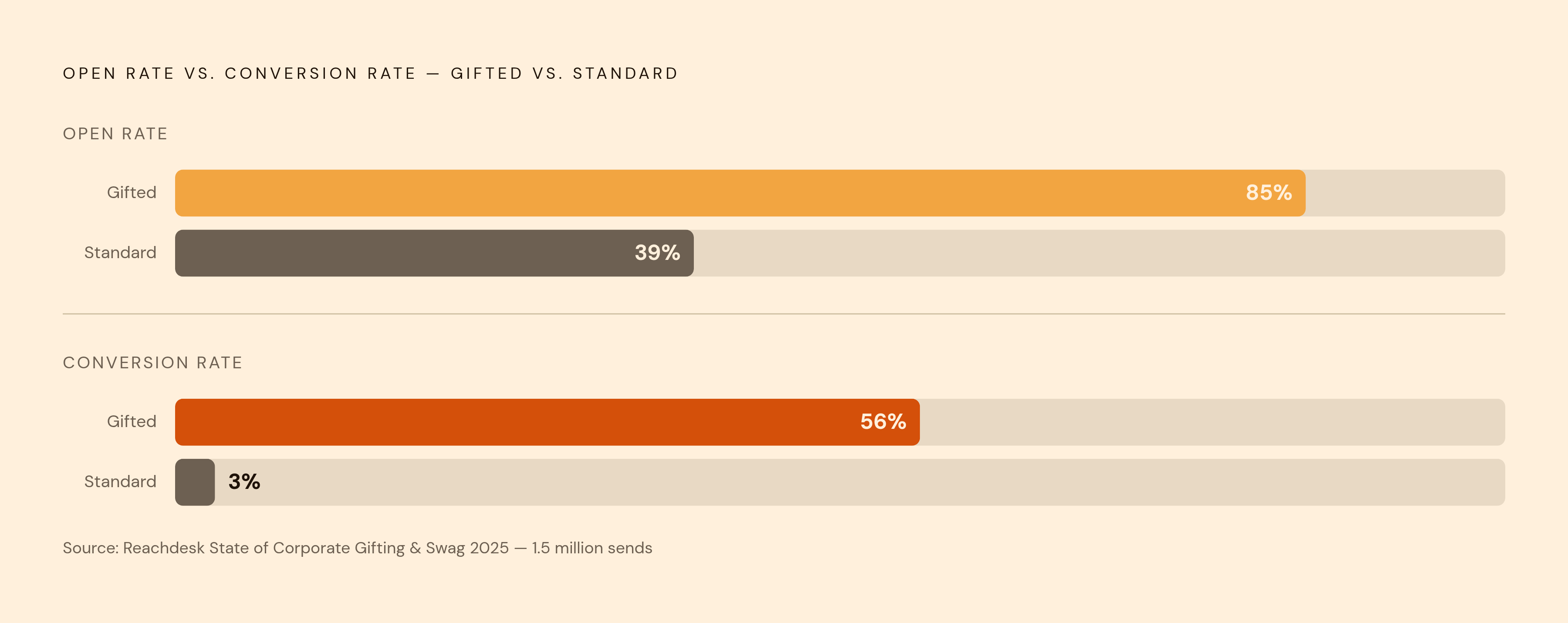
Research drawn from 1.5 million customer gift sends found gifted email campaigns hit an 85% open rate against 39% for standard email, two separate benchmarks from that same report. That gap is real, but it only shows up if the send is tied to a campaign record inside the CRM in the first place. Without that link, the number doesn't exist anywhere a report can find it.
Adoption follows the same logic. Reps use gifting more when they can fire a send straight from Salesforce, Outreach, or whatever sequencing tool they already live in, without opening a separate app they'll forget exists by next quarter.
HRIS integration and the employee recognition use case
HR teams run into the identical problem sales teams do, just with a different set of dates. Birthdays, work anniversaries, onboarding day one, a parent going on leave: all of it gets tracked in a spreadsheet somewhere, cut off from any system that could actually send something.
HRIS integration closes that gap by tying gifting sends to employee lifecycle events inside Workday, SAP SuccessFactors, Rippling, Gusto, and similar platforms. The event fires, the gift goes out. No manager has to remember, no HR coordinator has to check a calendar.
What it costs to build each of those connections one at a time is the real argument for a unified API. Giftpack's experience makes the scale of it plain: building each HRIS integration individually used to take two to three weeks of dedicated engineering time per connection. After moving to a single API approach, more than 60 integrations went live at once, which opened up self-serve onboarding for customers and cut the ongoing maintenance load by a wide margin.
That two-to-three-week figure per integration is worth sitting with if a company is weighing build-versus-buy. It's the clearest signal of what a custom-built connection actually costs an engineering team, multiplied by however many HR systems that company's customer base runs on.
What this buys people teams: recognition that lands consistently across a distributed or global workforce, not just wherever a manager happens to remember. No dependency on manager memory or HR bandwidth to make a send happen. And participation data on which cohorts actually got recognized, feeding back into how the program gets measured.
Connecting gifting triggers to ABM workflows at account scale
ABM programs typically run tiered: 1:1 for the highest-value accounts, 1:Few for a mid-tier, 1:Many for everyone else, each tier getting a different budget and a different level of hands-on attention. None of that tiering runs at scale without an API layer doing the differentiation on its own, account by account.
Physical touchpoints have become standard practice in B2B revenue strategy; industry research puts the figure at 84% of B2B teams now building them into their programs. What the API layer adds is coordination: the touch lands as part of a plan instead of whenever someone finally gets around to it.
Signal-triggered gifting is where this gets genuinely defensible as a strategy, not just a nice gesture. Walk through the chain: an intent platform like Bombora flags an account crossing a threshold, the CRM enriches that account record, the gifting API fires a curated send, and Salesforce logs the activity against the opportunity. The gift shows up while the account is actively in research mode, which means the timing itself carries the relevance. Nobody had to guess at it.
Executive engagement is where this shows up most clearly in the numbers. ABM and demand programs see 49% engagement from executive sponsors when a gift lands at the right moment in that research window, according to 2025 industry research.
The API also lets the physical send get sequenced alongside everything digital already running: targeted ads, a personalized landing page, an event invite. One motion, not a separate offline campaign running on its own clock. A physical object sitting on someone's desk extends the brand's presence past the browser window, in a way no ad impression manages to do.
What enterprise gifting APIs need to handle for global programs
An API can fire flawlessly and still produce a broken send, if the fulfillment network behind it doesn't reach the country the gift is going to. The API layer and the physical logistics behind it both have to be built for scale; one without the other just moves the failure point somewhere else, usually somewhere harder to spot.
A few things a global program needs baked into the API flow itself. Address validation running as part of the send, not as a manual check someone does beforehand. Currency and regional catalog logic, so a recipient in Germany gets something that actually makes sense there, instead of a U.S.-catalog item that can't legally or physically ship overseas. eGift delivery available as a fallback, or sometimes the primary option, for markets where physical fulfillment runs slow or costs too much. Data residency and compliance handling, GDPR in particular, for anything touching an EU recipient.
The eGift channel is where the growth is heaviest right now. The digital gifting segment overall is projected to grow from $581.38 billion in 2025 to $1,259.02 billion by 2030, which means any program running globally needs both a physical and a digital delivery route connected through the same API, not two separate systems bolted together after the fact.
The real differences between platforms only show up once a program tries to scale past North America: warehouse coverage across regions, whether an eGift gets charged at purchase or only once the recipient claims it, and how deep the regional catalog actually goes beyond the flagship market.
How to evaluate a gifting platform's API capabilities before committing
Most buyers judge gifting platforms on catalog size and how clean the interface looks, treating the API as a footnote to check off later. That's a mistake, and a common one in this procurement process. The integration layer is exactly where enterprise programs succeed or stall once volume goes up, and by the time that becomes obvious, the contract's already signed.
Five things worth actually testing during procurement, not just asking about. CRM sync depth: one-way push, or true two-way sync writing attribution back at the opportunity and campaign level? Trigger flexibility: can the API fire off any CRM condition, intent signal, or HRIS event, or only a fixed list the platform predefined? Developer experience: a real sandbox, versioned documentation, dedicated API support, or a developer portal nobody's touched since launch? Budget and approval controls: are spend limits and multi-tier approvals enforced right in the API layer, so finance has visibility without chasing anyone down manually? Attribution reporting: can it produce influenced-pipeline reports at the opportunity level, or does it stop at engagement metrics like opens and claims?
A few named platforms show the range here. Giftogram runs a developer-facing API with thorough documentation and supports PunchOut for procurement workflows, and it's a strong option for gift card and incentive programs specifically. Snappy runs a platform-agnostic API with flexible endpoints, a sandbox environment, real-time dashboards, built-in budget controls, and a marketplace of more than 250,000 gift options.
The build-versus-buy question comes down to engineering capacity, and here's where most teams talk themselves into the wrong answer. A team with the resources for it can go the white-label API route some platforms offer, but few enterprise revenue teams actually have that capacity sitting idle waiting for a gifting project. For most, a platform's pre-built integrations and managed fulfillment save months of engineering time a custom build would otherwise eat up. That's not a close call, and treating it like one usually means the build gets started, stalls at month four, and the team ends up buying the platform anyway.
That gap matters because most programs currently can't prove their own value. Research shows only 40% of North American companies formally measure recognition program ROI. A platform's attribution infrastructure is exactly what lets the other 60% close that loop, if they choose a platform built to do it.
Building the measurement framework that justifies API investment to finance
Any CFO looking at a gifting line item treats it as a soft cost, right up until sends get tied to deal records, pipeline stages, and retention numbers in a format finance already trusts. That's the objection to plan for before it gets raised, not after.
A three-layer framework handles it. The operational layer covers sends initiated, delivery success rate, claim rates, total spend, cost per recognition moment; all of it comes straight out of the API, no manual pull required. The event layer covers target-account meeting attendance, meaningful conversations that actually happened, reduced no-show rates at events; this layer needs the gifting system linked to calendar and event data specifically, not just the CRM. The commercial layer covers next-step completion, opportunity creation or progression, influenced pipeline, shorter sales cycles, expansion signals, retention; none of it is visible unless the gifting API writes back to the CRM at the opportunity level.
That commercial layer is what turns gifting from a line item into an actual revenue motion. Research on corporate gifting found gifted campaigns converting at 56%, against 3% for standard outreach. That's a wide enough gap to change a budget conversation, but again: it only shows up in a report if the send and the resulting conversion live in the same system.
Personalization compounds the effect. Research from Giftpack and Gifting 101 (2024) found 89% of companies reporting higher ROI on personalized gifts versus generic ones. Personalizing at any real scale needs AI-assisted selection, and the strongest APIs expose that as something callable in code, not a manual task someone does by hand for every account.
What a finance-ready gifting report actually needs to show: influenced pipeline attributed to sends, tracked at the opportunity level. Deal velocity, gifted opportunities compared against non-gifted ones at the same stage. Retention, compared across customers who got milestone gifts and those who didn't. Cost per influenced opportunity, set against the same figure from other demand channels.
None of this exists without the integration underneath it. A gifting API that writes activity back to the CRM, ties sends to campaign records, and surfaces claim and engagement data in a format the rest of the revenue stack can actually read is the prerequisite for the entire measurement framework to work at all.