Re-Engaging Stalled Sales Deals with Physical Outreach
Physical mail breaks through email noise to restart stalled sales conversations.

A stalled deal almost never means the prospect said no. It usually means they stopped noticing you. Most reps read silence as rejection and move the account to closed-lost, when the real problem is that the follow-up sequence became invisible the moment it hit an inbox already drowning in noise. That explanation wasn't accepted right away — it sounded too convenient, like an excuse for why cold email stops working. But sitting with the actual mechanics of attention, and with what the response-rate data shows, it holds up. Physical outreach breaks a pattern the prospect has already learned to filter out.
Consider what's actually happening on the other end of that "just checking in" email. The average professional in 2026 encounters more than 6,000 digital marketing messages a day. Nobody reads 6,000 messages, so they pattern-match instead: sender name, subject line, time of day, and most get filtered before a conscious decision ever happens. That's a survival mechanism. Cold outreach reply rates back this up: they dropped from 6.8% in 2023 to 5.8% in 2025, which tells you something uncomfortable: sending more email is making the problem worse, not better. Everyone's flooding the same channel, so the channel keeps getting quieter for everyone.
So what does "stalled" actually mean, if it's not disqualification? It means the prospect hasn't allocated attention to a decision they haven't closed. They're busy, the deal isn't urgent to them the way it's urgent to you, and your fourth follow-up email looks identical to the first three. The fix requires escaping the medium entirely.
What physical outreach does that digital structurally cannot
Here's the asymmetry worth sitting with: that same professional getting 6,000-plus digital messages a day receives a fraction of that in physical mail. The gap is stark, and it tracks with how little unsolicited paper mail most professionals get compared to email. That's an entirely different attention economy. When something physical shows up, it has to be handled, and it takes up space on a desk. It sits there until someone deals with it, in a way a read email never does.
That's the mechanism. A package creates an involuntary pause, a small moment of "what is this," that no subject line can manufacture. Email asks for a click. A box on the desk demands to be opened. That's the interruption, and the interruption is the whole point.
But the object alone doesn't do the work. A gift that arrives with no context is just a package, forgettable within the hour. A handwritten note attached to it turns a package into a gesture aimed at a specific person, about a specific relationship. Skip the note and you've spent money to send confusion.
There's also a structural fix here that digital struggles with: B2B deals typically run through 6 to 10 decision-makers. Email one contact and you're betting the whole deal on a single distracted inbox. A coordinated physical send to three or four stakeholders, each with framing suited to their role, reaches the buying committee instead of one person who may not even be checking that thread anymore. None of this replaces digital follow-up. It resets it. A prospect who's received something physical and memorable is a prospect who'll actually open the next email, because now there's a reference point in their head.
Which stalled deals are worth the investment in physical outreach
Physical outreach costs real money and real time to execute well, so it needs honest qualification before it earns a place on your calendar. Not every stalled deal deserves a box on someone's desk.
Deal size is the first filter, and it's worth working through the arithmetic rather than taking it on faith. Anything under a modest contract value threshold rarely pencils out against the cost of a thoughtful send plus the rep hours to coordinate it. The clearest fit is complex, consultative sales with substantial contract values, where even a meaningful gift spend is a rounding error against what's at stake. Named accounts inside an active account-based marketing program sit at the top of the list too: you already have account-level data justifying the spend, so the guesswork is mostly gone.
Before sending anything, run through a short diagnostic:
- Was there real engagement earlier? Meetings taken, content downloaded, a champion who spoke up?
- Is the silence recent, a matter of weeks, or has it stretched for months with zero internal signal?
- Is there someone inside the account who'd recognize the send and could restart the conversation?
- Do you actually have a verified address and enough personalization data to make the send feel intentional rather than random?
The deal stages that respond best to this kind of intervention: post-demo silence, a proposal that's gone quiet, contracts stuck in legal or procurement, and renewal conversations that have gone cold. Walk away, though, if there's no prior engagement, no internal champion, and no address data. At that point you're just doing expensive cold outreach with extra steps.
How timing and sequencing turn a gift into a conversation
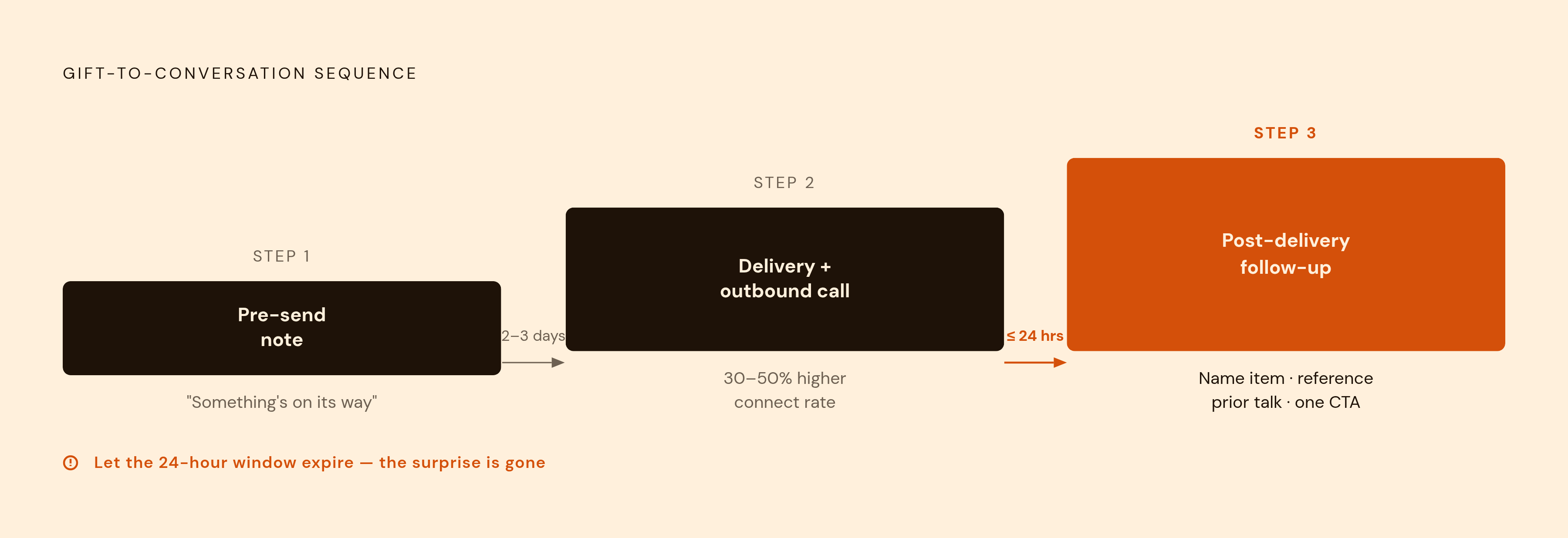
Timing is where most sends fail even when the gift itself was right. The window that matters is the 24 hours after confirmed delivery, while the package is still sitting on the desk. Call or email outside that window and you've let the moment of surprise expire before you cashed it in.
That means the follow-up needs to be triggered by delivery confirmation, not by whatever slot happened to be open on a rep's calendar three days later. Use tracking, and know the exact day it lands.
A sequence that tends to work looks something like this:
- A short pre-send note, something like "sending you something, keep an eye out," which builds a little anticipation and raises open rates on what comes after
- Delivery timed two to three days before a planned outbound call; coordinated mail-and-sales-outreach campaigns report connect rates 30% to 50% higher on outbound calls compared to digital-only outreach
- A post-delivery follow-up that names the actual item, ties it back to something said in an earlier conversation, and ends with one easy ask, not a pitch
That last part is where a lot of gifting programs quietly fail. A gift with no next step is just a nice thing that happened once. Every send needs a specific, low-friction CTA attached: a 15-minute call, a rescheduled demo, even just a reply confirming a good time to talk. And the message itself should acknowledge the gap in contact without making the prospect feel chased. Reference something concrete from the last real conversation. That's what separates a rep who remembers a prospect from an automation that logged a name.
For multi-stakeholder deals, this compounds. A coordinated send to three or four people on the buying committee, each framed around their role, consistently outperforms a single send to the one contact who went quiet. Multi-threading strategies that reach three to four stakeholders produce deals that close at roughly three times the rate of single-threaded outreach efforts. That's the difference between a program and a gamble.
What to send and how personalization determines whether it lands
The most common mistake in gift selection is picking something the sender finds impressive rather than something the recipient will find relevant. Nobody's re-engaging with a deal because the branded stainless tumbler looked sleek in the catalog.
A prospect who mentioned a specific hobby, a kid's soccer tournament, or a company milestone during a discovery call has already told you what to send; you just have to remember it. LinkedIn activity, a recent job change, something they published, all of it signals what kind of attention would actually land. Company context matters too: a sustainability-focused company receiving a sustainable product isn't a coincidence, it's a fit signal, and it reads as one.
When personalization data is thin, benchmarks help set a floor. Gift cards run the highest acceptance rate among common gift categories. Accessories and jewelry and apparel also post strong acceptance rates. None of these numbers guarantee a great outcome, but they tell you where the safe ground is when you're working with limited information.
One option worth considering seriously: letting the recipient choose from a curated set rather than picking for them. It removes the wrong-gift risk entirely, respects the fact that they know their own preferences better than you do, and still delivers the physical surprise that makes the whole tactic work in the first place. That's particularly useful on accounts where the data on the prospect is sparse.
Sustainability isn't a nice-to-have anymore either. Roughly 56% of corporate buyers say they prefer eco-friendly gifts, which means ignoring that preference leaves a visible mismatch for well over half the people receiving your sends. Dimensional mailers and well-designed branded merchandise are worth considering too, especially in regulated industries where a traditional gift runs into compliance friction; a smart mailer can create the same physical-surprise effect with a fraction of the approval headache.
And the handwritten note again, because it bears repeating: skip it, and even a perfectly chosen gift reads as automated. Include it, and a modestly priced item outperforms a far more expensive item that arrived without one.
Measuring whether the send actually moved the deal
A meaningful share of marketers undercount what direct mail actually returns, and it's rarely because the channel underperforms. It's because nobody built the tracking to connect the send to the outcome.
Here's the attribution snag specific to physical outreach: a deal revives, a meeting gets booked, and now three things are competing for credit, the gift, the follow-up call, and the email that came after both. Without a deliberate tracking structure, all three get partial credit and none of them get counted properly. That's a program problem, and it's fixable.
Start with benchmarks to calibrate expectations:
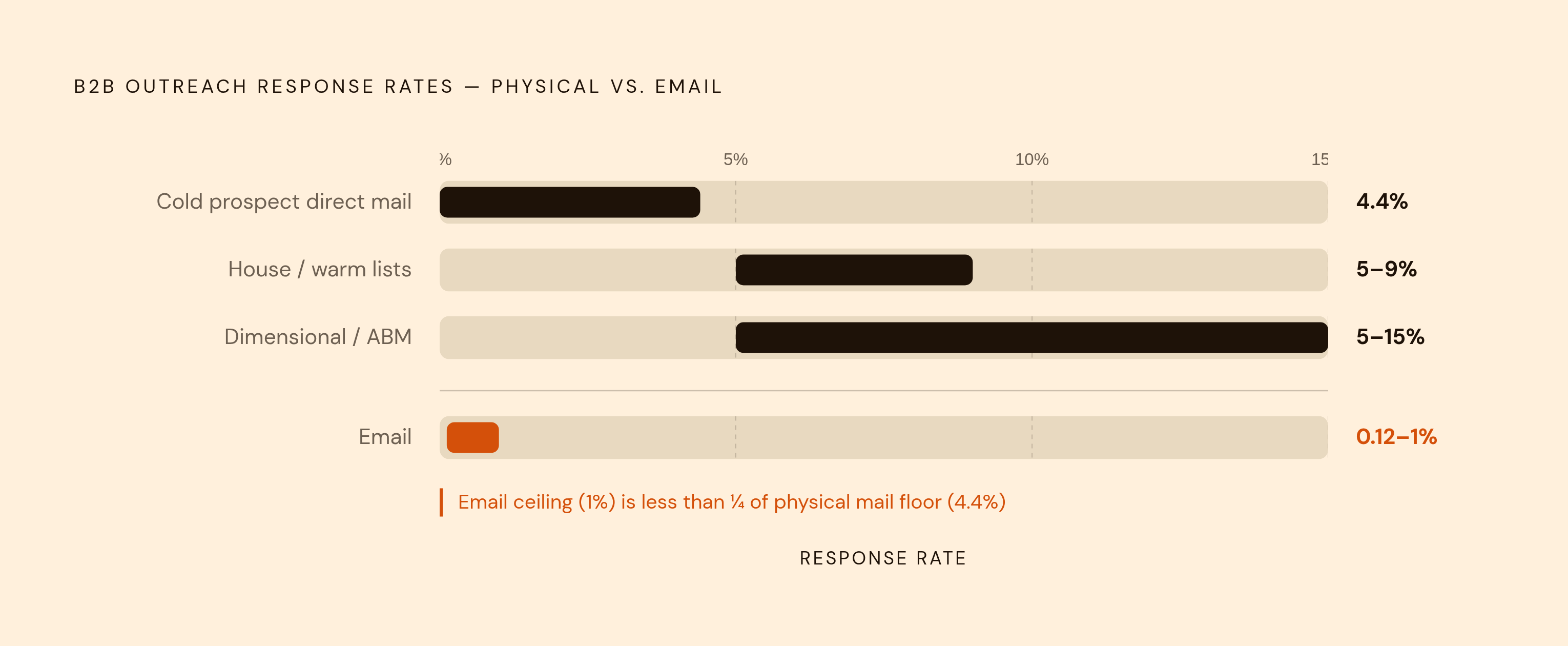
- Cold prospect lists in B2B direct mail: 4.4% average response rate
- House lists of existing customers and warm prospects: 5% to 9%
- Dimensional mailers to targeted ABM lists: 5% to 15%
- Email, for comparison: 0.12% to 1%
That gap between 4.4% and 1% is the entire argument for the channel, and it's worth sitting with rather than skimming past, because it's easy to assume email's convenience makes up the difference. It doesn't, at least not on the numbers. Even a handful of revived deals at typical B2B contract values covers the cost of the program many times over.
Beyond the response rate, a re-engagement program needs its own metrics, tracked separately from general pipeline reporting: response rate broken out by message type and gift category, time from delivery to first response, the conversation restart rate (how many stalled deals actually re-enter active pipeline), and closed-won rate on revived deals against the baseline. If the program uses a recipient-choice platform, gift claim rate and time-to-claim matter too.
None of this works if the send lives outside the CRM. Every gift needs to get logged as a touchpoint on the opportunity record, the same way a call or an email would be. That's what lets deal velocity and closed-won rate get measured at the account level instead of getting shrugged off as an unexplained bump. Programs that trigger sends off specific deal-stage events, rather than running them on a batch calendar, consistently perform better on return and on conversion, which points to a broader operational truth: gifting needs to sit inside the sales engagement stack, not next to it as a separate offline activity somebody runs from a spreadsheet.
Building a repeatable re-engagement motion rather than one-off sends
One gift that revives one deal is a nice story. A strategy is a defined set of triggers, thresholds, and sequences that produce the same kind of result across dozens of accounts without a rep having to reinvent the process each time.
What that actually requires:
- Deal-stage triggers that flag an account automatically, say, 21 days of no activity after a proposal goes out
- Qualification criteria built into the trigger itself, ACV threshold, ABM tier, prior engagement signal, so reps aren't guessing deal by deal
- Pre-approved gift tiers matched to deal size and account tier, cutting down the time spent deciding what to send
- A standardized follow-up sequence tied to delivery confirmation rather than whatever's open on the calendar
- Attribution logging built in as a required step, not something that happens if someone remembers
Scaling this without losing the personalization that makes it work is the real operational challenge, and it's the part that was initially underestimated. AI-assisted gift recommendation and address verification remove a lot of the manual grind that makes physical outreach feel expensive to run at volume; the same care that goes into one send can extend to a hundred, if the infrastructure behind it can carry the weight. Global programs raise the difficulty further: fulfillment across regions, gift acceptance policies that vary by country, cultural fit questions that a spreadsheet and a single vendor relationship simply can't handle at scale.
The strongest version of this sits inside an account-based marketing motion, treated as a coordinated piece of the account plan rather than a last resort after everything else has failed. The teams pulling 5% to 15% response rates on dimensional mailers to ABM lists are running an integrated account plan where the physical send is one piece among several.
And the economics keep getting more compelling as customer acquisition costs climb. B2B CAC has risen 60% over the past five years, and a stalled deal already comes with relationship history, a champion who once said yes to a meeting, a proposal someone already reviewed. Reviving that costs a fraction of sourcing an equivalent deal from scratch. As acquisition gets more expensive, the math on re-engagement gets harder to ignore.