Customer Data Platform Integration with Gifting Platforms
Data-driven timing turns corporate gifting from random gestures into strategic account signals.

I've spent enough time inside CRMs and CDPs to know the difference between a system that just stores data and one that actually tells you something. So let's get into what happens when you wire a Customer Data Platform into a gifting platform, and why the timing of a corporate gift stops being a guess and starts being a response.
Most B2B gifting still runs on memory, not data. A rep sends something after a good call, or before the holidays, or whenever it crosses their mind on a Tuesday afternoon. That's the strategy, such as it is. Wire a CDP into a gifting platform and the whole equation changes: now the gift responds to something the buyer actually did, not to whatever happened to be on the rep's calendar that week.
Corporate gifting is a $839.6 billion market globally as of 2024, headed toward $919.9 billion in 2025. Most of that money still has zero connection to buyer behavior. A gift lands on a Tuesday because that's when the rep had five free minutes, not because the account just hit the pricing page for the third time in a week. Nobody can say whether the send moved a deal forward or just showed up at a random moment and got tossed in a drawer. That's the gap worth closing.
What a Customer Data Platform actually does with B2B data
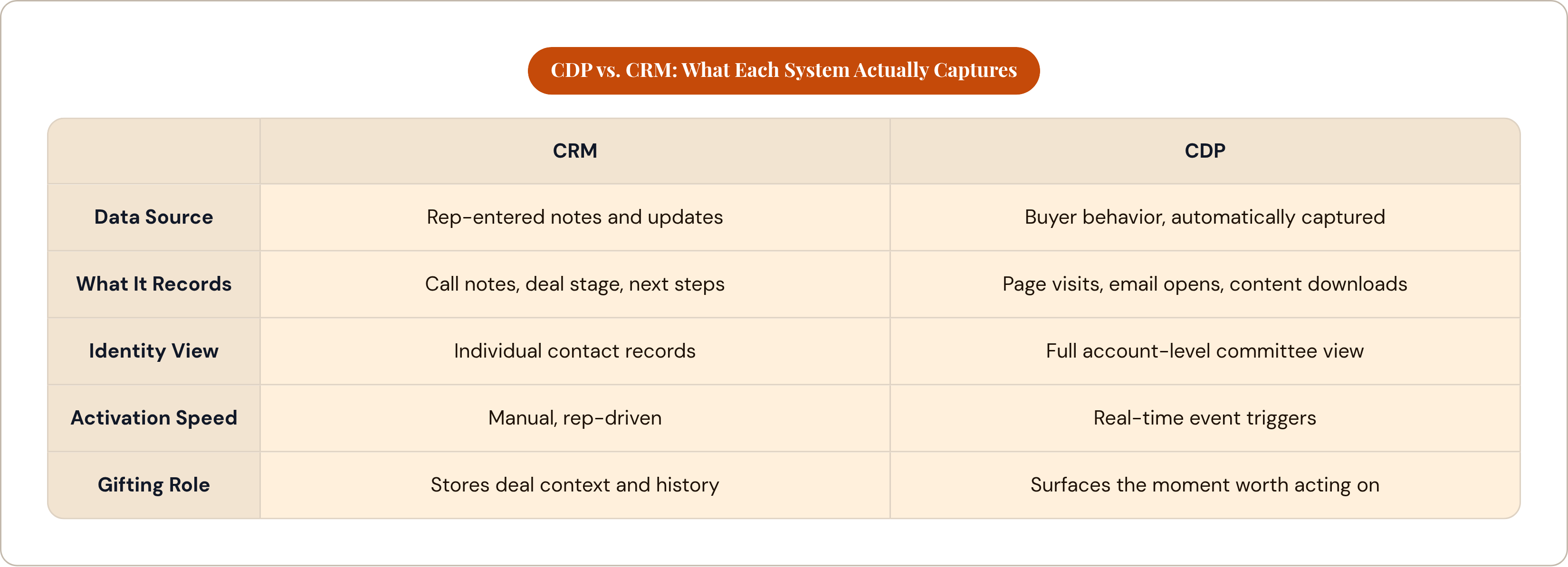
A CDP pulls in data from every touchpoint a customer or prospect has with you and stitches it into one profile that follows them across systems. Worth being precise about how that's different from a CRM. A CRM records what a rep types in: call notes, deal stage, next steps. A CDP captures what the buyer does on their own, without anyone typing anything: which pages they visit, which emails they open, which case study they downloaded, whether they logged into the product this week.
Identity resolution is where this gets genuinely hard in B2B. One account might have eight or ten people touching the buying decision, each one showing up as a separate, disconnected contact record unless something ties them together. Buying committees have grown considerably over the past decade, so a view limited to one contact is missing most of the room. A CDP resolves those scattered contacts up to the account level. Now a marketer sees the full committee, not just whoever happened to fill out a form.
Real-time activation is the other piece separating a modern CDP from a glorified spreadsheet. A decision-maker hits the pricing page, the platform registers it instantly, and something downstream fires: an alert to the rep, a segment update, a workflow trigger. And because CDPs lean on first-party, deterministic identifiers (email address, account ID, product usage logs) the data holds up better than third-party signals in a world where cookies are on their way out.
Worth mentioning the shift toward composable CDPs too. Instead of one big monolithic platform, teams build CDP logic on top of a data warehouse they already own. That makes plugging in outside tools, gifting platforms included, a lot more workable. The CDP itself doesn't decide anything. It generates and organizes signal. What happens next depends entirely on which signals actually deserve a response.
The signals that should trigger a gift — and how the CDP surfaces them
Not every data point deserves a gift, and that's worth saying plainly. Somebody opening a newsletter isn't the same as three people from one account hitting the ROI calculator in the same week. Separating those two is the CDP's real job here.
A few signals are worth building a trigger around:
- Repeated pricing page visits, especially from multiple contacts at one account
- High-intent content: ROI calculators, competitive comparisons, case studies
- Demo or trial requests, plus lead score crossing a set threshold that combines firmographic fit with behavioral activity
- CRM stage changes: proposal sent, contract out, or a late-stage deal stalled past a defined number of days
- Renewal windows approaching, or a drop-off in engagement on an existing account that reads as churn risk
Account-level aggregation is where this stops being tidy and starts being useful. One person visiting a pricing page is a data point. Three people from the same account doing it the same week is a signal the whole committee's in evaluation mode, and that's exactly the pattern a CDP is built to catch across contacts a CRM would otherwise show as unrelated records sitting in separate rows.
This is also what makes multi-threading possible at any real scale. The CDP shows which committee members have engaged and which haven't, so a trigger can go out to the group that's gone dark, right alongside the one contact who's already replying to every email. Some of these triggers run off segments (every named account crossing a scoring threshold this quarter), some fire off a single real-time event. Either way, the CDP's job stops at surfacing the moment. What gets sent, to whom, and how, that's the gifting platform's call.
How the data actually flows between a CDP and a gifting platform
The integration runs both directions. The CDP pushes profile data and trigger events out; the gifting platform sends send and redemption data back, closing the loop.
Going out, from CDP to gifting platform, you're looking at unified contact and account profiles (role, firmographics, segment membership), behavioral context like recent activity and current score, the specific trigger event that fired the workflow, and suppression data so nobody who already got a gift last week, or opted out entirely, gets hit again.
Coming back, from gifting platform to CDP and CRM: confirmation the gift went out, to whom, and when; redemption, meaning did the person actually claim it; claim velocity, how fast they redeemed after delivery; and non-redemption, which turns out to be its own kind of signal worth reading.
How this gets wired up in practice varies quite a bit. Some teams rely on native connectors, where a workflow rule in Salesforce or HubSpot fires the gifting action directly the moment a field updates or a score crosses a line. Others route events through middleware like Zapier, or a custom webhook, when no native connector exists. Teams running a composable CDP off a warehouse often push enriched segments straight into the gifting platform's audience layer through reverse ETL.
Leading gifting platforms build direct connectors into CRM and marketing automation systems, so the send event lands in the same record where the deal history already lives. Nobody's reconciling two separate systems by hand at 6pm on a Friday.
One structural wrinkle worth naming: gifting needs a physical address, and CDPs often just don't store one. That's a real gap, not a rounding error. Some gifting platforms resolve it with automated address confirmation workflows, which means a rep never has to send an awkward email asking a prospect for their mailing address mid-deal.
Data quality is the other risk, and it's not hypothetical. If the underlying CDP profile is stale, the trigger logic misfires right along with it: a deal marked stalled that actually closed-lost three weeks ago still fires a gift, a churn-risk account sends a gift to someone who left the company back in March. The integration is only ever as good as the data underneath it.
What this integration unlocks for ABM and multi-stakeholder deals
Account-based marketing is where this pays off most visibly. ABM already runs on named accounts, complex committees, and long cycles, exactly the conditions where a single-contact view falls apart.
With a resolved account view, a team maps the full buying committee, sees who's engaged and who's dark, and fires a coordinated send reaching the CFO, the IT lead, and the ops director at once, alongside the champion who's already logged into the CRM daily. Gifting one person and hoping they pass the message along internally is a different motion entirely, and a much weaker one.
Personalization sharpens here too. The CDP profile carries role, industry, and content history, so the gifting platform matches the gift to the actual person instead of sending the same branded box to everyone on a list. A technical evaluator and a C-suite economic buyer shouldn't get the same thing, and now there's data behind the difference instead of a guess. AI-driven recommendation tools can surface catalog options based on recipient profile, which cuts out the part where a rep scrolls through a catalog hoping something feels right.
Pre-meeting gifting is one of the more interesting plays here. A personalized send that lands before a first discovery call, informed by what the CDP shows the prospect already read, changes how that first conversation opens. There's a shared reference point on the table already, instead of a cold intro and small talk.
Mid-funnel stall recovery runs on the same logic. The CDP notices a deal's gone quiet (no new engagement, no stage movement in weeks) and the gifting platform fires a send to the full committee instead of just the primary contact, trying to pry the door back open before the deal goes cold for good.
Direct mail response rates run well ahead of standard email response rates, and that gap widens further when the send lines up with a real intent signal instead of an arbitrary date on a calendar. Why would that gap be so wide? Part of the answer's simple: a physical object that shows up at the right moment is harder to ignore than one more email in an inbox already sitting on forty unread messages.
Closing the attribution loop — from send event to pipeline record
The central problem with most gifting programs is that they sit outside the data stack entirely. Finance sees a line item for cost. There's no matching line for revenue, so the whole program looks like a nice-to-have that's tough to defend when budget season rolls around.
Write redemption and send data back into the CDP and CRM, and the gift becomes a tracked touchpoint sitting in the same system where pipeline gets measured. That changes what's possible. Multi-touch attribution models can credit a gift send the same way they'd credit an email open or a webinar registration. Teams can compare deal velocity for gifted opportunities against non-gifted ones at the same stage, in the same segment, and actually see whether there's a real difference.
Two distinct kinds of impact are worth separating here, because conflating them is where a lot of attribution claims quietly fall apart. Pipeline sourced means the gift was the first real touchpoint that got a response: a meeting booked, a form filled, a reply sent. Pipeline influenced means the deal was already moving, and the gift either sped it along or kept a stall from turning into a loss.
Influenced pipeline is the harder number to defend, since other touches are happening in parallel and untangling causation gets messy fast. Better to be honest with finance about the methodology than to claim more credit than one gift deserves in a deal with a dozen touchpoints.
Redemption rate and claim velocity work as leading indicators, showing up well before revenue data ever would. A gift claimed fast tends to correlate with real buying intent. Non-redemption isn't nothing either; it usually points to a wrong contact, a wrong moment, or a gift that just missed the mark entirely.
Cost matters here too. Once teams can measure cost per send against meeting acceptance, deal acceleration, and closed revenue, the conversation shifts from whether the spend is worth it to how much more of it makes sense.
How AI layers on top of CDP data to make personalization scalable
Having rich profile data on every account doesn't mean a team can act on all of it. That's a bandwidth problem. No sales or marketing team has the hours to hand-pick a gift for every account showing intent in a given week, and pretending otherwise just means the good data sits there unused.
AI is what closes that gap. Gift recommendation engines take the recipient's role, industry, and engagement history and surface relevant catalog options, so nobody's manually browsing a catalog trying to guess what a VP of Engineering might actually want on their desk. Message personalization works the same way: drafting the note that rides along with the gift, using the same behavioral context the CDP already captured, what the person read, what event they showed up to, what stage the deal's sitting in.
AI adoption inside organizations has grown sharply in recent years, so gifting platforms building AI into their workflows are keeping pace with a broader shift rather than getting out ahead of it. Modern gifting platforms are applying AI across gift selection, address confirmation, and message drafting, the three spots where a gifting workflow tends to stall out waiting on a human to make a call.
There's also a recipient-choice model worth mentioning here. Instead of the platform guessing at one perfect gift, it curates a small set of options matched to the recipient's profile and lets them pick. That's a reasonable middle ground between data-driven targeting and just handing someone a gift card and calling it a day.
Over time, redemption data feeds back into the models and the targeting gets sharper: which gift types work for which roles, which timing produces the best claim rates. Without that feedback loop, a CDP just produces more triggers than any human team could act on with real thought behind each one.
Extending the integration across the full customer lifecycle
Everything above applies just as well after the deal closes. The CDP keeps watching behavior, the gifting platform keeps executing sends, and the attribution loop keeps closing. Just on a different set of triggers now.
Retention is the clearest case. A drop in login frequency or product usage is an early churn signal, and it can trigger a personalized check-in before the account actually walks. Renewal dates sitting in the CDP trigger a send timed to the real renewal conversation, not whatever holiday happens to fall nearby that month. Expansion works the same way: when the CDP flags a new stakeholder at an existing account showing interest in a different product line, that's a window to multi-thread before the formal upsell conversation even starts.
Events follow the same pattern. CDP segments drive pre-event sends meant to boost attendance among priority accounts, and post-event sends aimed at whoever showed the highest engagement while they were there. Both timed to actual behavior, not blasted out to the full attendee list all at once.
Even employee recognition fits here, once HRIS data gets treated the way CDP data gets treated for customers. Tenure milestones, performance signals, onboarding stage, all of it works as trigger logic for people teams the same way behavioral signals trigger sends for prospects and customers.
This isn't a campaign tactic that runs for a quarter and gets shelved. It's infrastructure that responds to signal continuously, at every stage of a relationship, turning gifting from something a rep remembers to do into something the data decides is worth doing.