Corporate Gifting Email Templates for Outreach and Follow-Up
Tailor your gifting email to where the relationship actually stands.

Most corporate gifting emails fail for one reason: the email ignores where the relationship actually stands when it lands in someone's inbox. A cold prospect and a customer hitting a renewal milestone need two completely different emails. Companies keep sending the same template to both, and then wonder why the reply rate sits at zero.
That mismatch shows up everywhere once you start looking for it. A cold outreach email that pitches before earning a single reply. A post-gift follow-up that reads like it was drafted before the package ever shipped, no acknowledgment that the gift actually arrived. Generic language that tells the recipient, in the first sentence, that nobody on the sending side thought about them specifically. Research on B2B gifting behavior backs this up: the subject line and first sentence carry almost all the weight, because the body rarely gets read in full. Miss those two elements and the rest of the email doesn't matter much.
So the fix calls for a distinct template for each stage of the relationship, built around what that stage actually needs from the reader. Five relational moments, five jobs an email has to do, five structures that get each one right. That's what I want to walk through here.
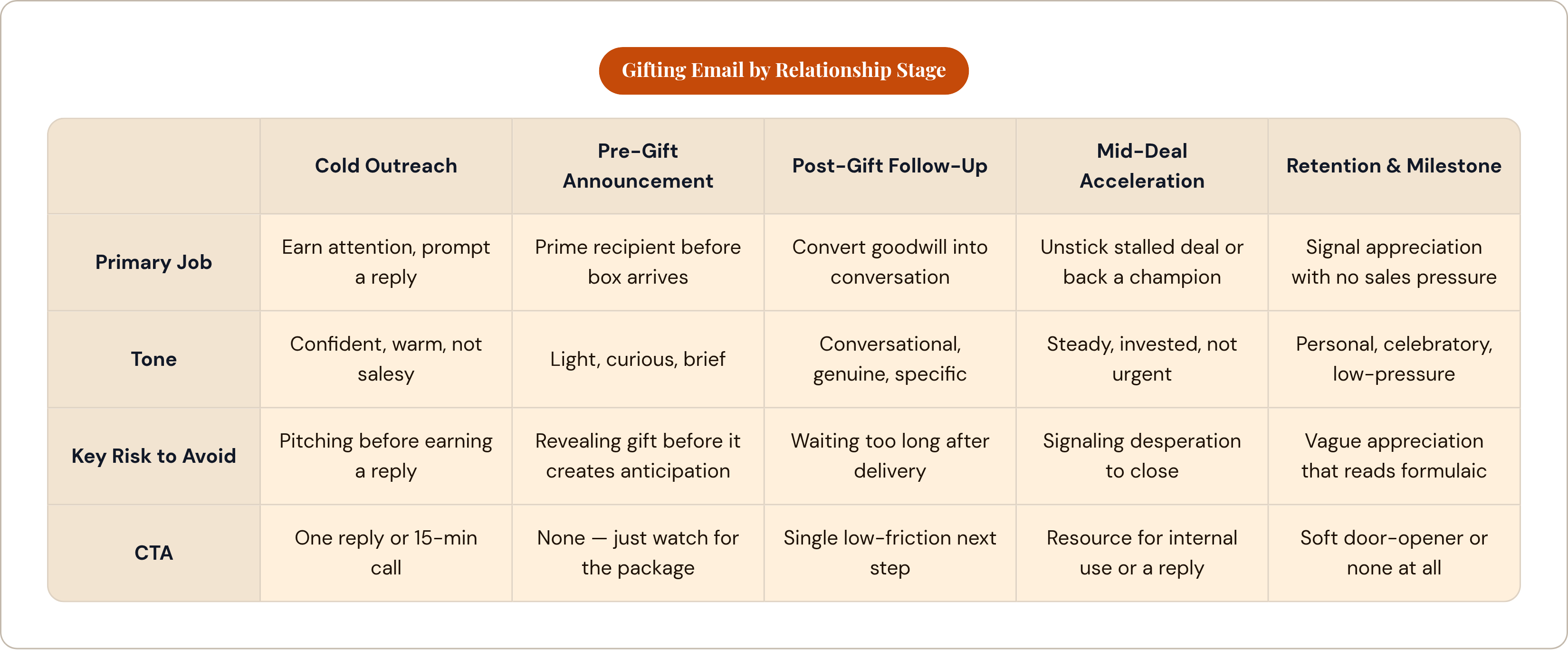
How the relationship arc maps to gifting moments
Gifting emails show up at five distinct points in a relationship, and each one asks something different of the reader.
Cold outreach has no relationship to lean on, so credibility has to get built in the first three sentences or the email dies in the inbox. Pre-gift announcement comes next: priming someone before a box shows up at their office, so it doesn't get tossed by a front desk assistant who has no idea what it is. Post-gift follow-up is the moment the gift has done its job and opened a door; now someone has to walk through it. Mid-deal acceleration uses a gift to either reinforce a champion pushing your deal internally or nudge a stalled prospect back to life. Customer retention and milestone emails signal appreciation with zero sales pressure, because the relationship's already paid for.
Attention, then curiosity, then conversation, then momentum, then loyalty. Skip a step, or write the wrong tone for the step you're on, and the gift reads as random instead of intentional.
Here's something worth sitting with: in account-based marketing, decision-makers buy into people and experiences before they buy into ideas. The email's real job, before and after the box arrives, is to deliver a slice of that experience in text. Gifting emails rarely travel alone anyway. They're one touch in a sequence that includes LinkedIn messages, phone calls, sometimes direct mail, and where the email sits in that sequence changes its tone. An email following three LinkedIn touches reads nothing like one arriving cold with no prior context.
And in a buying committee, the same gifting moment might hit three different people: a champion, an economic buyer, an end user. Same stage, same gift, three different emails. The champion cares about internal risk. The economic buyer cares about ROI. The end user cares about whether their day-to-day gets easier. One template rewritten three ways beats one template sent three times.
Cold outreach email template: earning attention before any relationship exists
The goal here is to get a reply, start a real exchange, or lock in a short meeting.
The gift works as a pattern interrupt, not a bribe, and the email has to frame it that way from the first line. Send a low-cost item and immediately ask for 30 minutes on someone's calendar, and you've turned a gesture into a transaction. People notice the difference, even when they can't name it.
Structural elements:
- Subject line: specific enough to signal relevance, short enough to read in a preview pane. Skip "I have a gift for you." Nobody opens that anymore, if they ever did.
- First sentence: has to earn the right to be read. Reference something real, a funding round, a new hire, a product launch, anything that proves you looked before you wrote.
- Gift mention: brief, low-pressure, framed as no strings attached. The ask comes later, not in the same breath.
- Single CTA: one action. A reply, a redemption, a 15-minute call. Never three options dressed up as flexibility.
Template:
Subject: Saw the Series B news, congrats Hi [Name], Congrats on the Series B; scaling the ops team that fast is no small thing. I've been following [Company]'s growth and wanted to send something small your way, no pitch attached, just a coffee gift to say welcome to the next chapter. If it's useful, I'd love to trade notes on how teams like yours are handling [specific challenge] at this stage. No pressure either way, just reply if it's relevant. [Sign-off]
Personalization cues to fill in before sending:
- Recent trigger event: funding, a leadership hire, a product launch
- Shared connection or community: a conference you both attended, an industry group
- A role-specific challenge the gift itself reflects awareness of
Avoid leading with your company name, avoid asking for a 30-minute meeting out of the gate, and avoid mentioning the gift's dollar value. That last one especially. Naming a price turns a gesture into a receipt.
Enterprises have been raising gifting budgets for a while now, so recipients are more used to gifting outreach than they were a few years back. That raises the bar. When everyone's sending something, relevance and personal detail are what separate an email that gets read from one that gets archived.
Pre-gift announcement email: building anticipation so the package lands better
Why send anything before the gift even arrives? Because a package from an unfamiliar address, sitting at a front desk or a mailroom, gets ignored, tossed, or opened without context weeks later. The announcement fixes that. It tells the recipient to watch for something and gives them a reason to care once it shows up.
This email does almost all its work in the subject line and opening line. "Something is heading your way" creates an open loop, and open loops are hard for the brain to ignore. That's just how attention works.
Structural elements:
- Subject line: hint at the delivery, don't reveal it. "Something we thought you'd appreciate is on its way" beats spelling out exactly what's inside.
- One sentence on why: keep it about them, not your product or your company.
- Soft setup for the follow-up: "I'll reach out once it arrives" sets an expectation without demanding anything now.
- No CTA beyond watching for it: this email has one job, anticipation, and asking for more dilutes it.
Template (physical gift):
Subject: Something's on its way to your office Hi [Name], Wanted to give you a heads up, something small is headed your way in the next few days. Given what you mentioned about [specific detail from a prior conversation or research], I think you'll actually get some use out of it. No need to do anything now. I'll follow up once it lands. [Sign-off]
Template (e-gift / digital delivery):
Subject: A small thank-you, pick what works for you Hi [Name], Wanted to send something your way as a thank-you for [specific reason]. I set it up so you can pick what actually fits, coffee, a book, a donation, whatever's useful to you right now. [Gift link] [Sign-off]
Tone shifts depending on where the relationship stands. With a cold prospect, keep it light and warm, and skip anything that reads like corporate boilerplate. With an existing customer, you can go warmer still, maybe reference something specific from your shared history.
Worth noting on e-gifts: the announcement and the delivery often happen in the same email, since there's no separate shipping window to plan around. When the platform lets the recipient choose from a set of options, frame that choice as a feature: you're letting them pick what's actually useful.
Post-gift follow-up email: turning the open door into a conversation
A gift with no follow-up is money spent for nothing. The follow-up is where pipeline actually starts moving, because it's the first moment you're asking for something in return, even if that something is small.
Timing matters more than most people think. Send promptly after confirmed delivery or redemption. Wait too long and the moment's gone; the gift is old news, and your email reads like an afterthought.
The follow-up's real job is to use the gift as a bridge into an actual conversation, one that doesn't feel like a sales call in disguise.
Structural elements:
- Subject line: callback to the gift, warm rather than salesy. "Hope the coffee arrived at a good time" beats "Following up on your gift."
- Opening: acknowledge the gift in one line, then pivot straight to them. Ask something real, or make an observation that shows you're paying attention.
- Transition: connect the gift's theme, or something you know they care about, to something useful you can actually offer.
- CTA: one specific, low-friction ask. A 15-minute call, a reply to a single question, a scheduling link.
Template:
Subject: Hope the coffee arrived at a good time Hi [Name], Hope that landed well and gave you a reason to slow down for five minutes. I know [role-specific challenge] has probably been keeping you busy this quarter. I put together something that might help with exactly that, happy to send it over or walk through it on a quick call, whichever's easier for you. [Sign-off]
Phone variant (for long-term clients or contacts you know personally): a short, friendly check-in call often beats an email here. "Hey, did the package make it? How's everything going on your end?" Casual, no pitch, and it opens the door just the same.
Some gifting platforms and B2B direct mail automation tools let recipients book a meeting the moment they redeem the gift, which changes the follow-up email entirely. If the calendar's already booked, the email shrinks, sometimes it disappears altogether, replaced by a confirmation note. That compression, from gift to conversation with nothing in between, is one of the more useful shifts these platforms have made possible.
The data backs up why this moment matters. Research on corporate gifting found 70% of gift recipients feel more valued by the sending company, and 61% report a more positive brand impression afterward. That goodwill is real, but it doesn't convert itself. The follow-up email is the mechanism that turns feeling valued into an actual next step.
Mid-deal acceleration email: using a gift to unstick a stalled opportunity
This template covers two different pipeline situations that share the same bones: reinforcing a champion advocating for you internally, and re-engaging a prospect who went quiet after showing real interest.
In both cases, the gift has to signal investment in the relationship, not desperation to close. The line between those two readings is thin, and the email's framing decides which side it lands on.
For champion reinforcement:
Acknowledge what they've been doing internally, even if you only know about it obliquely. "I know you've been running point on your end" goes a long way. Position the gift as appreciation for that effort, not as an incentive to keep pushing. The CTA should offer something they can use in their next internal conversation: a one-pager, a reference call with a similar customer, a direct answer to an objection you know is circulating.
Subject: For the internal conversations you've been having Hi [Name], I know you've been the one carrying this conversation forward on your end, and I don't take that for granted. Sent over something small as a thank-you. Also put together a one-pager addressing [specific objection] in case it's useful for your next internal discussion. Let me know if a quick call with [reference customer] would help too. [Sign-off]
For re-engagement after a stall:
Don't mention the silence. Bringing up the stall directly puts the recipient on the defensive, and defensiveness kills momentum faster than silence does. Instead, open with something new: a relevant piece of information, a case study, a trigger event at their company you noticed. Frame the gift as a "thinking of you" moment tied to that new context, not a nudge to respond. Keep the CTA low-stakes: a reply, not a meeting request.
Subject: Saw this and thought of your team Hi [Name], Came across [relevant news or case study] and thought of the conversation we had a while back. Sent along something small, no expectations, just wanted to stay on your radar. Curious if [specific development] has changed anything on your end. No rush, just let me know when you get a chance. [Sign-off]
Customized gifts are twice as likely to make a lasting impression compared to generic ones, and that gap matters more here than in cold outreach. In mid-deal, the relationship already exists. A generic gift at this stage doesn't just fail to help; it can actively undercut what you've built, since it signals you've stopped paying attention right when it counts most.
Customer retention and milestone email: gifting that deepens a relationship already earned
This one reminds someone the relationship has value beyond the invoice.
A few triggers consistently warrant this kind of email: a contract anniversary or renewal window approaching, a customer hitting a meaningful usage or outcome milestone, end-of-year appreciation with no ask attached, a promotion or life event for a key contact on the account.
The email should read like it came from a person, even when a workflow triggered it. Getting that right takes more effort than it looks like from the outside, but it's the whole point of the exercise.
Structural elements:
- Subject line: specific to the milestone. "Happy holidays from [Company]" is a wasted subject line; it says nothing about the recipient.
- Opening: name the specific thing being celebrated. Vague appreciation ("thanks for being a great partner") reads as formulaic, because it is.
- Middle: one sentence on what the relationship has meant, or what the customer achieved. Make it about their outcome, not your product's feature set.
- Close: no hard CTA needed. A soft door-opener like "would love to catch up in the new year" is fine, and entirely optional.
Template (milestone celebration):
Subject: One year in, and 40% faster onboarding, that's worth celebrating Hi [Name], Just saw that your team hit the one-year mark with us, and that onboarding times have dropped by 40% since you started. That's a real result, and your team drove it. Wanted to send something small as a thank-you for trusting us with that work. No agenda here, just wanted you to know it hasn't gone unnoticed. [Sign-off]
Template (end-of-year appreciation):
Subject: No pitch here, just a thank-you for this year Hi [Name], As the year winds down, wanted to take a second to say thanks for the partnership. Watching [specific outcome or project] come together this year was genuinely great to be part of. Sent something small your way, no strings, just appreciation. [Sign-off]
The retention numbers here are worth sitting with. 45% of B2B buyers say a thoughtful gift influenced their decision to renew or expand a contract, and 60% say they're more likely to do business again after receiving one. This is the template where that value actually gets captured, through the absence of a pitch.
The structural anatomy every gifting email shares
Strip away the differences between these five moments, and every high-performing gifting email shares the same skeleton underneath.
Subject line: specific, never a tease dressed up to dodge looking like spam. It should tell the recipient something real. First sentence: about them, not you. It's the only thing that earns a second sentence. Gift framing: brief and contextual, never the centerpiece. The relationship is the centerpiece; the gift is just how you showed up. One ask: not two, not three. A single, low-friction next step, every time. Sign-off: human, matching the tone of everything above it.
Personalization and customization get confused constantly, but they're not the same thing. Customization means a mail-merge field got filled in with a first name. Personalization means the email could only have been sent to this one person, because it references something true about them specifically.
Concision matters more than most people give it credit for. If a sentence can get cut without losing meaning, cut it. Gifting emails shouldn't run past three short paragraphs; go longer and you've lost the reader before the ask even shows up.
Tone shifts by stage, and getting this wrong is one of the more common mistakes I see:
- Cold outreach: confident, warm, not salesy
- Pre-gift announcement: light, curious, brief
- Post-gift follow-up: conversational, genuine, specific
- Mid-deal: steady, invested, not urgent
- Retention/milestone: personal, celebratory, low-pressure
Subject lines that consistently perform share a few patterns worth stealing: a question format ("Quick question about your Q3 plans?"), a name drop of a shared reference point, a specific benefit or event hook, or soft intrigue that stops short of clickbait ("Something heading your way from [Name]").
Personalization at scale: how gifting platforms change what's possible in the email
Here's the real bottleneck. A skilled writer can craft five perfect gifting emails by hand. That same writer cannot do it for five hundred accounts without some kind of system behind them, and pretending otherwise is how teams burn out trying to scale something that was never built to scale.
Gifting platforms change what's actually possible in that workflow, in a few concrete ways.
Address confirmation removes a friction point that used to need a separate email exchange just to get a shipping address. Recipient-choice gifts change the framing entirely: instead of the sender picking one item, the email offers a selection, and the writing has to position that as empowering the recipient rather than the sender dodging a decision. Triggered sends, tied to a deal stage change, a contract anniversary, an intent signal, mean the email goes out at the right moment without a rep having to remember to queue it manually. Meeting scheduling embedded right after redemption compresses the whole follow-up sequence, sometimes cutting out the need for a separate follow-up email altogether.
AI-powered gift selection adds another layer worth noting. When a platform recommends a gift based on a recipient's professional profile and stated interests, the email can reference why that specific item was chosen, and that explanation is what makes the message feel personal instead of automated. "We picked this because you mentioned X" reads nothing like "here's a gift."
CRM integration closes the loop that used to be invisible. When gifting emails tie into CRM workflows, redemption data, reply rates, and meetings booked all flow into pipeline reporting instead of living in a separate spreadsheet nobody checks. That matters, because enterprises have been raising their gifting budgets steadily, and the teams that can actually show the return on that spending are the ones who'll keep getting the budget next year.
The writing still carries the weight, though. A platform can trigger the send and confirm the address, but it can't invent the sentence that shows you actually paid attention. That part's still on the person holding the keyboard.