ABM Gifting Sequences for Enterprise Buying Committees
Reach every stakeholder on enterprise buying committees with strategic gifting at each deal stage.

Enterprise deals don't die because a champion goes cold. They die because the champion was never the whole committee, and nobody mapped the other nine or ten people who had to say yes before a contract got signed. Gartner's 2025 research puts the average B2B buying committee at 11 stakeholders, and Forrester's State of Business Buying goes further: 13 internal stakeholders plus 9 external influencers on a typical decision. Single-threaded ABM, the kind that pours all its energy into one relationship, wins the conversation and loses the room. This piece walks through how to build gifting sequences that reach the full committee, stage by stage, from first contact to signature.
The five committee roles and what each one needs
Start by mapping five roles for every Tier 1 account. Skipping this step means everything downstream, messaging, timing, gift selection, is built on guesswork.
The champion has already bought in. What they need now isn't more convincing, it's ammunition: social proof, executive validation, something that gives them cover when they walk into a room and pitch this upward to people who've never heard of the vendor.
The economic buyer, usually a CFO or VP of Finance, owns the budget line. This person needs ROI numbers, a clear payback period, and risk framing that survives a finance committee meeting. The technical buyer, sitting in IT, Security, or Architecture, can quietly kill a deal that everyone else loves. They need integration specs, a security posture that holds up to scrutiny, and a realistic deployment timeline, not marketing language about "seamless" implementation.
End users get less attention in most ABM programs than they deserve, given they're the ones who'll live inside the product every day. They care about workflow impact and whether adoption is going to be a headache. And then there's the blocker, often procurement, legal, or a VP who's skeptical for reasons that may have nothing to do with the product itself. This role needs risk mitigation and contract flexibility, not urgency tactics.
Messaging has to change by role even when the underlying facts don't. A CFO track leads with ROI. An IT track leads with integration. An end-user track leads with workflow. Same product, three different opening arguments, because three different people are deciding whether to say yes for three different reasons.
Practically, this means using CRM data, LinkedIn Sales Navigator, and intent signals to identify 3 to 5 contacts per target account before a campaign launches. Minimum viable coverage looks like one champion, one economic buyer, one technical buyer. Anything less, and the most common failure mode kicks in: sales teams map the economic buyer, feel good about the coverage, and never notice the technical evaluator quietly stalling the deal in a security review nobody's tracking.
Why physical gifting breaks through where digital channels stall
Digital outreach doesn't fail because it's poorly written. It fails because every competitor targeting that same committee is running an identical sequence through an identical inbox. Physical gifting works by operating somewhere most ABM stacks don't scale to: a channel where the sender has to actually think about a person, not just a segment.
The gap in performance is not subtle. Gifted email campaigns consistently outperform standard email sequences on open and conversion rates. That's not a marginal lift; it's a different category of response.
The effect compounds across a committee. Multi-stakeholder outreach that pairs gifting with email sees response rates 9 times higher than email alone, platform-reported data shows, and that number matters most exactly where digital touchpoints have already gone quiet. Procurement and legal, in particular, are trained to filter out vendor noise. A physical gift signals a kind of investment a drip sequence can't fake. It says someone spent actual time and actual money on this specific person, which is a different message than "opened your CRM record and hit send."
How to tier your accounts before designing any sequence
Not every account deserves the same level of attention, and pretending otherwise is how gifting budgets get spread so thin they stop mattering anywhere.
A three-tier model solves this. Tier 1 gets full committee coverage: custom content, physical gifting at multiple stages, executive briefings. This is reserved for the accounts with the highest revenue potential, the ones where a genuine 1:1 program is worth the labor. Tier 2 runs lighter, industry-specific assets and gifting only at key inflection points, with less exhaustive committee mapping. Tier 3 is templated and dynamic, with gifting held back for moments specifically meant to accelerate pipeline, not general nurture.
The common mistake here is building a list of a few hundred accounts and calling it Tier 1, when there's only real capacity for a handful of genuinely 1:1 programs. Tiering forces an honest look at what resources actually allow. And deal size isn't the only qualifier. Logo value, the chance to re-engage a lost account, geographic expansion, strategic fit, all of these can justify Tier 1 treatment even on a moderately sized deal.
Signal stacking is one more piece worth building in early. Bucket accounts by live signals, hiring patterns, funding events, a champion changing jobs, a competitor's renewal window coming up, and refresh that list monthly. A tier list set once a quarter is already stale by the time it's acted on. Sequencing should track the freshest signal available.
The deal-stage framework: what the sequence looks like from first touch through close
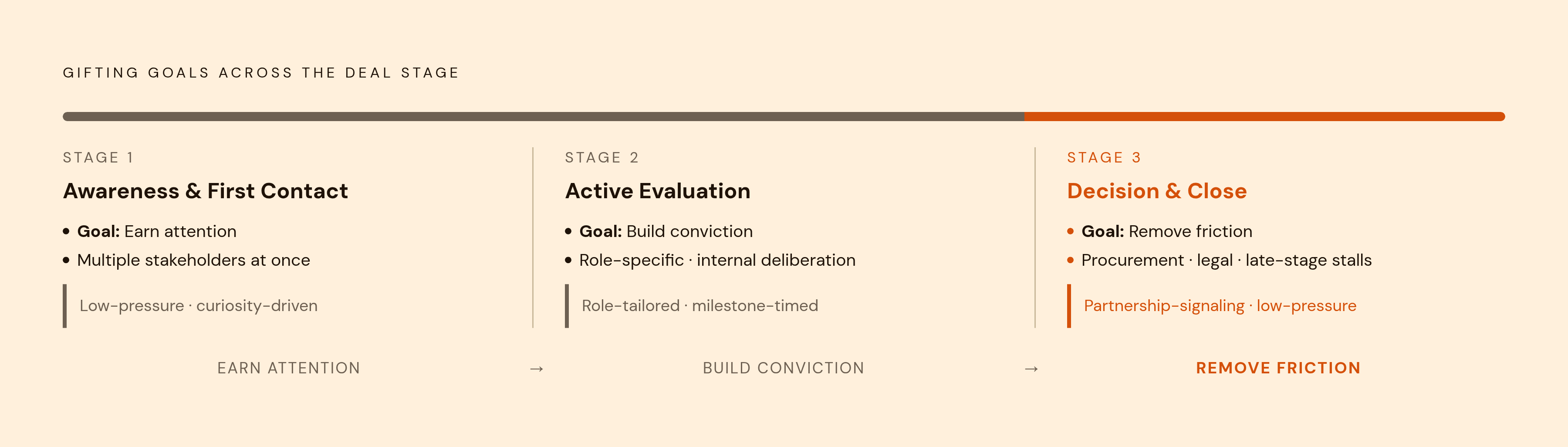
Three stages, three different committee objectives. Stage 1, awareness and first contact, centers on earning attention from multiple people at once, not just deepening a conversation with the champion. Stage 2, active evaluation, is about building conviction that's specific to each role while the committee works through internal deliberation. Stage 3, decision and close, is about resolving objections and keeping the deal from stalling out in procurement or legal right when it's closest to done.
Stagger the outreach. Hitting every contact on the committee with the same campaign on the same day reads as a mass send, and it burns the differentiation gifting is supposed to provide. The sequencing logic generally runs champion first, since they're the entry point. Economic buyer and technical buyer get engaged once there's real signal the deal has legs. Blockers get addressed proactively, before they've raised an objection, not reactively after they've already said no.
Gift type, spend, and framing all shift by stage. First-touch gifts exist to earn a conversation. Mid-funnel gifts reinforce the specific value each role cares about. Close-stage gifts remove friction and signal something closer to partnership than sales pressure. Treating all three the same, sending an identical gift at every stage, wastes the one advantage physical outreach has: the ability to say something different at each moment.
Stage 1 gifting plays: earning attention from a cold committee
The goal here is curiosity, enough of it that the champion has internal cover to bring the vendor's name into a room. It's curiosity, enough of it that the champion has internal cover to bring the vendor's name into a room.
For the champion, the first-touch gift should be low-pressure and genuinely useful. A curated book relevant to their function, a premium food or beverage item, or something tied to a publicly known interest all work better than anything branded. Pair it with a handwritten note that references a specific business challenge the company is facing. The ask is fifteen minutes, nothing more.
Economic buyers are a different animal at this stage, mostly because they're drowning in vendor outreach already. A dimensional mail package, something in a box or a tube rather than a flat envelope, signals a level of effort that stands out by default. The message should lead with a business outcome, tied to something publicly stated about the company's strategic priorities. Send after the champion has made first contact, so the CFO hears the vendor's name internally before a gift shows up out of nowhere.
Cold and unresponsive contacts respond differently to this channel than to another follow-up email. Reachdesk-reported data shows response rates from previously unresponsive contacts jumping as much as 212% when gifting runs alongside standard outreach, a number that matters specifically for the committee members who've ignored everything sent to their inbox so far.
Stage 2 gifting plays: sustaining engagement across the evaluating committee
Deals stall in Stage 2 more than anywhere else, mostly because the champion is off having internal conversations the vendor can't see, and the silence gets mistaken for disinterest.
Technical buyers respond well to sends that respect the seriousness of their evaluation. A curated resource kit, relevant documentation, a third-party analyst report, maybe a well-chosen tool or gadget, signals an understanding that this person is doing real diligence, not just kicking tires. Keep the message focused on integration, security posture, and deployment complexity. ROI belongs on the economic buyer's track, not here. Timing this send around a technical milestone, a proof-of-concept kickoff or a security review submission, gives it a reason to land when it does.
End users get skipped in most gifting programs, which is a mistake given how often they end up as the internal voice that either champions or torpedoes adoption once the deal reaches its final stage. Team-based sends, a shared meal delivery, a collaborative kit, something the whole group experiences together, build goodwill with the people who'll actually use the product day to day. The message here should stay in workflow and peer-testimonial territory. Business case language doesn't land with this audience, because it's not their job to think about the business case.
Keeping a committee engaged through Stage 2 matters because momentum lost during internal deliberation is rarely recovered at a later stage.
Stage 3 gifting plays: resolving committee friction at the close
By the time a deal reaches procurement and legal, the relationship has usually gone fully transactional. That's exactly the moment a physical send can do the most work, because it's the moment least likely to see one.
Procurement and legal exist, in part, to slow vendors down. A thoughtful, low-pressure gift, a quality food item, a note that acknowledges how complicated their role actually is, doesn't rush the process. It humanizes it. The framing should lean into partnership and vendor stability, not urgency. Timing this send for when the contract first enters their queue, rather than after they've already raised a red flag, keeps it from reading as damage control.
When a deal goes quiet after Stage 2, a well-timed physical send to the economic buyer or champion often does more than another follow-up email ever could. Reachdesk has reported a 163% increase in won business tied to gifting integrated into marketing and sales campaigns, alongside that same 212% lift in response from previously unresponsive contacts. Both numbers point at the same mechanism: silence isn't always a no, sometimes it's just a channel problem.
For deals above a certain size, an executive-to-executive send, something curated from a CEO or VP directly to the economic buyer, signals a level of commitment no contract clause can replicate. Paired with a handwritten note, this combination is arguably the highest-signal touchpoint available at the close stage. It says the relationship matters beyond the paperwork, at exactly the moment the paperwork is all anyone's looking at.
Connecting gifting sequences to the broader ABM tool stack
Gifting doesn't replace orchestration, intent data, or attribution tools. It extends them into a physical channel most competitors aren't running at any real scale.
A workable stack builds in layers. Personalization and account intelligence come first: research tools and contact data that make sure a send actually reaches the right person with the right context. As a program grows, predictive intent platforms help prioritize which accounts are showing real buying signals right now, versus which ones just look good on paper. Orchestration and attribution tools come in once volume picks up, tracking which touches actually move a deal forward. Gifting platforms slot in as a specialized layer on top of all this, triggered by the same signals that fire off an email sequence or a targeted ad, rather than running on their own separate calendar.
Every gift has to get logged in the CRM, tied to the account, the contact, and the deal stage it was sent at, and this isn't optional. A gift that lives outside that system can't be attributed to anything. Nobody can tell whether it worked, and a sequence that can't be measured can't be improved. Given how much more expensive physical outreach is than an email send, that tracking discipline is essential. It's the only way to know if any of this is actually paying for itself.