Webinar and Virtual Event Gifting Workflows for Pipeline Teams
Time your webinar gifts to engagement signals, not the calendar date.

Webinar volume across B2B is climbing, and most of the pipeline it generates never gets credited back to the event that sourced it. Webinar volume across B2B is climbing, and most of the pipeline it generates never gets credited back to the event that sourced it, a sequencing problem: marketers still treat gifting as a single blast tied to a calendar date, when the actual lifecycle of a webinar has at least three distinct moments where a well-timed send changes behavior. It's a sequencing problem: marketers still treat gifting as a single blast tied to a calendar date, when the actual lifecycle of a webinar has at least three distinct moments where a well-timed send changes behavior. Fix the timing, and gifting becomes a lever on pipeline instead of a mere thank-you gesture.
Sales teams now account for the highest participation rate in webinar hosting across functions. That alone should end the argument that webinars are a top-of-funnel awareness play. They're a revenue motion, sourcing and advancing deals directly, and a gifting workflow built around the old assumption, that a webinar is just brand exposure, will waste budget on the wrong moments and the wrong people.
What the webinar engagement data tells you before you send anything
Most gifting budgets get wasted on the wrong assumption: that everyone who registers, or everyone who shows up, deserves the same treatment. Most gifting budgets get wasted on the wrong assumption: that everyone who registers, or everyone who shows up, deserves the same treatment, but they don't. Certain behaviors during and after a session predict buying intent. Missing those signals turns the gifting program into an expensive way to thank people who were never going to buy anything.
Watch for these:
- Resource link clicks during or right after the session
- Chat participation and question volume, not just presence in the room
- Q&A submissions, especially multi-part or product-specific ones
- Poll answers that reveal where someone sits in their buying process
- Full attendance versus an early drop-off
None of these signals mean much in isolation. A poll response paired with a product-specific Q&A question tells a different story than the same poll response sitting alone. So what happens with this data? It feeds lead scoring and the segmentation tiers that decide who gets what kind of send later. Skipping this step turns every later stage in the workflow into a guess wearing a strategy's clothes.
Stage one: pre-webinar sends that lift registration and show-up rates
Pipeline doesn't leak at the send button. It leaks in the gap between registration and attendance, and that's where gifting earns its keep before the event even starts. Chasing more low-intent registrations is a weaker move than getting the people who already said yes to actually sit down and watch.
Three sends do most of the work. An incentive-to-register piece, aimed at target accounts pulled from ABM or intent data, works because a physical item ahead of the invite signals the event is worth clearing calendar time for. A reminder send goes to registrants who haven't engaged with follow-up emails, using a physical or higher-touch channel that stands apart from the inbox where earlier outreach went unread. Executive-tier sends, reserved for VIP or named-account registrants, run higher-touch and get coordinated with the account owner directly in the CRM, so nothing crosses wires with outreach already underway.
None of this works if it reads as generic. The strongest account-based campaigns personalize down to the account itself, not just industry vertical or job title, and they hit across more than one channel at once. A pre-webinar send that name-drops "great event coming up" without tying to what that specific account actually cares about reads as noise. The mechanism behind an email subject line and a box on someone's desk isn't different: specificity earns the open, or the unboxing, in both cases.
Stage two: live-event and same-day sends that deepen engagement during the session
The live session is the highest-intent window in the whole lifecycle. Attention sits on the topic, the speaker, and the brand all at once, so a send timed to land during or right at that moment catches someone already leaning in, rather than someone who's moved on to the next tab.
Digital gift cards, delivered to confirmed attendees the moment the session opens, carry almost no fulfillment lag and need no mailing address. That makes them the default for anything same-day, and the low friction is why they work. Virtual experience kits play a different role: tasting boxes, activity kits, workshop materials, these need to ship ahead of time so they land the day of the session, giving a video call a physical anchor it wouldn't otherwise have. Then there's the real-time layer, the send triggered by something that happens live: a sharp Q&A question, or a poll answer that signals real pain, earning a same-day digital gift as acknowledgment.
Enterprise webinars rarely draw one attendee from an account. Multiple stakeholders from the same buying committee usually show up together, and sending them identical gifts wastes a chance to speak to each role on its own terms. A technical evaluator responds to something hands-on: a workshop kit, a tool-related item. An executive sponsor wants the opposite, something with almost no obligation attached, a short note and a well-made item that doesn't read as a sales tactic. An internal champion, the person who talked their own team into showing up, deserves a send that names that role directly instead of treating them like another line on the registrant list.
Stage three: post-event sends timed to behavioral signals, not the calendar
Most attendees never convert to a qualified lead, and most of those qualified leads never turn into pipeline. Two steep drop-offs, stacked on top of each other, and a well-timed gift is what pushes someone across the line before that momentum bleeds out over a week of silence. A generic three-day-later email is the weaker default most teams still run on autopilot. Behavioral triggers beat calendar-based nurture because they respond to what a person actually did, not to what day it happens to be.
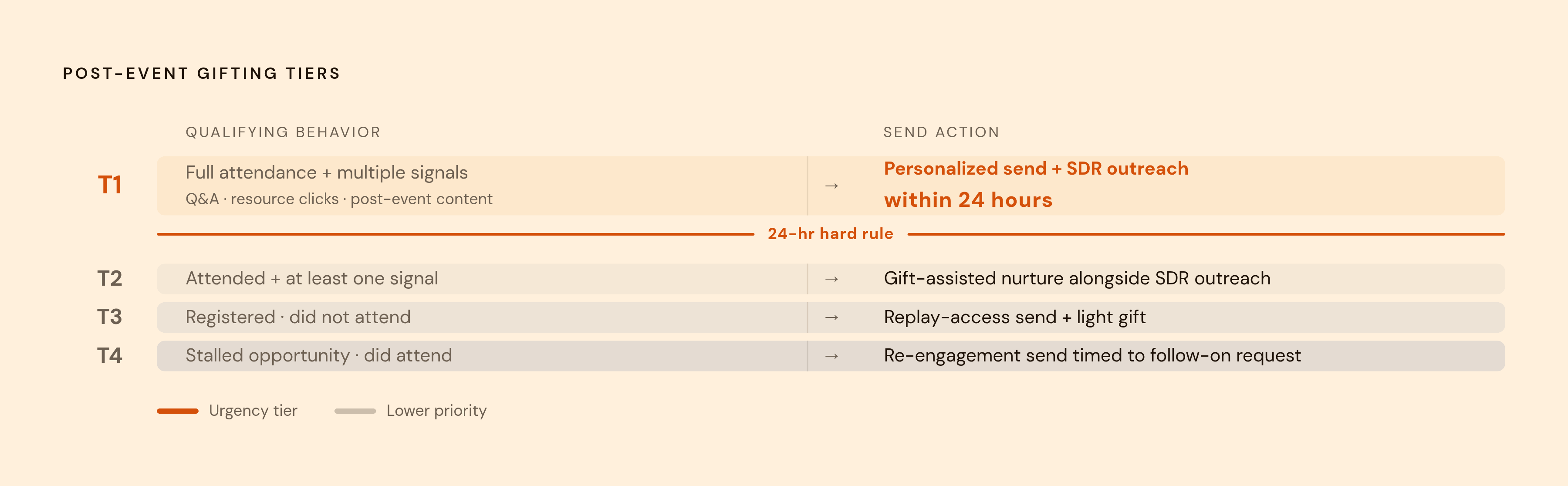
Segmentation carries the weight here, and it splits into four tiers. Tier 1 is full attendance plus multiple engagement signals: Q&A participation, resource clicks, post-event content consumption. That tier earns an immediate personalized send paired with SDR outreach inside 24 hours, no exceptions. Tier 2 covers moderate intent, attended plus at least one signal, and gets a gifting-assisted nurture sequence timed to land alongside SDR outreach, so the prospect feels a physical touch and a human one close together. Tier 3 covers registered-but-didn't-attend, which gets a replay-access send with a light gift attached, more of a re-qualification move than a real pipeline bet. Tier 4 is stalled opportunities that did attend, where a re-engagement send is timed to a specific ask for a follow-on conversation.
CRM-triggered gifting is what lets this tiering run without someone babysitting it. Delivery fires automatically at the right pipeline stage. Gift selection and message still need a human eye, since a template stamped out at scale undermines the point of tiering people.
How AI and Platform Integrations Remove Manual Bottlenecks From This Workflow
None of the above survives if someone has to sit down after every webinar and sort attendees into tiers by hand. It's a part-time job, one that collapses the moment webinar volume climbs past a handful of sessions a month. It's a part-time job, and it collapses the moment webinar volume climbs past a handful of sessions a month.
The integration stack has to handle four things without a person in the loop. The webinar platform pushes engagement data, watch time, Q&A activity, poll answers, CTA clicks, into the CRM in real time or close to it. The CRM scores and segments attendees against thresholds set ahead of time. The gifting platform picks up that trigger and starts the right send sequence on its own. Every send logs back to the CRM record, so whoever owns the account sees what went out and when, without hunting through a second system to find it.
AI earns its place in exactly one part of this chain: gift selection, and nowhere else. Systems that pull in recipient details, past interactions, relationship context, occasion, budget, can generate a short list of options instead of forcing someone to pick from scratch every time. The hours spent hand-curating sends one at a time are the actual bottleneck AI removes; the judgment calls around tiering or timing remain.
Teams that wire AI into the webinar-to-gifting pipeline now are running with a structural edge over the majority still doing this by hand. And that edge compounds the longer the rest of the market leaves it uncontested.
How to measure whether the gifting workflow is moving pipeline
Most marketers underestimate what gifting and direct mail return, because the attribution window is too short to catch the result. The programs work. Measurement gets disconnected from the physical timeline of delivery and decision-making, and a 30-day cutoff doesn't come close to capturing how an enterprise buying cycle actually moves.
SMB programs need a 90-day measurement window at minimum. Enterprise programs need 180 days, not a day less. Cutting that window short causes the ROI numbers reported up to leadership to undercount what the event actually drove, steering next quarter's budget in exactly the wrong direction.
Once the window is set correctly, five metrics belong on the dashboard. Response rate lift compares gifted against non-gifted segments from the same webinar cohort, holding the event constant so the gift is the actual variable under test. Meeting book rate tracks what percentage of Tier 1 attendees convert into a booked meeting. Deal velocity compares days from attendance to the next opportunity stage across gifted and non-gifted attendees, showing whether the send actually speeds anything up. Win rate looks at closed-won percentage specifically on deals where a gifting touchpoint got logged in the CRM. Pipeline influenced totals the dollar value of webinar-sourced opportunities where gifting played a role somewhere along the way.
Direct mail as a category sets a high floor, and marketers who run it consistently rank it among their best-performing channels for return on spend. A gifting-assisted webinar workflow that clears that bar has earned its budget. One that falls short deserves a hard look, and more often than not, the fix is the tiering, the timing, or the measurement window. It's the tiering, the timing, or the measurement window that's broken.