Funny White Elephant Gifts That Work in a Professional Setting
The quirky gift that gets stolen beats the expensive one that gets forgotten.

I've run White Elephant exchanges at three different companies now, and the pattern is always the same: the gift everyone remembers is the one that got laughed at and fought over, more than the most expensive one in the pile. That's the whole game, and most people misunderstand it before they even start shopping.
What "professionally safe" actually means in a mixed workplace crowd
Here's the problem nobody thinks through before buying: you're shopping for a room, not a person. White Elephant pulls from every department, every seniority level, every age bracket and cultural background in the building, and you have zero information about who's going to end up with your gift. That's the whole format, baked in by design. But it does mean your usual gift instincts, the ones built around knowing someone's taste, don't apply here.
So what's the filter? Start with the obvious one: nothing NSFW. I've seen a genuinely funny gift kill the mood in a room because one person went quiet and visibly uncomfortable while everyone else laughed. That silence spreads faster than the joke did. Once that happens, people stop opening gifts with curiosity and start opening them with dread, wondering what's next.
Then there's the personal-care trap. Skincare, clothing, anything with a strong scent, these read as presumptuous even when they're expensive and well-intentioned. You're essentially telling a stranger what you think of their appearance or their bathroom shelf, and that's an overstep even when it's meant as a compliment.
Alcohol deserves more suspicion than it usually gets. It seems like a safe crowd-pleaser because so many office parties involve wine anyway. But not everyone drinks, company policies on alcohol gifts vary more than people assume, and a bottle of cabernet in a pile of twenty gifts can turn into an awkward moment for whoever unwraps it in front of their manager. Edibles carry a smaller version of the same risk: allergens and dietary restrictions you can't see coming when you're buying for forty strangers.
The inside-joke trap is subtler and just as common. A gift built around a meme, a niche hobby, or a reference that only half the room gets reads as exclusionary funny rather than universally funny. The other half of the room just watches everyone else laugh.
Office culture does shift the line, some. A ten-person startup with three years of shared inside jokes can get away with sharper humor than a four-hundred-person department exchange where half the attendees have never met. Even so, in loose cultures, I'd still lean toward universal over edgy. Think about the actual trade: edgy might get you a slightly bigger laugh, but if it misses, people remember that far longer than they remember a solid, safe laugh. The math doesn't favor the risk.
None of this means safe has to mean boring. Safe means aiming the joke at something everyone's lived through, bad Mondays, the printer that never works, the fourth coffee of the day, instead of aiming it at a person, a group, or a belief.
The quirky-plus-practical formula that turns a gift into something people actually fight over
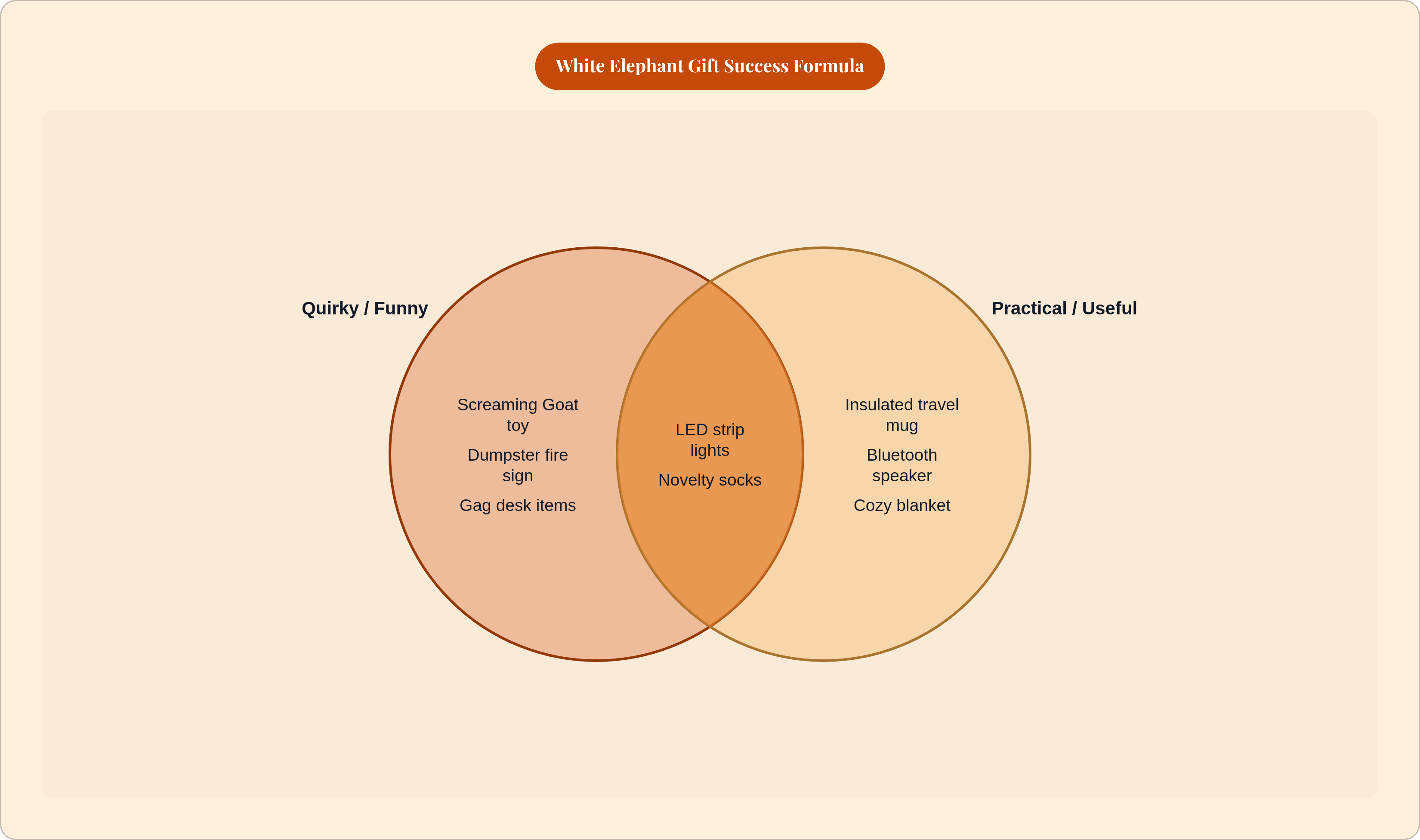
Every gift that actually works passes two tests at once: it's quirky enough to get a real laugh when it's unwrapped, and it's practical enough that the person holding it doesn't want to let it go. Miss either half and the gift underperforms.
Pure gag gifts are the classic miss. They get opened, they get a laugh, and then they sit in a drawer forever. The person who ends up with a whoopee cushion or a rubber chicken feels like they got stuck rather than like they won the round. Nobody steals a gift they don't actually want.
That's the tell, honestly. Watch the steal mechanic during your next exchange: it's a live signal for gift quality. If a gift gets stolen three or four times before the game ends, that's not luck. That's a gift that made people think "I'd actually use that" and laugh at the same time. Those two reactions together are what create demand.
Universal subject matter beats niche references every time, and this is worth sitting with for a second. Workplace chaos, caffeine addiction, dreading Mondays, sitting through a meeting that should've been an email, these are experiences shared across every role, every industry, every age group in the building. A pop-culture reference, on the other hand, has a shelf life. It's funny for exactly as long as the reference stays current, and it excludes anyone who doesn't watch that show or follow that meme.
Gender-neutral and consumable gifts travel the farthest, too. Whoever ends up holding it can use it as-is, no adjustment needed. Keep this formula in your head as you read through the categories below: quirky plus practical, universal over niche. It's the lens for every single pick that follows.
Desk accessories and novelty office items that land the joke without cluttering someone's space
Desk items have a built-in advantage: everyone has a workspace, so the utility question answers itself. A funny object sitting on a desk also keeps working long after the party, generating a laugh every time a coworker walks by and notices it.
A few that consistently perform well:
- Mini Wacky Waving Inflatable Tube Guy. Battery-powered, absurd, flails on command. The joke needs zero explanation, which matters more than people realize; anything that requires context loses half its punch.
- Dumpster fire pen holder or sticky-note pads. This hits directly at the shared experience of a rough Q4 or a project that's gone sideways. The humor points at the situation, not at any specific coworker, which is exactly the target you want.
- Magnetic thinking putty. Framed as "adult desk therapy." Satisfying to touch, easy to explain in one sentence, no setup required.
- Elephant-shaped desk organizer. This one's a small meta joke, a literal white elephant that also holds pens. People catch the reference a beat after opening it, and that delayed laugh is its own reward.
- Desktop zen garden. Small, calming, a little ironic given the high-stress office it's sitting in.
- Magnetic decision-maker spinner. Pokes fun at how long it takes anyone to pick a lunch spot or decide between two nearly identical email drafts.
One practical note: skip anything noisy if you're not sure about the office layout. A talking or beeping toy is fine in a loud sales floor, less fine in an open-plan office where six people are on calls. And keep size in mind. Nobody wants to lug home something bulky or fragile after the party's over; that turns a fun gift into a chore.
Mugs, coffee gear, and beverage items that tap into the office caffeine obsession
If there's one experience that crosses every department, seniority level, and personality type in a company, it's needing coffee to function. That makes this category close to a guaranteed hit.
Mugs are funny when the joke is specific but still legible to outsiders. A mug with a pivot-table joke printed on it will get a genuine laugh out of anyone in finance or data, and everyone else still gets the gist even without spreadsheet experience. A Loch Ness Monster tea infuser works on pure visual comedy, Nessie rising out of a mug of hot water, no shared context required at all.
Then there's the upgrade angle. A sleek pour-over coffee brewer is funny and useful because it implicitly roasts the sad drip machine sitting in the break room. The joke is in what it says about office coffee; the utility is in the fact that it actually makes a better cup. A high-quality insulated travel mug, something like a Yeti Rambler, earns its steals through brand recognition alone. People know what that mug is worth, and that recognition drives demand in ways a mystery gift can't.
For something more inclusive than wine or spirits, a gourmet tea, coffee, or hot cocoa sampler works well either alone or paired with a mug. It sidesteps the alcohol problem entirely and still feels like a treat.
The category's real advantage is how low-risk it is. Mugs and coffee gear are gender-neutral, easy to wrap, and carry no allergen or fragrance risk. That's a rare combination.
Books, card games, and novelty stationery that reward wit without requiring everyone to play along at once
A funny book or card game works differently than a desk toy. It doesn't ask for immediate participation; it sits on a shelf or a coffee table and invites comments over time.
The Field Guide to Dumb Birds of North America by Matt Kracht is a strong example. The illustrations and the premise, birds are inherently ridiculous creatures, land without needing any office context at all. It works as a coffee-table book for months after the party ends. Exploding Kittens is another safe bet: widely known, simple rules, absurdist without leaning on inside knowledge. It works whether the recipient plays it with coworkers at the next game night or takes it home to their family.
Rubber stamps printed with corporate-speak phrases ("circle back," "per my last email") are a smaller, sharper joke. They land best in offices where people are already self-aware about the absurdity of meeting culture; in a more formal environment, that same stamp might just get a polite chuckle instead of the knowing laugh you're going for.
On the cheaper end, funny sticky notes and sarcastic notepads punch well above their price. They're immediately usable and often get stolen on the strength of the laugh alone, no bigger investment required.
One caveat worth naming directly: this whole category depends on an office that leans toward sarcasm and self-awareness. In a more formal or buttoned-up environment, a cozy gift or a practical desk item is the safer bet.
Cozy wearables and blankets that win on comfort and get stolen for purely selfish reasons
The steal dynamic here works differently than it does with novelty items. People fight over a blanket because they genuinely want it, not because it's funny, and that makes cozy gifts reliable no matter what kind of office culture you're dealing with.
Big, plush throw blankets are some of the most consistently stolen gifts I've seen in these exchanges. Nearly everyone works in an office that's too cold half the year, so the appeal is immediate and it doesn't require any explanation.
Novelty socks fill a different niche entirely. They're cheap enough to fit any budget, cheerful enough to get a laugh the second they're unwrapped, and practical enough that someone will actually wear them the next day. Bold prints, food patterns, animal faces, whatever the design, the comic moment happens right at the reveal, and there's no personal commitment involved. That's what makes socks such a strong pick when you know almost nothing about the person who might end up with them: one-size-fits-most, gender-neutral, no fragrance or allergen risk to worry about.
Where wearables go wrong is anything beyond socks and small accessories. Sizing, style, personal taste, these turn a simple gift into a guessing game, and an anonymous exchange is exactly the wrong place to guess. That sweater you thought was cute? It's next year's regift.
Tech gadgets and desk toys in the mid-price range that feel like a real prize
Tech gifts carry a certain weight the moment the pile gets unwrapped. Novelty and perceived value both read higher here, so these often become the item everyone's eyeing from across the room before the game even starts.
A few that consistently deliver:
- Smart LED strip lights. Easy to set up, visually striking, works in a home office just as well as anywhere else. The appeal is almost entirely in the color-changing novelty.
- Shashibo Shape-Shifting Cube. A magnetic fidget toy that doubles as desk art. It's satisfying to fidget with, genuinely hard to put down, and it appeals across age groups in a way a lot of desk toys don't.
- Compact Bluetooth speaker. Practical, portable, unlikely to be something a colleague already has three of. It also works well for remote employees who'll actually use it at home.
- Tabletop desk vacuum. Small, oddly satisfying, and genuinely useful for keyboard crumbs. Nobody thinks they need one until they see it suck a week's worth of debris out of a keyboard.
One caution worth flagging: prank tech, the fake blue-screen-of-death USB drives and similar gags, should stay reserved for offices where everyone involved has explicitly signed up for that kind of chaos. In a mixed group, the risk of someone panicking over what looks like a dead laptop just isn't worth the laugh.
Under-budget picks that punch above their price through sheer absurdity
Here's something worth sitting with: in White Elephant, steal frequency tracks laughs and desire, not price tag. A genuinely funny five-dollar gift gets stolen more often than a forgettable thirty-dollar one. Price and popularity aren't the same variable here.
The Screaming Goat mini figurine is the clearest proof of this. Push the button, it emits a startlingly realistic goat scream, and it costs next to nothing. The joke lands instantly and it's completely harmless, which makes it one of the safest picks on this entire list regardless of office culture.
The "Days Since Last Dumpster Fire" erasable wood sign works on a similar principle but goes a step further: the erasable counter lets the recipient adapt the joke to whatever chaos they're currently dealing with. The humor points at shared professional suffering, not at any individual, which is exactly the target this whole article keeps circling back to.
What makes absurdist gifts work at these prices is that the humor is carrying the entire load. There's no utility expectation to fall short of, so one genuine laugh is the whole value proposition, and it's enough. The catch: the joke needs to be obvious the second it's unwrapped. Anything that needs a follow-up explanation loses the room before it gets going.
The short list of gifts that look funny but reliably misfire in a professional setting
Even one uncomfortable reaction changes the temperature of the whole room, and that's the core reason NSFW humor doesn't belong in a professional exchange no matter how funny it seemed at the store.
A few specific categories worth avoiding on sight:
- Alcohol and spirits. Exclusionary for non-drinkers, complicated by company policy in ways you might not know about, and easy to swap for a better consumable option anyway.
- Strong fragrances and perfumes. Sensitivity to scent is common and completely invisible until someone's dealing with a headache for the rest of the party.
- Anything that reads as commentary on someone's appearance, habits, or personality. Even when it's meant warmly, the anonymous format means you don't know who's opening it, and the risk runs one direction only.
- Prank tech built to cause alarm, like fake error screens or fake spills. Calibrated for offices where everyone's opted into that kind of chaos, not the default for a mixed group of strangers.
- Clothing beyond socks. Sizing assumptions and personal style turn a fun idea into next year's regift pile.
The heuristic that ties all of this together: if the joke only works for a specific type of person, it's an inside joke, and inside jokes don't belong in a format built entirely around not knowing who's on the other end.
How to make the exchange itself run smoothly so the gifts land
Even a great gift can fall flat if the exchange itself is clunky, so the mechanics matter almost as much as the shopping does.
Set a price range and stick to it, something in the fifteen-to-twenty-five-dollar band tends to keep things low-stakes without feeling cheap. Cap the number of steals per gift, two or three max, or the game drags and people lose interest waiting for their turn. Wrap gifts so nobody can guess what's inside; a gift bag with tissue paper sticking out gives away the surprise before the game even starts.
Explain the rules before anyone picks a number, especially if there's a mix of people who've played before and people who haven't. And build in a few minutes of actual downtime after the last steal so people can look at what they ended up with, laugh about it, maybe negotiate a trade. That's usually when the best conversations happen, coworkers from different departments comparing notes on the goat that screams versus the dumpster fire sign, and for one afternoon, that's worth more than whatever was actually in the box.