Post-Conference Follow-Up Gift Sequences for Field Marketing Teams
Physical gifts paired with rapid follow-up convert conference leads before competitors reach them.

The average reply rate on outbound email sequences is 3.8 percent, Salesloft's benchmark data shows. That number is the starting point for understanding why post-conference gift sequences have become a tactical necessity rather than a nice touch. Field marketing teams spend months building toward a conference, then hand the entire follow-up phase to a channel that fails to get a reply from the vast majority of people it reaches. As AI filters out more of the generic outreach flooding every inbox, the 42DM 2026 conference guide points out that in-person channels are becoming harder to replace with anything digital.
Slow sequencing compounds the low reply rate. An attendee who talked to a sales rep at a booth has usually heard from three competitors before most field teams send their first follow-up email. Tofu's 2026 automation guide documents why: teams spend days cleaning badge-scan data, removing duplicate contacts, writing copy, and building out sequences. Every one of those days erases the speed advantage that made the booth conversation valuable. By the time the email goes out, the prospect has moved on, and the message lands in a crowded, cold inbox instead of a warm one.
The same Tofu research cites data from the Center for Exhibition Industry Research showing that 80 percent of trade show leads never get personalized follow-up, even though 81 percent of attendees carry real buying authority. Picture that gap for a moment: four out of five people who could actually sign off on a deal walk away from a conference and hear nothing specific to them again. That gap between who holds buying power and what kind of follow-up they receive is exactly where pipeline disappears, quietly, long before anyone runs a quarterly report.
Some teams will say they already personalize their post-event emails, and in a narrow sense that may be true. True one-to-one personalization, the kind that references what a person said at a specific session or asked at a specific booth, cannot be produced by hand at the volume a single conference generates. A show that brings in a large number of badge scans does not leave room for a human to write that many individual messages inside the window where speed still matters. That's the structural mismatch this piece is built around: what field teams are doing after a conference and what actually converts a conversation into a deal are no longer the same thing.
How field marketing's long cadence reshapes post-conference follow-up
Why does a single follow-up email, however well-written, fail to do the job? Because field marketing doesn't run on the timeline most reporting tools assume. A team that judges an event's success 90 days after the booth comes down is measuring the wrong window.
That long tail changes what a single touch is supposed to do. One email, sent once, asks an entire 6-to-12-month relationship to turn on one message landing at the right moment, which is a lot to ask of any single artifact. A gift sent the week after a conference is the opening move in a much longer sequence of planned touches, each one timed to keep a contact moving instead of letting the relationship go cold the way most post-event follow-up currently does.
This has a direct planning consequence. Every touch in that sequence, the email, the phone call, the LinkedIn message, the physical gift, has to be mapped out before the event even ends. Building it on the fly afterward causes it to collapse into the same mass email everyone else is sending.
Since the follow-up phase carries a substantial share of an event's total effort and ROI, on par with what's sunk into pre-event planning and larger than what's spent on-site, the structure handling that follow-up has to earn its share of that weight. A single email clearly doesn't. The answer field marketing teams are converging on is a tiered, multi-touch sequence, and that structure is what the rest of this piece works through.
Three-tier gift segmentation
Not every name on a badge-scan list deserves the same follow-up, and sending identical gifts to everyone who walked past a booth wastes money while making the whole program look like a mass mailing rather than a real relationship. The first decision a field team has to make, before writing a single message, is who gets a gift at all and what kind. That decision rests on one signal more than any other: what the person actually did at the event, not their job title and not the size of their company. A contact who requested a demo, discussed pricing, or asked to schedule a meeting is behaving like a buyer. A contact who scanned a badge while walking to the coffee station is not, and treating the two the same wastes budget on the second group while under-investing in the first.
Tofu's 2026 framework turns this into a usable four-tier model. Tier 1 covers contacts who requested a demo, discussed pricing, or scheduled a meeting on-site, and they get same-day or next-morning one-to-one outreach from the rep who actually spoke with them. Tier 4 covers students, competitors, partners, and companies outside the ideal customer profile, and they get nothing, because spending gift budget on contacts who were never going to buy is money that should have gone toward Tier 1.
Gift spend should track that same tiering. The spend curve should follow the deal value curve, not the size of the list, because a program that spends evenly across all three tiers is really just spending evenly across contacts who have very different odds of ever becoming a customer.
Session attendance deserves a closer look, because it can quietly upgrade a contact's tier in a way that's easy to miss. Tofu's guide points out that someone who sat through a sponsored 45-minute session on a specific topic knows far more about the product and the problem it solves than someone who grabbed a branded water bottle on the way past the booth. Treating those two contacts the same because they both showed up on the badge-scan list ignores a real signal about buying intent.
One more wrinkle matters here, and it cuts against the instinct to personalize as deeply as possible. Gartner research cited in the underlying brief found that individual-level personalization in ABM post-conference sequences can actually work against a deal when it creates conflicting messages across a buying group, because each decision-maker on the account receives information optimized for their own role rather than a shared, consistent story. Tiering gives a team the structure to make that calibration deliberately instead of by accident, and without it, every gift sent is closer to a guess than a strategy.
A Tier 1 post-conference gift sequence, touch by touch
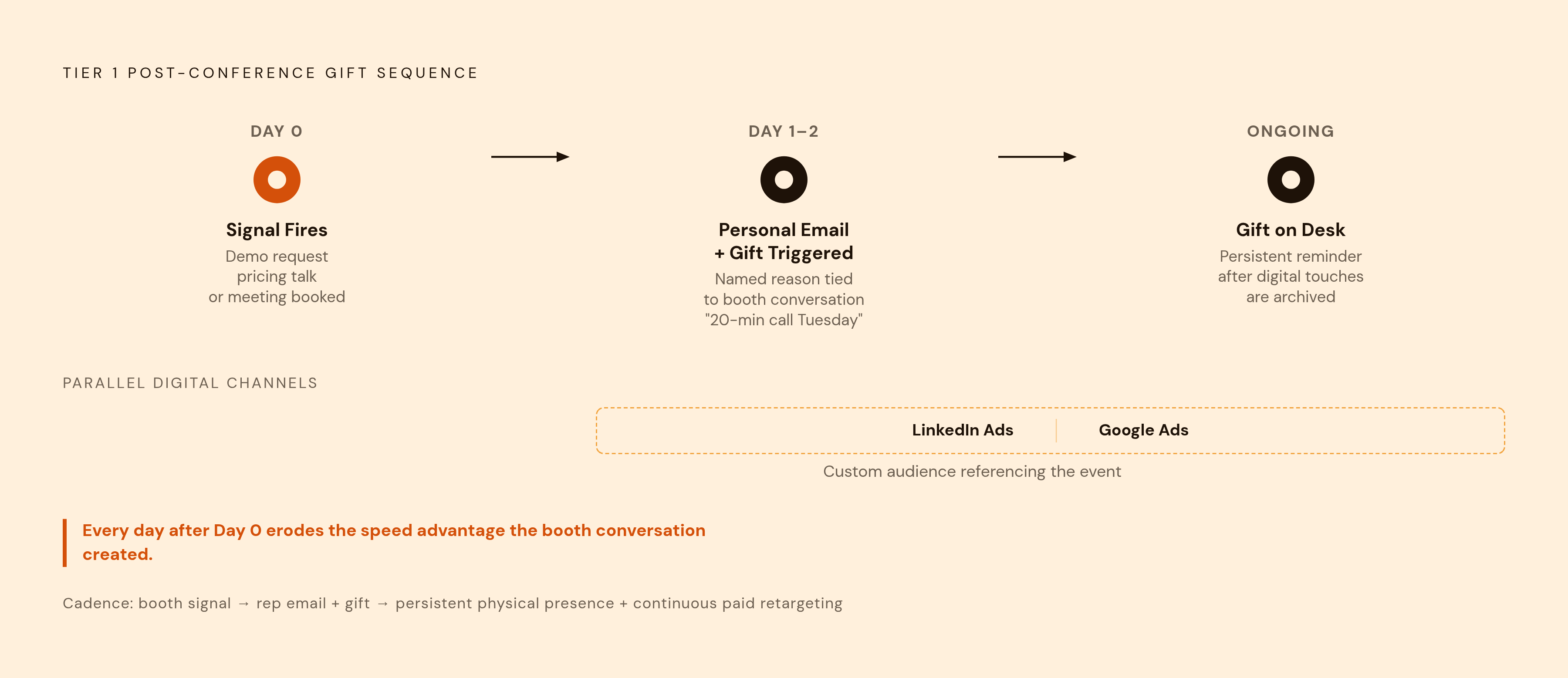
A Tier 1 sequence works because every touch is timed to a signal, carries a message that names the gift directly, and ends with a specific ask. Sending an expensive item by itself does none of that work. The mechanism matters more than the gift, and the clearest way to see it is to walk through the cadence day by day.
Day 0 is the day the signal fires, the moment a contact requests a demo, discusses pricing, or asks to schedule a meeting on-site. That's the trigger point, and everything downstream depends on starting the clock here rather than days later. That is the argument for triggering the gift immediately rather than waiting on list-cleaning or badge-scan processing, because those delays erode the advantage speed creates.
Day 1 to 2 is when the first personal touch goes out: an email from the actual rep who spoke with the contact at the event, instead of a templated note from a shared marketing inbox. The physical gift gets triggered here too, as its own distinct touch in the sequence, separate from the email.
The message itself needs to name the gift directly. A line like "I sent you [X] because [reason tied to what you told me at the event]" does the double duty of proving the sender was paying attention and giving the gift a reason to exist. That message closes with a specific ask, something like "Would you be open to a 20-minute call next Tuesday?" rather than a vague "let's connect." The gift opens the door. The ask is what walks through it.
Two real examples show how differently this mechanism can be built. BillingTree sent executives a locked, branded case, secured with two combination padlocks, along with a personalized notecard explaining that an Amazon gift card was inside, without giving the combination. The executive had to engage further to get the combination and claim the gift card, and that requirement to act is what turned a gift into a conversation rather than a one-way gesture.
Salesloft ran an account-based campaign offering coffee and lunch vouchers as an incentive to book a meeting, and the campaign generated a 60x return. Gift value and campaign return don't move together in a straight line. The design of the required action matters more than the price tag on the item.
None of this happens in isolation from the rest of the follow-up channels running in parallel. Uploading the event attendee list to LinkedIn Ads and Google Ads as a custom audience, then running ads that reference the event and point back to post-event landing pages, means a contact sees the same event referenced across email, LinkedIn, and paid ads at once. The physical gift adds a channel none of those digital touches can replicate: something that shows up on a desk, gets picked up, and sits there as a physical reminder of the conversation long after an email would have been archived.
Automation at scale: from twenty contacts to two thousand
Everything in the previous section works beautifully for the dozen or so Tier 1 contacts a single rep can track by memory. What happens to that same logic once a conference produces a much larger volume of leads is the question this scale raises. Running the Tier 1 sequence by hand across Tier 2 and Tier 3 as well is a workload large enough to consume a full-time employee's entire year, which makes manual execution a hard ceiling on how far the program can scale, regardless of how good the sequence design is.
Closing that gap is what gifting platforms with automation built in are for. The same platforms can require an action, booking a meeting, answering a qualification question, before a recipient can claim the gift, and can trigger a follow-up call-to-action once the gift has been claimed. That combination reproduces the BillingTree and Salesloft mechanism (signal, required action, follow-through) at a scale no team could manage by hand.
The next step in this direction connects gifting platforms directly to intent data sources like 6sense, Demandbase, and RollWorks, so gifts trigger based on where an account actually sits in its buying journey rather than on how many days have passed since the conference ended. Tied into a gifting workflow, that kind of signal lets a team send a gift when an account starts showing renewed buying intent three months after the event, timed to where the account actually stands instead of a fixed day-30 schedule.
Measuring whether the gift sequence moved pipeline, not just generated activity
Most teams don't fail to prove gifting worked because the proof is impossible to get. They fail because no one built a way to measure it before the campaign ran, and activity data gets mistaken for outcome data long after the fact. Counting gifts sent and notes opened feels like progress. It says nothing about whether any of it moved a deal forward.
Trade shows, executive dinners, and physical gifts all happen outside the digital tracking systems most revenue teams already rely on, which makes gifting one of the hardest touches to attribute and one of the most contested when budget reviews come around. The answer taking shape across the industry is attribution stacking: combining multi-touch attribution, marketing mix modeling, and incrementality testing, so gifting shows up as one discrete, trackable touch inside a CRM instead of an untracked line item nobody can defend.
Specific metrics to track for gifting include response rate lift between gifted and non-gifted outreach cohorts, meeting book rate, deal velocity, and win rate on deals that included a gifting touchpoint somewhere in the sequence. Trying to reconstruct them afterward from whatever data happens to exist rarely works.
The gap between belief and proof shows up in 2026 research from Huggg, which found that a strong majority of HR professionals believed gifting positively affected employee retention, but only a small fraction had actually measured a retention improvement or tracked gifting ROI in any formal way. That gap between what people believe and what they've actually measured is the exact objection a measurement framework has to answer, in gifting applied to retention and in gifting applied to post-conference pipeline alike.
Building that framework in practice starts with pulling two cohorts from the same conference list: contacts who received a gift touchpoint somewhere in their sequence, and contacts who received digital-only follow-up with no physical send. Compare meeting book rate between the two groups. Platforms built to integrate gifting with CRM data make this kind of cohort comparison possible by default, turning what used to be a leap of faith about whether a gift mattered into a number a budget review can actually defend.
Sources
- 2026 Marketing Conference Guide for B2B Tech Leaders
- How to Automate Post-Conference Follow-Up at Scale in 2026
- How to Build a B2B SaaS Field Marketing and Events Program From Zero: The Operator Playbook for Conferences, Owned Events, Roadshows, and Executive Briefings in 2026
- The B2B Field Marketer's Event Stack: What to Use and What to Stop Paying For in 2026