Geographic Segmentation for International Gift Campaigns
Build regional gift strategies before customs blocks them or culture rejects them.

Most B2B teams build one gifting playbook, swap in a foreign address, and call it global. That's how campaigns break: the gift gets stuck in customs, it reads as offensive in the recipient's culture, or the timeline assumes a delivery window that only exists in North America. I've sat through the post-mortem on more than one of these, and the pattern repeats itself almost exactly each time. So let's go region by region, look at what actually goes wrong, and build segmentation logic that catches these problems before a box ever ships.
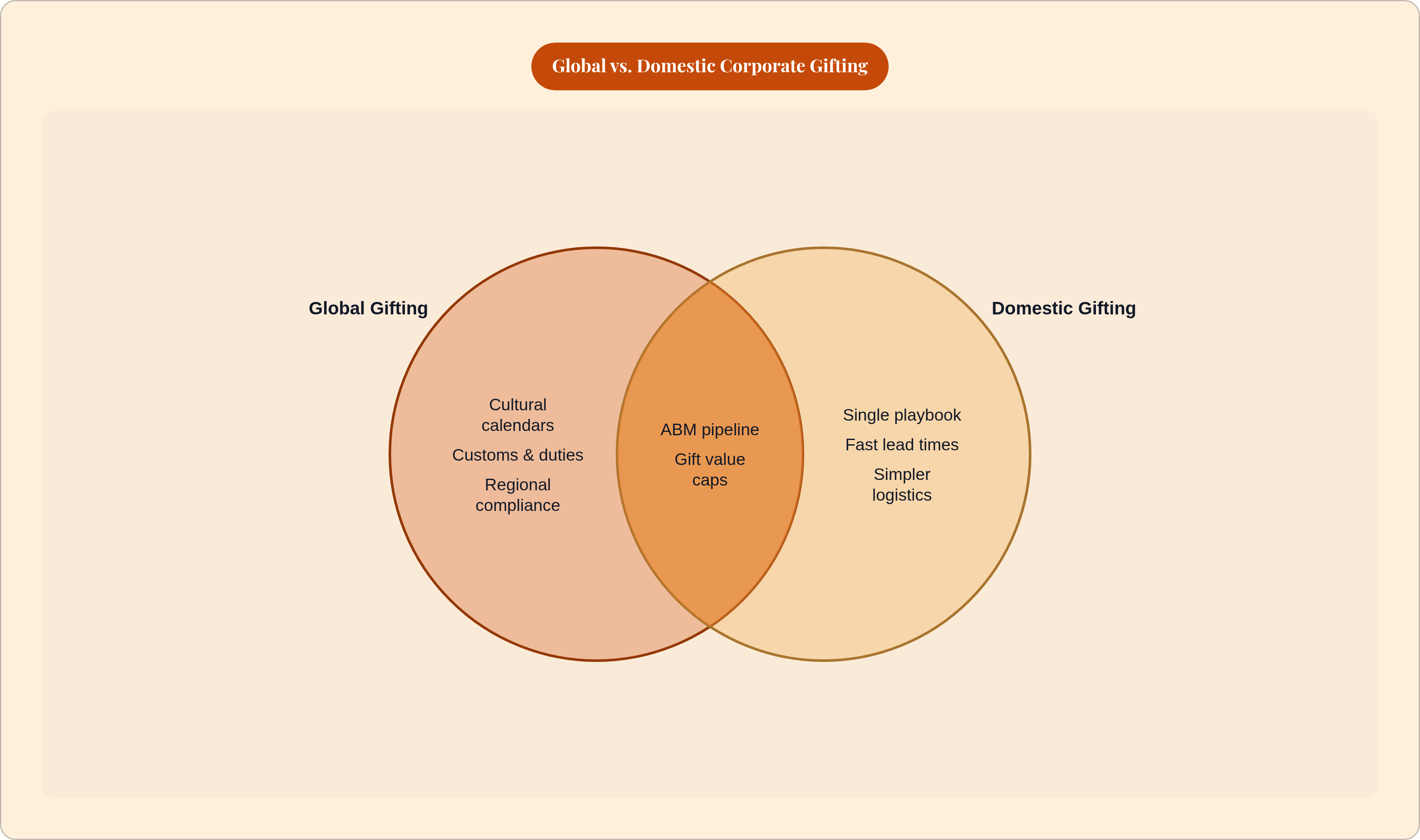
The size and shape of the international corporate gifting opportunity
The global corporate gifting market hit $886.56 billion in 2025. The Business Research Company puts it on track for $1.31 trillion by 2030, about 8.2% growth a year. That's a big number, but on its own it tells you nothing about where to put next quarter's budget.
Break it down by region and things get more useful. North America holds a leading share of the global market, per Cognitive Market Research, which is probably why most gifting programs default to it without much thought. Europe sits at a substantial share, mature but running on different rules and different tastes. Asia-Pacific comes in at a comparable share, split unevenly between China (the largest single contributor), Japan (a significant contributor), and India (a smaller but growing contributor). It's the fastest-growing region, and also the least uniform: what lands in Tokyo will probably miss in Bangalore.
The Middle East and Africa region is smaller in total share but clustered tight. The UAE alone accounted for close to 30% of that region's market in 2025, worth about $29 billion according to Global Growth Insights. That's money concentrated in a handful of premium cities, not spread across a continent. South America sits around 6% globally, and Brazil does most of the heavy lifting there, at roughly 2.4% of the total.
So which regions actually have enough pipeline to justify their own gifting segment? Tech, finance, and services buyers drive around 55% of all corporate gifting demand, which lines up with who's running ABM programs in the first place. But a market being large doesn't mean it's ready for the same gift you'd send someone in Chicago. Size and cultural readiness are two different questions, and the moment you mix them up is usually the moment things go sideways.
How cultural norms reshape what a gift means before it's even opened
In China and much of Asia-Pacific, gift-giving lives inside the idea of guanxi, relationship maintenance built over time. A gift there carries the weight of a long-term signal, not a transaction. Send something that reads as a pitch wearing a bow, and you've undercut the whole gesture before the recipient even gets to the ribbon.
Japan runs on its own rules entirely. Presentation matters, timing matters too, with specific seasonal windows for business gifts, and hierarchy matters more than most Western teams walk in expecting. Get the wrapping wrong, or send something that ignores who's senior in the room, and the gesture misfires even when the item itself was well chosen.
In the Gulf and wider Middle East, Ramadan and Eid are the moments that count, and a gift tied to those windows carries far more weight than a generic year-end send. There are hard lines here too, not just soft preferences: certain categories of gifts are flatly inappropriate due to religious and cultural norms, and there are no exceptions worth debating.
Europe still holds onto a strong seasonal tradition, Christmas hampers, year-end boxes, but there's a real pull toward sustainability and local sourcing now, especially in Germany, Austria, Switzerland, the Benelux countries, and Scandinavia. A mass-produced item with a logo slapped on reads as lazy against that backdrop, maybe worse than sending nothing at all.
Latin America leans toward locally sourced and artisanal goods, sports merchandise, gifts tied to festive occasions, and warmth beats brand prestige here every time. North America is the most permissive market in the mix by comparison, but even that has texture underneath it: what lands with a Texas enterprise buyer might not fly with a compliance officer at a regulated New York bank.
Seasonal spikes drive around a third of annual gift order volume worldwide, but the season that spikes isn't the same everywhere. Run one big Q4 push globally and you'll miss most of the calendar that actually matters to your accounts. What you need is a cultural calendar paired with a "what not to send" list, built region by region, before anyone picks a product. And that calendar can't be a one-time deliverable, since it needs regular input from people who actually live in these markets, because norms shift under your feet faster than a doc gets updated.
Regulatory and compliance constraints that vary by geography
Anti-bribery law sets a hard ceiling on what you can send in a lot of places. The UK Bribery Act, the US FCPA, various EU anti-corruption frameworks: they all cap gift value in ways that matter for B2B sends, not just for government relations. Regulated industries like financial services and healthcare often layer stricter internal codes on top of that. A gift can be perfectly legal and still land your contact in trouble with their own compliance team, which is a strange position to put a prospect in right before a deal.
Customs adds another layer, and it splits by category more than by country. Food and beverage items see the widest swings: agricultural restrictions, labeling rules, outright import bans differ sharply between the EU, the GCC, and APAC markets. Electronics run into import duties and certification requirements (CE marking in Europe, local equivalents elsewhere) that can stall or block a shipment outright. Branded apparel sometimes needs country-of-origin labeling or textile certification depending on where it's headed.
Then there's data privacy, and this one tends to show up earlier than teams expect. Collecting and confirming a recipient's address for an international send has to comply with GDPR in Europe, PDPA rules across parts of Asia-Pacific, and similar frameworks elsewhere. Address collection carries its own compliance weight, separate from the operational task of actually getting a package out the door.
Here's what usually happens instead: compliance gets treated as a procurement checkbox, not a design input, and by the time someone flags the issue, the creative's approved, the fulfillment plan is locked, the send date is set. Fix it by building a compliance checklist into campaign intake from day one: gift value thresholds, prohibited categories, data handling rules, mapped per region, before anyone signs off. Address confirmation and logistics tooling can catch delivery problems early; that same instinct needs to exist at the design stage for compliance, not just at the fulfillment stage.
Gift type preferences that shift meaningfully across regions
As a global baseline in 2024, practical swag made up about 23% of gifts sent, eGift cards around 20%, food hampers 19%, personalized clothing 18%, experience gifts a smaller 5-6%. eGift cards grew fastest of the group, up 31% between 2022 and 2024, partly because they skip customs entirely and dodge the cultural landmines a physical item can step on. Whether a digital gift lands well still depends heavily on where the recipient sits, though.
In Europe, food and beverage hampers keep performing, especially when the product is sustainable and locally sourced. Premium regional producers often beat international brands outright. Across Asia-Pacific, mobile-first gifting and digital wallets are gaining fast, so eGifts feel native rather than like a shortcut, and bundles tied to local festivals outperform anything generic. In the Middle East, luxury and premium items dominate; a mid-tier gift can actually read as an insult where corporate hospitality norms set the floor that high. Latin America holds the same pattern from the cultural picture above: artisanal, locally rooted products and sports gear beat anything that feels like an exported brand identity.
One thing holds across every region in this data: gifts that feel regionally specific consistently beat volume sends. A single global product catalog with free shipping bolted on works more as a shortcut than a strategy. Teams need a tiered catalog with real regional variants, not a spreadsheet of exceptions. And once you're running this across hundreds of accounts in a dozen countries, mapping gift categories to local preference by hand stops being realistic. AI-driven gift selection, built with regional rules baked in, earns its place here: fewer mismatched sends, faster decisions, less second-guessing at 4pm on a Friday before a launch.
Building the segmentation framework: the variables that should drive each regional tier
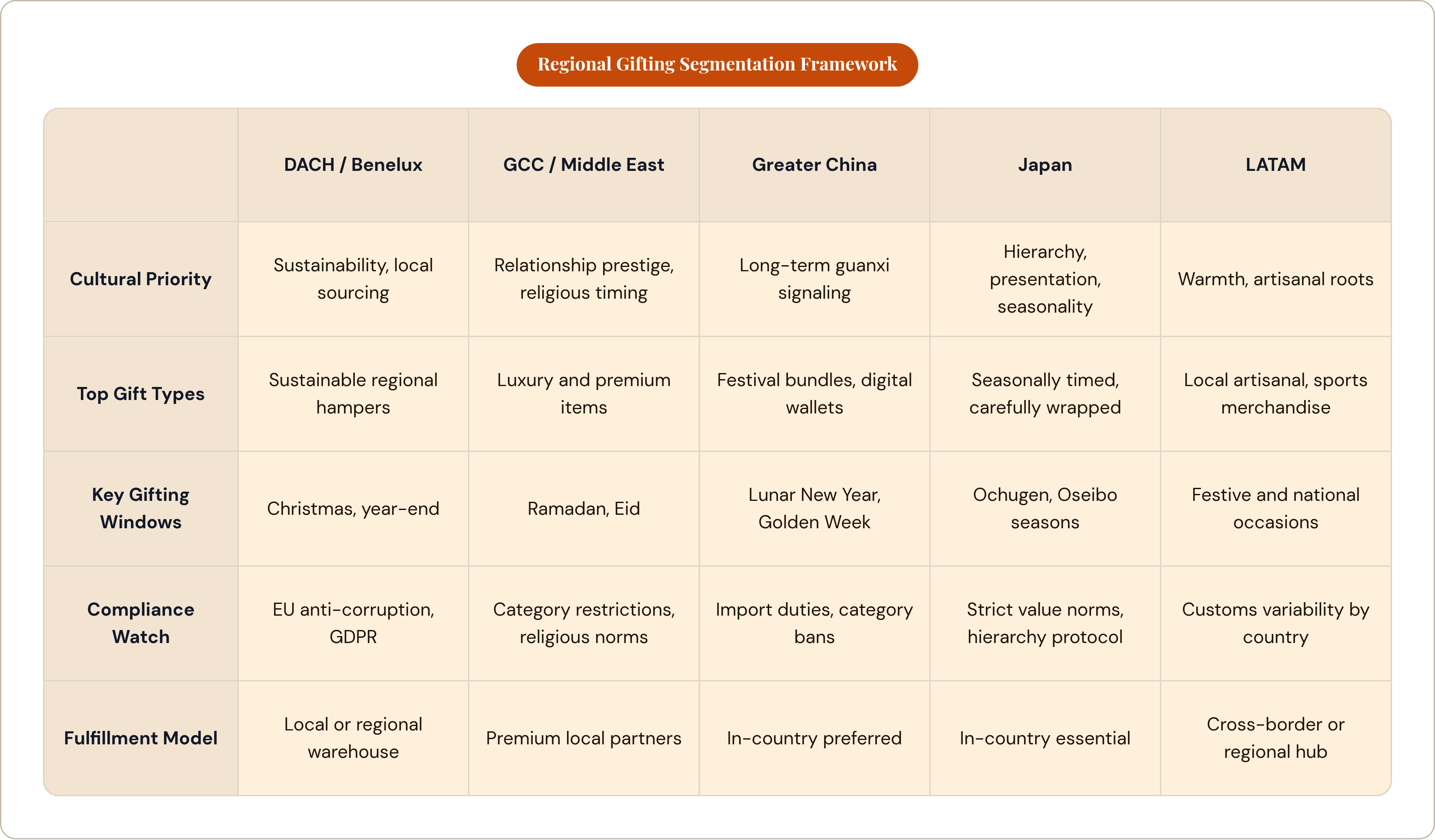
Four things should define every regional tier:
- Cultural norms: what occasions call for gifts, what's taboo, what symbolic weight certain items or colors carry.
- Regulatory environment: value caps, banned categories, data privacy rules tied to address collection.
- Logistics and infrastructure: carrier reliability, customs processing speed, whether local fulfillment exists or everything ships cross-border.
- Recipient preferences: gift type affinity, digital versus physical leanings, language and personalization expectations.
The right level of granularity sits between country and continent, since country-by-country is too much to manage at scale, and continent-level is too blunt to mean anything. Cluster instead by shared regulation and cultural closeness: DACH plus Benelux, UK plus Ireland, the GCC as its own group, Southeast Asia, Greater China, Japan on its own, India on its own, ANZ, and LATAM split north and south.
Inside each cluster, define approved gift categories and price bands by seniority level, the gifting windows worth targeting and the ones to skip, whether fulfillment runs through local warehousing, cross-border shipping, or a digital alternative, and how personalization should work: language, tone, whether the sender's name leads or the company brand does.
This works best living inside the CRM or gifting platform as tagged account attributes, not in a spreadsheet nobody opens after quarter one. A framework parked outside your data stack stays a planning document forever, but wired into the stack, it becomes something that actually triggers sends on its own. CRM and marketing automation integrations built into your gifting platform exist for exactly this: regional logic tagged at the account level, flowing straight into send decisions instead of sitting in a doc someone has to remember exists.
Logistics realities that segmentation must account for before campaign launch
There are two fulfillment models, and each comes with very different tradeoffs. Cross-border shipping from one central warehouse keeps inventory overhead low, but it's exposed to customs delays, import duties, and longer lead times. It works best for lower-volume, higher-value sends going to markets where local warehousing wouldn't pay for itself. In-country or regional fulfillment gets gifts there faster with less customs friction, but it needs local partners on the ground, or a platform that already has that infrastructure built out.
Treat customs as a planning input, not a surprise you discover after the fact. De minimis thresholds, the value below which a gift clears without duty, differ country to country, and what clears in one market may incur charges in another. Food, alcohol, and electronics see the highest rate of customs holds and the most inconsistent treatment. Landed cost, meaning gift price plus duties plus carrier fees, needs modeling before the campaign launches, not discovery on an invoice three weeks later when finance asks questions.
Address verification is its own failure point. Plenty of international markets run address formats and postal systems that don't map cleanly onto North American conventions, and a failed delivery overseas is rarely as simple to fix as a quick reroute. Lead times shift dramatically too: a campaign built around fast domestic shipping may need significantly longer lead times in parts of APAC. Plan backward from the send date with that regional norm in mind, not the domestic one you're used to.
Gifting platforms with international fulfillment infrastructure handle procurement, storage, packing, shipping, and returns across multiple regions. That takes the operational weight off teams who don't have the headcount to manage international logistics on their own. For every regional segment in the framework, write down the fulfillment model, the expected lead time, and the address verification process before the creative gets locked. Skip that step and you'll find out the hard way, usually right before a launch date you can't move anymore.
How geography-aware gifting fits into an ABM sequence and accelerates pipeline
ABM is where this segmentation work turns into revenue. In 2025, 71.2% of organizations report running active ABM strategies, and companies selling into enterprise accounts are 2.4 times more likely to run ABM than those that aren't. Gifting usually shows up mid-sequence, after an account's been identified and warmed through digital channels, right before or around a high-stakes meeting. It's the physical interruption a well-timed email can't pull off.
What changes when the gift is actually built for the recipient's region instead of pulled from a generic catalog? The recipient notices, plain and simple, and that difference is the whole point. A locally sourced hamper sent to Berlin, or a gift timed to Ramadan in Riyadh, tells the account someone did the work instead of running a template through a mail merge. That fit signals the kind of investment ABM is supposed to represent in the first place.
Marketers overwhelmingly report ABM outperforming other strategies: 97% say it delivers stronger ROI. ITSMA's 2024 benchmark, drawing on 167 B2B marketing leaders across North America and EMEA, found mature ABM programs produced a 171% lift in qualified pipeline over non-ABM efforts within a year. Geographic segmentation adds to that by making the gift believable as a signal of attention rather than a line item in a budget. Teams that treat it that way are the ones who see it show up in pipeline, not just in goodwill.