Q4 Gifting Timeline: When B2B Teams Need to Start Planning
Start your Q4 gifting strategy in July, not October.

October is already too late. By the time someone in marketing opens a browser tab in early October to start a holiday gifting program, the good suppliers are hitting minimum-order walls, quoting extended lead times, or flagging stockouts on the items that would've actually landed well. What follows is a month-by-month plan starting in July, because a Q4 program has to run on a schedule, not on adrenaline.
What a well-designed Q4 gifting program is actually trying to accomplish
Q4 gifting is a bundle of distinct campaigns. It's five or six campaigns wearing the same coat: employee recognition, client retention, prospect re-engagement, partner appreciation, event follow-up. Each has a different recipient, a different goal, and often a different deadline.
Most teams get the order of operations backward, and this is the mistake that makes everything downstream harder. They start with product ("what should we send?") when the real sequence has to run recipient, objective, budget, gift format, delivery deadline, and only then product. Start with the catalog and the gift ends up forced onto a segment it was never right for.
Five recipient groups usually run on separate tracks: employees, clients or strategic accounts, prospects, partners and vendors, and international recipients. International gets pulled out on its own because customs and lead times don't behave like domestic shipping does.
The case for doing this well isn't soft. Companies running strategic, well-timed gifting see meaningfully higher demo show-up rates and stronger response rates on outbound than programs that skip the strategy layer. A large share of B2B buyers say a thoughtful gift factored into a renewal or expansion decision. Recipients report feeling more valued, and holding a better opinion of the sending brand, after a gift that clearly wasn't picked at random.
None of that shows up on its own, though. Gifting earns its line item in the budget when someone can trace it to pipeline movement, renewal influence, or engagement data. Otherwise it's a cost center finance eyes every January. So the real starting point comes before any product decision. It's deciding, in the summer, what "success" looks like for each segment. Everything else in this timeline follows from that.
July and August: building the strategic foundation before any product is selected
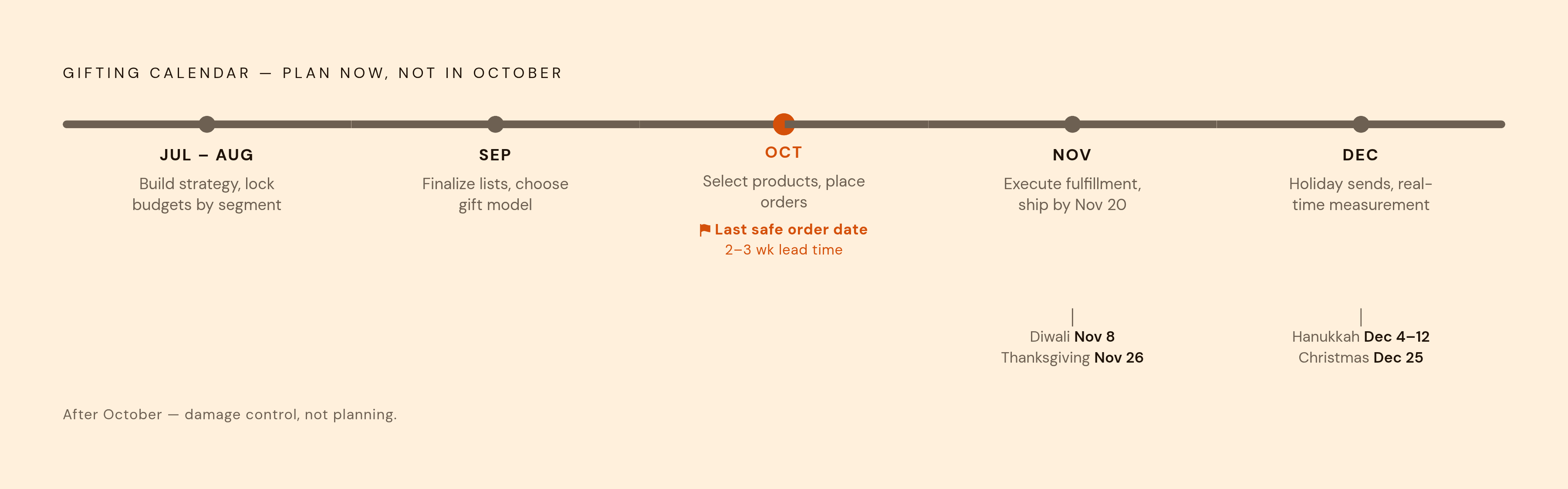
Planning starts in July or August. Not shopping, planning. This is the season for structure, not catalogs, and skipping straight to catalogs is the single most common way teams sabotage their own October.
A few things need to happen before the late-summer holiday:
- Lock a budget by segment. Employees, clients, prospects, and partners rarely deserve the same per-gift spend.
- Get sales, marketing, HR, and finance agreeing on what this program is for, before anyone looks at a single product.
- Pull last year's numbers: what got sent, who got it, and what the outcomes looked like.
- Rough out recipient list sizes per segment, and flag international recipients separately, since their lead times and customs paperwork run on a different clock.
- Write down the success metric for each segment: acceptance rate, redemption rate, meetings influenced, renewals influenced, cost per delivered recipient.
Budget ranges worth anchoring on: for prospecting and pipeline work, the $25 to $75 per gift range is where most successful programs land. For high-value accounts or retention plays, that climbs toward $100 to $150. Numbers below that range carry real risk of undermining the gesture the gift is meant to make.
This is also when the measurement plumbing gets built: CRM tagging, unique URLs or QR codes, dedicated landing pages, the attribution model. Design that now. Retrofitting tracking onto a program that's already shipped is how teams end up with a spreadsheet full of "sent" and nothing next to it.
Key 2026 dates worth putting on the calendar immediately: Diwali on November 8, Veterans Day on November 11, Thanksgiving on November 26, GivingTuesday on December 1, Hanukkah running December 4 through 12, Christmas on December 25, Kwanzaa from December 26 through January 1, and year-end appreciation sends closing out December 31.
Browsing gift catalogs in July feels like progress. It isn't. Teams that shop before nailing down objectives usually end up with a gift that doesn't fit the segment, or the moment, it was meant for.
September: finalizing recipient lists, addresses, and gift model decisions
By September, the goal is an approved recipient list and confirmed delivery requirements, full stop. Product decisions come after, not during.
Address collection sounds like a footnote until it isn't. Employees across distributed teams rarely have a single reliable mailing address on file. Enterprise contacts change firms mid-quarter. CRM data on prospects goes stale faster than most teams expect. Treat address validation as its own mini-campaign in September, not a task squeezed in during November.
One workaround sidesteps a lot of this: recipient-choice models, where a secure link lets the person supply their own shipping address. That single move removes the address-collection headache for entire segments, and it's worth defaulting to unless there's a specific reason not to.
September is also when the gift model gets decided, not sketched, decided:
- Preselected physical gift: needs confirmed addresses and real production lead time
- Recipient-choice link: more flexible, works across borders, removes the address burden
- Branded store credit or gift card: fastest to execute, but reads as less thoughtful
- Curated kit: highest perceived value, longest lead time, needs warehouse coordination
- Hybrid physical-plus-digital: the most complex option, so plan it first if it's on the table
If there's one call worth making early and sticking to, it's this: skip the gift card unless speed is genuinely the only thing that matters. It's the fastest option on the list and tends to carry the least perceived thoughtfulness. A curated kit or a recipient-choice link costs more coordination up front, but it's the difference between a gift and a transaction.
International recipients need extra runway here: customs requirements, duties, whether a given gift type even makes cultural sense in that market, local fulfillment options. These take weeks to sort out, not days, so September is the last comfortable month to resolve them.
Worth a quick compliance check too: some client organizations cap gift values or ban certain categories outright. A sales team gifting a strategic account should confirm that account's policy before falling in love with a product.
By September 30, the checklist should confirm recipient segments with rough counts, show addresses validated or actively being validated, reflect a gift model chosen per segment, and include budget signed off.
October: product selection, creative approval, and order placement
October is for finalizing product and creative, and placing orders. It's not for launching the program. If the groundwork wasn't done in July or August, October becomes a scramble no amount of hustle fixes.
Here's the math that makes October non-negotiable: custom manufacturing runs two to three weeks at baseline. Order on October 1, and that gift lands sometime in November, leaving almost no cushion before Thanksgiving on November 26 or Hanukkah opening December 4.
Before any product gets a final yes, confirm:
- Production lead time with the supplier, in writing
- Minimum order quantities actually fit the list size
- Decoration and packaging specs are locked
- Warehousing and kit assembly arranged, if the gift model calls for it
- Shipping carriers and timelines confirmed for both domestic and international legs
- A returns and replacement policy agreed on before something arrives damaged
Price matters more than budget-conscious teams like to admit, and this is where most of them get it backward. Premium gifts priced above $75 land a 90.1% acceptance rate, versus 85.5% for gifts in the $30 to $75 range, according to data from Postal. Cheaper often carries its own risks. It's just cheaper, and the acceptance numbers say recipients can tell.
Creative and messaging need sign-off in October too: personalization copy, brand guidelines, any handwritten note language. Get legal and brand review done now, so fulfillment in November isn't sitting around waiting for an email back.
Teams arriving in October without a plan run into all three failures at once: supplier backlogs pushing delivery past the dates that mattered, customization options disappearing as inventory thins out, and a forced choice between shipping something generic or missing the send entirely.
Small side note worth keeping in the back pocket: October 31 works as a light, informal touchpoint, a Halloween nod to employees or accounts, that warms things up without competing with the main holiday send.
November: fulfillment execution and the first delivery windows
For a team that finished October on schedule, November is a coordination month. For everyone else, it's the month the wheels come off.
A few dates shape how this month gets sequenced. Diwali falls on November 8, 2026, and any gifts tied to that need to ship in late October or the very first days of November. Veterans Day lands November 11, calling for a respectful nod to veteran employees or military-connected clients. Thanksgiving, November 26, is the single most valuable pre-holiday send window on the whole calendar. Buyers are still at their desks, holiday noise hasn't drowned everything out yet, and a package arriving the week of November 17 to 21 gets noticed in a way a December 20 arrival, buried under a dozen other packages, just doesn't.
To hit that window on ground shipping, sends generally need to go out by around November 20.
GivingTuesday, December 1, needs its groundwork laid in November: nonprofit partners confirmed, messaging approved, logistics settled, so the campaign isn't assembled the week it's supposed to launch.
Follow-up timing deserves its own attention. Once tracking shows a package has arrived, a call or email within 24 hours, while the gift is still sitting on the recipient's desk, does far more work than the same outreach a week later. That kind of tracking has to already exist. Building it in November, mid-send, is too late.
Scale is where a lot of this quietly breaks down. A large share of operational mail leaders report struggling to scale gifting programs because of slow, manual workflows, and November is usually when that bottleneck becomes visible to everyone, not just the person running the spreadsheet.
Anything international that hasn't cleared customs planning by early November is genuinely at risk of missing December altogether.
December: executing the holiday send, managing the final window, and capturing data
December is dense with dates, and each one carries its own shipping math.
Hanukkah runs December 4 through 12, which means gifts for Jewish recipients need to arrive by December 3 at the latest, pointing to a mid-to-late November dispatch. Christmas, December 25, has its own ground-shipping cutoffs that arrive well before the holiday, earlier still for anything international. Kwanzaa runs December 26 through January 1, giving slightly more room than the Christmas rush. Year-end appreciation sends, timed for December 31, often go to executives or account teams and can be physical or digital depending on what already went out earlier in the month. New Year's Day 2027 works as a fallback too, a delayed or fresh-start touch for anyone who didn't get reached before December 25.
Teams still finishing approvals as late as December 1 are competing for carrier capacity during the busiest shipping weeks of the entire year. No amount of extra budget fixes a scheduling failure at this stage. The order needed to go out weeks ago.
Measurement can't wait for January either. What needs to happen in December, in real time:
- Log every send to CRM the moment it dispatches, not after the holidays wind down
- Track delivery confirmation and acceptance rates as they come in
- Watch for meetings booked, opportunities advanced, or renewals influenced, ideally against some kind of control group that didn't receive a gift
- Capture acceptance rate, redemption rate, cost per delivered recipient, and any direct recipient feedback before it goes stale
High-ROI senders lean harder on automation partners, invest more in quality targeting data, and use multi-touch attribution at notably higher rates than average, according to Lob's State of Direct Mail research. None of that gets decided in December. But December is exactly when the presence, or absence, of those choices shows up in the results.
Everything gathered here feeds straight into next July's planning session. That's the loop closing, and it's also the evidence a team needs walking into the next budget conversation.
How platform infrastructure determines whether the timeline holds under pressure
A large share of operational mail leaders say they can't scale gifting programs because their workflows eat too much time by hand. Every month in this timeline assumes some kind of automation is picking up the slack no human team can carry alone at volume. Skip that infrastructure question, and the calendar above is just a wish list.
A sending platform built for this needs to handle a specific set of jobs. Address confirmation shouldn't put the burden back on the sender, so recipient-choice links or smart address lookup have to be standard, not a bolt-on. CRM and marketing automation integration matters just as much: every send should log itself against pipeline data instead of living in a spreadsheet somebody updates by hand on a recurring schedule. Beyond that, a platform worth using should offer AI-assisted gift selection and personalization, so nobody's burning an afternoon hand-picking gifts one recipient at a time, fulfillment that actually reaches multiple countries for the international segments flagged back in September, real-time delivery tracking that makes the 24-hour follow-up window in November actually possible, and reporting tied to campaign outcomes, not just a shipment confirmation number.
The market has a range of platforms built for exactly this kind of high-volume, multi-segment program. Some support enterprise-scale operations reaching well over a hundred countries, backed by dedicated fulfillment centers, AI tools for gift recommendations and message personalization, and CRM integrations deep enough to tie every send back to a pipeline outcome. Others sit closer to the mid-market, built for teams that need solid personalization and clean reporting without enterprise-level complexity. The mid-market option is the wrong call for a team already running international sends across five segments. It's the right call for a team running one or two segments at moderate volume, and pretending otherwise just means paying for capacity that never gets used.
Whichever platform a team lands on, the question worth asking in July, before any of the rest of this timeline starts, is whether it can actually do these jobs at the volume this program needs. Get that answer early, and the rest of the calendar holds.