Corporate Gift Card Programs for B2B Referral and Loyalty
Systemized gift card programs outperform ad-hoc ones on ROI and customer retention.

A gift card program that runs on Slack messages and a spreadsheet of codes bought back in March isn't a program. It's a habit dressed up as a strategy, and it falls apart the moment volume picks up. This piece breaks down what a real one looks like: tiered rewards tied to actual milestones, wired into the CRM so nothing depends on someone remembering to check a thread, and measured well enough that finance stops asking whether it's worth the spend.
Picture the referral program that launched on a Monday. Marketing sent the announcement, sales reps got excited, and then the first referral actually came in on Wednesday. Now what? Someone pings ops on Slack. Ops digs up a spreadsheet of gift card codes purchased two months ago for a different campaign. Two weeks pass before the referring customer sees anything land in their inbox. By then the moment's gone cold, and the rep who made the referral has moved on mentally, wondering if it even registered.
The gift card was never the problem. The absence of a system was. No pre-set trigger, no automation, no way to track redemption, no follow-up logic. That gap matters more in B2B than it does anywhere else, because B2B runs on small customer counts, big deal sizes, long sales cycles, and decisions made by committees rather than individuals. When each account relationship carries that much weight, treating incentives as an afterthought gets expensive fast.
What does "informal" actually look like on the ground? One-off sends with nothing logged in the CRM. No attribution back to a campaign. No record of whether the incentive changed anyone's behavior at all. It's not that teams don't care, it's that nobody built the plumbing. The rest of this piece is about building that plumbing: a tiered system tied to specific milestones, wired into existing workflows, and measured in a way that survives scrutiny.
How large and fast-moving the B2B gift card market already is
The B2B gift card market was valued at $315.8 billion globally in 2024, and it's projected to hit $629.7 billion by 2031, growing at a 10.4% compound annual rate. That's not a niche experiment some vendor is trying to talk companies into. That's a mature category picking up speed.
Zoom out to corporate gifting broadly, physical and digital combined, and the number climbs to a projected $919.9 billion in 2025, up from $839.6 billion the year before. In the UK, B2B gift card sales now make up more than 70% of the entire gift card market there, meaning the business side has overtaken consumer spending in at least one major economy. That's worth sitting with for a second: gift cards used to be a consumer holiday thing. In the UK at least, that's no longer true.
In North America, gift cards account for 43% of all non-cash incentives, according to the Incentive Research Foundation's 2025 Industry Outlook. That's more than merchandise and experiential rewards combined. So this isn't an alternative format competing for scraps of budget. It's the dominant one.
Maybe the most telling number in the bunch: program discontinuation rates dropped from 44% in 2021 to just 15% in 2024. Companies aren't running these programs once and quietly shelving them. They're keeping them alive because they keep producing results worth the spend. That survival rate is itself the signal.
So the question a revenue or marketing team should be asking isn't whether gift cards belong in a B2B incentive strategy. The market already settled that. The real question is whether the program in place is structured well enough to actually capture the return everyone else seems to be getting.
Why gift cards outperform cash and merchandise as B2B incentives
Three things explain why gift cards beat cash and merchandise as incentives, and none of them are complicated once laid out.
First, certainty beats uncertainty. A guaranteed $25 gift card will outperform a sweepstakes entry with the same expected dollar value, every time, because busy B2B professionals don't have the bandwidth to chase uncertain upside. They'll take the sure thing.
Second, choice raises perceived value without raising cost. Research published in the Journal of Management Information Systems in 2024 found that a recipient-choice gift card, one redeemable across a wide range of brands, feels more valuable to the recipient than a single-retailer card of identical face value. The sender pays the same amount either way. The recipient just feels better about it. That's close to a free upgrade.
Third, and this one matters specifically for referral programs: in-kind rewards avoid social friction that cash creates. Pay someone cash for a referral and it starts to feel like a transaction, which makes the referrer worry their recommendation will look self-interested to the person they referred. A gift card carries the same financial value but doesn't trigger that same discomfort.
Why does that third point matter so much in B2B specifically? Because the referrer is putting their professional reputation on the line every time they make an introduction. Removing social friction isn't a nice-to-have here, it's a direct lever on participation rates. Fewer people hesitate to make the ask.
There's supporting evidence on the personalization side too: a large majority of companies report higher ROI on personalized gifts compared to generic ones. A recipient-choice gift card is one of the easiest ways to deliver that kind of personalization at scale, without building a custom gifting operation for every account.
And the business case underneath all of it goes back to customer lifetime value. Wharton research tracking thousands of bank customers found that referred customers churned at a meaningfully lower rate and carried higher lifetime value than customers who came in through other channels. The gift card is just the trigger that gets the referral moving. The real payoff shows up months later, in retention numbers that never mention the incentive at all.
The five use cases where gift cards move the needle in B2B programs
Not every use case deserves the same treatment. Effort level, social dynamics, and appropriate dollar amounts shift from one scenario to the next, and treating them all the same is exactly where a lot of programs quietly underperform.
Customer referrals. A standard benchmark looks like $25 for a typical referral, scaling up to $500 for a key-account referral, sometimes paired with branded swag or an invite to a VIP event. For teams selling into high annual contract values, even a modest incentive pays for itself many times over if the referred deal closes. That underlying dynamic is the whole argument for running the program in the first place.
Survey and market research participation. People aren't refusing to answer surveys because they don't care. They're refusing because their calendar is already full. A modest gift card makes the time trade feel fair rather than bought, for anything mid-length or longer. And again, recipient-choice cards beat single-retailer cards at the same dollar value here too.
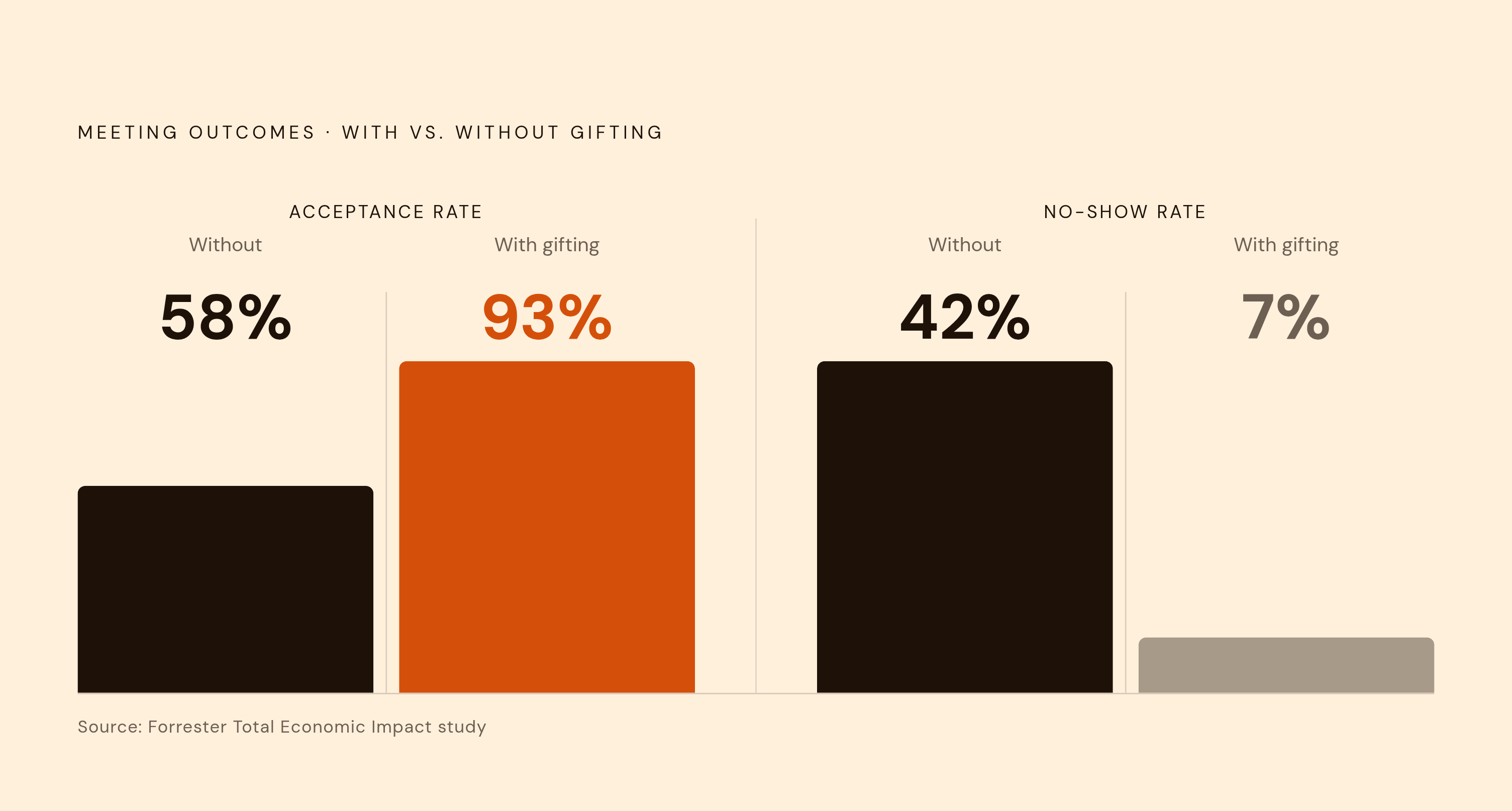
Meeting and demo booking. This is where the numbers get striking. Forrester's Total Economic Impact study found that integrating physical or digital gifting touchpoints into outreach moved meeting acceptance rates from 58% up to 93%. No-show rates in that same study dropped from 42% down to 7%. The gift doesn't just get someone to say yes. It creates enough of a commitment that they actually show up.
Review and social proof generation. Platforms like G2 and Capterra require verified reviewer identity, even though anonymous posting is allowed on the front end. A gift card here lowers the activation energy needed to get someone to sit down and write the review, without compromising how genuine that review is. The effort required is moderate and the social stakes are low, so a smaller card fits. Going bigger risks tipping into compliance territory nobody wants to deal with.
Re-engagement of dormant accounts. An account that's gone quiet for 90 to 180 days responds differently to a gift card landing in their inbox than to yet another check-in email. The channel switch itself signals genuine attention rather than an automated drip. This use case leans directly on the loyalty architecture covered next.
How to design a tiered gift card program for referral and loyalty milestones
Rewards should climb as the relationship deepens and the ask gets harder. That's the whole design principle in one sentence. A flat reward structure treats someone's first referral exactly the same as their tenth, which quietly kills the escalating motivation that turns a one-time favor into a repeat habit.
Three structures cover most situations, and each fits a different scenario:
- Fixed rewards work for single actions like completing a survey or booking a demo. One action, one reward, easy to explain to anyone.
- Tiered rewards escalate with cumulative milestones, which is the right shape for referral programs aiming to turn casual referrers into repeat advocates.
- Conditional rewards only unlock once a downstream condition is met, say, a referral actually converts rather than just getting submitted. This protects budget in programs sitting on top of long sales cycles.
A tiered referral structure might look something like this: a modest reward for the first referral to spark initial engagement, a premium gadget or a weekend getaway at the fifth referral to recognize sustained effort, and VIP event access or a substantial bonus at the tenth to mark real impact. The dollar amounts aren't fixed law, but the escalation shape is the point.
For sales cycles that stretch across months, smaller interim rewards at funnel checkpoints (booking a demo, downloading a gated asset, starting a trial) keep a referrer engaged through a process that might not close for a while. The bigger reward waits at the finish line.
Dual-sided incentives are worth building in too: reward both the person making the referral and the new customer being referred. The referred party then has their own reason to actually click the referral link rather than just contacting the company directly, which cleans up attribution and builds in some reciprocity on both sides.
A gamification layer adds another lever without requiring cash for every single participant. Quarterly leaderboards, raffle entries per referral submitted, recognition for the top three referrers each quarter. Suddenly participation is a competition, not just a transaction.
Non-monetary tiers round the whole thing out. Professional development perks (conference passes, course access, certifications) land especially well at companies where growth is part of the culture. Product-based rewards, free upgrades, early beta access, extended trials, deepen engagement with the actual product while staying inside existing infrastructure costs. And co-marketing tiers, case study features, advisory board seats, speaking slots, give the referrer something a gift card never can: professional visibility.
How does all this map onto broader loyalty program structure? Points programs, tiered status programs, and partner rewards programs each suit different account bases and deal frequencies. The right fit depends on how many accounts a team manages and how often deals actually happen, not on which model sounds most impressive in a slide deck.
Integrating gift card sends into CRM and marketing automation workflows
Good incentive design still fails if fulfillment depends on a Slack message to ops. That's the failure point worth naming directly. Automation is what closes the gap between the moment someone takes the qualifying action and the moment the reward actually shows up.
A workable automated flow has four steps. A trigger fires first: a referral form gets submitted, a deal stage changes, a survey gets completed. Validation runs next, checking whether the action actually clears the bar (did the referral convert, not just get submitted, for programs built on conditional logic). Fulfillment happens third: the gift card issues and delivers digitally, no human needed in the loop. Attribution logs last, recording the send against the contact and opportunity record so it shows up later in pipeline influence reporting.
On the CRM side, this plugs into Salesforce campaign members and campaign influence attribution, HubSpot workflow triggers, or Zapier for teams stitching things together without native integrations.
Physical address used to be the bottleneck for any kind of corporate gifting. Digital gift cards remove that entirely, since eGift delivery skips the shipping delay altogether. Some platforms offer thousands of eGift options with instant delivery across well over a hundred countries, which gives a sense of how far this infrastructure has already scaled.
Worth remembering: the average B2B purchase involves somewhere around 6 to 8 stakeholders. A loyalty or referral program touching only one contact per account is missing most of the buying committee. Automation should support sending to multiple contacts on the same account off a single trigger, not just the one person who happened to fill out the form.
When evaluating a platform, look for native CRM connectors, redemption tracking that actually feeds back into the existing data stack, multi-currency and multi-country support, and spend controls capping how much any one contact or account can rack up. That last piece protects the budget from someone accidentally triggering the same reward five times.
Platforms that handle procurement, storage, and global delivery on the back end take the logistics burden off marketing and sales entirely. At that point the program runs as a data workflow, not a shipping-and-handling project someone has to babysit.
How to measure whether the program is actually changing behavior
Gifting tools are genuinely good at the operational side: triggering sends, managing fulfillment, tracking who redeemed what. But without CRM integration wired in, connecting any of that to actual business outcomes, deal velocity, win rate, becomes close to impossible. The activity data and the outcome data live in two different systems that never talk to each other.
Finance wants to see specific things: total program cost (gift spend plus fulfillment plus whatever the platform charges), pipeline sourced where gifting was the actual first touch, pipeline influenced where gifting contributed along the way (with the attribution model clearly noted), and a return figure that holds up under questioning. A defensible 3x return is more credible to a CFO than an optimistic 10x they're going to push back on immediately.
Attribution models come in a few flavors. First-touch works cleanest for simple referral plays where the gift card is what got the conversation started in the first place. Last-touch fits shorter sales cycles where the gift card is what nudged a stalled deal over the line. Position-based or time-decay models suit longer, multi-touch journeys spanning months. Whichever gets picked, stick with it consistently, so quarter-over-quarter comparisons actually mean something.
Holdout testing is the method that proves incrementality rather than just correlation. Hold back a random control group at the contact or account level, keep every other piece of messaging and timing identical, set the success threshold before the test starts (say, a 20% lift in meetings booked), and run it for a full cycle so timing quirks don't skew the read. That's the setup that produces a number finance can't wave off as coincidence.
KPIs differ by function. Referral programs track number of referrals submitted, referral-to-close rate, pipeline sourced, and cost per referral acquired against cost of acquisition through cold channels. Loyalty programs track account retention, expansion revenue, and NPS or CSAT scores for incentivized accounts against a control group. Meeting acceleration programs track acceptance rate, no-show rate, and time-to-close for gifted opportunities against non-gifted ones.
On the range of outcomes: most established gifting programs land somewhere around 8 to 15x ROI. High-performing enterprise programs that are fully built into the sales playbook, with attribution done properly, can reach 25 to 50x. Most programs show measurable ROI within 3 to 6 months if they're running on ready-to-ship gifts, and 6 to 12 months for anything requiring more concierge-level coordination.
Context helps make these numbers feel real rather than abstract. The average email reply rate on outbound sequences sits around 3.8%, according to Salesloft benchmarks. Forrester research found that BDRs who followed up soon after sending a direct mail or gift piece saw response rates triple or quadruple compared to cold outreach alone. Put next to that baseline, the gifting ROI numbers stop sounding inflated and start looking like a pattern.
Common design mistakes that erode program performance
The most common mistake is running a flat incentive across wildly different use cases. A $25 referral bonus and a $25 survey incentive might use the same dollar figure, but they're solving different problems and carry different social weight. Collapsing them into one policy usually means one of the two ends up mispriced.
Skipping the validation step is another one. Sending the reward the moment a referral form gets submitted, before checking whether it actually converts, burns budget on people gaming the system. It also cheapens the reward for everyone else who put in real effort to get a qualified lead through the door.
Single-contact targeting shows up often too. Sending one gift card to one contact at an account with 7 stakeholders involved in the buying decision misses almost everyone who actually needs to feel appreciated. The relationship that matters might belong to someone who never got touched at all.
Choosing single-retailer cards over recipient-choice options is a smaller mistake, but it adds up. The cost is identical either way, so leaving perceived value on the table for no reason doesn't make much sense once someone actually notices.
And maybe the mistake that undoes everything else: launching without an attribution plan in place. A program can run for a year, generate plenty of goodwill, and still get cut in the next budget cycle because nobody can produce a number that ties the spend to a business outcome. Good will doesn't survive a budget review. A clean attribution report does.
Sources
- The marketing team’s guide to gift card incentives: referrals, campaigns, and promotions
- 15 B2B Referral Program Incentives to Try in 2025 | Commsor Blog
- The Business of Gifting: Why Your Gift Card Program Needs a B2B Strategy in 2025
- B2B Gift Card Market to Hit $315.8B in 2024, Driven by Corporate Gifting and E-commerce