Direct Mail Formats for B2B Pipeline Campaigns
High-value accounts need custom formats; wrong formats waste budget regardless of inbox saturation.

Direct mail is back in B2B pipeline programs for a structural reason: the inbox is saturated, and the physical desk is not. A senior decision-maker's inbox absorbs a volume of messages every day that their physical desk never will, and a piece of mail cannot be filtered, muted, or auto-archived before a human being actually sees it. That asymmetry is the whole case for the channel. Digital ad costs in B2B have climbed sharply, with B2B SaaS customer acquisition costs jumping significantly in 2025 on top of a multi-year run-up that has steadily eaten into the cost advantage digital once held. Budgets are following that logic: nearly all marketers plan to maintain or increase direct mail investment in 2026.
None of that makes direct mail a guaranteed win. The response benchmarks marketers cite are blended across industries and use cases, not a B2B-specific promise that a check in the mail will produce pipeline. What actually moves results is list accuracy, how much of the buying committee gets reached, and whether sales follows up inside the delivery window. Sending accurate mail to the wrong eight people on a fourteen-person buying committee collapses the response rate no matter how good the format is. Sending the right format to the right person three weeks after the piece lands on their desk means the moment has already passed. Direct mail works as a deliberate channel decision, built on specific inputs, not as a default to fall back on when digital gets expensive.
Format as the variable separating productive spend from waste
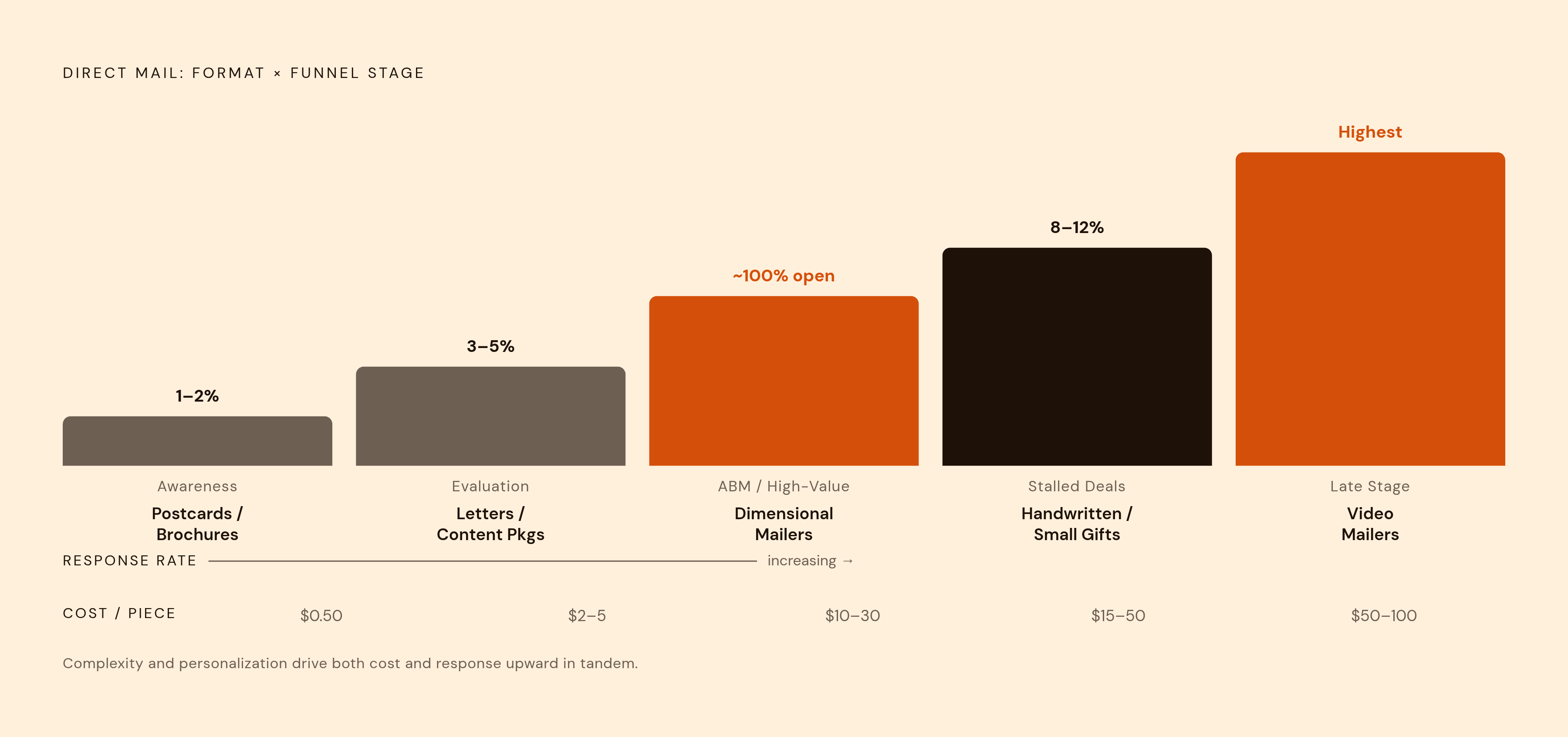
Every direct mail format has its own cost-per-piece, its own open rate, and its own response profile. Getting that detail right turns a direct mail budget into pipeline; getting it wrong turns it into a stack of recycling. Sending an expensive format where a cheap one would do the job, or a flat postcard where the moment calls for something dimensional, is one of the fastest ways to make a channel that works look like a channel that doesn't.
Production costs rise sharply as format complexity increases. A postcard costs the least in the range. A dimensional mailer can cost many times more per unit, and that's before you add postage. That cost curve means the format decision is a unit-economics decision as much as a creative one. The response-rate hierarchy tracks the cost curve in a predictable order: video mailers lead, dimensional mailers follow, and letters in envelopes come next. Dimensional ABM mailers in particular get opened close to 100% of the time, for two separate reasons. Recipients instinctively open three-dimensional packages before any rational filtering kicks in, and office mailrooms route packages directly to the named recipient rather than screening them the way they screen flat mail that looks like advertising.
Format also signals the level of investment a sender is making in a relationship. A postcard communicates scale and awareness. A dimensional package communicates specific, researched intent. The discipline that separates productive spend from waste is matching the format to deal value and audience tier, not maximizing production quality across the board. A dimensional package that is a rounding error against an enterprise contract becomes a poor use of budget the moment it gets sent to a low-ACV prospect instead. The sections that follow map each format to the pipeline moment where it actually earns its cost, starting at the widest part of the funnel and working toward the deals closest to close.
Postcards and brochures at top of funnel: broad awareness for large prospect lists
Postcards and visually striking brochures belong at the top of the funnel because they trade personalization depth for reach, and reach is the goal when the audience is a well-defined ideal customer profile at scale. A postcard is built for a five-second read. That's appropriate when the job is planting a brand signal across a large list, not closing a conversation with one person.
Copy discipline at this format is non-negotiable. The benefit needs to be visible in five seconds or less. The headline has to state the problem solved. Body copy stays short, and the call to action is singular and impossible to miss. None of that is a design preference: it's what the format's five-second read window actually requires.
List quality decides whether a postcard run generates pipeline or fills a recycling bin with cardstock. You need the ICP definition to filter every list and every campaign decision from the start. The most common failure mode at this stage is mailing to job-title filters instead of verified decision-makers, which fills the list with the wrong names before a single piece gets printed. Validating and enriching the list before printing solves two different problems: enrichment fills in missing titles and addresses, and validation prevents wasted budget on mail that never gets delivered. Before scaling a postcard campaign to a full list, testing a few hundred to roughly a thousand pieces per segment shows which audiences and which messages are actually working, before the larger budget commits to either.
Letters and content packages at mid-funnel: personal authority for prospects in active evaluation
Once a prospect moves into active evaluation, the audience shrinks and gets more defined, and the format needs to carry more weight than a postcard can. That's the shift from a postcard's brand signal to a letter's relationship signal. A letter signed by a senior leader, not a branded postcard, is what tells a prospect in active evaluation that they're dealing with real intent, because it mirrors the kind of interpersonal communication the decision itself already runs on.
The sender's title and signature carry weight that a brand name by itself can't match, which is the reason letters work at this stage specifically. Pairing the letter with a relevant case study, a one-pager built around a specific use case, or a printed research summary extends the life of the piece past a single read. Committee members can pass it around internally as they compare vendors.
That dwell time is the format's real structural advantage. A letter can sit on a desk for days while a buying committee deliberates, reinforcing whatever digital touches are running in parallel, and it reaches people who are genuinely hard to engage by email alone. None of that works if the envelope fails first: flat mail has to earn the open on the outside alone, so envelope copy and design deserve the same deliberate attention as the letter inside, not an afterthought tacked on at the print shop. Variable data printing means you can personalize at this tier without rebuilding the layout for every recipient. Headlines, copy, images, and offers can swap based on industry, job title, or buying stage, so a CFO and a CTO at the same account open letters addressing their distinct concerns. Response rates can improve by as much as 500% over static mailings when that kind of hyper-personalization gets applied.
Dimensional mailers for high-value ABM targets: when the account justifies the unit cost
Dimensional mailers carry the highest response ceiling of any flat-adjacent format, but they also cost the most. They earn that cost only when the accounts behind them are valuable enough that near-certain delivery to a named decision-maker, combined with a response rate several times the blended benchmark, adds up to favorable unit economics. That's a real caveat, not a footnote: the same mailer that makes financial sense against a six-figure contract makes no sense at all against a list of unqualified leads.
The near-100% open rate comes from two separate mechanisms working together. Humans open three-dimensional packages on instinct, before any rational filtering happens. The physical depth of the package reads as a delivery once it hits an office mailroom, and the mailroom routes it straight to the named recipient. Dimensional mailers sent to ABM target lists land well above the blended response benchmark, because the audience is already pre-qualified and the format itself commands attention before a word of copy gets read.
The spend-to-deal-value discipline is what keeps this format honest. Against a large enterprise contract, the per-unit cost of a dimensional mailer is trivial, a rounding error against the pipeline it can open. Sent to thousands of unqualified contacts, that same cost becomes a serious waste of budget. ABM tiering logic should map directly onto the format choice: 1:1 enterprise accounts warrant fully personalized dimensional packages built around that one account. 1:few mid-market clusters can work with segment-specific kits: a relevant small gift, curated content, and a personalized note addressing challenges the cluster shares. Persona-level creative within a single account, built differently for a CFO than for a CTO or a VP of Operations, extends the relevance even further. What gets opened, remembered, and passed to other committee members is a branded box with something genuinely useful inside, not promotional filler. The gift's relevance to the recipient's actual role is what turns attention into a response.
Handwritten notes and small personalized gifts to advance stalled deals
A deal gone quiet is a specific, common, and costly problem at mid-to-late funnel, and it calls for a specific tool. When momentum stalls, a handwritten note or a small, personally relevant gift does something a follow-up email cannot do: it acknowledges the pause without applying pressure, and it restores the human dimension of a relationship that's started to feel transactional.
A straightforward mail piece that acknowledges the gap in communication and offers an easy way to restart the conversation is a documented re-engagement motion. The format itself signals that the sender invested real time, not the ten seconds it takes to fire off an automated touchpoint. Handwritten notes work especially well at this moment because they carry no digital fingerprint. They can't be mistaken for an automated sequence, and they land on a desk rather than in an inbox already associated with a conversation that went cold.
Format, again, signals investment level. A handwritten note at this stage tells the recipient that the relationship matters to the sender, not just the transaction sitting on the table. The gift that accompanies it should stay small and specific: a shared interest, a professional milestone, a reference back to a previous conversation. The goal here is recognition. A stalled deal doesn't need another pitch. It needs proof that someone on the other side remembers who they're talking to.
Video mailers for late-stage deals where a live conversation has not yet happened
Video mailers carry the highest average response rate of any direct mail format, which makes them the right call for late-stage, high-value accounts where getting in front of a final decision-maker justifies the cost, and where a moving, voiced message can do something static print simply can't. Dimensional mailers to ABM lists already clear the blended benchmark by a wide margin. Video mailers exceed even that ceiling when the content is well-matched to the recipient watching it.
The format fits a specific buyer: an executive who hasn't engaged with sales yet. A video message from a company's own senior leader, personalized to that prospect's known business context, can create something close to the relational warmth of an actual meeting before any meeting has happened. That's valuable precisely at the moment when a live conversation hasn't occurred and the deal needs one to move forward.
Video mailers are the format where the cost-to-outcome logic has the least room for error, since their per-unit expense only pays off when deal size supports it. Video mailers are expensive per unit, and that expense only makes sense reserved for accounts where deal size supports it. Sending a video mailer at awareness stage, or to an unqualified list, is the clearest possible example of a format mismatched to its pipeline stage. Paired with a personalized landing page or a one-to-one ROI projection, a video mailer creates a coordinated experience that's genuinely difficult to replicate through digital channels working alone.
Sequencing mail with digital touches to multiply response across every stage
A mail piece sent without a coordinated digital sequence around it leaves response on the table, because the sales rep has no concrete reference point for a follow-up call and the prospect has no signal that the sender's message holds together across channels. The pattern that consistently produces stronger results follows a simple timeline: mail arrives first, a sales rep calls or emails a few days later referencing the mailer specifically, and digital retargeting reinforces the same message across the following week. When campaigns integrate mail with digital touches, response rates run substantially higher than mail sent on its own.
A coordinated cadence gives each channel its own job, so channels don't end up competing for the same credit. An introductory email opens the sequence. A LinkedIn touch follows. The direct mail piece lands next. A follow-up call or email that references the mailer by name closes the loop. Each touch reinforces the one before it.
Timing depends on knowing exactly when the mail piece lands, so you can't guess. Delivery events fed back into the CRM let a rep reach out while the piece is still sitting on the desk, and USPS scan data shows precisely when a piece enters the mail stream and when it gets delivered, giving reps an exact trigger for follow-up timing. For event campaigns, if you send mail to ABM targets ahead of a trade show or field event, it creates a recognition moment the second that prospect reaches the booth. Post-event fast-follow kits, a recap, relevant content, a clear next step, convert a booth conversation into real pipeline before the memory of it fades.
Measuring which format drove which outcome: the tracking infrastructure that makes the budget defensible
Most B2B direct mail campaigns are under-measured rather than underperforming, and in a quarterly budget review the two look exactly the same. Measurement infrastructure carries as much weight as format choice in making the channel defensible, because a format decision that can't be traced to an outcome is just a guess dressed up as a strategy.
A full measurement stack runs on four layers. USPS Intelligent Mail Barcodes confirm delivery. Personalized QR codes and URLs track online response by individual recipient. CRM integration pushes mail events back onto the contact record. Matchback analysis attributes revenue to recipients who converted but left no trackable digital touch behind. Matchback analysis connects recipients to the actions that follow: form fills, demo requests, opportunities, closed-won deals. Layering in QR codes, personalized URLs, and campaign-specific promo codes sharpens that attribution further and draws a direct line from a mail piece to actual revenue.
The level of measurement should match the format tier. If a postcard campaign runs against a large prospect list, it needs matchback analysis and PURL tracking to surface response at all, because no single rep can track each of the thousands of recipients individually. A dimensional ABM send to a small, named account list can get tracked at the individual contact level instead, with delivery confirmation and rep follow-up logged directly to the CRM.
The strongest objection to any direct mail ROI comparison comes down to how you handle attribution. Email's cost-per-contact runs far lower than direct mail's, so its stated ROI-per-dollar can look better even when the actual revenue behind it is smaller. The honest comparison accounts for the deal sizes each channel realistically reaches, not just the cost of the touch that opened the door. Measured this way, a direct mail budget stops being a line item defended on faith. It becomes a set of decisions, format by format and stage by stage, that a revenue team can actually trace back to pipeline.