Direct Mail Postage and Delivery Options for Enterprise Senders
Optimize postage rates and class choice to lower direct mail cost per piece.

Class, presort depth, format, promotions, and logistics together determine what a program pays to reach its audience. Optimizing those choices, then connecting delivery to response, makes postage a lever on program ROI.
Why enterprise direct mail postage deserves strategic attention, not just budget line management
Postage is the single largest per-piece cost in enterprise B2B direct mail programs. That means the choice of class, presort depth, and care with format have an unusually large effect on the total budget. Yet many enterprise marketing teams accept postage as a fixed input set by their vendor. The physical mailbox is less contested than digital channels for senior B2B decision-makers, so there is a reason to invest in reaching it well. Plan postal choices to serve the campaign’s purpose without paying for features it does not need.
How the 2026 USPS rate environment changes the planning baseline
USPS changed its rates effective July 12, 2026, for every mail class enterprise senders use. USPS Notice 123 gives the retail reference prices as $0.82 for a Forever stamp on a stamped letter and $0.78 for a metered First-Class letter. The First-Class postcard retail rate is $0.65. The cost to mail a First-Class large envelope / flat (≤1 oz) is $1.69.
These figures provide the retail baseline. Commercial rates depend on the class, piece category, and sortation. The July 12, 2026 adjustment therefore replaces pre-July figures for planning under the new rates. The gap between retail and commercial presort is the first distinction in that baseline.
The presort tier ladder and why list quality is the first cost lever
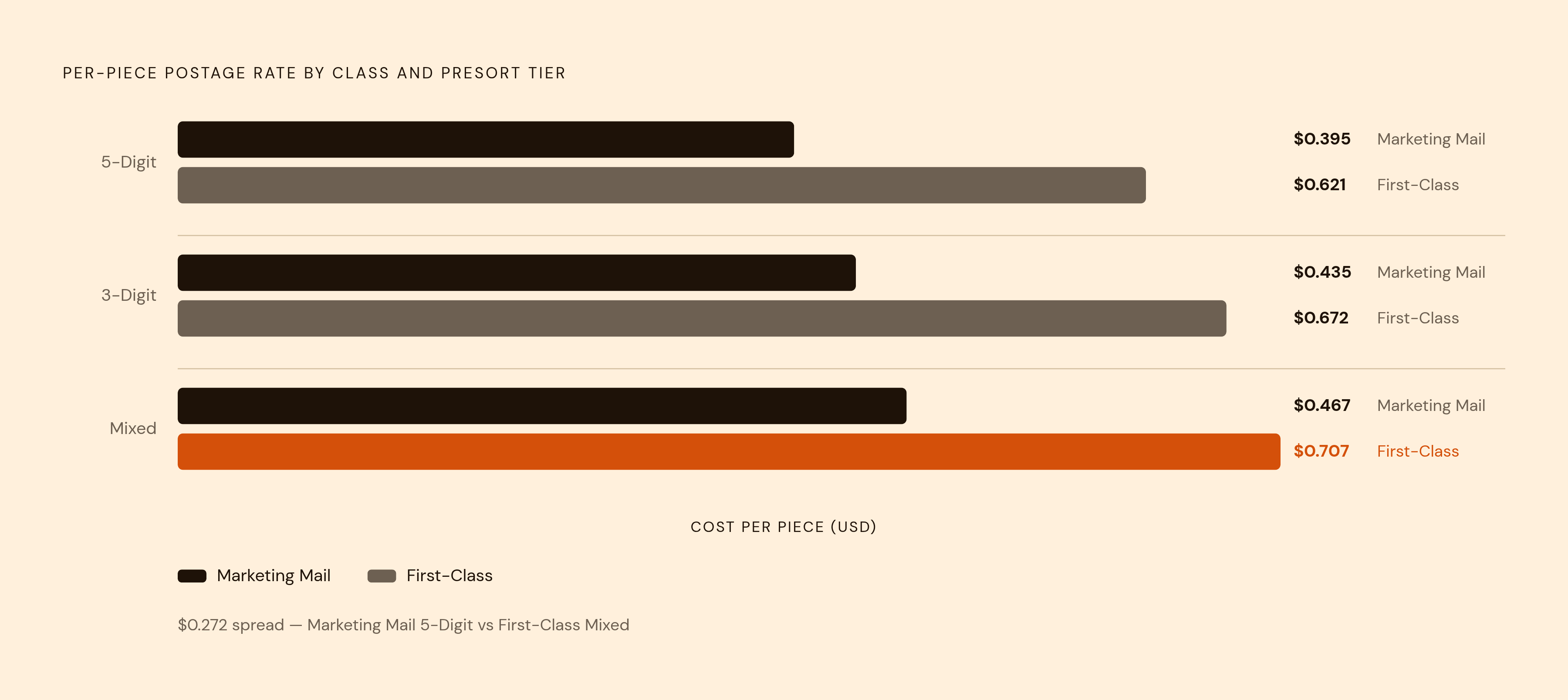
The same piece mailed in the same class can cost materially less when the list supports deeper sorting. Under USPS Notice 123, the Marketing Mail automation letter rates are $0.395 per piece for 5-Digit sort, $0.435 for 3-Digit sort, and $0.467 for Mixed. For comparison, First-Class Mail presort letters cost $0.621, $0.672, and $0.707 at those respective tiers. First-Class Mail presort postcards cost $0.453, $0.478, and $0.495. Qualifying nonprofit automation letters cost $0.185, $0.225, and $0.257.
The dollar value of deeper sorting is clearer than the tier names alone. Moving Marketing Mail letters from Mixed to 5-Digit reduces postage per piece, with savings accumulating across a large mailing. But volume alone does not earn that saving. Most mailings land at Mixed because their lists have too few addresses in each 3-Digit or 5-Digit ZIP group.
Address quality is the prerequisite, while geographic concentration determines how far sorting can go. CASS validation standardizes addresses, and both CASS validation and an Intelligent Mail Barcode, or IMb, are required for automation discounts. Without them, a mailing pays a higher non-automation rate. Commingling through a consolidator combines a program’s mail with other mailers’ volume, allowing smaller programs to reach deeper tiers than their own lists would support.
Choosing between Marketing Mail and First-Class Mail for enterprise sends
Class choice turns the rate ladder into a decision about the job each mailing must do. Marketing Mail letters range from $0.395 at 5-Digit to $0.467 at Mixed, require a 200-piece minimum, and typically arrive in 3–10 business days. They do not include forwarding or return service unless the mailer purchases an ancillary endorsement.
If the send is a promotional offer or awareness campaign with a wide response window, Marketing Mail fits when list hygiene is maintained separately. If it is a contract renewal notice, a time-sensitive send, or an event invitation with a hard deadline, First-Class is the more appropriate choice. If learning that an address is bad has value for later outreach, that feedback also belongs in the comparison. For ABM programs aimed at specific decision-makers in named accounts, paying more for First-Class often pays off because delivery is more certain and the sender gets address hygiene feedback.
Undeliverable Marketing Mail pieces still consume production and postage, while the absence of return service leaves the sender without a signal that the address is wrong. That can let list quality deteriorate silently across repeated sends.
When EDDM makes sense for enterprise programs — and when it does not
Every Door Direct Mail, or EDDM, costs less but gives up targeting people by name. USPS lists July 12, 2026 rates of $0.260 per piece for EDDM Retail and $0.259 for EDDM BMEU DDU entry. EDDM eliminates list costs and individual addressing because the campaign targets carrier routes. USPS’s EDDM Online Tool lets mailers choose routes by ZIP Code and filter them by age, income, and household-size using U.S. Census data. That makes geography the organizing principle.
EDDM Retail requires no permit, only a USPS.com account, with a 200-piece minimum and a limit of 5,000 pieces per day per ZIP Code. Mail is dropped at a local Post Office. EDDM BMEU needs a Business Customer Gateway account and bulk mailing permit, has no limit on how much mail can be sent each day, and takes enterprise-scale drops at a USPS Business Mail Entry Unit. Pieces must qualify as flats, taller than 6.125 inches or longer than 11.5 inches, no larger than 12×15 inches, and no heavier than 3.3 oz. They are addressed to “Postal Customer,” with EDDM Retail pieces carrying the EDDM Retail indicia.
This works for building awareness in a region, field marketing near event venues, and new office openings. It can also suit high-volume follow-up drops where list acquisition would otherwise dominate cost. It does not fit named-account ABM, individual personalization, or reporting that must connect each send to a specific CRM recipient.
Format decisions that change the postage class a piece qualifies for
A design can cross into a different postage category before anyone sorts the list. A piece exceeding 6.125 inches high, 11.5 inches long, or 0.25 inches thick is classified as a flat. Marketing Mail Automation 5-Digit postage is $0.783 for a flat against $0.395 for a letter. That boundary nearly doubles the postage line.
The word “postcard” on a creative brief does not establish postal eligibility. To earn the postcard rate, a piece must be rectangular, single-sheet, and unfolded, between 3.5×5 inches and 4.25×6 inches, and between 0.007 and 0.016 inches thick. Oversized cards price as letters or flats instead. Promotional cards entered as Marketing Mail use the Marketing Mail letter rate because there is no separate card rate.
Spec review before printing is therefore a budget decision. Self-mailers and booklets exceeding letter dimensions price as flats, with Marketing Mail flat postage quoted by job according to weight and sortation. Dimensional ABM mailers, including boxes, tubes, and padded envelopes, use parcel pricing instead. Their economics depend more on justifying production value and response than on optimizing letter postage.
USPS promotions as a structured postage discount layer
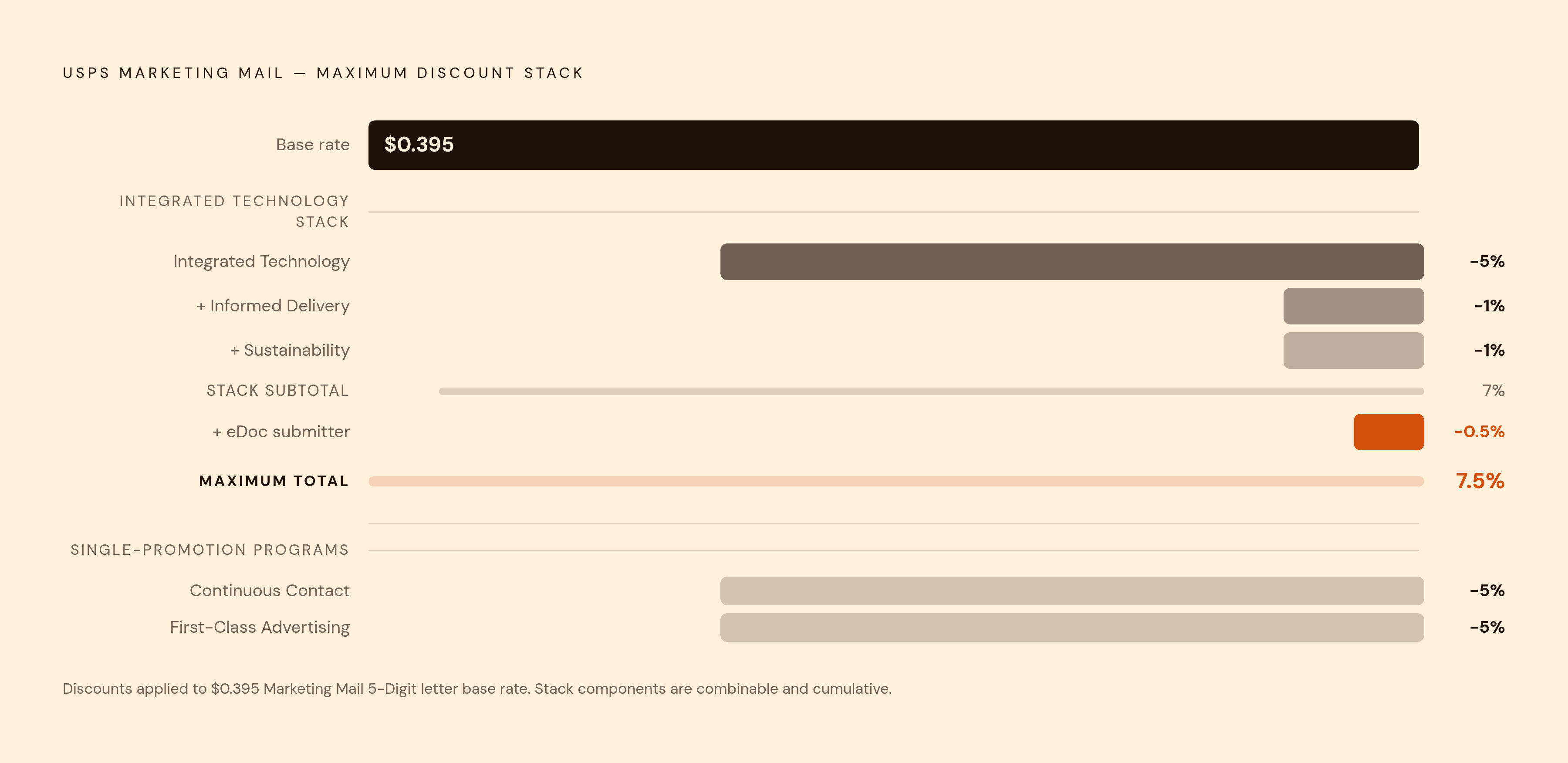
Once the class and format are set, promotions can cut the base postage further if the mailing qualifies. USPS Business Customer Gateway lists the Integrated Technology promotion at 5% for any 6 consecutive months in 2026, with registration open through December 31, 2026. Its AI track includes tools used for copy, images, design, or AI-powered chatbots. Continuous Contact offers 5% from April 1–December 31, 2026. First-Class Mail Advertising offers 5% from September 1–December 31, 2026, while the Tactile, Sensory & Interactive promotion closed on June 30, 2026.
Informed Delivery and Sustainability each add 1% to a base promotion, bringing the Integrated Technology mailer discount to as much as 7%. A separate 0.5% eDoc-submitter incentive brings the total to 7.5%, but that incentive accrues to the entity filing the postage statement. Applying 7% reduces the $0.395 letter rate further. Across a large mailing, that can mean substantial savings beyond the presort saving.
The Mail Growth Incentive is separate and gives mailers postage credits. It offers a 30% credit on pieces above the prior-year baseline or one million pieces, whichever is higher, for qualifying programs meeting the one million-piece minimum. Promotion discounts require registration and eligibility documentation and must be claimed at mailing. Teams concerned about the administrative work can delegate most registration and documentation to a mail service provider or fulfillment platform that regularly processes permit mail.
Induction point strategy — where you drop the mail changes what you pay
Postage also reflects how much transportation the mailer handles before USPS takes possession. EDDM BMEU DDU entry illustrates the principle at $0.259 per piece when the mailer delivers to the local post office serving the carrier routes. Destination entry makes the handoff location a planning variable rather than a fixed consequence of where the piece was printed.
For a single-facility program, reaching destination entry points nationally requires a provider with distributed production or a drop-ship network, or a consolidator that transports pooled volume. Geographic concentration strengthens the economics because a regional campaign can move mail to a small number of entry points. But for ABM sends spread across the country, transport can cost more than the postage it saves. The useful discussion with a fulfillment partner focuses on net campaign cost.
The four-layer cost model enterprise teams should use to plan and compare programs
A defensible per-piece budget separates four layers, namely postage, printing, list and data, and lettershop and mail prep. Postage reflects class, format, presort depth, induction point, and promotions. Printing covers paper, ink, press time, and finishing. Its per-piece cost falls significantly between 1,000 and 5,000 pieces as setup cost is spread across more pieces, then flattens.
List and data costs depend on the records and filters required. House-list records cost nothing to acquire, but require NCOA processing under USPS Move Update rules within 95 days of the mail date. Rented B2B lists filtered by title and revenue cost more per record than consumer lists. Lettershop and mail prep cover inkjet addressing, CASS validation, sorting, traying, and BMEU induction, with complexity such as inserting, matched personalization, and folding raising cost.
Enterprise teams should request itemized quotes separating these layers. Otherwise, a lower postage charge can hide a higher production or preparation charge. Teams should check the format closely because moving from a letter to a flat can raise both postage and print cost. The aim is to compare complete programs on the same terms.
How platform and fulfillment infrastructure translate postage strategy into execution
A qualifying rate becomes a real saving only when fulfillment executes the requirements correctly. That means each mailing must go through CASS validation and USPS induction, have an IMb applied, and have the paperwork for promotions. The review of a provider should check whether its system uses the lowest rate the mailing qualifies for or a default class. It should also establish who handles promotion registration, whether commingling is available, and whether destination entry or drop-ship is supported.
Delivery tracking is another part of that evaluation. IMb-based signals connected to the CRM give sales teams delivery information for follow-up. But tracking cannot fix mail sent to the wrong address. A decision-maker may work remotely, have a different office address from the registered contact address, or have an outdated record.
Teams should confirm addresses before the drop date. International campaigns add multilingual content requirements, customs documentation, and country-specific carrier selection. Those needs call for global fulfillment infrastructure or a platform that handles those decisions.
Attribution discipline as the final multiplier on postage ROI
Postage optimization improves the cost side of ROI, while attribution establishes the return. Campaign-specific response codes or URLs connect responses to a drop. Separate landing pages or phone numbers show which campaign cohort a response comes from. A matchback workflow defined before mailing gives the program a way to connect results afterward, rather than attempting to reconstruct that process when the campaign closes.
IMb tracking connected to the CRM adds a delivery signal before sales follow-up. The barcode thus serves two purposes, earning automation discounts and supporting piece-level delivery tracking. Using it only for postage savings leaves its sales-timing value unused. A cheaper mailing with incomplete attribution may still struggle to defend its budget, while a well-attributed program at higher per-piece cost can make a stronger case.
The next drop is the point to bring these decisions together. Audit the current postage class, check promotion eligibility for the remainder of 2026, and confirm the attribution setup before mailing. Class choice, format discipline, promotion stacking, and measurable response together make direct mail a defensible revenue program.