Gifting Strategies for Conference Booth Traffic Generation
Sequence your conference gifts across three stages to turn registrations into qualified pipeline.

Conference gifting works best when it is planned as a sequence. For B2B event and field marketing teams, the goal is to turn registered attendees into booked meetings, booth conversations into qualified interest, and follow-up into pipeline. Each stage needs a different gift, a different reason to send it, and a clear way to measure what happens next.
Why most conference booths fail to generate qualified traffic before anyone sets foot on the floor
Most exhibitors invest heavily in booth design, staffing, and giveaways, then compete for attention after attendees have already decided how to spend their time. The race for meetings begins six weeks before the event, when target accounts are looking into exhibitors and deciding how to spend their time. A well-run booth can serve the people who arrive, but it cannot win back every meeting already booked with another company.
The event-cycle model and its three conversion jobs
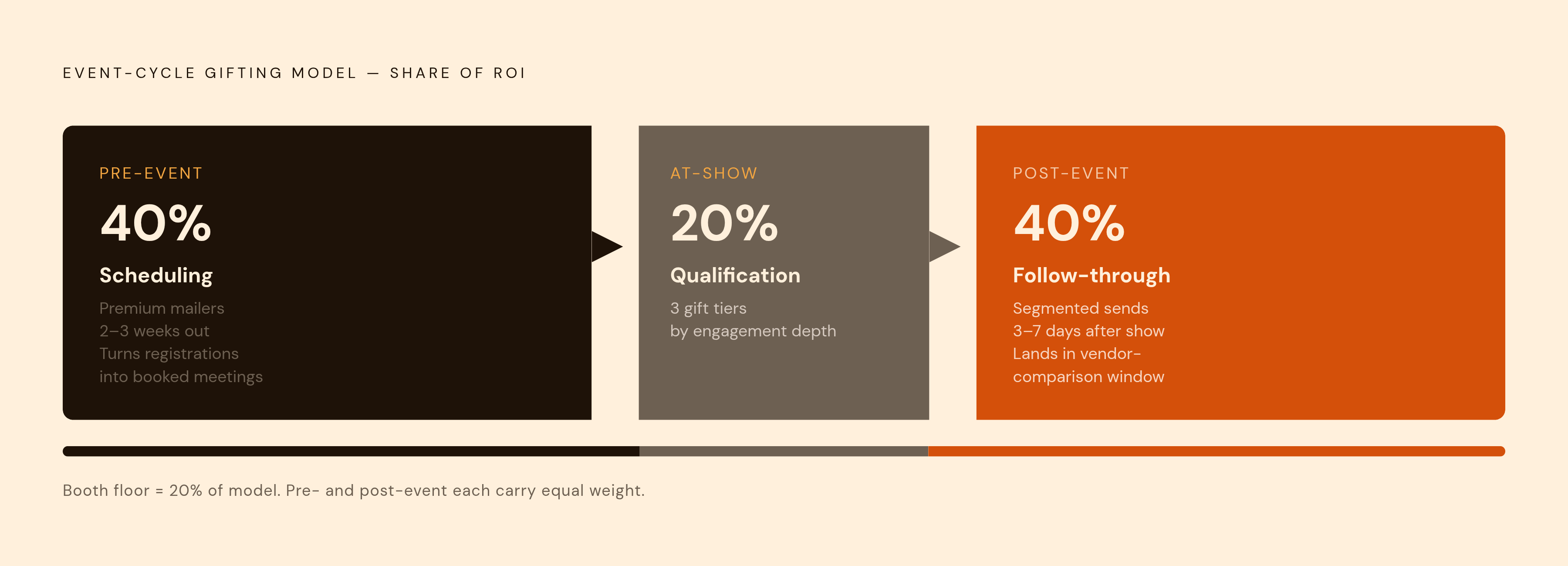
The event-cycle research context offers a useful 40-20-40 framing. The model assigns the largest share of event ROI to pre-show work, a smaller share to at-show execution, and an equally large share to post-event follow-up. It is a way to organize the work rather than a promise about any individual conference’s returns. Its central point is that the hours on the floor are only one part of the conversion process.
Before the event, gifting solves a scheduling problem by giving target accounts a reason to commit time. During the event, it solves an engagement and qualification problem by distinguishing serious interest from casual foot traffic. Afterward, it solves a follow-through problem by keeping a specific conversation active during purchasing consideration. Collapsing them into one swag budget hides the different jobs the program must do.
Pre-event sends that turn registrations into booth appointments
A targeted physical send is the central pre-show move because it gives a registered attendee something more tangible than another invitation in the inbox. A premium mailer arriving two to three weeks before the show can make the brand familiar before the recipient reaches the floor. A notebook or custom drinkware can serve that purpose without turning the package into a product sampler. The item should support a personalized note and a specific meeting invitation.
The physical touchpoint also needs a digital path back to the team. A postcard with a QR code can connect the recipient to a scannable link and feed engagement data into the CRM. Email then supports the sequence through an early teaser, a midpoint incentive offer, and a reminder in the final days. For a high-value named account, the packaged, personalized send should be materially different from the broader digital invitation. Address-confirmation tools belong in this workflow so that missing shipping details do not stop it. By opening day, the most important meetings should already be on the calendar.
On-floor gifting that rewards engagement depth
Once attendees arrive, gifts should follow engagement. Tier 1 is a practical, quality item, such as a tote bag or notebook, for visitors who stop and engage. Its job is to open a conversation and give that conversation room to develop. Tier 2 offers a more valuable reward for a defined action, such as watching a demo or booking a follow-up meeting. Tier 3 reserves a premium, personalized gift for qualified prospects who complete a discovery conversation or executive briefing.
These tiers give booth staff a consistent way to match their time to the interaction. However, an incentive response is not the same thing as buying intent, so the action and the conversation still matter. Salesloft used coffee and lunch vouchers as incentives to book meetings, yielding strong ROI. The distinction is not between generous and ungenerous gifting, but between rewarding presence and rewarding progress.
Choosing gift formats by audience tier and event objective
Gift selection starts with three variables, which are audience role, engagement depth, and the action the gift is meant to encourage. Budget constrains the choice, but it does not explain why a recipient would value it. For broad engagement, usefulness is the anchor. A quality everyday item gives someone a reason to keep it, while a logo alone does not give someone a reason to carry an object home.
For Tier 2, the reward should feel proportionate to the requested action. A branded tech item, premium drinkware, or a curated food-and-beverage experience can recognize time spent in a demo. For Tier 3, relevance matters more than a higher price. A gift tied to the prospect’s industry, a CRM profile signal, or a detail from the conversation makes the recognition specific.
Compliance also belongs in selection. FINRA’s gift limit rose to $300 in 2026, so financial services teams need to take that limit into account when planning conference gifts. The best gift within any tier and its applicable limits is the one the recipient did not expect but immediately found useful or meaningful.
Post-event sends that turn warm conversations into pipeline
Post-event gifting is where the value of a booth conversation can be captured or allowed to fade. A prospect may have discussed a real problem and still receive no meaningful follow-up. The package should close that gap by referring to the use case, concern, or business issue raised at the booth. A generic thank-you leaves the most valuable part of the interaction unused.
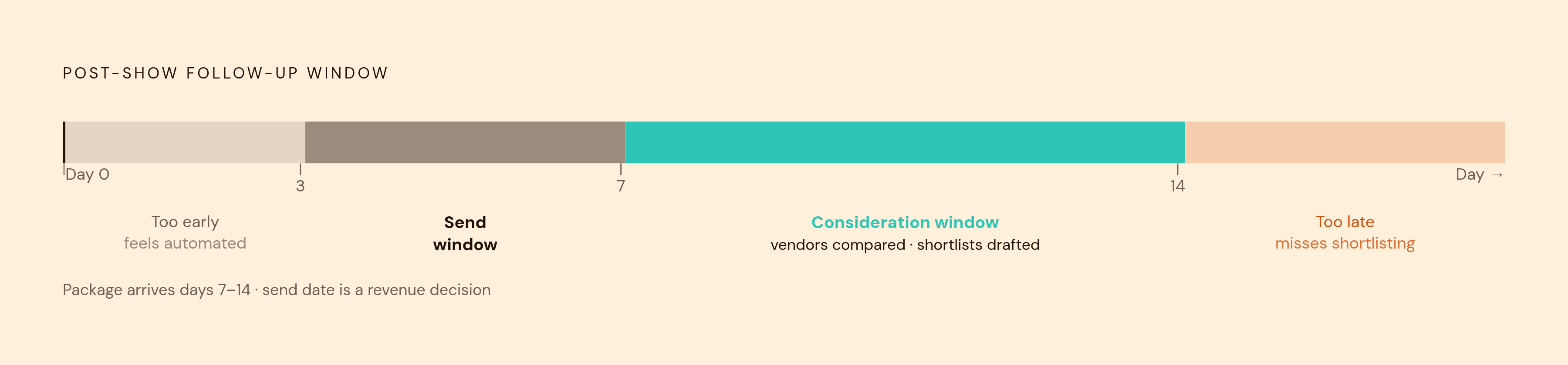
Teams need to plan for both when a gift leaves and when it arrives. The recommended sending window is three to seven days after the event, with a high-quality package arriving one to two weeks afterward. That puts the follow-up into the period when prospects may be comparing vendors and drafting shortlists. Too early, the gesture can feel automated, while too late, it can miss the consideration window.
Segmentation should carry through from the floor. A prospect who completed a 30-minute qualified conversation warrants a different send from someone whose only recorded action was a badge scan. Meeting-completion fields and booth-visit data should drive the sequence, with address confirmation built into the workflow. The post-event send is a revenue motion with a measurable window.
Measuring gifting’s contribution to booth ROI
A gifting program that sits outside the CRM is difficult for revenue leadership to evaluate. Visible spending with unclear connections to meetings and opportunities makes gifting vulnerable when budgets tighten. Teams need to plan how to measure the program before the first package ships.
Every pre-event send should have an activity record that links it to a named contact and target account. Tier 2 and Tier 3 gifts should trigger a sales task or sequence so that someone is assigned to follow up on the engagement. Post-event sends should be logged against the opportunities they are intended to accelerate. This creates a record that follows the interaction beyond the booth.
The useful measures are meeting-to-opportunity conversion rate, deal velocity for event-attributed opportunities, and pipeline influenced per dollar of gifting spend. Badge scans and distributed tote bags describe activity. Comparing deal velocity before and after a send can help evaluate contribution, though influence should not be confused with proof that the gift alone caused the outcome.
ABM gifting calibrated to account tier and deal size
For account-based marketing programs, the conference is one moment in a longer relationship. Gift tiers therefore depend on account value, buying-group size, and engagement at the booth. Enterprise accounts with $500k+ ACV and buying groups of nine or more call for executive-to-executive outreach, a reserved private meeting, and a premium follow-up tied to the discussion of what the business needs to resolve. High-intent mid-market accounts with $100k–$500k ACV can follow a different sequence, including personalized video outreach, VIP access to a booth experience, and a send timed to the next sales touchpoint.
UviaUs’s BillingTree case study shows how a package can carry the message for the account itself. Opening the case revealed a fully branded interior with a video player embedded in the lid. The player activated when the case opened and played an animated video pitch created specifically for the campaign. Applied to conference planning, that makes the account’s broader sales sequence the frame for the gift, with the booth visit serving that sequence.
Scaling gifting without losing control of execution
Delays in procurement, missing addresses, trouble with customs, and fulfillment errors can send a package to the wrong place or make it arrive too late to help. International sends also require customs documentation, import duties, and country-specific restrictions on contents to be addressed. Global fulfillment infrastructure matters because a well-chosen gift has no relationship value if it never arrives.
At the event, seeing inventory in real time helps booth staff keep the promises they have already made. Low-stock alerts and reorder triggers help teams avoid promising Tier 2 or Tier 3 gifts they do not have enough of. Afterward, gifts left over should go back into managed inventory. Procurement, storage, packing, shipping, and returns need to function as one process across events.
Sendoso is one option that combines fulfillment across 165+ countries with tools that can recommend gifts using internet signals or Gong conversation transcripts and connect sends to CRM and pipeline tracking. Those tools do different jobs, so teams still need to plan how the gift will arrive and how the send will be recorded.
A gifting sequence for the next conference
Well before the event, finalize target accounts from registrations and identify the enterprise accounts that merit personalized outreach. At the same time, brief the CRM team on tagging and attribution. Six weeks out, begin the send sequence for those accounts with a specific meeting invitation and launch the broader email campaign. Plan the later premium mailers to arrive two to three weeks before the show.
Three weeks out, send the incentive-offer email, confirm appointments in the CRM, and finalize on-floor inventory by gift tier. Set reorder triggers before staff begin making commitments. At 48 hours out, send engaged nonresponders a reminder with the booth location, QR code, and Tier 2 incentive description. During show days, record badge scans, meeting completions, and gift tiers, and trigger personalized sends for qualified meetings.
After the show, segment visitors from those records and prepare notes that refer to their conversations. Send within three to seven days so packages can arrive one to two weeks after the event. Four weeks afterward, look at pipeline influence, meeting-to-opportunity conversion for each tier, and deal velocity. Use those findings to refine gift selection, timing, and tier thresholds for the next conference.
Repeating the sequence makes the program measurable and improvable rather than dependent on fresh improvisation at every show. The companies that treat conference gifting as a sequenced revenue motion are the ones whose booths are consistently full of the right people.